
City Council - Jun 16, 2026 - Regular Meeting
City Council • Walnut CreekJune 16, 2026
Locunity is a independent informational service and is not an official government page for this commission.We use AI-assisted analysis and human editorial review to publish information.
Council Greenlights Bay Area's First Coordinated Ramp Metering Pilot on I-680
Walnut Creek's City Council unanimously approved a multi-agency agreement to bring the Bay Area's first coordinated adaptive ramp metering system to northbound I-680, a corridor ranked among the region's most congested. The meeting also surfaced a 20% office vacancy rate in a new economic development plan, renewed the city's hotel tourism district, and ended with Mayor Pro Tem Matt Francois announcing he won't seek reelection after nearly two decades of city service.
- Bay Area's first coordinated ramp metering pilot approved for I-680, with construction slated for 2028 and full operations by early 2029
- Draft economic development plan reveals 20% office vacancy citywide — above the state average — while retail remains a bright spot
- Mayor Pro Tem Matt Francois announces he will not run for reelection, opening a council seat after eight years on council and 11 on the planning commission
- Hotel tourism assessment renewed as occupancy outperforms national average; international cycling race booked for 2027
- Council questions whether city should run tennis courts in-house after pulling the Lifetime Activities contract from consent
A New Playbook for I-680 Congestion
The basics: Northbound I-680 through Walnut Creek is one of the Bay Area's top 10 most congested freeway segments. Rather than adding lanes, the Contra Costa Transportation Authority, Caltrans, and the city are betting on technology — a Coordinated Adaptive Ramp Metering system, or CARM, that lets all ramp meters communicate in real time, adjusting release rates corridor-wide to smooth traffic flow.
Why it matters: The three-year demonstration project promises 10–30% travel time reductions on the freeway, but council members spent the bulk of the evening pressing staff on whether that relief would simply push congestion onto local arterials like Olympic Boulevard, Treat Boulevard, and Rudgear Road.
Where things stand: The CARM system will cover northbound ramps from Alcosta Boulevard to Burnett Avenue using the Streams software platform and physical vehicle detection along the mainline and ramps. Caltrans is separately installing standard Adaptive Ramp Metering on southbound and select northbound ramps. A part-time shoulder lane will be added at the Olympic Boulevard on-ramp for additional storage, and the Buskirk on-ramp will gain nearly 1,000 linear feet of queue space.
Stephanie Hu, a Contra Costa Transportation Authority representative, told the council that the project was designed differently from past ramp metering deployments: "We're doing something different — in the other corridors in Contra Costa, ramp metering has been deployed without very much collaboration and coordination with the local jurisdictions."
Councilmember Craig DeVinney wasn't fully reassured. "I'm still unclear as to how you would say on Olympic Boulevard — it's already backed up all the way to the bottom of the on-ramp every day and past that," he said. He later added: "I just hope it doesn't come at the expense and the offset of spending more time on the arterials and the on ramps."
Scott Patera of GHD, the consultant to CCTA, explained that back-of-queue detection systems will trigger faster release rates if ramp queues approach arterial intersections, and that performance will be measured using arterial travel time, throughput, and third-party probe data over the three-year pilot, with quarterly stakeholder reviews.
Councilmember Cindy Silva zeroed in on the unique configuration of Walnut Creek's on-ramps: "Olympic on-ramp backs up every day all the way to the CVS."
The other side: Mayor Pro Tem Matt Francois urged the agencies to invest in public outreach before construction begins. "We didn't have a lot of public comment, but I suspect in two years we might," he said.
Decisions: The council voted 5-0 to authorize the city manager to execute the MOU. (For: DeVinney, Darling, Silva, Francois, Wilk; Against: none.)
What's next: Construction on both the CARM and ARM projects is expected to finish in 2028, with full operations beginning early 2029. The city will participate in quarterly stakeholder reviews throughout the three-year pilot.
20% Office Vacancy Looms Over Economic Development Plan
Why it matters: Staff presented a draft two-year Economic Development Action Plan that lays bare a tension at the heart of Walnut Creek's economy: retail is thriving, anchored by Broadway Plaza, but office vacancy sits at 20% — well above the state average of 12%. The plan's six strategies will feed directly into the city's upcoming General Plan update, shaping whether Walnut Creek retains its jobs-housing balance or drifts toward becoming a bedroom community.
Where things stand: A Spacewalk office demand study commissioned by the city found that Walnut Creek's roughly 13 million square feet of office inventory holds somewhere between 3 and 20 years of future employment capacity, depending on growth assumptions. Economic Development Manager Mike Nimon told the council the consultant found "somewhere between 3 and 20 years of future employment growth that could be accommodated in the current office space depending on the scenario."
The plan identifies six strategies: promoting Walnut Creek as the East Bay's economic epicenter, attracting and retaining businesses, enhancing downtown vitality, aligning with the General Plan, supporting the auto industry, and serving as a data broker for market intelligence. Staff highlighted completed accomplishments from the prior plan, including an award-winning Outdoor Dining Pods program, reinstatement of the Mayor's Business Retention visits, and the attraction of Matson and Five Star Bank as major office tenants.
Councilmember DeVinney questioned why the auto industry received its own standalone strategy while healthcare — another major economic driver — did not. "We singled out the auto industry and no doubt the fiscal impact of the auto industry in Walnut Creek is significant. But I wonder if we wouldn't have the same wording and the same strategic action for healthcare," he said. Staff explained that auto dealerships present unique land-use characteristics that justify a separate strategy.
DeVinney also raised the idea of a commercial vacancy tax. Mayor Kevin Wilk noted the concept was explored roughly 10 years ago but rejected due to the potential collateral impact on good-faith landlords actively marketing their spaces.
Councilmember Silva pushed the discussion into less traditional territory, raising diversity and inclusivity as factors in the city's economic competitiveness. "They wanted to know, well, how white is Walnut Creek? Because they're all in mixed race marriages and they're like, we want to raise our kids someplace where they'll feel comfortable," she said, describing conversations with younger families considering a move to the city. She also raised mixed-use healthcare zoning as an area worth exploring.
Ed Del Balcaro, a public commenter who identified himself as a 40-year Walnut Creek broker and EDA vice chair, offered context for the vacancy number. "San Francisco, after leasing 5 million feet to AI, is 30% vacant. Oakland is 35% vacant. Concord is 28% vacant," he said, praising city staff's permitting improvements and concierge approach to business retention.
What's next: The plan is informational — no formal vote was required. Council feedback will be incorporated into the final version, which is expected to align with the General Plan update process.
Francois Won't Run Again After 19 Years of City Service
Mayor Pro Tem Matt Francois announced during council reports that he will not seek reelection when his term expires in November 2026. The decision ends a combined 19 years of city service — 11 on the Planning Commission and eight on the council.
"After a lot of thoughtful consideration, I have decided not to run for reelection this year. I can honestly say it's been one of the true honors of my life to represent my fellow residents as a council member," Francois said. He cited the passage of Measure O as the chief accomplishment of his tenure and pledged to serve out his remaining term through December 2026, assisting his successor's transition.
Mayor Wilk expressed appreciation and noted Francois will continue working through the end of his term.
What's next: The open seat will be on the ballot in the November 2026 election.
Hotel Tourism District Renewed; International Cycling Race Headed to Town
Why it matters: The council adopted resolutions renewing the 3% hotel assessment that funds Visit Walnut Creek, the city's tourism marketing arm, and set a public hearing for July 21. With hotel occupancy running 71–73% — above the national average of 67% — and a new international event on the calendar, the district's marketing investment appears to be paying off.
Where things stand: Nicole Hankton of the Walnut Creek Chamber of Commerce and Visitors Bureau presented the FY 25-26 renewal report covering eight hotels with 1,311 total rooms. Key developments include a new AI-powered visitor guide replacing printed materials, an "Always in Season" brand refresh replacing "Go Calipolitan," a hotel shuttle service during the Art and Wine Festival, and a Very Local video campaign targeting Sacramento and Bay Area markets. Data showed 345,000 overnight trips, with 85% of visitors coming from California.
The DMO also secured the GFNY international cycling race for April 2027 under a three-year deal expected to draw 500–1,000 cyclists to the area.
"We're still averaging between 71 and 73% per month on occupancy, which is actually pretty good. The national average is around 67%, so we're still above the national average," Hankton said.
Councilmember Silva questioned the financial trajectory. "I noticed that you're running a net loss and then you're running one budgeted projection this year, and you may have been doing that for a couple of years," she said. The TBID treasurer acknowledged the district is spending down COVID-era reserves but emphasized that the hotels want continued visibility and marketing investment.
Decisions: Approved 5-0. (For: DeVinney, Darling, Silva, Francois, Wilk; Against: none.) Public hearing set for July 21, 2026.
Should the City Run Its Own Tennis Courts?
Councilmember DeVinney pulled the Lifetime Activities contract extension from the consent calendar to ask a pointed question: given the operator's apparent profitability, should the city consider running the tennis and pickleball program at Heather Farm in-house?
"It reads as if there's quite a bit of profit made there. And it makes me wonder — have we explored running that from an Arts and Rec standpoint?" DeVinney said.
Staff explained that Lifetime's overhead — marketing, instruction, tournament management — is shared across multiple locations, making it more cost-effective than city operation. They acknowledged the analysis hasn't been revisited in six to seven years and committed to examining the question during the upcoming RFP process. The operator currently pays the city $67,500 annually plus 5% of profits above $700,000.
Decisions: The one-year extension was approved 5-0.
Minor Items
- Consent calendar (Items 2A–2E) approved 5-0, including June 2 council minutes, warrant registers, a salary and wage plan resolution effective June 21, a water utility easement for the new Heather Farm aquatic center, and a doubling of the Mark Thomas & Company civil engineering consulting cap from $300,000 to $600,000.
- Chick-fil-A traffic calming (Item 2G): Council accepted $30,000 from Chick-fil-A and appropriated $60,000 in mitigation fees for crosswalk improvements and vertical delineators on Citrus Avenue near the school. Mayor Wilk reported receiving no resident complaints about traffic since the restaurant opened, despite pre-opening controversy. Approved 5-0.
- Juneteenth proclamation: Mayor Wilk read a proclamation recognizing June 19, 2026, as Juneteenth National Freedom Day. Nicole Hankton of the Chamber accepted alongside local entrepreneurs Aaron Robertson, Wilson Stevens, and Julian Hein.
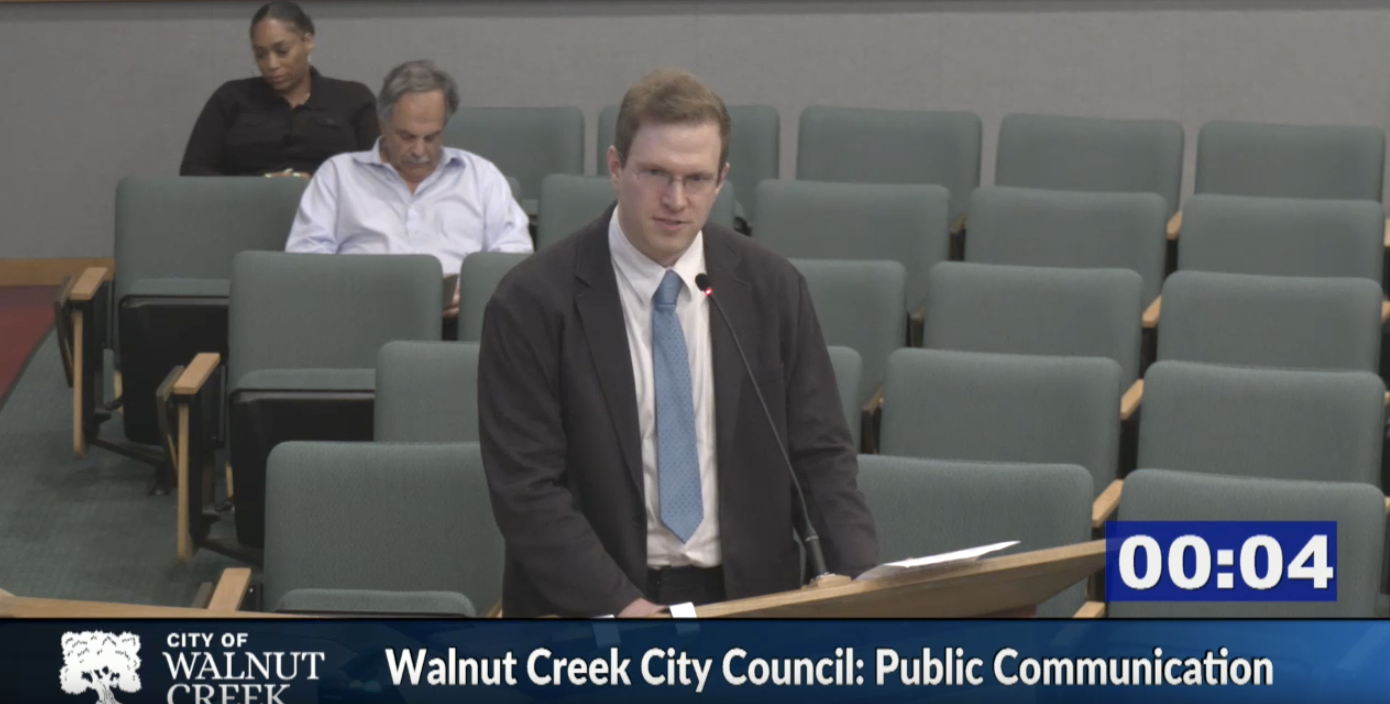
- Public comment — King Walnut mascot: Resident Alex Williams urged the council to revive the King Walnut mascot as a community symbol tied to the Walnut Festival and Twilight Parade. City Manager Dan Buckshot clarified that the Walnut Festival Association is an independent entity that has chosen not to bring back the parade; the festival has been temporarily relocated due to Heather Farm Park construction.
- Chullenbat settlement: City Attorney Steve Mattas reported the council unanimously approved a settlement with MPA Karma and excess insurance companies in a March 13 closed session; the delayed reporting was due to months needed to finalize terms.
- Council activity reports: Councilmember Darling reported MCE's short-term power contract solicitation yielded prices well below budget, potentially saving millions. Councilmember Silva reported on a US-China Sister Cities summit, Cal Cities policy work, and her final ABAG executive board duty. Mayor Wilk highlighted a state audit that found no basis for consolidating East Bay transit agencies including County Connection — "Combining the East Bay transit agencies specifically was not a recommendation due to the analysis that it may not provide significant financial benefits and would likely have higher costs," he said. He also reported on Cal Cities Environmental Quality Committee debate on BACA, multiple community events, and a NAMI mental health stigma reduction event.
- Closed session: Council adjourned to closed session on Hanely v. City of Walnut Creek; no reportable action during the meeting. Next open session: July 21, 2026.