
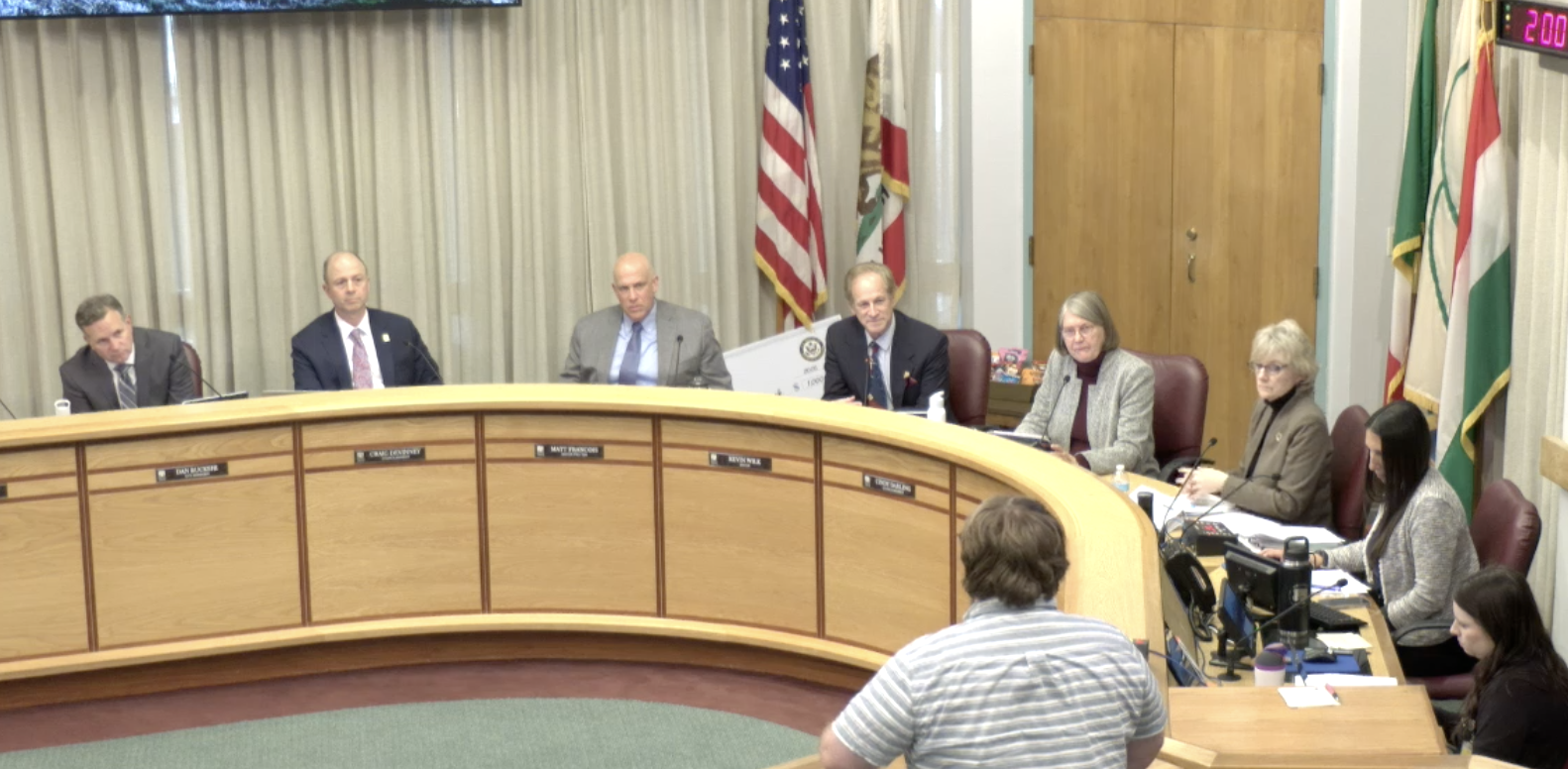
Walnut Creek, CA – City Council – May 5, 2026
City Council • Walnut CreekMay 5, 2026
Locunity is a independent informational service and is not an official government page for this commission.We use AI-assisted analysis and human editorial review to publish information.
Council Approves $943K Grant Plan, Scales Back Homeless Outreach
Walnut Creek's City Council moved through a packed agenda on May 5, adopting nearly $1 million in community grant funding while dialing back its dedicated homeless outreach team, updating the city's emergency preparedness playbook to address wildfire and climate risks, and greenlighting $404,000 in LED upgrades that will cost taxpayers nothing upfront. Residents also showed up to demand the city crack down on an illegal short-term rental operating in their neighborhood.
Council adopts $943K community grant plan, shifts homeless outreach team from full-time to half-time amid declining state funding
Safety Element update strengthens wildfire, evacuation, and climate policies, qualifying Walnut Creek for additional FEMA cost-sharing
$404K LED retrofit approved for Lesher Center, Clay Arts, and library through PG&E's zero-interest financing — no upfront cost
Downtown entertainment zone ordinance finalized with management plan tweaks to address public confusion over hours and scope
Woodlands residents press council on illegal short-term rental operating since mid-2025 without enforcement action
Editor's Note: Due to a technical issue, Locunity's systems missed the May 5, 2026, meeting. The issue is now resolved.
Homeless Outreach Scaled Back as Council Adopts $943K in Community Grants
The council unanimously approved the city's fiscal year 2027 Community Development Block Grant annual action plan and community grant program, allocating $942,667 in federal and local funds for housing rehabilitation, homeless services, senior support, and workforce development — but the headline policy shift was a decision to cut the city's dedicated CORE homeless outreach team from a full-time model to half-time.
Why it matters: The CORE team, which provides street-level outreach to people experiencing homelessness, had been expanded to full-time at roughly $300,000 per year when a half-time option was unavailable through the county. With state Permanent Local Housing Allocation (PLHA) funding declining, the city's Housing and Community Development Committee recommended right-sizing the service.
Where things stand: Housing Analyst Jennifer Llamas presented the plan, noting total available CDBG funding of $1,050,232 with $80,000 set aside for administration. "The halftime model right sizes the level of service with Walnut Creek's current needs and service demand," she said, adding that the city's HOP team through the police department provides a standing complement to the outreach work.
Councilmember Craig DeVinney asked about the city's accumulated affordable housing fund balance. Staff explained that roughly $7 million has built up because few affordable housing projects have come to fruition in the city — though several are now in the pipeline. The Pro Housing Incentive Program contributes $150,000 for homeless services and $800,000 for affordable housing preservation over three years.
Two public commenters underscored the stakes. Molly Clopp, board chair of the Trinity Center, said the organization served more than 1,450 unique individuals with over 47,000 services last year through its day shelter, winter evening shelter, and workforce development programs. Matt Hulse from Contra Costa Senior Legal Services thanked the council for maintaining senior services funding amid what he described as declining support at every level of government.
Decisions: The resolution passed 5-0 (For: Mayor Kevin Wilk, Councilmember Cindy Silva, Councilmember Cindy Darling, Councilmember Craig DeVinney, Mayor Pro Tem Matt Francois). Councilmember Silva added direction for staff to explore alternative outreach service delivery models beyond the county's current offering. "If we can add and direct staff to explore alternative service delivery models for the outreach services that we've had to cut back from the county," she said while seconding the motion.
What's next: Staff will evaluate alternative outreach providers and return to council with options. Five community grant contracts exceeding $125,000 were authorized for the city manager to execute.
Safety Element Update Tackles Wildfire, Evacuation, and Climate Risks
The council adopted a comprehensive update to the General Plan Safety Element, adding new policies on wildfire preparedness, evacuation route capacity, climate adaptation for vulnerable populations, and extreme heat — positioning the city for additional federal disaster reimbursement.
The basics: The Safety Element is the portion of Walnut Creek's General Plan that addresses natural and human-caused hazards. This update, initiated in 2022 alongside the Housing Element, was paused until the county completed its Local Hazard Mitigation Plan (LHMP) and the state released updated Fire Hazard Severity Zone maps.
Why it matters: Adoption qualifies Walnut Creek for FEMA cost-sharing under AB 2140, meaning the city could recover a larger share of disaster-related expenses. The update also feeds directly into the broader General Plan update now getting underway.
Where things stand: Associate Planner Alison Rustic and consultant Darin Neufeld of Harris and Associates presented the update, which draws on community outreach — two workshops and an online survey — that identified climate change, drought, extreme heat, and wildfire as top concerns. Key additions include strengthened evacuation planning informed by route capacity analysis, a new climate change section addressing vulnerable populations, policies on extreme heat and heavy precipitation, stronger wildfire and vegetation management referencing Cal Fire Zone 0, and expanded public education goals.
Councilmember Silva, who serves on the California Seismic Safety Commission, pressed staff on multi-hazard scenarios. "The worst case scenario is an earthquake occurs and not only does it damage your home, but it damages the water lines, it causes gas lines to break, fires to start," she said, asking how the Safety Element accounts for fire-following-earthquake risks. Neufeld confirmed the element addresses multi-hazard cascading events and noted that evacuation routes serve dual purposes for both wildfire and seismic scenarios.
Councilmember Darling raised the distinction between insurance and regulatory requirements for fire zone compliance and asked whether integration with the WatchDuty wildfire alert app had been considered. The Planning Commission recommended adoption on March 26, and five public comment letters received during the review period required no substantial revisions.
Decisions: Passed 5-0 with errata amendments provided at the dais.
What's next: The Safety Element will inform the upcoming General Plan update cycle. Staff noted the LHMP connection enables potential FEMA pre-disaster mitigation grants.
$404K LED Retrofit: Zero Upfront Cost, $415K in Savings Over a Decade
The council authorized sole source contracts with EcoGreen Solutions to replace fluorescent lighting with LEDs at three city facilities — Lesher Center, Clay Arts, and Walnut Creek Library — financed entirely through PG&E's zero-interest on-bill financing program.
Why it matters: The project requires no capital outlay from the city. Loan payments come from utility bill savings, and any surplus savings accrue directly to the city. The state has also banned new fluorescent lamp installations, making the switch a regulatory inevitability.
Where things stand: Public Works Director Rich Payne presented the project under Government Code Section 4217, which permits sole source energy service contracts when projected savings exceed costs. The total cost is $404,000 plus a $40,000 contingency, repaid over 10 years through PG&E's on-bill financing. Estimated annual savings: roughly $41,500 — with $29,000 from the library alone (56% energy reduction) and $9,600 from Lesher Center (46% reduction). Clay Arts achieves a 64% reduction.
Anthony Mitchell of EcoGreen Solutions explained that PG&E uses conservative runtime assumptions to guarantee bill neutrality. "They don't allow us to claim all the hours, they actually buffer the hours," he said. "For instance, if the lights are on all night long, they only let us claim a percentage of those hours to make sure we're not pushing the edge of the envelope."
Councilmember Darling questioned who bears the risk if utility rates shift unfavorably. Mitchell confirmed that PG&E bears the downside risk, and rate increases actually benefit the city by increasing the dollar value of energy saved. Councilmember DeVinney asked about lumen matching and mercury recycling for the old fluorescent fixtures.
Decisions: Passed 4-0. Councilmember Silva recused herself due to a financial conflict of interest from her husband's PG&E retirement income. "I am recusing myself from this item because I could effectively have a financial conflict of interest from my husband's earnings from PG&E retiree," she said before stepping away. Work could begin within two weeks of contract execution, with all three facilities completed in approximately three weeks.
Downtown Entertainment Zone Gets Final Approval — With Guardrails
Councilmember Silva pulled items 2C and 2D from the consent calendar to clear up what she described as significant public confusion surrounding the new downtown entertainment zone ordinance enabled by SB 969.
Why it matters: Media coverage had led some residents to believe the zone would permit alcohol-inclusive outdoor events 365 days a year. The reality is more limited: events are only allowed when organized by qualified nonprofits — currently Walnut Creek Downtown (WCD) as the designated project sponsor — with streets closed, age verification, and ID checks in place.
Where things stand: Assistant City Manager Charles Ching walked through the ordinance details, confirming the zone covers a single multi-block downtown area, though additional zones (such as Broadway Plaza) could be established later. Councilmember Silva identified four management plan amendments: consistent use of specific day names rather than "weekends/weekdays"; notation that management plan hours are less than the ordinance maximums; restroom requirements per special event permits; and verification that participating businesses hold ABC permits and city business licenses.
Mayor Wilk noted that the public confusion was substantial. "Just because there's a zone does not mean it has these entertainment hours just allowed 365 days a year," Councilmember Silva emphasized. Kathy Hemingway from Walnut Creek Downtown directed residents to walnutcreekdowntown.com for additional information.
Decisions: Passed 5-0 with all four management plan amendments incorporated.
Woodlands Residents Demand Action on Illegal Short-Term Rental
Three residents of the Woodlands neighborhood used public comment to escalate a months-long complaint about a property they say has been rented through VRBO for periods under 31 days in violation of city regulations — with no enforcement resolution since mid-2025.
Why it matters: The complaints expose gaps in the city's ability to enforce its short-term rental rules and prompted two council directives for staff follow-up.
Where things stand: Joe Warren said he has been documenting violations and notifying code enforcement since mid-2025 without resolution. Jan Warren described her frustration with enforcement delays and the lack of a single point of accountability, noting she had raised the issue at council meetings in August and November. Lisa Blanco described being awakened at 3:30 a.m. by a short-term rental guest and raised safety concerns about Valley Verde Elementary School located two blocks away.
Mayor Wilk directed the residents to speak with Director of Community Development Erika Vandenbrande. Mayor Pro Tem Francois requested staff produce a public clarification of the city's short-term rental rules. "It might be helpful to get a clarification on the rules on short-term rentals — less than 30 days, more than 30 days, what's allowed, what the permit requirements are — as a public service announcement," he said. Councilmember Silva noted state law constraints and questioned whether a non-owner agent could obtain a conditional use permit.
Minor Items
Consent calendar items 2A, 2B, 2E, and 2I through 2M approved 5-0 on a single vote, including $2.9 million in affordable housing funding for the SAHA project (item 2I).
City Manager Dan Buckshi and City Attorney Steve Mattas both received 4% raises effective July 1, 2026, with an additional 3% contingent on satisfactory spring 2027 evaluations. Buckshi's contract was amended to extend his involuntary termination notice period from 90 to 180 days following the seating of a new council and increase severance from 9 to 12 months with health benefits. Mayor Wilk praised Buckshy's leadership: "City managers from other cities come to us and tell us how fortunate we are to have Dan Buckshi as a city manager. Newer city managers in the East Bay have mentioned that they look to Dan as a mentor." Approved 5-0.
SB1 road project resolution adopted 5-0; Ignacio Valley Road from Oak Grove Road to the city limits is planned for 2027 construction pending Caltrans funding confirmation.
Bike Month proclaimed for May 2026. Danny Tennyson of Walk Bike Walnut Creek, accompanied by his daughters who bike to school daily, urged faster progress on safe bike routes connecting trails to downtown. Robert Prinz, advocacy director with Bike East Bay, invited residents to Bike to Wherever Day on May 14.
National Police Week proclaimed for May 10–16, with May 15 designated Peace Officers Memorial Day. Shane Blatz, Walnut Creek POA president, thanked the council. Mayor Wilk separately announced a $1 million federal body-worn camera equipment grant from Congressman Marc Desaulnier.
Council member reports covered Cal Cities legislative advocacy in Sacramento, including SB 922 (road damage cost recovery from heavy vehicles), AB 2296 (earlier housing element work), advocacy for $1 billion in HHAP homeless funding, $400 million for Proposition 36 implementation, and opposition to the Howard Jarvis property transfer tax initiative. Councilmember Darling reported on MCE energy classes and the upcoming Mulqueeney wind project, and flagged East Bay MUD affordable housing water meter costs. Councilmember DeVinney noted 12-plus e-bike legislative bills under discussion at the state level.