City Council - Sep 15, 2026 - Regular Meeting
City Council • Walnut CreekSeptember 15, 2026
Locunity is a independent informational service and is not an official government page for this commission.We use AI-assisted analysis and human editorial review to publish information.
Council Celebrates Faster Permits as Lean Overhaul Shows Results
Walnut Creek's City Council spent the bulk of its Sept. 15 meeting hearing how a yearlong Lean process-improvement initiative has cut commercial building permit response times by roughly two weeks and won rare public praise from developers who called it a genuine cultural shift. The Council also introduced zoning amendments to bring the city's ADU rules in line with state law and remove a discretionary permit layer for residential projects in two key districts, and approved $210,000 in federal grant funds for downtown sidewalk accessibility repairs.
- Lean permitting overhaul earns unanimous Council support and developer praise after staff show two-week drop in permit response times and 90% customer satisfaction
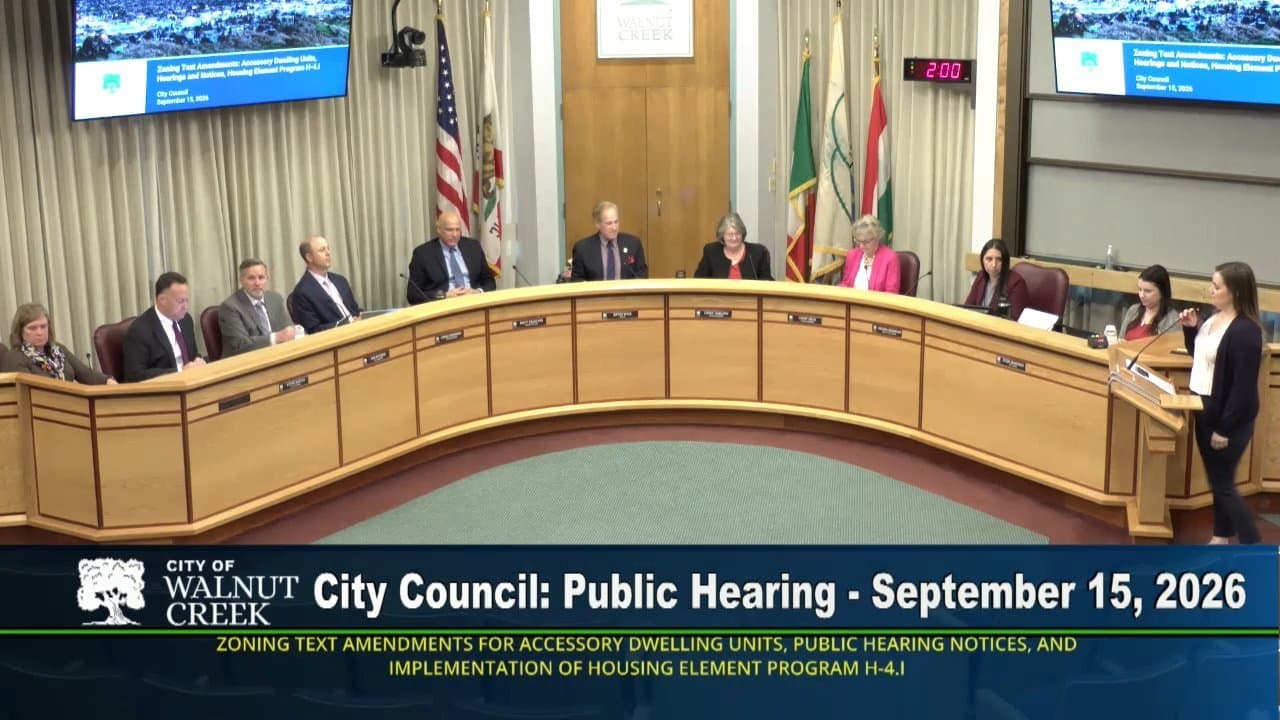
- ADU zoning amendments introduced, increasing allowable units per lot and removing the Plan Development Permit for residential projects in Mixed Use and Multifamily High Density districts
- $210,000 in CDBG funds approved for ADA curb ramp and sidewalk replacement along North Main Street
- Council schedules October vote on endorsing school parcel tax Measure W, treasurer Measure T, and regional transit Measure RTM
- Resident presses Council on Flock cameras, citing 100+ jurisdictions canceling contracts nationwide
From Hindrance to Competitive Advantage: Inside the Permitting Overhaul
Thirty-three staff members across three city departments spent months working with consultants Partners in Public Innovation on a Lean process-improvement initiative organized around three themes: clarity, communication, and efficiency. The results, presented during a special study session, covered more than 50 initiatives — and drew something rarely heard in a city council chamber: unsolicited praise from the people who pull permits.
Why it matters: Walnut Creek is attempting to do what few cities manage — turn its development review operation from a source of friction into a selling point for attracting investment, housing, and commercial activity.
Where things stand: Key deliverables include a Customer Journey Map visualizing the 12-step development process, redesigned comment letters organized by topic rather than department, simplified plan review turnaround brochures, an external agency contact map, and a redesigned city website and Accela permit portal with a new permit wizard. Staff also rolled out a three-tier Development Consultation Services program: a free concept consultation, a $1,000 flat-fee preliminary review, and a $3,500-deposit ongoing consultation. Data showed commercial building permit customer response times dropped by approximately two weeks, and 90% of permit counter survey respondents strongly agreed they were satisfied.
City Manager Dan framed the ambition in blunt terms: "We wanted our development service permitting processes to move from being a hindrance to a competitive advantage … for not only housing and jobs, but for entertainment, for it to live, work and play." He added that staff plans to apply Lean next to housing processes and then expand citywide.
The developer perspective: Jeff Dudum, a developer with 18 projects in downtown Walnut Creek since 1994, told the Council the new process is already working in practice — not just on slides. He urged the city to proactively reach out to downtown landlords: "We need to get to the landlords of the city of Walnut Creek and let them know about this process because there's a few of them."
Brian Harahara, a downtown stakeholder for more than 25 years, said it was the first time he had ever seen actual building permit processing time data. He recalled a prior era when staff couldn't answer basic questions about how long a permit takes and shared a recent experience where staff acknowledged their own delays and proactively streamlined a sign approval, bypassing a subcommittee step entirely.
Mayor Kevin Wilk reflected on the journey, noting that when he first ran for Council around 2016, business owners told him their top concern was timeliness and responsiveness — and frustration with feedback that simply said "no" without offering a path forward. "The collaboration between departments is truly impressive. All viewing yourself as one team the way that you do," he said.
Councilmember Cindy Darling illustrated the old culture with an anecdote: she once stood in the planning department looking out the window at a restaurant with no sign and asked why. "The answer I got was, 'Well, they haven't come and asked us what to do,'" she recalled.
Councilmember Craig DeVinney pressed on a practical problem — cases where a permit application stalls because the applicant thinks the city is reviewing it while the city is waiting for the applicant. Staff confirmed new tracking and communication protocols are designed to flag exactly those gaps.
Decisions: Council unanimously accepted the report (For: 5, Against: 0 — Wilk, Francois, Darling, DeVinney, Silva).
What's next: Staff plans to roll out the revamped process early in 2027, with housing as the next Lean focus area.
ADU Rules Updated, Permit Barrier Removed for Housing in Two Districts
The basics: The Council introduced three sets of zoning text amendments recommended by the Planning Commission on Aug. 13. Together, they update accessory dwelling unit regulations to match state law, reorganize public-hearing notice provisions for readability, and — most significantly — remove the Plan Development Permit (PDP) requirement for residential development in the city's Mixed Use (MU) and Multifamily High Density (MHD) zoning districts. A PDP is a discretionary review layer that adds time and uncertainty to housing proposals; removing it means qualifying residential projects proceed through design review only.
Why it matters: Eliminating the PDP in two key districts advances the city's Housing Element compliance and could meaningfully speed residential development at a time when the state is pressing cities to lower barriers to housing production.
Where things stand: On ADUs, the ordinance adds a definition of state-exempt ADUs, increases the number of ADUs allowed on single-family lots from three to four (consistent with HCD guidance), and aligns junior ADU kitchen and owner-occupancy requirements with state law. Councilmember Cindy Silva asked technical questions about lot vs. parcel definitions and multifamily unit thresholds.
The other side: Kevin Dowling of Habitat for Humanity East Bay Silicon Valley raised concerns about ADUs being built inside parking garages of high-density developments, citing a friend's experience in San Jose. "He's in a three story above parking development in San Jose right on the Campbell border. He said they're putting an ADU in my garage," Dowling told the Council. The City Manager confirmed state law allows such garage conversions but noted building safety and code requirements still apply. Dowling also spoke during general public comment in support of Prop 1, an $11 billion state housing bond, and announced a three-day Habitat buildathon.
Decisions: The ordinance was introduced unanimously with first reading waived (For: 5, Against: 0 — Silva, Wilk, Darling, DeVinney, Francois).
What's next: The ordinance returns for a second reading and adoption at a future Council meeting.
$210,000 in Federal Funds Headed to Downtown Sidewalk Accessibility
Housing Analyst Jennifer Llamas presented a substantial amendment to the city's CDBG 2026-27 Annual Action Plan to allocate approximately $210,000 in unallocated program income — generated primarily through repaid city home rehabilitation loans — for ADA accessibility improvements on the west side of North Main Street between Bonanza and Lincoln avenues.
Why it matters: The stretch is a high-traffic downtown corridor, and broken sidewalks and outdated curb ramps create barriers for seniors and adults with disabilities.
Where things stand: The project includes replacing ADA curb ramps and damaged sidewalk sections and removing trees whose roots have lifted the pavement. Public Works Director Rich Payne confirmed the $210,000 fully covers the work and that the project is part of a larger intersection redesign. Councilmember Cindy Darling asked whether the work would conflict with adjacent outdoor dining patios; Payne said there are no engineering conflicts. Darling also asked about tree removals, and Payne noted nearby businesses support removing the overgrown trees. No public comment was received.
Decisions: Resolution adopted 5-0 (Darling, Silva, DeVinney, Francois, Wilk).
Ballot Measure Endorsements Head to October Agenda
Mayor Pro Tem Matt Francois flagged that the Acalanes Union High School District had requested a formal Council endorsement of Measure W, a parcel tax for teacher pay and class sizes. Mayor Kevin Wilk added treasurer Measure T and regional transit Measure RTM to the list.
Why it matters: Ballots are mailed approximately 29 days before the election, meaning an Oct. 6 endorsement would coincide with ballot arrival — limiting the endorsement's campaign impact but enabling a collective Council position on school funding, treasury, and regional transit.
Councilmember Cindy Darling raised concern about the timing, but the City Attorney confirmed a collective endorsement required an agendized item and that a special meeting was not warranted.
Decisions: Council voted 5-0 to agendize all three endorsements for Oct. 6 (Wilk, Francois, Darling, DeVinney, Silva). Separately, Francois moved to table to a date uncertain a proposed handbook modification addressing the 30-day election certification timeline, given the uncontested council race this year. That motion passed 4-1, with Councilmember Silva casting the lone dissenting vote.
Minor Items
- Consent calendar (Items 2A–2E) approved 5-0, including Sept. 1 meeting minutes, warrant registers, an ordinance setting Councilmember compensation at $1,600 per month, a $351,966 DigEplan electronic plan review subscription renewal, and a $168,579 five-year Konica Minolta content management renewal.
- Hispanic Heritage Month proclaimed for Sept. 15 – Oct. 15; recipients were unable to attend in person.
- Diablo Valley Giving Partners — newly independent from the National Assistance League after nearly 60 years — reported raising over $913,000 last year, serving 10,000 individuals, clothing 3,400 children, distributing 5,400 food boxes, and awarding $300,000 in scholarships to 73 recipients. Councilmember Silva noted the Civic Pride Foundation has supported the organization for about 30 years.
- Flock camera concerns: Resident Tristan President cited over 100 jurisdictions canceling Flock contracts and misidentification incidents, urging the Council to agendize oversight. Mayor Wilk responded that the annual police report in spring 2027 would include a full Flock update.
- Open space priorities: Resident Barbara Guinness urged restoring open space protection to the 2027-28 Council priorities after it was dropped from the 2025-26 list. City Manager Dan confirmed open space remains covered by the general plan.
- Heather Farms tennis court lights remain out due to equipment failure; Glenn McBee of the Walnut Creek Racquet Club said a solution will be presented to the PROS Commission in October.
- County Supervisor Ken Carlson's office introduced new district representative Samantha Lennon as the liaison for Walnut Creek.
- Councilmember Silva reported MCE clean energy milestones: California became the first major grid to generate over 50% solar for an entire month in May, and battery storage has grown 30-fold since 2020.
- Mayor Pro Tem Francois reported the Transpac transportation committee approved up to approximately 2,000 student transit passes.