
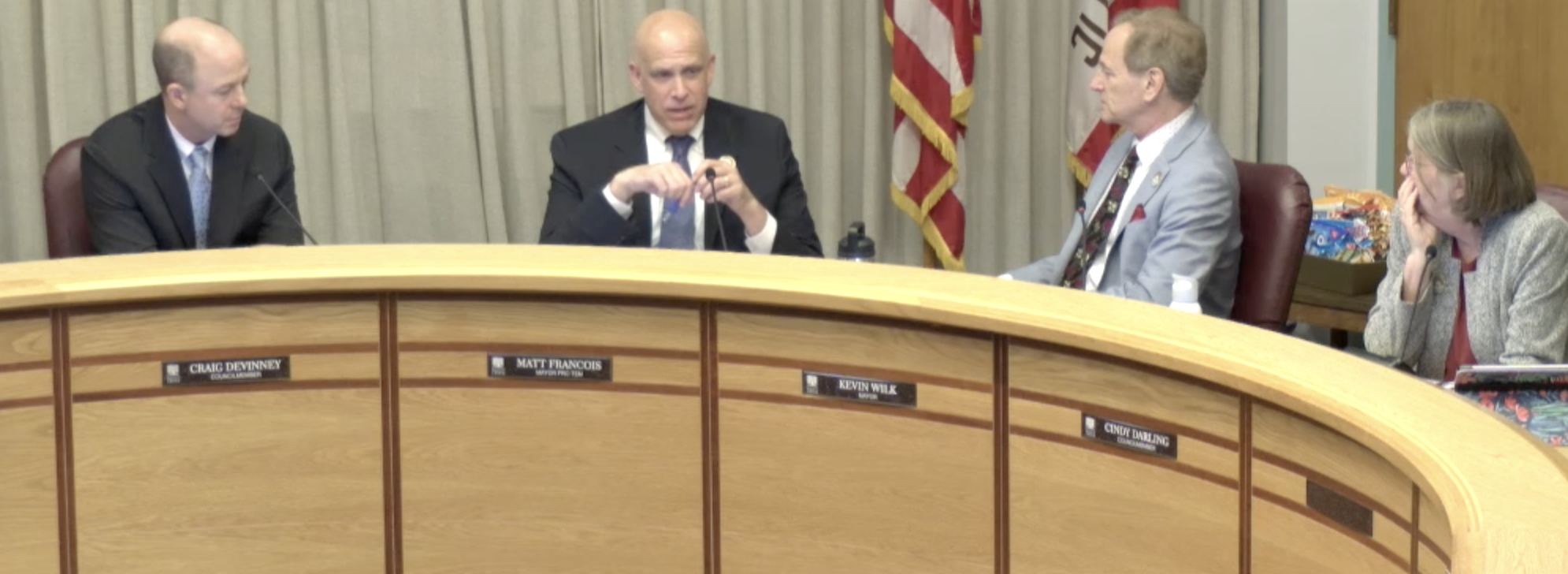
City Council - Mar 17, 2026 - Regular Meeting

City Council - Mar 17, 2026 - Regular Meeting

City CouncilWalnut CreekMarch 17, 2026

Sources:

Locunity is a independent informational service and is not an official government page for this commission.We use AI-assisted analysis and human editorial review to publish information.

Council Greenlights $3M General Plan 2050 Overhaul

Walnut Creek's City Council unanimously approved a four-year contract to reimagine the city's land use blueprint through 2050, while a housing progress report revealed the city has permitted just 4% of its state-mandated housing target — with a state review looming in 2027. The downtown business district, meanwhile, unveiled a five-year vision to transform the commercial core into a year-round destination.

  • $3.16 million General Plan 2050 contract awarded to Alta Planning and Design, launching the city's most consequential planning process in years

  • Housing permits surged 147% but the city has reached only 4% of its 5,805-unit RHNA obligation, with a mid-cycle state review approaching

  • Downtown BID advances 3% assessment increase as the Walnut Creek Downtown Association unveils its "Downtown 365" walkability and activation vision

  • Resident reports third catalytic converter theft in three years, prompting the mayor to direct staff to research statewide prevention legislation

  • MCE electricity rates dropping April 1 alongside a gas-powered leaf blower ban and expiration of the outdoor dining grant program


A New Blueprint for 2050

The council voted 4-0 to authorize a $3,160,705 consultant services agreement with Alta Planning and Design — formerly Raimi and Associates — to prepare the General Plan 2050 update and a programmatic environmental impact report. Councilmember Cindy Silva was absent.

Why it matters: The general plan will govern Walnut Creek's land use, housing, mobility, and climate policies for decades. The contract launches a multi-year community engagement effort spanning six city commissions and more than 30 public meetings.

Where things stand: Principal Planner Crystal De Castro told the council the city sent the request for proposals to more than 24 firms. Three submitted qualifying proposals, and a multidisciplinary interview panel selected Alta based on proposal quality, community engagement approach, experience, and fees.

Eric Yurkovich, a principal at Alta Planning and Design, outlined a five-phase process: discovery and learning, land use and mobility alternatives, policy development, general plan drafting, and adoption. Community engagement will include a joint meeting with six commissions — Arts, Transportation, Parks and Recreation/Open Space, Youth Leadership, Design Review, and Planning — along with interactive online open houses, focus groups, pop-up meetings, and workshops.

Council members pressed on how the plan would remain relevant in a rapidly changing world. Mayor Pro Tem Matt Francois raised the risk of planning documents becoming outdated quickly: "We've adopted several specific plans and other plans that it seemed like they would get dated pretty quickly — we had a big push for ground floor retail, for instance, and that space seems hard to fill in with things other than services."

Councilmember Cindy Darling pushed further, asking how autonomous vehicles and AI would reshape the built environment: "Such as adoption of alternative modes of transportation like self-driving cars and Waymos that can dramatically change what people are expecting in the built environment. Like, do we really need parking lots?"

Yurkovich said the planning profession is already adapting: "What we have done in the planning world, in the design world, is focus on curbside — how do we adapt our curbside to accommodate fewer parked vehicles but more vehicles that are coming, dropping off people, picking up people, dropping off deliveries, food service."

He also emphasized the importance of setting expectations early in a multi-year process: "One of the things that I have learned in the last couple of general plans that I've done is to actually do the thing that says kickoff and project outcomes right up front. It's a way to establish and set expectations both for the process and the outcomes of the general plan."

Councilmember Craig DeVinney expressed concern about council oversight during the lengthy timeline: "I worry about this process sort of getting away from us a little bit." He asked about the frequency of council updates, noting the scope includes approximately four additional flex meetings beyond the scheduled 30-plus.

Decisions: The resolution passed 4-0 (For: Darling, Francois, DeVinney, Wilk; Absent: Silva). No public comment was offered on this item.

What's next: Alta Planning will begin the discovery and learning phase. The contract runs four years with an option to extend for 12 additional months.


Housing Permits Surge, but RHNA Gap Looms Large

The council approved the 2025 Housing Element Annual Progress Report for submission to the state, acknowledging a sharp increase in building permits — and a long road ahead.

The basics: California's Regional Housing Needs Allocation, or RHNA, requires Walnut Creek to plan for 5,805 new housing units across the current cycle. The city's Housing Element — certified by the state in 2023 — lays out 145 action items to meet that goal.

Why it matters: A mid-cycle state review expected around 2027 could require the city to identify additional housing sites if production remains below the midpoint of its RHNA obligation. Falling short can trigger state enforcement tools that override local zoning authority.

Where things stand: Housing Manager Stephanie Brynn reported the city issued 244 building permits — a 147% increase over the prior year — but that figure represents just 4% of the overall RHNA target. Approximately 1,300 units are in the development pipeline, accounting for about 23% of the obligation, with nearly half identified as affordable.

Of the 145 housing element action items, 138 have been implemented since the element was certified, with only one remaining for 2026. Key achievements include the ADU Accelerator program, which saw rebates fully allocated within nine months; pre-approved ADU plans; zoning amendments allowing ADUs on faith-based properties; removal of growth limitation requirements; and a $1 million Pro Housing Incentive Program award from the state.

Mayor Kevin Wilk asked directly about accountability: "So what happens if the RHNA targets aren't met, and what are the consequences, if any, of how cities would be held accountable on this?"

Staff explained the city is not currently penalized for missing RHNA numbers as long as housing element commitments are fulfilled, but the mid-cycle state review could change that calculus. Interest rates and construction costs remain key barriers to developer activity.

Mayor Pro Tem Francois praised staff for focusing on implementation rather than just counting permits: "I commend staff for the focus on achieving 137 of the 145 programs, because those are the things we really can control and that could have the difference in terms of increasing the number of units."

Decisions: Passed 4-0 (For: DeVinney, Darling, Francois, Wilk; Absent: Silva). The report will be submitted to the California Department of Housing and Community Development and the Governor's Office of Land Use and Climate Innovation.


Downtown BID Plots Year-Round Transformation

The Walnut Creek Downtown Association delivered its annual report and requested approval of a 3% assessment increase for the next fiscal year, while unveiling an ambitious five-year plan to make the 29-block district a daily destination.

Why it matters: The downtown and South Business Improvement Districts cover approximately 680 businesses that form the city's economic engine. The assessment funds events, safety programs, and marketing — and the new vision could reshape the downtown experience.

Where things stand: Kathy Hemingway, executive director of the Walnut Creek Downtown Association, described a year of significant milestones. The organization launched a new 501(c)(3) entity and developed the "Downtown365" vision plan focused on walkability and year-round activation.

"WCD's vision for the next five years is centered on Downtown365 — creating a downtown that is vibrant, walkable, and active every day, all day of the year," Hemingway said.

Event highlights included Oktoberfest's 20% attendance growth to more than 15,000 attendees, the Locust Street Festival rebrand, Walnut Creek on Ice's 20th season, and 511 new businesses choosing Walnut Creek. The organization reported 182,000-plus website visitors and 45,000 social media followers.

The WCD is also exploring an entertainment zone concept that would allow open-container to-go drinks at designated events — a model gaining traction in downtowns across California.

Council members asked about farmer's market partnership prospects, alignment with Measure O funding, shifting arts programming from summer to year-round, and whether assessments could be set higher. Hemingway noted the 3% increase remains palatable for smaller businesses while the organization evaluates expansion options.

Decisions: Passed 4-0 (For: Darling, DeVinney, Francois, Wilk; Absent: Silva). A public hearing on the assessment was set for April 7.


Catalytic Converter Theft Spurs Call for Action

Three-Time Victim Asks Council for Help

Aliyah Issa, a Walnut Creek resident living near the 24/680 interchange, told the council her catalytic converter has been stolen three times since she moved to the area — roughly once a year. She said thieves wear masks and use plate covers, making identification difficult even with quick police response.

She urged the council to support VIN etching programs, increase penalties for resale of stolen parts, and partner with local repair shops for theft deterrence.

Mayor Wilk directed her to the police department and asked staff to explore legislation the city could support: "What I would like to see is something in the future that we may be able to get behind and support as a city that we can help to discourage the resale of these."

A staff member noted the issue has been discussed at the statewide level and offered to provide an update on pending legislation.


Minor Items

  • Consent calendar (Items 2A through L) approved 4-0 without discussion; Councilmember Silva absent.

  • Proclamation: International Transgender Day of Visibility (March 31). Alex Bacaro of the Rossmore LGBTQ Alliance accepted the proclamation and shared that three transgender students died by suicide in the past year. Bacaro presented "You Are Safe With Me" pins to council members.

  • Proclamation: Prescription Drug Abuse Awareness Month (March 2026). Thea Helene of the CCC Meds Coalition cited 183 opioid overdose deaths in Contra Costa County in 2023 and rising counterfeit fentanyl risks among youth. Councilmember Darling noted medication drop-off boxes at city hall and the police station. The DEA Take Back Day is April 25.

  • Year in Review report: The city published its first comprehensive annual report, featuring a 20% crime reduction, 511 new businesses, Measure O investment updates, and Heather Farm Park aquatic center progress.

  • Adult kickball league: John Panetta of Club Waka East Bay praised the partnership with Walnut Creek Parks and Rec and expressed interest in expanding social sports programming.

  • Closed session: Council held a closed session on existing litigation before the regular meeting. No reportable action was announced.


Looking Ahead

  • April 1: MCE electricity rates drop for customers across four counties. Councilmember Darling reported the rates will get final approval at MCE's Thursday meeting. The gas-powered leaf blower ban also takes effect April 1, and the $10,000 outdoor dining grant program expires March 31.

  • April 7: Public hearing on the downtown BID and South BID 3% assessment increase for FY27.

  • April 25: DEA National Prescription Drug Take Back Day.

  • Councilmember DeVinney highlighted Mobility Matters, a free volunteer transportation service for Contra Costa seniors: "Mobility Matters is a volunteer organization that pairs you up with somebody for each service appointment. It's all volunteer run, and they will come out, do an assessment, match you with the right services, and it's all free for any member of Contra Costa."

  • Mayor Wilk noted the self-funded council delegation trip to sister city Kita City, Japan, and recognized Susan Hildreth as State Senator Tim Grayson's Woman of the Year.