
Walnut Creek Adds $56K for Downtown, Draws Line on Measure O Staffing
City Council • Walnut CreekOctober 20, 2026
Locunity is an independent informational service and is not an official government page for this commission. All information is sourced from public footage and an analysis of official agendas with the aid of responsible, fact-checked AI. to report an error or omission.
Walnut Creek's City Council spent the longest stretch of its Oct. 20, 2026, meeting on what Measure O money should, and shouldn't, pay for downtown. In a 4-0 vote amending the FY2027 budget, the council added $56,000 in event marketing to staff's $196,400 recommendation for Walnut Creek Downtown and rejected open-ended staffing add-ons. The council also launched two park master plans and absorbed a $2.26M sales tax cut, while one-time revenue kept last year's books in the black.
- $252,400 for Walnut Creek Downtown after council adds $56,000 for marketing; staffing add-ons rejected
- Heather Farm update and first Civic Park master plan approved 4-0 for about $500,000, with no General Fund money
- FY27 sales tax forecast cut $2.26M, and the staff vacancy assumption raised to just over 10%
- $2.95M from the facilities reserve goes to City Hall brick-veneer repairs
- FY26 closes $1.3M above budget on one-time money; underlying General Fund revenue fell about $350,000 short
Downtown Gets $252,400, but Not for Staffing
Why it matters: The debate set a working rule. Measure O pays for one-time beautification and programming, not a partner organization's ongoing payroll. That standard will shape future nonprofit funding requests.
Where things stand: Walnut Creek Downtown requested about $530,000. Staff recommended $196,400, paid on a reimbursement basis. It would cover lighting, trash-receptacle art, crosswalk art, Cypress Mini Plaza artwork, Civic Park lighting, entertainment zone activation, and $56,500 in park rental reimbursements for Walnut Creek on Ice and Oktoberfest.
Staff declined three requests: marketing for the Locust Street Festival, which turned a profit; contracted marketing for Walnut Creek on Ice; and electrical work. "The events that are effectively profitable, more than break-even, the thought was not to fund those to subsidize because it would effectively be subsidizing the bottom line as opposed to the event itself," said City Manager Dan Buckshi.
Kathy Hemingway, executive director of the Walnut Creek Downtown Association, made the case for the investment. She said 64% of measured visits to the August Locust Street Festival came from outside Walnut Creek, and Oktoberfest drew about 20,000 people, roughly 5,000 more than last year. She also argued that profit figures can mislead: "For Locust Street Festival, there was a net income of $39,000, but the staff time was $31,000."
The other side: Councilmember Craig DeVinney pushed for a much larger commitment. "So Walnut Creek downtown was instrumental in passing Measure O, and my feeling is that they're a great return on investment," he said. DeVinney proposed four changes:
- A funding floor of about 3% of Measure O, or roughly $400,000
- A 20% staff-time add-on to approved projects
- Cutting the business improvement district (BID) administration fee to 5%. Mayor Pro Tem Matt Francois noted the city currently charges 10%.
- Help with the association's Economic Injury Disaster Loan (EIDL)
The city's past funding has swung widely: $287,000 in FY24, $325,000 in FY25 and $75,000 in FY26.
The rest of the council preferred line-item, one-time funding. "The rationale goes back to not wanting to use Measure O funds to pay for ongoing staffing support of WCD," Buckshi said. Francois wanted a transparent method: "If it's not in one of these 2 or 3 categories, it's not likely going to get funded from Measure O dollars." Councilmember Cindy Darling offered a middle path: "I could see my way to 10% to cover staff time to implement the projects as being a part of the one-time costs."
Decisions and stakeholder impacts: Mayor Kevin Wilk moved the FY27 budget amendment, and Francois seconded. The motion added $16,000 for Locust Street Festival marketing and $40,000 for Walnut Creek on Ice contracted marketing, bringing the total to $252,400. Vote: For: 4 (Wilk, Francois, Darling, DeVinney), Against: 0, Absent: 1 (Councilmember Cindy Silva).
Downtown merchants and restaurants get marketing support for two marquee events. The association, however, still carries its own staff costs, which Hemingway said already limited the size of this year's request.
What's next: BID changes and loan assistance were left for future consideration. "This isn't the final action on this item," Francois said.
Council Widens Park Planning, Delays Clark Pool Site Work
Why it matters: Master plans open the door to grants and future funding. The trade-off is that work at the Clark Pool site slips about a year.
Where things stand: The council had earlier approved $250,000 in Measure O funds for a plan to repurpose Clark Pool and its Pool House. Since then, two gaps came into focus: the Heather Farm master plan is more than 20 years old, and Civic Park has never had one.
The Park, Recreation and Open Space Commission (PROS) recommended doing both plans and folding them into General Plan outreach. The roughly $500,000 cost would come from two sources:
- The original $250,000 in Measure O money, shifted to Civic Park
- $250,000 from the Glen at Heather Farm community benefit agreement, which must be spent at Heather Farm
"We're not asking for any general funds to do that," said Arts and Recreation Director Chris Farrow. Pool demolition is projected for summer 2028, followed by $100,000 in interim landscaping.
The other side: "Why don't I just leave the pool open for another year?" asked DeVinney. "I'm not sure the pool will make it another year," Farrow replied. DeVinney also questioned spending $250,000 on a Civic Park plan.
Wilk asked, "Are we trying to boil the ocean?" Darling said, "I'm thinking about plan fatigue," and pressed staff on whether the city could carry out the plans; she also asked about solar and storage. Francois asked how park outreach would avoid getting lost in the General Plan process.
Staff answered that the plans unlock grant funding and that a Civic Park plan would cost more if delayed. "Your Parks, Your Future has sat on the shelf for a while," Farrow said.
Michael Vecchio, a Walk/Bike Walnut Creek member and former city transportation employee, supported the Civic Park plan. He urged that it include bike connections from the Iron Horse Trail to downtown and BART. He noted that earlier east-west connections never advanced and the Lincoln Avenue bike demonstration project was rejected.
Decisions and stakeholder impacts: Francois moved, and Wilk seconded. Vote: For: 4 (Wilk, Francois, Darling, DeVinney), Against: 0, Absent: 1 (Silva). Darling said, "I guess I've finally come around to doing both of them." Wilk explained his support: "How does somebody climb Everest? One step at a time."
Heather Farm users and Civic Park event-goers gain a long-range plan, and cyclists have an opening to push for trail connections. Neighbors of the Clark site wait longer.
One-Time Money Masks Sales Tax Slide
Why it matters: FY26 looks healthy on paper, but core revenue is weakening, and the FY27 fixes are short-term.
Where things stand: Administrative Services Director Kirsten Lacasse reported FY26 General Fund revenue $1.3M above budget. That figure includes $2M from the Glen at Heather Farm agreement, which must be set aside for future use. Expenditures came in $1.22M under budget.
The weak spots were core taxes. Property tax ran about $239,000 short, and sales tax about $770,000 short. Staff partly attributed the shortfalls to commercial vacancy appeals and changes in how auto-sector sales tax is reported. "Excluding those one-time revenues, general fund revenues actually came in approximately $350,000 below budget," Lacasse said.
Other year-end results:
- The General Fund contributed about $357,000 to fund balance.
- The budgeted $1M draw from the pension reserve wasn't needed.
- Measure O revenue beat budget by about $1.3M.
- The parking fund and Boundary Oak Golf Course both ended positive.
Leftover money goes to the facilities reserve and the Measure O reserve, with final amounts set after the annual financial report. Darling moved, and DeVinney seconded. Vote: For: 4, Against: 0, Absent: 1 (Silva).
The FY27 squeeze: The budget amendment addresses a projected $2.3M deficit driven by online retail growth and a state tax agency change in auto and transportation reporting, which the city is appealing. It makes these changes:
- Cuts sales tax revenue by $2.26M
- Trims about $2.35M in spending, mainly by raising the vacancy assumption from about 6% to just over 10% to match actual experience
- Leaves authorized positions unchanged
- Raises the projected contribution to fund balance from about $762,000 to $844,000
City Hall repairs: The original 1979 portion of City Hall has deterioration between its brick veneer and structural wall. The city spent about $300,000 on urgent stabilization. "The remaining funding needed is approximately $4.2 million," Lacasse said. The money comes from $2.95M in facilities reserves plus deferred capital projects, which staff rated low-to-moderate impact.
What's next: Staff called the vacancy fix short-term and said a broader revenue fix will come in the next budget cycle. A City Hall cost breakdown will return with the contract award.
Minor Items
- Consent calendar passed 4-0: It included three on-call tree contracts up to $1.25M over five years, a $1M Byrne grant, and a PG&E easement for the Heather Farm aquatic center.
- $265,000 Measure J grant for senior and disabled rides passed 4-0: The programs it supports provided over 6,900 rides in 2025. "So without these funds from Measure J, these services may not be available," DeVinney said.
- El Niño preparation: Crews inspected over 4,000 storm drain inlets, and sandbags are available at five locations. Residents can sign up for WC Alert and the county's Community Warning System.
- Transit warning: Wilk said County Connection plans a 22% service cut if a regional transit funding measure fails.
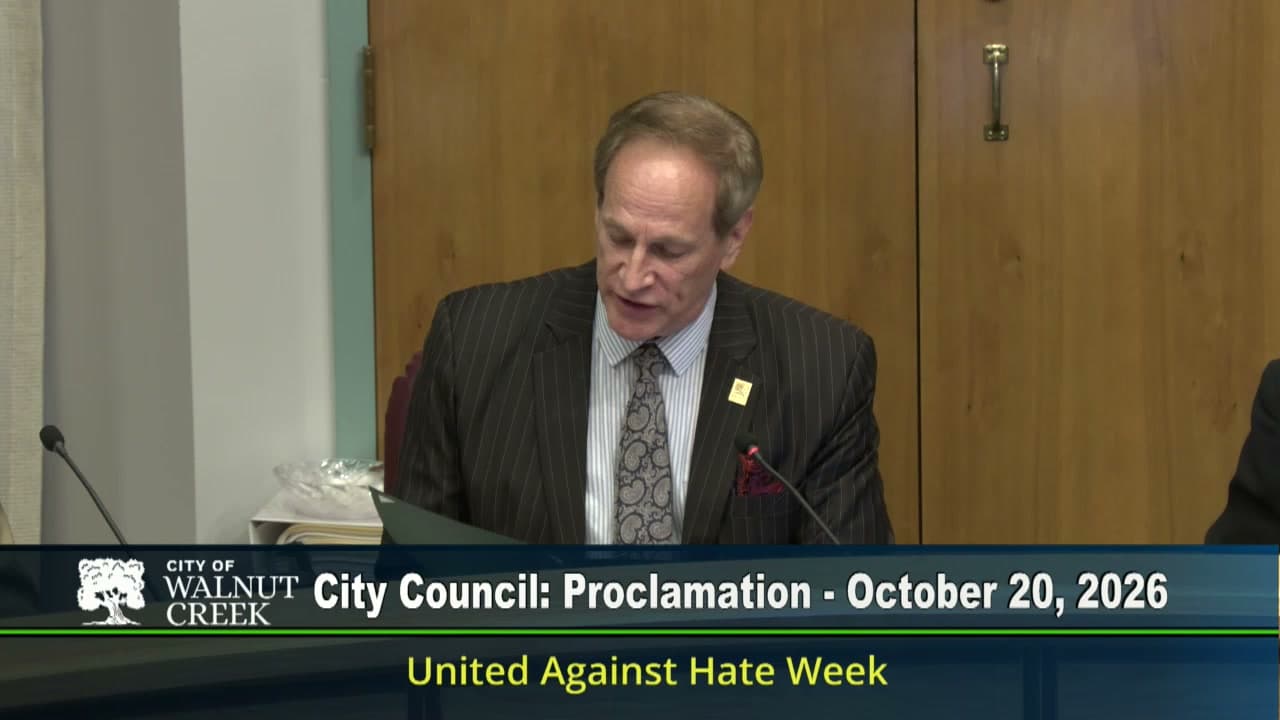
- Proclamations: The council recognized United Against Hate Week (Oct. 19–25), Red Ribbon Week (Oct. 23–31) and Arts and Humanities Month. Fifteen Youth Leadership Commission members were introduced.
Looking ahead: A redesigned shade structure for the golf course driving range returns within a couple of months. MCE electricity rates stay at parity with PG&E through April.