
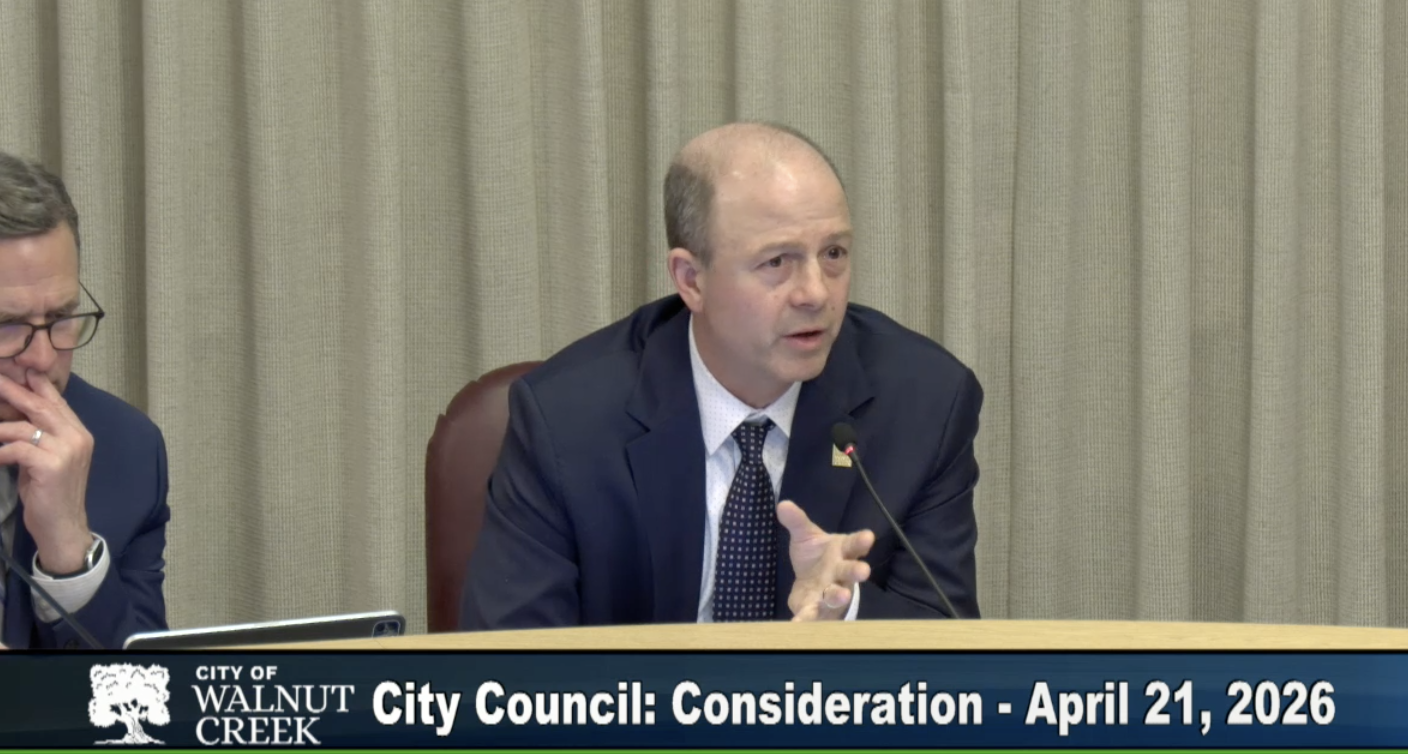
City Council - Apr 21, 2026 - Regular Meeting
City Council • Walnut CreekApril 21, 2026
Locunity is a independent informational service and is not an official government page for this commission.We use AI-assisted analysis and human editorial review to publish information.
Council Greenlights Ballot-Measure Study for Senior Housing Near BART
Walnut Creek's City Council kicked off a consequential review of a citizen-driven initiative that could rezone a prominent downtown office site for more than 200 senior housing units adjacent to BART — a move that, if approved by voters, the council would have no power to amend. In a busy evening that also broke new ground for downtown nightlife, the council introduced an entertainment-zone ordinance allowing open-container events on Locust Street starting this summer.
- Council orders Elections Code report on 200+ unit senior housing ballot initiative near BART
- Entertainment-zone ordinance introduced, allowing outdoor alcohol at downtown events through September 2028
- Residents demand noise enforcement against amplified protesters at Planned Parenthood clinic
- Library usage surges up to 39% as Ygnacio Valley branch prepares for 10-month closure
- $2.9M in affordable housing grants advance to May 5 council vote
Senior Housing Ballot Initiative Gets Green Light for Study
The basics: On March 16, the city received a Notice of Intent to circulate a petition for the Walnut Creek Senior Housing Transit Village Initiative. If enough signatures are gathered and the measure qualifies, the council must either adopt it outright or place it before voters — with no ability to modify it. The Elections Code Section 9212 report the council ordered will be the city's primary tool for analyzing the initiative's impacts before that binary choice arrives.
Why it matters: The initiative would create a new zoning district on a 2.4-acre office site at the northeast corner of North California Boulevard and Ygnacio Valley Road — steps from the Walnut Creek BART station — allowing 55-and-older multifamily housing with commercial uses. At roughly 163 units per net acre, the site could accommodate more than 200 senior housing units at heights consistent with existing zoning (up to 89 feet). If voters approve, the change would override both the General Plan and the North Downtown Specific Plan permanently, unless the property owner consents to modifications.
Where things stand: Assistant City Manager Charles Ching presented the item, explaining that the initiative's proponents are Stephen Koska, Marlene Farrell, and Haley Murphy; the property is owned by Hall Equity Group. The city's inclusionary housing requirements — 10% low-income for rental, 6% very-low-income — would apply, and the CEQA exemption covers only the rezoning itself if approved by voters, not any future development project.
Cecily Barclay, land use counsel for Friends of Walnut Creek Senior Housing, told the council the initiative largely mirrors how the city already regulates mixed-use residential downtown. "All this initiative does is basically adopt how the city currently regulates mixed-use residential downtown, but limited it to seniors," she said, noting slightly higher commercial floor-area ratio (0.6 vs. 0.3) and some commercial use restrictions. She argued the initiative route was chosen to expedite the process: "We can just come in with a project and if things are looking good then we can come up with what that project is and start moving, as opposed to going through what could be a much longer process."
The other side: Jan Warren, a resident of The Woodlands, pushed back, calling the initiative a "backdoor approach" that bypasses years of public planning processes and questioned why the developer would pursue a ballot measure instead of standard city review.
Council members pressed hard on the details. Councilmember Cindy Silva zeroed in on environmental review: "To what extent does this initiative allow for, or does it preclude, our normal environmental review processes?" City Attorney Steve Mattas clarified that CEQA exemption applies only to the rezoning, and any future project would still undergo full environmental review. He also laid out the council's constrained options: "You can either adopt it as it's proposed without changes at all, or you place it before the voters. Those are the only two choices you have."
Mayor Pro Tem Matt Francois pressed on affordability, voicing concern the project could end up entirely market-rate: "I would just want to make sure that includes not just the numeric number of units, but the affordability. It seems to me there's a possibility this could be an all market-rate project."
Decisions: The council voted 5-0 (For: 5, Against: 0, Absent: 0) to direct staff to prepare the 9212 report, adding requirements for analysis of community benefits, affordability scenarios, the entitlement process, Measure A height limits, an environmental overview, and commercial demand. The initiative proponents will reimburse the city's costs for the report under a cost-payment agreement.
What's next: The report will return to council, at which point members will decide whether to adopt the initiative outright or send it to the ballot. The 9212 report process is expected to be completed within approximately 30 days.
Downtown Gets an Entertainment Zone — With a Sunset
Why it matters: Authorized by State Senate Bill 969, which took effect in January 2025, the new ordinance creates a framework for designated entertainment zones where patrons can walk with open alcoholic beverages purchased from licensed businesses during special events in the public right-of-way. The model builds on 12 years of successful downtown street festivals and is designed to shift beverage sales from Walnut Creek Downtown-operated bars to local businesses.
Where things stand: Economic Development Manager Mike Nimon presented the ordinance, which adds Chapter 7-4 to the Municipal Code. The framework is event-based: a nonprofit project sponsor submits a management plan for council approval, followed by individual special event permits. Walnut Creek Downtown (WCD) would be the first sponsor, initially targeting Locust Street for two events this summer — July 8 and August 5.
Kathy Hemingway, executive director of Walnut Creek Downtown, described detailed operational controls including custom cups, wristbands, ID checks, staff training, and volunteer monitoring. Police Chief Ryan Hibbs backed the plan: "We don't have any major concerns here. Our position on this is that Walnut Creek Downtown has thought this out pretty thoroughly." He noted that existing First Wednesday events had produced no issues.
Mayor Pro Tem Francois clarified the geographic limits, confirming patrons could not, for instance, buy a beer at an off-site pub and carry it into the festival zone. Councilmember Silva preferred a report-back requirement over a hard sunset: "Rather than having it sunset, I would prefer just including a requirement that we get a report back to council so that we have eyes on how it's working." But Mayor Kevin Wilk pushed for a formal expiration, and the council settled on a compromise. City Attorney Mattas amended the ordinance to terminate Sept. 30, 2028, unless the council affirmatively extends it.
Decisions: The council voted 5-0 (For: 5, Against: 0, Absent: 0) to waive reading and introduce the amended ordinance.
What's next: The management plan will return for council approval at a subsequent meeting before the first event can proceed.
Residents Push for Noise Enforcement at Planned Parenthood
Why it matters: The complaints test the city's ability to enforce its own noise ordinance against amplified sound while respecting First Amendment protections.
Where things stand: During public communications, Kathy Dunn described ongoing harassment at the Planned Parenthood clinic on Oakland Boulevard, where protesters are deploying six-foot-tall tripod speakers with amplified sound. She cited the city's noise ordinance, which prohibits amplified sound heard clearly more than 50 feet away without a permit. Michael Vecchio, an engineer, confirmed he had measured audibility at 500–600 feet.
Councilmember Craig DeVinney broadened the discussion to downtown noise more generally, including loud car music, and suggested reviewing the noise ordinance for better enforcement tools. Mayor Wilk acknowledged the council had previously voted on the ordinance and directed Police Chief Hibbs and Captain Slater to meet with the complainants.
What's next: The police department will follow up directly with the residents who raised the complaints.
Library Usage Surges as Branch Closure Looms
Contra Costa County Library managers reported double-digit growth across the board during a National Library Week presentation. Physical circulation is up 9%, digital circulation up 39%, and physical visits up 10%. The Walnut Creek downtown branch saw nearly 300,000 visitors and its users checked out more than 350,000 ebooks and audiobooks — the highest in the county by 60,000.
Ygnacio Valley Branch Manager Ali Bernback announced the branch will close around fall 2026 for eight to 10 months to receive a new HVAC system, roof, and electrical upgrades. Staff will be reassigned to other branches during construction. Council members praised the library's vitality, with Mayor Wilk noting the busy nature of the Ygnacio Valley location.
Minor Items
- Consent calendar approved 5-0, including April 7 meeting minutes, warrant registers, a multi-year auditing contract with Macias Gini & O'Connell (FY 2026–2030), storm drain investigation and cleaning service agreements up to $1M, $678,222 in Cisco network equipment from Computacenter, the revised meeting schedule canceling the April 28 special meeting, and the Lesher fire alarm bid rejection (pulled and voted separately).
- Lesher Center fire alarm bids rejected 5-0 after costs exceeded expectations due to the building's height. The existing proprietary system remains functional; the project will be re-evaluated in future capital improvement plans.
- $2.9M in affordable housing grants and approximately $1M in community grants are advancing to the May 5 council meeting, per Councilmember Silva's housing subcommittee report.
- Fair Housing Month proclaimed for April 2026, with Echo Housing highlighted as the city's 49-year fair-housing partner.
- Robert Kearsley sworn in for the Iron Horse Corridor Management Committee.
- Youth Ride Free returns June 1 through July 31 on County Connection buses for ages 6–18.
- Employee recognition: 25-year honorees Captain Jeff Slater and Alex Wong; employee of the year Ben Schuster.
- Summa Academy opened in Walnut Creek, serving special-needs students with autism ages 5–22.
- Buena Vista Elementary students Elle, Kieran, and Rocco announced they qualified for the Odyssey of the Mind World Championships and sought approximately $6,000 in community support.
- Council adjourned to closed session for labor negotiations regarding the city manager and city attorney contracts.