
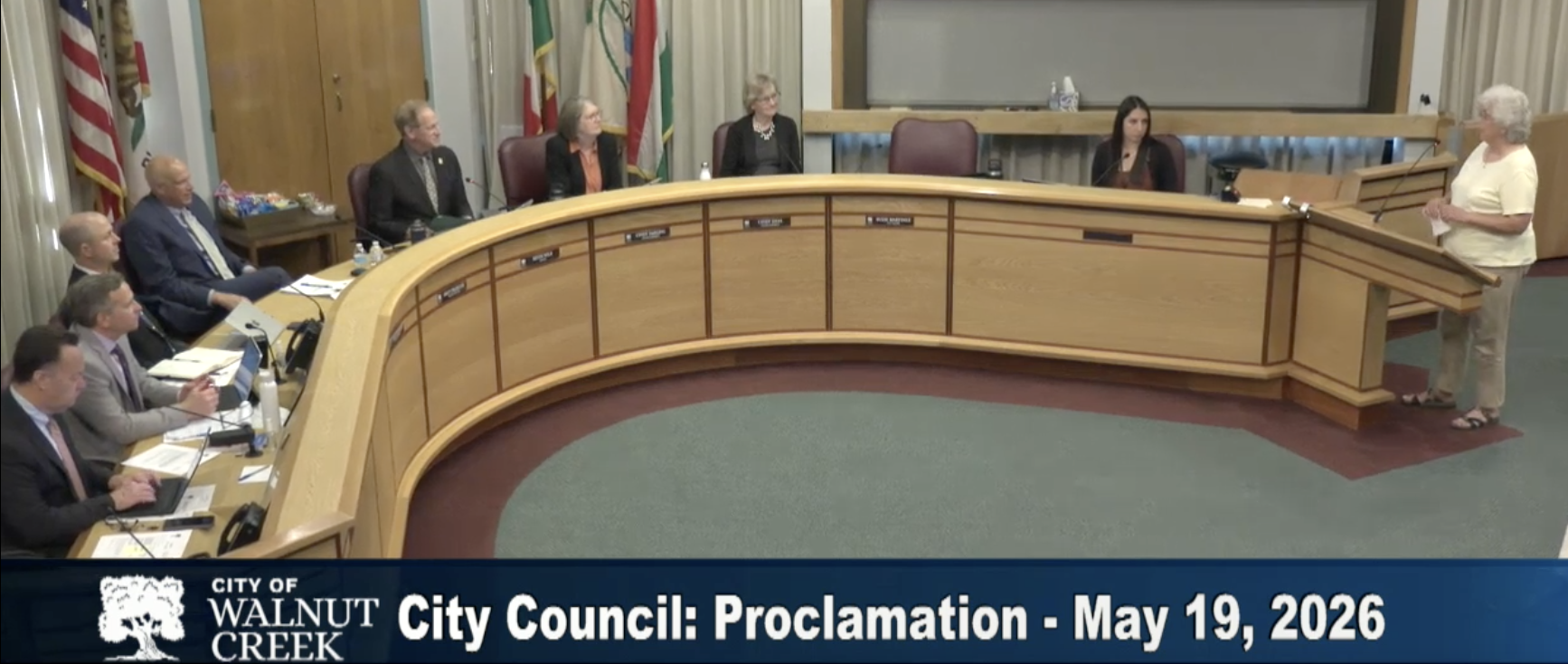
City Council - May 19, 2026 - Regular Meeting

City Council - May 19, 2026 - Regular Meeting

City CouncilWalnut CreekMay 19, 2026

Sources:

Locunity is a independent informational service and is not an official government page for this commission.We use AI-assisted analysis and human editorial review to publish information.

Walnut Creek Voters to Decide Fate of Elected City Treasurer on November Ballot

The Walnut Creek City Council moved unanimously Tuesday night to let voters decide whether to end more than a century of elected city treasurers, placing a measure on the Nov. 3, 2026 ballot that would convert the position to a professional appointment. The three-hour meeting also produced budget amendments that add the city's first dedicated emergency management staffer in years and a sweeping progress report on council priorities — from a gas leaf blower ban that generated 230 complaints in its first month to a Bay Area venture capital boom positioning Walnut Creek for healthcare-driven growth.

  • Council puts treasurer's future to voters, asking whether the increasingly technical position should shift from elected to appointed
  • FY2027 budget amendments approved, adding ~$600,000 to fund balance, a new Measure O-funded emergency management analyst, and expanded library hours during a branch closure
  • Five council priorities get progress check: PODS dining program earns state award with 45:1 investment leverage; leaf blower ban strains small sustainability team; zero homeless encampments reported
  • Bay Area captures 79% of U.S. venture capital in 2026, with healthcare office conversions favoring Walnut Creek
  • Council Handbook updated for new state laws, with staff ordered to study December meeting scheduling to ease election certification crunch

Should Walnut Creek's Treasurer Be Appointed? Voters Will Decide.

The council voted 5-0 to place a measure on the November 2026 general municipal election ballot asking a simple question: Shall the office of City Treasurer be appointive?

Why it matters: The city treasurer manages the investment of public revenues — a role that has grown far more technical over the decades. Current Treasurer Ron Cassano has held the position for nearly 30 years, and his term expires in 2026. If voters approve the measure, the next elected treasurer would serve a full term through 2030, after which the position would transition to an appointment under the city manager.

Where things stand: Assistant to the City Manager Joe Caroza presented data showing that 12 of 19 Contra Costa County cities — about 63% — already use appointed treasurers. "A move to an appointed would be in alignment with our fellow cities in the county," he said. Walnut Creek voters rejected similar proposals in 1956 and 1996.

Mayor Kevin Wilk framed the issue in blunt terms: "I don't want this position to become political. Seems like everything is political now when it comes to every government from local up to federal. And the treasurer is responsible for the investments of our revenues from taxpayers."

The resolution authorizes Mayor Wilk and Mayor Pro Tem Matt Francois to submit written ballot arguments in favor. Staff noted the city can produce informational materials but cannot campaign for or against the measure. The City Attorney will prepare an impartial analysis.

What's next: The measure goes before Walnut Creek voters on Nov. 3, 2026. The council cannot advocate, but proponents and opponents may submit ballot arguments through official channels.

Vote: 5-0. (For: Wilk, Francois, Darling, Silva, DeVinney.)


Budget Adds Emergency Analyst, Expands Library Hours Amid Sales Tax Shortfall

The council unanimously approved FY2027 budget amendments that add roughly $600,000 to the city's fund balance while navigating a $2.3 million sales tax shortfall tied to auto and transportation reporting changes.

The basics: The amendments include $550,000 in additional revenue — interest earnings up $300,000 and community development reimbursables up $500,000, offset by a terminated police Apple contract — along with a net $50,000 in expenditure savings. The fund balance contribution grows from $160,000 to approximately $760,000.

Why it matters: Two new commitments stand out. A Measure O-funded emergency management analyst will join the city manager's office, filling a gap that predates the pandemic and addressing voter priorities around disaster preparedness. And with the Ignacio Valley Library branch closing for 8-10 months of renovation, the Finance Committee recommended increasing extra hours at the Walnut Creek branch from 12 to 16 per week — a roughly $20,000 net cost to maintain library access.

On the Measure O side, transaction and use tax revenue was reduced by $280,000 due to slower growth, but interest earnings rose by $300,000 to partially compensate.

What's next: The broader approach to the $2.3 million sales tax shortfall will be addressed alongside a citywide fee study, with results expected between June and August. All five council members expressed support for the amendments.

Vote: 5-0. (For: Wilk, Francois, Darling, Silva, DeVinney.)


Five Priorities, One Scorecard: What the City's Progress Report Revealed

Five department heads gave the council a comprehensive update on 2025-2026 priorities spanning economic development, sustainability, the General Plan, parks, and public safety. The council then green-lighted a community survey to help shape the next two-year priority cycle — one that will coincide with a new council taking office in early 2027.

Downtown Dining's Big Return on Investment

Economic Development Manager Mike Niemann reported that the PODS outdoor dining program — seven installations completed — earned a California Association for Local Economic Development (CALED) award. The private-sector response has been striking: "That generated a return of about 45 to 1 in terms of the public dollars invested being matched by the private sector investment, which then brought this enhanced vitality to downtown," Niemann said. Staff is also developing lean process improvements, broker roundtables, and a forthcoming KPI dashboard.

Leaf Blower Ban Strains a Small Team

Sustainability Manager Candace Rankin Mumby delivered perhaps the evening's most telling operational data point: "In the first month we received about 230 complaints of potential violation. So at this point we're really working as an education-based enforcement." The gas-powered leaf blower ban, she said, is consuming roughly 30% of the two-person sustainability team's time. Other sustainability initiatives include on-bill financing for energy efficiency at three city facilities, an EV strategic plan arriving in July, restaurant reusable container conversions, emergency mask distribution, and Green Business Network promotion.

General Plan 2050: "Rooted, Evolving, Thriving"

Community Development Director Erica Vandenbrand reported that the General Plan 2050 update — branded "Rooted, Evolving, Thriving" — has completed consultant touring and data gathering. A joint commission meeting is scheduled for June 25, with public meetings planned for August.

Parks and Measure O Projects Move Forward

Public Works Director Rich Payne detailed Measure O-funded capital work including Heather Farm Park construction (underway), Civic Park playground replacement (September through November), multiple trail crossing enhancements, the Broadway/Newell Safe Routes to School project, the Oakland Boulevard bike lane, and a Clark Pool repurposing study beginning in November.

Zero Encampments, Rising Catalytic Converter Theft

Police Chief Ryan Hibbs reported zero established homeless encampments in city limits: "I am pleased to report that we have no established encampments in city limits." The department secured a $1 million federal earmark for body-worn cameras and is evaluating AI tools for dispatch and records. When Mayor Wilk asked about the city's biggest crime challenge, Chief Hibbs confirmed: "Approximately 90% of all the crimes committed in [Walnut Creek] are property." Catalytic converter theft is trending upward, and Q1 traffic collisions dropped 12%. New Business Watch and Neighborhood Watch programs are rolling out, and the department supports AB 1942, which would create a state e-bike registration system.

What's next: Staff will conduct a community survey — both digital and through targeted focus groups — to gather resident input on 2027-2028 priorities.


Bay Area VC Surge and Healthcare Conversions Signal Opportunity

City Manager Dan Buckshi shared data from the East Bay Economic Development Association's economic forum that paints a bullish picture for the region. U.S. venture capital grew from $100 billion in 2024 to $178 billion in 2025, and through early 2026 has already hit $236 billion — with the Bay Area's share rocketing from 46% to 79%, driven almost entirely by AI and robotics.

"So far in 2026, we grew from 178 billion to 236 billion. We're obviously less than halfway through the year. And 79% of that is in the Bay Area," Buckshi said.

While traditional office space continues to struggle from remote work, Buckshi identified a bright spot: "One of the biggest growth areas for conversions of more traditional office space is in health care, which actually bodes really well for Walnut Creek" — a reference to the city's John Muir and Kaiser healthcare campuses. Economic activity and rents are increasing in San Francisco and Oakland after years of stagnation, with projected spillover benefiting the broader East Bay.

Buckshi also reported on fire season preparedness and the appointment of new Contra Costa County Fire Chief Aaron McAlister, encouraging residents to sign up for WC Alert.


Handbook Updates and a Looming December Scheduling Problem

Councilmember Cindy Silva pulled a consent calendar item — amendments to the City Council Handbook for compliance with SB 707 and SB 827 — to flag two concerns.

First, the technology disruption addendum: under SB 707's two-way communication requirement, if the system goes down, the council would take a recess of up to one hour (or until service is restored, whichever is earlier) rather than waiting a full hour. If service can't be restored, the council may resume after a roll-call vote finding good faith efforts were made.

The bigger issue was December scheduling. The 28-day election canvass period consistently falls on or near the first Tuesday in December — the same day as the council's first meeting. Silva warned the problem could intensify: "I anticipate that if we go to districts, the voter pool will get smaller and it's greater likelihood of a tie. Martinez has had it, Richmond's had it where they had to figure it out."

The City Attorney confirmed current practice complies with state law but noted that other cities, such as Martinez, adjourn the first December meeting to a later date — an approach that would also be lawful. Silva's first motion to approve the handbook without the December scheduling change failed for lack of a second. Her revised motion — approve as presented plus direct staff to study scheduling alternatives and report back — passed unanimously.

Mayor Wilk also raised a question about making the required financial training more Walnut Creek-specific. Silva pushed back gently, noting the value of a broader curriculum: "One of the things you get from a standardized presentation is new ideas. If we just hear about what's going on in Walnut Creek, there are no new ideas." City Manager Buckshi suggested a hybrid: standard training for legal compliance plus a local finance addendum.

Vote: 5-0. (For: Wilk, Francois, Darling, Silva, DeVinney.)


Minor Items

  • Consent calendar approved 5-0, including a $358,509 City Hall building management system contract, a $582,674 five-year recreation software agreement, a $131,651 CAL-ID fingerprint program renewal, the FY2026 Q3 budget update, and a Measure O Citizens' Oversight Committee appointment.
  • LGBTQ+ Pride Month resolution adopted 5-0, with a public flag-raising ceremony planned for June 1 at City Hall. Mayor Wilk pulled the item from consent to highlight the event.
  • National Public Works Week proclamation honored the department maintaining 213 miles of streets and 22 parks for more than 70,000 residents. Public Works Director Rich Payne accepted on behalf of staff.
  • Affordable Housing Month proclaimed. Jan Warren of East Bay Housing Organizations accepted, noting the organization's 400+ members and 25+ public events during the month. Councilmember Silva reported the RHNA 7th cycle numbers are due by Jan. 31, 2031, with new requirements to account for unhoused populations and university students. Silva noted the statewide jump from 187,000 in the fifth cycle to 441,000 in the sixth cycle, adding that a repeat increase of that magnitude is unlikely.
  • Jewish American Heritage Month proclaimed amid rising antisemitism. Rabbi Jenny Chabon expressed gratitude for the council's allyship: "It is a really uncertain and quite scary time to be Jewish in the world and to be Jewish in our country. It means a tremendous amount to have allies within this council."
  • National Mental Health Month proclaimed, with the city highlighting support for Contra Costa County's A3 Crisis Response Initiative to expand mental and behavioral health crisis services.
  • Councilmember Cindy Darling reported on a field trip to the Mulquinny wind farm, highlighting AI-optimized turbine placement and raptor-detection camera systems: "As soon as they spot a raptor, all the turbine blades feather and they slow, and it prevents the mortality of raptors."
  • Councilmember Craig DeVinney reported on a CCTA transportation workshop and suggested the city create a community input webpage for local transportation projects.
Walnut Creek Voters to Decide Fate of Elected City Treasurer on November Ballot | City Council | Locunity