
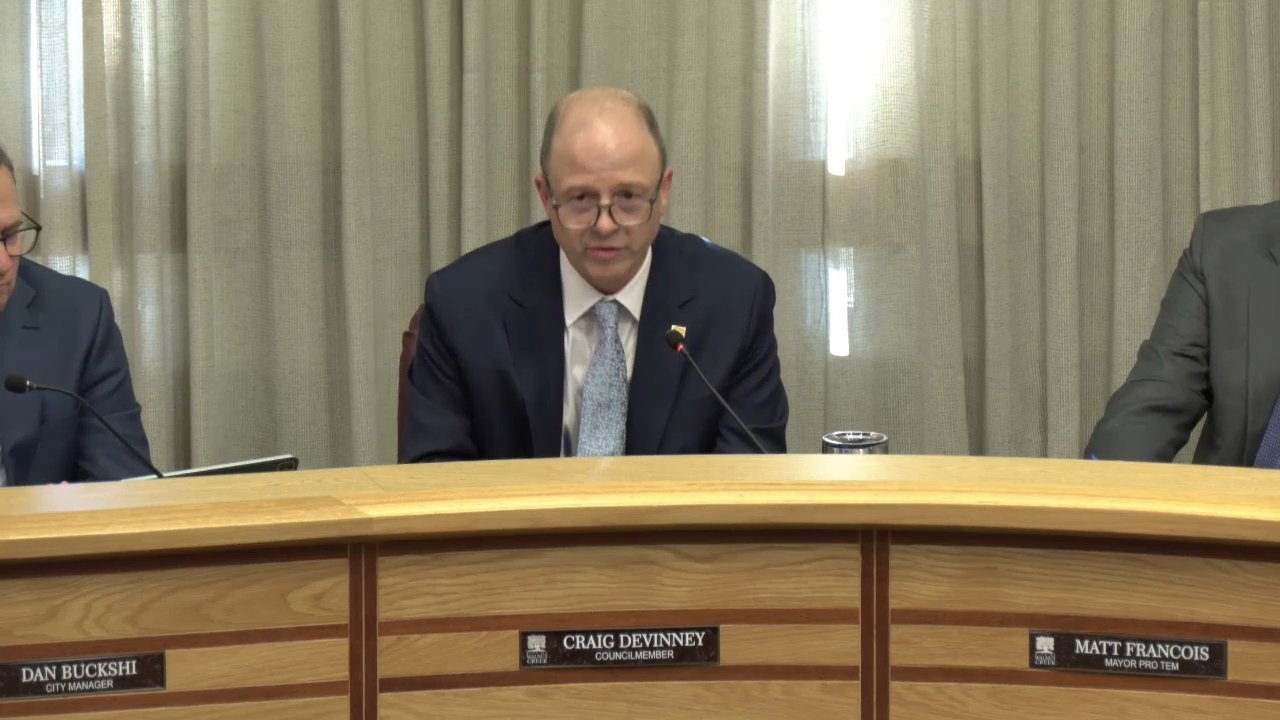
City Council - Jul 21, 2026 - Regular Meeting
City Council • Walnut CreekJuly 21, 2026
Locunity is a independent informational service and is not an official government page for this commission.We use AI-assisted analysis and human editorial review to publish information.
Senior Housing Initiative Heads to November Ballot as Council Maps 2050 Vision
Walnut Creek's City Council unanimously placed a citizen-sponsored measure to rezone 2.4 acres near the BART station for up to 280 senior housing units on the Nov. 3, 2026 ballot — the capstone of a nearly six-hour session that also launched the city's first comprehensive general plan update since 2006 and advanced a sweeping overhaul of more than 600 user fees.
- Senior housing transit village initiative placed on November ballot after council declines to adopt it outright or file opposition arguments, sending the rezoning question directly to voters
- 2050 General Plan Update kicks off with council identifying transportation, housing and economic resilience as the top challenges facing the city over the next quarter century
- Fee overhaul advances with council directing a four-tier cost recovery policy and 10% resident discount — limited to incorporated city residents only — covering recreation, building permits and planning applications
- Tourism BID renewed unanimously for fiscal year 2027 with no protests from assessed hotels
Senior Housing Near BART Goes to the Voters
Why it matters: A citizen-initiated measure could rezone prime BART-adjacent land for hundreds of senior housing units, bypass the normal entitlement process and lock in development standards that future councils cannot change without voter or property-owner consent — potentially reshaping Walnut Creek's north downtown.
The basics: The Walnut Creek Senior Housing Transit Village Initiative would create a new Mixed Use Residential Senior Commercial zoning district on a 2.4-acre portion of the Ignacio Center site at the northeast corner of North California Boulevard and Ignacio Valley Road, directly across from the Walnut Creek BART station. The property is currently zoned for office use.
Where things stand: City Attorney Steve Mattas presented the Elections Code 9212 report prepared by RSG Solutions, whose president, Jim Simon, walked the council through technical findings. The analysis showed one-time city implementation costs of roughly $250,000 but a net positive annual fiscal impact of $191,000 to $469,000 depending on the development scenario. The initiative could yield 225 to 280 senior housing units with density bonus, 15-17% inclusionary affordable units or $6.4 million to $7.7 million in in-lieu fees, and reduced traffic compared with the site's current office entitlements. Senior housing is eligible for a 20% density bonus without providing any affordable units.
Council members drilled into development standards — one unit per 425 square feet of net lot area, an 89-foot height limit, and a 3.5 to 4.5 floor-area ratio — as well as the initiative's definition of "primarily" senior housing, its interaction with the North Downtown Specific Plan's street cross-sections and its lock-in provisions restricting future council amendments.
Mark Hall, principal owner of the Ignacio Center through Hull Equities Group and chairman of the initiative campaign committee, made the case that the depressed office market demands a new vision. He told the council the BART-area office market is roughly 30% vacant and that his group purchased the property at 40 cents on the dollar.
"If we can get a mixed use project here that works really well, this is going to be really important for the whole north downtown area to support values for all of those office buildings," said Mark Hall, Hull Equities Group principal owner.
Hall described plans to take the five-story parking garage underground, create surface convenience parking and attract quality retail to revitalize the entire 6.8-acre block.
Land use attorney Cecily Barclay of Perkins Coie clarified technical details, including that the 425-square-foot density formula governs the number of allowable units rather than actual unit sizes, which would average about 1,000 square feet. Chuck Davis, Hull Equities Group senior vice president for development, confirmed right-of-way dedications of 3 additional feet on North California Boulevard and up to 8 feet on Ignacio Valley Road to meet the North Downtown Specific Plan's street cross-sections.
The other side: Council members expressed a shared tension — excitement about the project's potential but discomfort with the initiative process bypassing normal planning review.
"I'm excited about what could be, but I'm not excited about the process that it's taken to get there," said Councilmember Cindy Silva.
Mayor Pro Tem Matt Francois took a different view, calling the initiative route legitimate: "I think this is just the natural outflow of an initiative process which is allowed by our California constitution."
Mayor Kevin Wilk framed the ballot question as a broader test: "I think that this will also help us, based upon the vote of the community, to help us see the city council to make decisions in the future for similar projects."
Decisions: The council voted 5-0 to place the initiative on the Nov. 3, 2026 ballot. The resolution was amended to remove Section 8, which would have authorized the council to file ballot arguments in opposition, and to modify Section 2 to use the Elections Code 9280 process — making the full 65-page measure available on the city website rather than printing it in the ballot pamphlet. (For: Wilk, Darling, DeVinney, Silva, Francois; Against: none; Absent: none.)
What's next: If approved by voters, the initiative creates a new MURSC zoning district enabling up to 280 senior housing units near BART. Development standards would be locked in and could not be changed by future councils without voter or property-owner consent. Staff was directed to post the full initiative text on the city website.
Council Launches 25-Year General Plan Update
Why it matters: The 2050 General Plan Update — Walnut Creek's first comprehensive overhaul since 2006 — will determine where housing, jobs and infrastructure investments go for the next quarter century and must plan for 2.5 more housing element cycles under state law.
Where things stand: Principal Planner Crystal De Castro introduced the project, and Eric Yerkovic, principal at Alta Planning and Design, presented a five-phase timeline branded "Plan to Place," along with early findings from engagement with 40 community partner representatives. Key themes from initial outreach included honoring Walnut Creek's identity, balancing housing and business needs, improving mobility, investing in arts and culture and fostering healthy, resilient communities.
Each council member described the city in a single word — resilient, family, community, livability, welcoming — before identifying transportation, public safety, economic vitality, climate change, infrastructure modernization and regional regulatory pressures as the most pressing issues.
Mayor Wilk zeroed in on transportation, noting that BART ridership remains at only 60-70% of pre-pandemic levels. He also flagged cannabis storefront discussions and downtown retail diversification as topics for the general plan process.
Councilmember Craig DeVinney said long-range transportation planning gives him the most anxiety: "What gives me the most angst when I fast forward like 20 years is thinking about we're going to have more housing, we're going to grow, we're going to densify is transportation. Like, how are we going to get around the city?"
Councilmember Silva emphasized the need for adaptability and highlighted Walnut Creek's comparative openness to housing: "We welcome more people and different people. We have convinced the community to be welcoming to housing because I hear more communities all over the state basically describe harrowing council meetings where people are objecting to housing."
Yerkovic warned the council about a statewide tension between housing mandates and fiscal health: "What's happening within state laws, there's this pressure to meet our housing need over time, which is really important to meet our housing crisis. And what we're doing is giving up a lot of employment lands at the same time."
What's next: Community pop-up engagement events begin in August, with a public workshop scheduled for September. The update is expected to take several years and will proceed through five phases.
Fee Overhaul Raises Cost Recovery, Sparks Debate Over Who Gets the Discount
Why it matters: The first citywide fee study since 2010 will close a growing gap where only about 65% of service costs are recovered through fees, with the remaining $12 million subsidized by general fund taxpayers. More than 600 fee line items across every department are on the table.
Where things stand: Administrative Services Director Kirsten LaCasse presented the proposed framework alongside Arts and Recreation Director Chris Farrow. The policy creates four benefit-based cost recovery tiers: community benefit (0-50%), community/individual (40-80%), voluntary individual (70-100%+) and non-voluntary individual (80-100%). Of the 600-plus fees studied, 257 would remain unchanged, 285 are proposed for adjustment and 74 are new line items — 68% of those related to affordable housing administration at zero charge. The largest increases concentrate in building valuation schedules, complex planning applications and specialty administrative fees. Common resident-facing fees like recreation programs and swim lessons see more modest increases. The proposed changes would primarily offset a $1.7 million revenue decline rather than generate net new revenue.
The sharpest debate centered on a proposed 10% resident discount — specifically, whether unincorporated Walnut Creek residents who share a zip code but don't pay property tax to the city should qualify.
Councilmember Silva argued for inclusion: "Our unincorporated residents pay as much sales tax as our city's residents because the stores are where the stores are. What they don't pay is property tax, and that's it."
Mayor Pro Tem Francois countered by linking the discount to the city's Measure O sales tax: "62% of our city residents supported Measure O. And in my mind, this is a way, a small way of saying thank you for that. Here's another benefit you get from supporting Measure O is that you get a city discount."
A straw vote showed a 3-2 majority — Darling, DeVinney and Francois — favoring the discount for incorporated residents only, with Silva and Wilk leaning toward including unincorporated residents.
DeVinney also pushed for a broader policy anchor, proposing that the city establish an overall cost recovery target percentage for transparency. Staff agreed to study the idea further during the next budget cycle.
What's next: Formal adoption of the fee schedule is set for Aug. 18, with updated fees taking effect Jan. 1, 2027.
Minor Items
- Consent calendar approved 5-0, including meeting minutes, warrants, the salary and wage plan resolution, a six-lot subdivision final map at 1948 3rd Ave., a $750,000 Lesher Center concession agreement and acceptance of a green infrastructure project.
- Tourism Business Improvement District assessments renewed 5-0 for FY 2027 after a public hearing with no protests received.
- League of California Cities voting delegates appointed 5-0: Mayor Wilk as voting delegate, Councilmembers Silva and DeVinney as alternates for the annual conference.
- Port Chicago Remembrance Day proclaimed with enthusiastic bipartisan support, recognizing the historically overlooked 1944 disaster and recent federal pardons driven by Congressman Mark DeSaulnier.
- Park and Recreation Month proclaimed for July.
- Buena Vista Elementary Odyssey of the Mind team recognized for second-place finish at world championships.
- Councilmember Darling reported MCE CEO Dawn Weiss departed June 17, with the board recruiting a replacement; a civil grand jury response is pending.
- Councilmember DeVinney noted the youth ride free program has generated 3,000 additional transit rides.
- Meeting adjourned in memory of former three-term Mayor Sue Rainey.