
Council Backs Transit Sales Tax as BART Warns of Deep Cuts
City Council • Walnut CreekOctober 6, 2026
Locunity is an independent informational service and is not an official government page for this commission. All information is sourced from public footage and an analysis of official agendas with the aid of responsible, fact-checked AI. to report an error or omission.
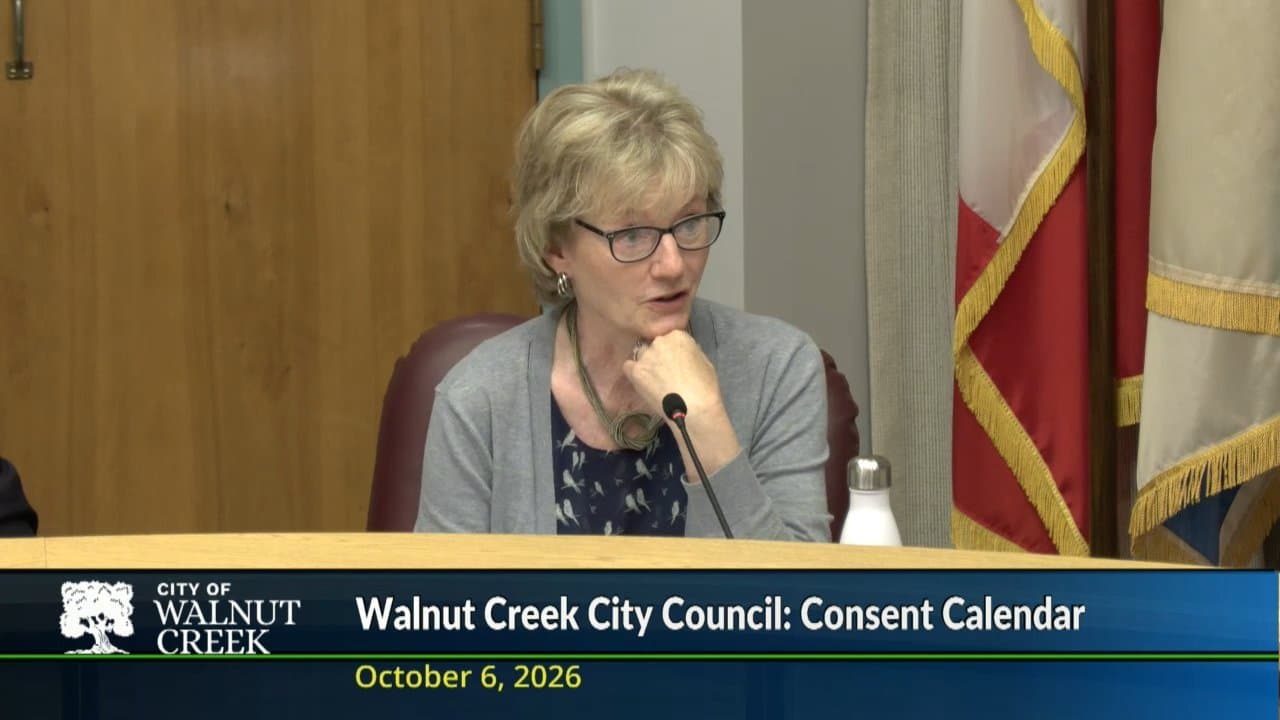
At its Oct. 6 meeting, Walnut Creek's City Council endorsed Measure RTM, a regional transit sales tax that BART and County Connection officials say is the only thing standing between local riders and deep service cuts. The council also backed three other November measures: a high school parcel tax, an appointed city treasurer and a statewide housing bond. Each passed 4-0, with Councilmember Cindy Darling absent.
Measure RTM endorsed 4-0 after BART outlined a $370M structural deficit
Five students help win 4-0 backing for Measure W's $168 parcel tax
Appointed treasurer and $11.25 billion housing bond also win council support
Free Route 7 shuttle's future in doubt as Shadelands owners question funding
$7M Heather Farm turf fields accepted, but locked gates frustrate residents
Transit Tax Gets the City's Nod
Why it matters: Without new revenue, County Connection would eliminate Walnut Creek express routes 92X, 93X and 95X and weekend Route 301. BART's scenarios include 9 p.m. closures and 50% fare hikes.
The basics: Measure RTM, the five-county Connect Bay Area Transit Initiative, would levy a half-cent sales tax in Alameda, Contra Costa, San Mateo and Santa Clara counties and 1% in San Francisco for 14 years. It is estimated to raise about $980 million. It needs a simple majority counted across all five counties.
"So if it were not to pass in Contra Costa, for instance, but have 50% vote among the 5 counties, it would still pass and take effect in Contra Costa," said Mayor Pro Tem Matt Francois, who presided.
Where things stand: BART Director Matt Rinn reported crime down about 41% after new faregates were installed and crimes against riders down 67%. He also reported a $370 million structural deficit, with ridership around 200,000 a day compared with 300,000 before COVID. His agency's alternative plans could cut some service by up to 70% or close stations. Asked by Councilmember Craig DeVinney whether RTM would cover the gap, Rinn said, "It gets us a lot closer." Rinn recused himself from the council's RTM discussion.
County Connection CFO Amber Johnson said the bus agency faces a $6.5 million annual deficit and has adopted a 22% service-cut plan to take effect by the end of fiscal 2028. Walnut Creek routes carry more than 1 million annual trips, or 39% of the system's total. Routes 5, 7 and 21 would also be reduced.
The other side: Mark Jaffe, president of the Contra Costa Taxpayers Association, urged transit agencies to cut executive pay and benefits. "It will raise sales taxes in Walnut Creek to 9.75%," he said. "The state legislature can divert Cap and Invest funds from the failing high-speed rail project to BART, County Connection, and other agencies."
Francois, a daily BART rider, admitted "this one I had to think about a little." He rejected the state-funding alternative. "I think it's somewhat simplistic to say the state should fund it when it funds part of it, but has never funded really all of it," he said, noting the tax's fixed term.
Decisions and stakeholder impacts: Councilmember Cindy Silva argued that "if the transit agencies fail financially, it does not improve local transportation. It degrades it." DeVinney said a fare-only funding model isn't viable. Mayor Kevin Wilk, the council's County Connection liaison, warned that "fewer and fewer people will take public transit and it will truly be a death spiral." He projected an extra 30 to 40 minutes each way for commuters on the Bay Bridge.
The winners are commuters, students and paratransit users. Sales-tax payers absorb the cost. Silva moved and Wilk seconded. For: 4 (Silva, DeVinney, Francois, Wilk), Against: 0, Absent: 1 (Darling).
What's next: Voters decide Nov. 3, 2026.
Students Make the Case for Measure W
Why it matters: Students said $4.2 million in cuts have already crowded classrooms and thinned counseling at Acalanes Union High School District schools, including Walnut Creek's Las Lomas High School.
The basics: Measure W would levy a $168 parcel tax for eight years. The district estimates it would raise roughly $6 million annually for teacher recruitment and retention, STEM, arts and manageable class sizes. It includes independent audits, an oversight committee and exemptions for seniors and people with disabilities. It needs a two-thirds vote.
Where things stand: The public comment period resembled an organized show of support. Five students spoke, along with Denise Burian of the American Association of University Women. Ingrid Yott, a Las Lomas sophomore, noted that Lafayette, Orinda and Moraga have already endorsed the measure. Henry Pickett, a Las Lomas junior, described teacher layoffs and desk-sharing: "some of the students have to stand in the back."
"Before the wellness center was improved in the AUHSD district, there was a suicide rate of twice the state average," said Amber Acker, a Las Lomas junior. "One librarian for approximately 5,400 students is unsustainable," said Lorelei Fairclough, also a junior. Shaheen Mohabadi, a WCI seventh grader, asked for a stronger high school to grow into.
The other side: "I respectfully ask you not to weigh in on the 3 measures that do not specifically pertain to the city," said Jaffe. He noted that Walnut Creek School District's Measure J and last year's Acalanes Measure T both fell short of two-thirds in Walnut Creek, and that the district rejected his group's suggestion of a lower rate.
Decisions and stakeholder impacts: Silva rejected the "not a city issue" argument. "I think there is nothing more economically important to a community than supporting its schools," she said. DeVinney cited property values and challenged opponents' criticism of wellness centers. "I think it's a wise investment that we vote to endorse Measure W," said Francois. Francois moved and Wilk seconded. For: 4, Against: 0, Absent: 1 (Darling).
Treasurer Overhaul, Housing Bond Win Support
Why it matters: Walnut Creek's treasurer oversees $100 million to $150 million in investments. Under state law, the only qualification for the elected post is being a registered city voter.
Where things stand: Measure T, which the council placed on the ballot unanimously in May, would make the treasurer a city manager hire. Joe Carrozza, assistant to the city manager, said more than 90% of California cities appoint their treasurers. The duties would be absorbed by existing staff, and "there should be no significant cost to the city or to taxpayers." Longtime treasurer Ron Cassano has served about 30 years.
Silva noted that the post could currently go to "an 18-year-old senior at Las Lomas High School who is eligible to vote, who's failing math." Wilk rebutted opponents' claim that the change reduces accountability: "The accountability goes from the appointed treasurer reporting to the finance director, reporting to the finance committee, reporting to the city manager, and ultimately reporting to the entire city council." Wilk moved and Silva seconded. For: 4, Against: 0, Absent: 1 (Darling).
Proposition 1: At the League of California Cities' request, the council also backed the $11.25 billion Veterans and Affordable Housing Bond Act of 2026. The bond includes $1.25 billion for CalVet home loans and $200 million for local housing trust funds. "The hardest housing to get funded and built is affordable housing," said Francois. Silva tied housing to jobs and homelessness. For: 4, Against: 0, Absent: 1 (Darling).
Shadelands Shuttle Hangs in the Balance
Why it matters: The free Route 7 bus between BART and Shadelands carried 56,000 riders last year. Council members called it key to absorbing traffic from new housing in the business park.
Where things stand: The Shadelands Property and Business Improvement District (PBID), a self-assessment district of 114 parcels, kept assessments flat. It plans to spend down roughly $868,000 in reserves by 2029. Spending ran about $240,000 under budget, mainly because of the timing of a $300,000 wayfinding sign program. Blair Sanchez, chair of the PBID steering committee, said that program is the district's largest investment of the term. DeVinney noted that wayfinding makes up 46% of spending. He also asked about a roughly $20,000 revenue shortfall, which was partly due to a 1% city fee left out of the original budget, and about the impact of the Del Monte closure. Consultant Jared Ash said Shadelands vacancy is below downtown office levels.
The other side: Route 7 is budgeted for next year, but Sanchez said, "The property owners are questioning the fiscal responsibility of their fund and their particular commitment to that relationship."
Decisions and stakeholder impacts: Wilk called the bus "a big carrot for businesses as well as development that's happening within Shadelands." Francois noted it costs about $80,000 of the district's $500,000 budget. Silva confirmed with staff that the service is in the management plan, which is subject to council approval. The council accepted the report by consensus, without a formal vote.
What's next: Assistant City Manager Charles Chang said signs placed in the public right-of-way will return to the council for a maintenance agreement.
Turf Fields Done, Public Access Still Locked
Why it matters: Measure O dollars and a Walnut Creek Soccer Club fundraising campaign helped pay for the $7 million Heather Farm fields. They stay locked unless rented.
Where things stand: Wilk relayed resident frustration that "people have voted for Measure O and then are not able to use these fields." City Manager Dan Buckshi said the city wants to "avoid any more challenging and permanent damage." Arts and Recreation Director Chris Farrow said a spring-break pilot drew off-leash dogs, e-scooters and e-bikes, even with staff present. More hours "would come with a budget ask" in the next two-year cycle.
Decisions and stakeholder impacts: DeVinney floated rotating gates to keep out bikes. Silva, recalling past damage to grass fields, suggested signs directing visitors to 22 other parks. Francois moved and Silva seconded acceptance of the project as complete. For: 4, Against: 0, Absent: 1 (Darling).
Minor Items
ADU ordinance adopted on consent, aligning city zoning and notice rules with state law.
Contracts approved: two Public Works temp-staffing deals at up to $625,000 each, plus $237,175 for AX9 Security.
$210,000 federal block grant accepted for ADA sidewalk upgrades on North Main Street.
Townsend Public Affairs briefed the council on new state laws; Jaffe objected to AB 1821's longer records deadlines.
The city won a platinum Beacon award for a 32% emissions cut since 2008.
Looking Ahead
BART substation construction at the Walnut Creek station starts Oct. 19, across from the Waymark Apartments. Finance Committee recommendations come to the council Oct. 20. RecycleSmart rates will rise with new services starting in March 2027. The April 2027 council meeting stays on April 20.