
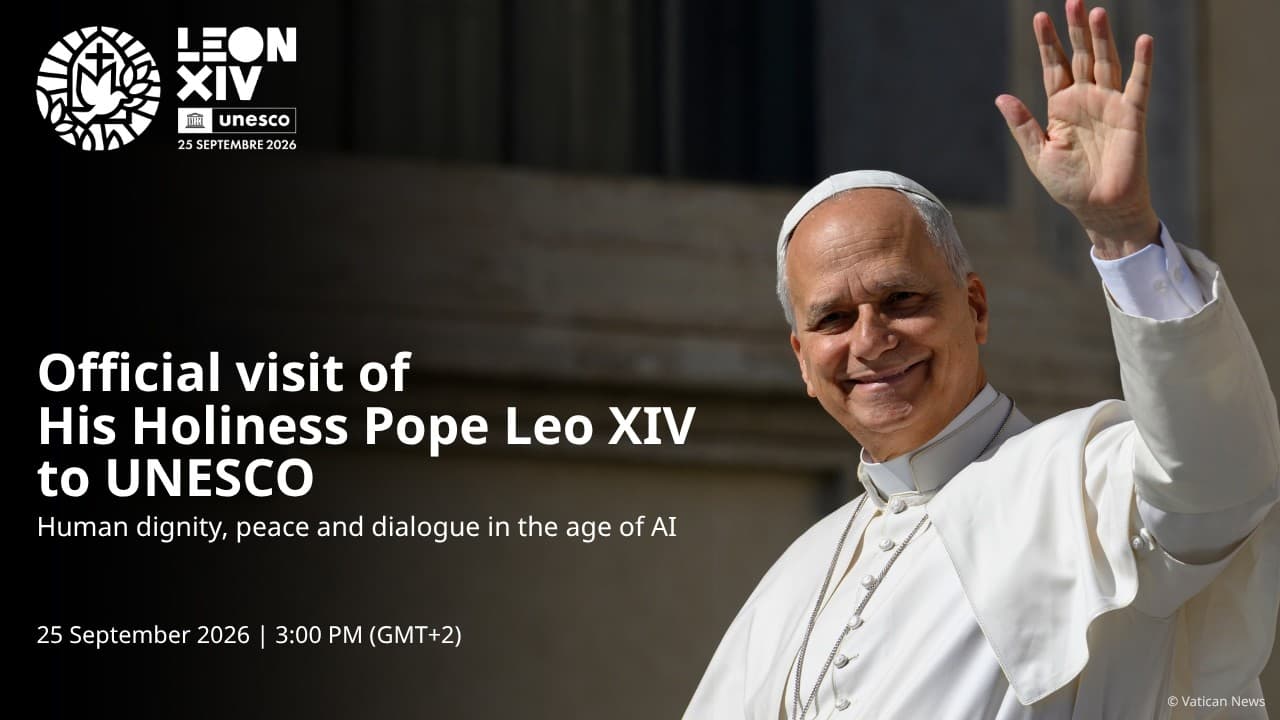
Pope Leo XIV Delivers Historic Address at UNESCO, Warns AI Must Serve Humanity
UNESCO • United NationsSeptember 25, 2026
Locunity is an independent informational service and is not an official government page for this commission. All information is sourced from public footage and an analysis of official agendas with the aid of responsible, fact-checked AI. to report an error or omission.
Pope Leo XIV made the first papal visit to UNESCO in more than 40 years on Sept. 25, 2026, delivering a sweeping address on human dignity, artificial intelligence and the future of multilateralism. The visit aligned the Vatican's moral authority with UNESCO's regulatory ambitions on AI ethics at a moment when international institutions face mounting skepticism.
- Pope Leo XIV completes first papal visit to UNESCO since John Paul II in 1980, choosing the Paris-based organization as his first international stop outside Italy
- Pope warns AI must not replace "discernment, moral conscience, or empathy," calling for global protections for children in the digital age
- UNESCO Director-General frames the organization's 2021 AI Ethics Recommendation as the cornerstone of global technology governance
- Both leaders call for "renewed multilateralism" amid what the Pope described as a "crisis of effectiveness" in international institutions
- Pope links ecological degradation to an anthropological crisis, extending the integral ecology framework of his predecessors
The Pope's Message: What Does It Mean to Be Human?
Pope Leo XIV devoted the centerpiece of his visit — a solemn address before the UNESCO General Conference — to a single, sweeping question: What does it mean to be human? His answer threaded together themes of dignity, technology, peace, ecology and education over a wide-ranging speech that drew on his recent encyclical, Magnificat Humanitas.
Why it matters: The address positioned the Vatican as a major global voice on AI governance, child protection online and environmental justice — directly reinforcing UNESCO's own policy framework with the weight of moral authority directed at 194 member states.
Where things stand: The Pope grounded his argument in a deceptively simple observation: every human being begins life as a child, born without choice.
"Before all else, the human person is someone who is conceived and born. Thus, first of all, to be human means to be a child. None of us chose to be so. None of us decided from whom, when, or where to be born," said Pope Leo XIV. "This evident truth sheds light on something that is not merely biological, but ethical. As children, we are all brothers and sisters."
From that foundation, he built an argument that modern technological and economic systems risk reducing human life to a question of productivity. He warned of a dangerous paradox at the heart of the AI revolution:
"While intelligence is attributed to computational systems, we struggle to recognize the inalienable dignity of human persons whose lives are judged according to the criterion of efficiency, and when deemed no longer productive, they're rejected and discarded," Pope Leo XIV said.
He called specifically for the protection of children and young people online: "I encourage the international community as a whole to devote particular attention to the protection of children and young people. In the digital age, their vulnerability must never become an opportunity for exploitation."
Peace, Justice and the Babel Metaphor: The Pope invoked the UNESCO Constitution's preamble — "since wars begin in the minds of men, it is in the minds of men that the defenses of peace must be constructed" — but argued that treaties alone are insufficient.
"Peace is genuine when it springs from the virtue of justice rather than from a mere contract, and from an upright will rather than from an unstable balance of interests," he said.
He drew a striking contrast between the biblical Tower of Babel and Pentecost as competing models for international cooperation. "The Tower of Babel represents a unity imposed through domination. At the same time, this edifice reveals that the more power seeks to oppress, the more it weakens itself, exposing its inhumane face," Pope Leo XIV said — applying the image to what he described as modern neocolonialism and ideological imposition.
Ecology as Anthropological Crisis: Building on the frameworks of Pope Benedict XVI and Pope Francis, Pope Leo XIV argued that environmental degradation cannot be separated from the broader crisis of how humanity treats its own members. "The present ecological crisis is an anthropological crisis," he said, warning against a culture of extraction that consumes without safeguarding. He referenced the Catholic Church's tradition of founding schools in the poorest places and Pope Francis's Global Compact on Education, insisting that education must address the question of life's meaning.
What's next: The Pope noted that "2027 will mark the 75th anniversary of the Holy See's presence at UNESCO" — signaling continued engagement between the Vatican and the multilateral organization on shared priorities including AI ethics, education and cultural heritage.
UNESCO's DG Stakes Claim on Global AI Governance
Director-General Khaled El-Anani used his opening remarks to frame UNESCO as the indispensable forum for governing artificial intelligence, while calling for a reinvigoration of multilateral cooperation.
Why it matters: With governments and tech companies racing to set the terms of AI regulation, UNESCO is asserting that its 2021 framework — adopted before the recent explosion in generative AI — gives it a first-mover advantage and a legitimate claim to leadership.
Where things stand: Director-General El-Anani pointed to the 2021 Recommendation on Ethics and Artificial Intelligence as UNESCO's signature achievement in the technology space. "UNESCO played a vital role in 2021 by adopting the Recommendation on Ethics and Artificial Intelligence, which is the first global standard-setting framework in this area," he said.
He emphasized that human intelligence must remain paramount: "At UNESCO, we believe more than ever in the primacy of human intelligence. Human intelligence has always been and will remain at the heart of our action because it is our most present, most precious, and most sustainable resource."
The Director-General outlined UNESCO's broader priorities — Africa, gender equality, Small Island Developing States and youth — and explicitly connected them to the AI agenda. "We are working to give rise to artificial intelligence in the service of peoples, which is ethical, accessible, equitable, and sustainable," Director-General El-Anani said.
He also drew a direct line between the Pope's writings and UNESCO's founding charter: "Your encyclical, Magnificat Humanitas, stands as a powerful testament to the values we share. It resonates deeply with UNESCO's constitution."
The other side: Director-General El-Anani acknowledged that the multilateral system is under pressure, calling for "renewed multilateralism capable of tackling the challenges of the 21st century and remaining faithful to its founding values." Pope Leo XIV echoed this point, conceding that international institutions inspire "mixed feelings" — relied upon to solve problems no single state can face alone, yet experiencing a crisis of credibility. "Trust that differences do not necessarily constitute a threat," the Pope urged. "Trust that honest dialogue can bring about a greater good than what individuals could achieve on their own."
A Historic Day of Diplomacy and Symbolism
The visit itself was layered with diplomatic protocol and symbolic gestures. Director-General El-Anani welcomed Pope Leo XIV on the Piazza — the two had previously met at the Vatican on June 5, 2026. The Pope toured UNESCO's library, which houses the organization's archives and the historic "Letter of the Three Popes," and signed UNESCO's Golden Book.
Diplomatic gifts were exchanged: the Pope received a book on views and sketches of Saint Peter of Rome, and the Director-General received a symbolic globe fragment by artist Eric Ritzel. The two leaders watered the Olive Tree of Peace in the Square of Tolerance. A guard of honor composed of UNESCO staff and permanent delegations greeted the Pope.
"We are so very happy that you chose UNESCO as your first organization to visit outside Italy," a senior UNESCO official said. "Your mission and UNESCO's mission is basically the same mission, so your visit here reenergizes us, empowers us to do the work that we have been doing here at UNESCO."
Director-General El-Anani underscored the significance: "We are especially honored that UNESCO is the first international organization outside Rome that Your Holiness has chosen to visit."
Young people also played a role in the day's events. A senior UNESCO leader noted that a youth gathering preceded the papal visit: "We had a morning with young people this morning to prepare your visit and for young people to express themselves around especially AI and ethical use of AI."
Lydia Brito, Assistant Director-General for Priority Africa and External Relations at UNESCO, introduced herself to the Pope and highlighted her own background: "I'm a scientist and working with the recommendation of AI, the ethics of AI, ethics of neurotech was my former life. Now I'm with DG in looking at the priority Africa, my continent, but also external relations."
Following his address and an official photograph with the flags of all 194 member states, Pope Leo XIV departed UNESCO headquarters in the Popemobile, heading to Notre Dame Cathedral to celebrate Mass.
- 75th anniversary: The Holy See's permanent observer status at UNESCO, established in 1952, will reach its 75th anniversary in 2027 — with celebrations already in planning.
- Art exhibition: Attendees were directed to an art exhibition on the UNESCO grounds following the Pope's departure.