Stationary Source Committee - Jun 10, 2026 - Meeting
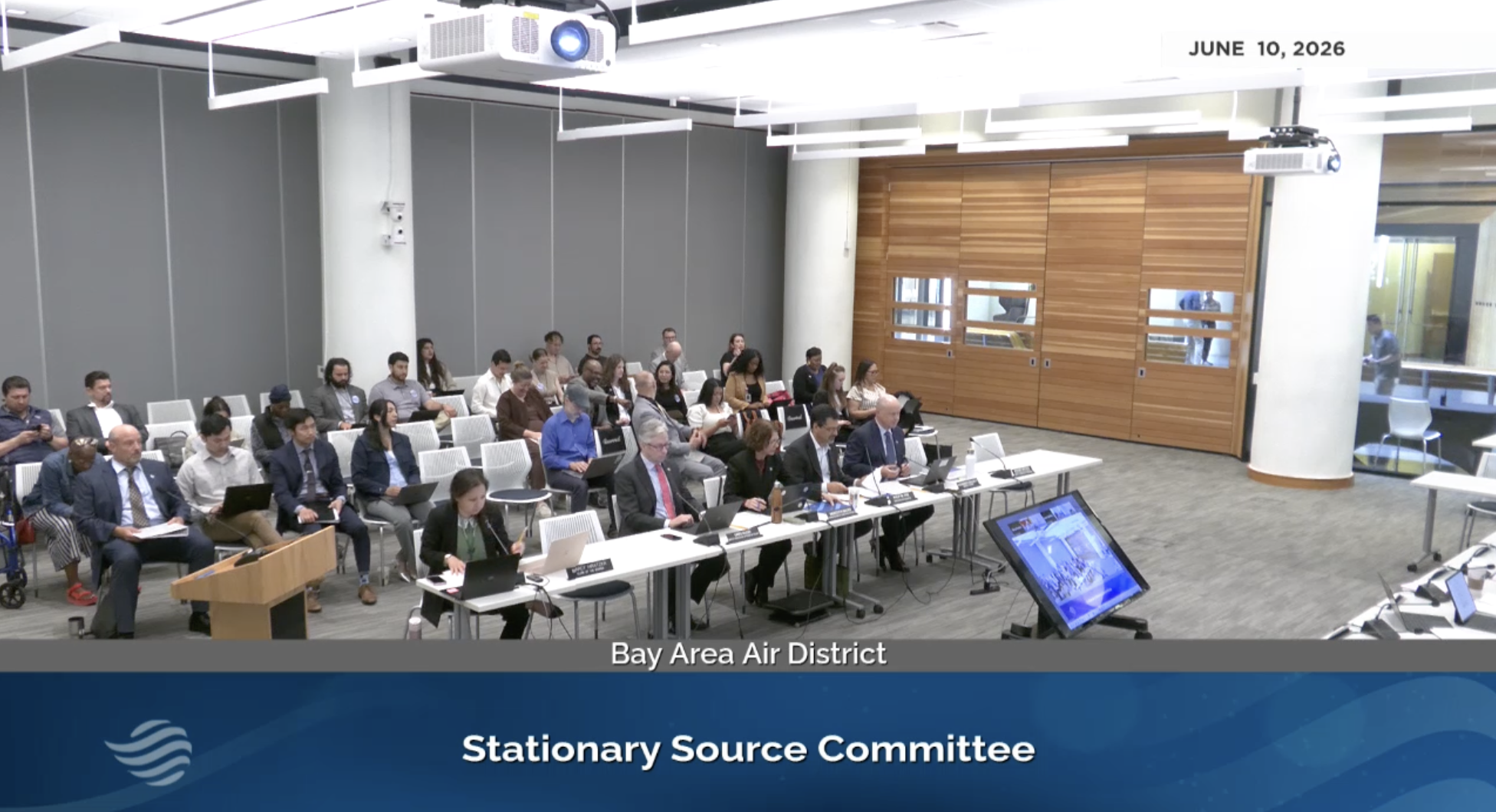
Stationary Source Committee • Bay Area Air Quality Management DistrictJune 10, 2026
Locunity is a independent informational service and is not an official government page for this commission.We use AI-assisted analysis and human editorial review to publish information.
Warehouse Pollution Rule Heads to Full Board After Marathon Debate
The Bay Area Air Quality Management District's Stationary Source Committee spent more than two hours Tuesday hearing from environmental justice advocates, industry groups, physicians and community residents before punting its most contentious rulemaking — a proposed indirect source rule targeting warehouse diesel pollution — to the full board for a fall prioritization vote.
Proposed warehouse pollution rule sent to full board after 20+ public commenters split sharply between environmental justice supporters and industry opponents
Environmental justice groups push for 50,000 sq. ft. threshold and zero-emission technology mandates for Bay Area's ~16,000 warehouses
Industry coalition warns of economic leakage, citing EPA's refusal to grant SIP credit to South Coast's similar rule and San Diego's decision not to pursue its own
Committee members clash over resources and priorities, with some questioning whether the board has ever formally voted to pursue the rule
Vice Chair Gioia counters with FedEx data showing zero-emission trucks are cheaper over their life cycle, warns abandoning rule breaks promises to AB617 communities
14+ active rulemakings crowd the district's agenda, with Rule 9-6 water heater amendments pushed to November 2026
The Fight Over Bay Area Warehouses
The basics: Staff presented the district's fifth update on a proposed indirect source rule that would require Bay Area warehouses to reduce diesel particulate matter from truck traffic. The concept paper, released April 16, proposes a phased approach starting with reporting requirements, a 100,000-sq-ft applicability threshold — with a potential 50,000-sq-ft threshold in overburdened communities — and a flexible compliance menu modeled partly on South Coast AQMD's Warehouse Actions and Investments to Reduce Emissions (WARE) program.
Why it matters: With the federal Advanced Clean Fleets rule weakened and state truck-emission protections under political pressure, this local rule is the district's primary remaining tool to cut diesel pollution exposure in communities already breathing some of the worst air in the Bay Area — neighborhoods near ports, freeways and warehouse corridors in West Oakland, East Oakland, Richmond and Bayview. But industry warns the rule could push businesses and jobs out of the region without producing meaningful additional emission reductions.
A Room Divided
Twenty-four comment letters representing 71 organizations and individuals landed before the June 1 deadline, and more than 20 speakers testified Tuesday — producing a near-perfect split between environmental justice advocates demanding urgency and industry groups urging a pause.
Public commenter Kaitlin Alcontin, legal fellow at Communities for a Better Environment, told the committee that warehouses between 50,000 and 100,000 square feet account for 35% of warehouse floor space in overburdened communities, arguing a higher threshold would leave the most affected neighborhoods behind.
Public commenter Bret Andrews, a neurologist and board member of San Francisco Bay Physicians for Social Responsibility, detailed the health toll of diesel emissions — asthma, stroke, dementia and cancer — and supported the 50,000-sq-ft threshold with per-facility targets and zero-emission technology requirements.
Public commenter Marina Munoz, an East Oakland community committee member who spoke through a Spanish interpreter, described her family's health struggles living near the 880 and 580 freeways and called for more community outreach about pollution sources.
On the other side, public commenter Skyler Wonnacott, representing NAIOP Bay Area and the California Business Properties Association on behalf of 24-plus organizations, called on the district to first evaluate whether South Coast's WARE program has actually produced emission reductions beyond what existing regulations already require.
Public commenter Jennifer Cohen of the Pacific Merchant Shipping Association argued that ISRs fundamentally do not reduce emissions, citing EPA's refusal to grant SIP credit to South Coast's rule.
Public commenter Chris Shimoda of the Supply Chain Federation cited a Ramble study finding ISR compliance costs three to nine times higher than South Coast projected, and noted San Diego APCD found ISRs cost up to 75 times more per ton reduced than other district rules.
Public commenter Diego González of the Port of Oakland opposed the rule, citing nearly $1 billion in existing zero-emission investments — trucks, charging infrastructure and roughly 100% ship shore power — and warned the ISR would add costs and regulatory uncertainty that could push jobs and emissions to other regions.
Public commenter Tim Sbranti, executive director of the Contra Costa Building Construction Trades Council, urged the committee to wait for the socioeconomic analysis policy expected in September before advancing the ISR.
Committee Members Draw Battle Lines
The debate among committee members was nearly as heated.
Director Ray Mueller pressed for a formal board vote on whether to continue pursuing the rule at all, arguing the board has never weighed in despite five committee presentations. "I really think that the board needs to weigh in on whether or not we actually want this to be pursued, especially at a time when we're already looking at expanding the reach of the air board into other areas it historically hasn't been in," he said.
Director Dionne Adams echoed concerns about staff capacity, noting "one, not wanting to overtax staff when we have these other priorities, and so just balancing what's the level of impact for some of the things that we're focused on to really determine our efforts."
Director Gabe Quinto went further, arguing California is hemorrhaging businesses. "California is losing. We are now playing — I have to pay over $600 to fly to Long Beach. So we're paying the highest prices on airplane tickets, the highest prices on energy, even with our CCAs," he said, citing conversations with mayors at the U.S. Conference of Mayors about companies leaving Los Angeles County.
Vice Chair John Gioia delivered a lengthy rebuttal, drawing on his experience negotiating zero-emission warehouse requirements with FedEx and Amazon in West Contra Costa County. "We could bring in the vice president of FedEx to tell all of us that the 15-year life cycle cost of a zero-emission truck is less than the 15-year life cycle cost of a diesel truck," he said. He warned that walking away from the ISR would betray communities that spent years developing emission reduction plans under the state's AB617 program: "If we don't face this issue in the AB617 communities then we've broken a promise. And all the investment that the state and this air district has made to try to develop these community-driven reduction plans will have been wasted."
Director Tyrone Jue sided with continuing the process, arguing the board already allocated resources and made strategic plan commitments. "We don't want to end up in a situation where you've done all this work and then nothing happens. And that would be a travesty in terms of our, not just our commitment to community, but also just the waste of resources and time being devoted to this," he said, supporting a full-board prioritization discussion.
Staff Pushes Back on Economic Fears
Executive Officer Greg Fine cautioned against accepting industry claims at face value. On the SIP credit issue, he explained: "It does not mean emission reductions aren't occurring. It just means that the determination by EPA for that particular rule was that it didn't meet that very, very high bar."
He also pushed back on premature economic projections: "I would guard against presupposing some major economic impact until we actually know what it's proposing. There's just no way for us to do a socioeconomic impact analysis at this point because we have no idea of applicability, stringency, what we're asking for."
Decisions: The committee reached a consensus to continue conceptual work and stakeholder outreach but bring the ISR to the full board around September–October 2026 for a prioritization check-in — and potentially a formal vote on whether to proceed. No formal vote was taken at the committee level.
What's next: The full board will take up the warehouse ISR for a prioritization discussion by fall 2026. The outcome will determine whether the Bay Area's primary local tool for addressing warehouse-related diesel pollution moves toward rulemaking or is shelved. With the district's socioeconomic analysis policy also expected around September, the two processes could collide — giving industry groups the comprehensive cost-benefit review they're demanding, or giving environmental justice advocates the data they need to press their case.
District Juggles 14-Plus Active Rulemakings
Why it matters: The district's regulatory development team is stretched across more than a dozen simultaneous efforts — from refinery flaring to water heaters to backup generators — and how the board prioritizes those efforts will determine which air-quality improvements Bay Area residents see first.
Where things stand: David Joe, manager of the Regulatory Development Division, delivered an abbreviated mid-year review covering the full slate. Key updates: Rule 1118 Phase 1 (toxic risk at existing facilities) was adopted by the board the prior week, with Phase 2 to begin later in 2026; the Rule 9-6 water heater affordability amendments target date shifted from October to November 2026 to incorporate affordable housing provider feedback and complete CEQA analysis; refinery flaring rules (1211/1212) are under development with a Refinery Technical Working Group meeting in July; Rule 6-4 (metal recycling/shredding) draft language is expected in Q3 2026; and the district is exploring backup generator regulatory changes, including data center implications.
The "next in queue" list includes toxic new source review changes for cumulative impacts, refinery-specific toxic rules, health-based PM rulemakings, composting operations and auto body operations.
Director Adams asked staff to add a column showing how long each rulemaking has been on the docket. "Is it possible in that column there in the middle where it's blank, to really talk about how long this has been on the agenda for the board? It helps give me some context," she said. Director Rico Medina seconded the request. Staff agreed to return with an enhanced prioritization list at the next check-in.
Several public commenters weighed in: Jacob Klein of Industrious Labs urged prioritization of a new Rule 9-7 for industrial boilers, noting 1,800 units at 600-plus facilities contribute roughly 1,000 tons of NOx and 100 tons of PM annually. Michael Corbett of Bradford White Corporation urged an early vote on Rule 9-6 implementation date delays to give industry planning certainty. Robert Whitehair supported continued implementation of Rules 9-4 and 9-6 for gas appliance replacement.
What's next: Staff will return to the committee with a revised regulatory agenda that includes historical context and timeline data for each rulemaking. The enhanced list will go to the committee before being presented to the full board, giving members a clearer picture of the backlog and the trade-offs ahead.
Minor Items
April 8 meeting minutes approved by roll call vote (For: 6, Against: 0, Absent: 5 — Directors Haubert, Hopkins, Quinto, Young and Jue absent or not responding).
Next meeting set for July 8, 2026, at 10 a.m. at the Metro Center.