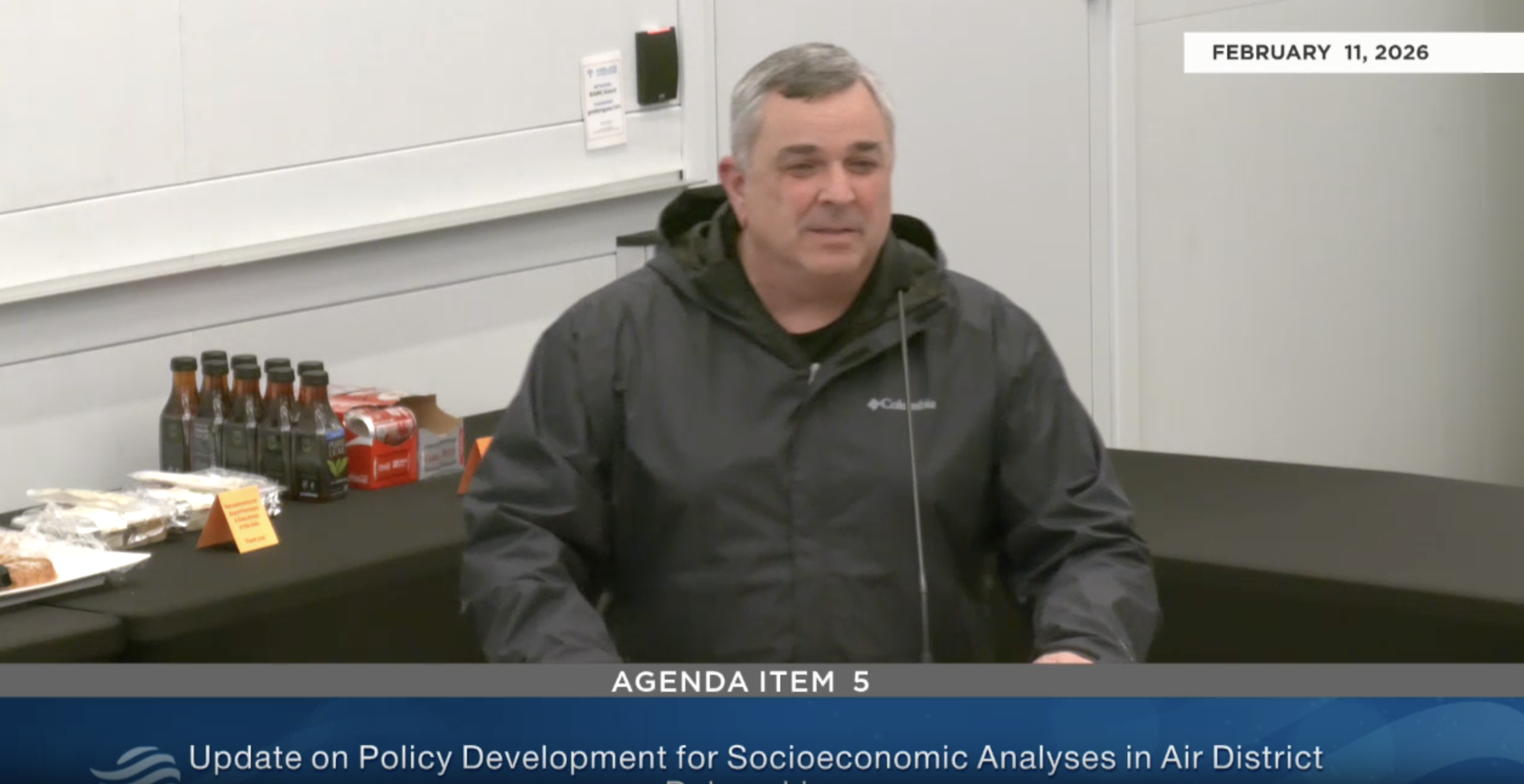
Stationary Source Committee - Feb 11, 2026 - Meeting
Stationary Source Committee • Bay Area Air Quality Management DistrictFebruary 11, 2026
Locunity is a independent informational service and is not an official government page for this commission.We use AI-assisted analysis and human editorial review to publish information.
Bay Area Air District Wrestles With Who Pays for Clean Water Heaters
The Bay Area's push to eliminate gas water heaters ran headlong into a fundamental equity question at the BAAQMD Stationary Source Committee on Feb. 11: Should low-income households be exempted from a rule designed to protect their health — or does exempting them simply guarantee they're the last to benefit? More than 30 speakers weighed in on what could become the region's most consequential building electrification mandate, and committee members left without a vote but with a clear message to staff: get the costs right, close the incentive gap and come back in May.
Committee debates two low-income exemption models for the zero-NOx water heater rule taking effect January 2027, with no formal vote taken
$38M in annual incentives falls far short of the $49M–$83M needed to cover low-income conversions, raising questions about implementation readiness
Members push back on exemptions as equity tool, arguing they could deny health benefits to the communities most burdened by pollution
New socioeconomic analysis policy for Air District rulemaking advances, with public draft expected in March
Earthjustice attorneys urge priority action on a warehouse indirect source rule in 2026
Zero-NOx Water Heaters: The Exemption Dilemma
The basics: Rule 9-6 requires all replacement water heaters sold in the Bay Area's nine counties to meet zero-NOx standards — effectively mandating heat pump water heaters — beginning January 2027. The rule was adopted with a built-in four-year on-ramp and provisions for low-income exemptions that still need to be defined. The committee reviewed two staff proposals for drawing that income line.
Why it matters: Gas appliances in Bay Area buildings produce more nitrogen oxide (NOx) pollution than all the region's refineries or passenger vehicles combined, according to staff. Replacing gas water heaters could prevent 85 premature deaths and save $890 million in health care costs annually. But the conversion isn't free — and who absorbs the cost will determine whether the rule narrows or widens the region's deep inequities.
Where things stand: Amy Dao, BAAQMD Planning and Climate Protection Division staff, laid out the pollution stakes: "Natural gas combustion in buildings accounts for more NOx emissions in the Bay Area than all fuel refineries or passenger vehicles. Of those emissions, about 90% are from space and water heating."
Staff presented two exemption options. Option A would combine eligibility for existing low-income programs (households at or below 250% of the federal poverty level) with a housing cost-burden test requiring that 28% or more of income goes to mortgage and taxes — exempting roughly 18% of Bay Area households. Option B would use a simpler threshold: 80% of area median income, covering about 20% of households. Staff recommended Option A as more targeted.
But the committee's sharpest concern wasn't which option to pick — it was whether exemptions themselves are the right tool.
"Somebody Can Buy a Tesla and I Can't"
Multiple committee members voiced deep discomfort with the idea that exempting low-income residents effectively leaves them breathing dirtier air.
Committee Member David Haubert, representing Alameda County, was blunt: "Just don't need to be as healthy as everyone else. We'll exempt you, it feels like we're sending that message. And so I'm extremely, I'm extremely concerned about that."
Committee Member Dionne Adams of Pittsburg put it in personal terms: "And so how can we figure out a way so that less people are stranded? It doesn't make me feel good that somebody can buy a Tesla and I can't."
Committee Member Gabe Quinto of El Cerrito, who sits on the MCE Clean Energy board, connected the debate directly to the Air District's mission: "Looking at what this airborne, what our mission statement is, and it's to have cleaner air in all communities, including low income communities. So we're defeating the purpose of with this exception."
The Cost Data Problem
Committee Member Ray Mueller of San Mateo County challenged the reliability of the staff's $3,496 average incremental-cost figure for heat pump water heater conversion, arguing it may be biased downward because it's drawn from completed projects — not from households that abandoned conversions because the price was too high.
"When I see this $3,496 incremental cost, that makes me worried, especially when we're talking about the impact to low income households if it is artificially low," Mueller said. "And so that's my number one question is as we're looking through this year, I don't see the data on what actual cost is nor how that calculation was reached."
Mueller also spoke for what he called "the middle class who many of which in our community are house poor," noting that if 30% of Bay Area households face conversion-cost problems, "that's 840,000 households in the Bay Area that are going to have a problem with cost of conversion."
He proposed a hybrid approach: tying exemptions not just to income but to the actual cost of a given project, so that anyone whose conversion exceeds affordability at their income level would qualify. Executive Officer Dr. Philip Fine confirmed staff is already developing a parallel project-based exemption for high-cost installations involving panel upgrades or space constraints.
The Funding Gap
Chair Ken Carlson of Contra Costa County did the math on the incentive shortfall and found it stark:
"If 18% of the Bay Area households are low income … that's 21,600 households per year that would need water heater replacements. Based on your analysis at 120,000 Bay Area wide, 21,000 times 3,500, which we acknowledge is a low number, is $75 million. We don't have anywhere close to $75 million in available support for rebates."
Dow had presented the gap more conservatively: roughly $38 million available annually from state and ratepayer programs versus $49.6 million to $82.7 million needed to cover full incremental costs for low-income households. She noted that most of this funding is not significantly exposed to federal funding cuts.
Still, Carlson argued the schedule shouldn't drive the policy: "It's more important that we get this thing right than we get it fast. And so I'm in agreement with Director Haubert that we have to move it when it's ready to move and not do it for the sake of trying to meet some arbitrary schedule."
Signs of Progress on the Ground
Not every committee member saw the timeline as a problem. Committee Member Tyrone Jue of San Francisco reported that the city's climate equity hub has already completed 55 heat pump water heater installations without turning anyone away — including in older homes with electrical panels at or below 100 amps.
"We've done 55 installations through this process now and we haven't had to turn anyone away," Jue said. "These are installations that have just been done over the last year or two … I just want to offer that as an example that the market has changed and we've had many of those installations occur where panel sizes were 100 amps or less."
Jue expressed a preference for Option B's simplicity but said he could support Option A if it proves equally easy to implement: "I'm leaning towards Option B just for the simplicity … could be convinced for Option A if that is just as implementable as Option B."
Carlson offered his own market check: "I was just shopping for a water heater for my own home. It's basically $1,000 for a 50 gallon water heater. Plug and play for me, even though my home was built in 1955 … A gas water heater is $1,100. For me to go electric with the same brand, same size, same warranty is actually $200 cheaper in the physical unit."
Dr. Fine explained that 70–80% of installations would be straightforward 110-volt swaps requiring no panel upgrade: "If you have a hot water heater today, that's a gas hot water heater and it goes out and there is a replacement unit at 110v, the replacement time should be exactly the same because even if you bought a new gas unit … that new gas unit is going to require 110 volts."
A Flood of Public Comment
Over 30 members of the public spoke on the item. A strong majority — from environmental, health, and community organizations — urged the committee to stay on schedule while making exemptions targeted and easy to access. Real estate interests and one water heater manufacturer requested delays.
Fernando Gaytan of Earthjustice warned against treating exemptions as a reason to slow down, citing the $890 million in avoided health care costs. Colleen Corrigan of SPUR presented data showing that when state and local rebates are stacked, low-income households can get heat pump water heaters for $2,500 less than gas.
Srinidhi Sampath Kumar of the Sierra Club said affordable housing providers serving residents below 80% AMI "were not talking about exemptions but about what they need before the January 2027 compliance date," and invited board members to site visits in San Leandro, East Palo Alto and Richmond.
Julie Lindo, associate director of SF Bay Physicians for Social Responsibility, representing hundreds of health care providers, urged staying on the implementation timeline, arguing rules drive the change that brings funding, innovation and cost reduction.
Patrick Messick, a public commenter, challenged the equity framing of broad exemptions, noting most low-income households are renters who don't choose their own water heaters. Broad landlord exemptions, he argued, risk delaying health benefits in the very housing where low-income tenants live.
On the other side, David Stark of the Bay East Association of Realtors pointed to the incentive gap and called for voluntary programs. Mike Corbett of Bradford White Corporation, a water heater manufacturer, said manufacturers need about one year from the final rule to prepare the right product mix. Lisa Badenfort of North Bay Realtors argued Sonoma and Napa counties face higher challenges due to older housing stock, citing her own home needing $30,000 in work, and requested a 120% AMI exemption threshold.
Igor Tregub, a Berkeley City Council member, reported that the full council unanimously adopted a resolution supporting Rules 9-4 and 9-6.
Decisions: No formal vote was taken. Staff was directed to refine proposals incorporating committee feedback — updated cost data, incentive integration, low-friction exemption processes, and the potential for parallel income-based and project-based exemption pathways — and present detailed regulatory concepts to the full board in May 2026.
What's next: The full BAAQMD board will receive refined Rule 9-6 proposals in May. Whether the January 2027 implementation date holds depends on how quickly staff can resolve the cost data questions and build the administrative systems several members demanded. The committee was visibly split on whether to delay if those pieces aren't ready.
New Socioeconomic Analysis Policy Takes Shape
Why it matters: The Air District is developing, for the first time, a formal policy governing how it measures the economic effects of its regulations — including impacts broken down by race, gender and household income. The effort responds to a proposal from the Contra Costa Building and Construction Trades Council and could reshape how future rules, including Rule 9-6 amendments, are evaluated.
Where things stand: Staff reported areas of alignment with the trades council proposal: contractor qualification checks, expanding analysis by race and gender where data permits, assessing indirect economic impacts, and conducting specific analysis for refinery regulations given the fossil fuel transition. Open questions remain around what triggers the "major regulation" threshold, potential duplication with existing state requirements, availability of facility compliance cost data and how to calculate cost flow-through to demographic groups.
Tim Sbranti of the Contra Costa Building Trades thanked staff for productive engagement, highlighting racial breakdown and household income analysis as cornerstones of the policy and emphasizing the importance of capturing cumulative impacts — what he called "death by a thousand cuts."
A public commenter from the Environmental Justice League urged the District to do outreach to communities of color, delivering a pointed message: "I don't want to be in this room 30 years from now, listening to a land acknowledgement for the black people who used to live in the East Bay."
What's next: A draft policy is expected for public review around March 2026, with a 45-day comment period. The committee expects an update in July, followed by board adoption.
Earthjustice Pushes for Warehouse Pollution Rule
During general public comment, two Earthjustice attorneys — Katrina Tomas and Colleen Fitzgerald — urged the Air District to prioritize development of a warehouse indirect source rule in 2026. They called for a rule modeled on the South Coast AQMD's WAIRE program but tailored to Bay Area conditions, centering equity and cumulative impacts on communities already overburdened by refineries, ports and freeway pollution. Both also voiced support for timely implementation of Rules 9-4 and 9-6.
Minor Items
Consent calendar: Minutes from the Dec. 10, 2025 Stationary Source Committee meeting approved 8-0 by roll call vote (moved by Committee Member David Haubert, seconded by Committee Member Otto Lee; Lynda Hopkins, Ray Mueller and Vice Chair John Gioia absent).
Next meeting: March 11 at 10 a.m.
What to Watch
The central tension from this meeting — exemptions as protection vs. exemptions as exclusion — will only sharpen as staff refines its proposals. The committee's demand for better cost data, a workable incentive strategy and a friction-free exemption process sets a high bar for the May board presentation. Meanwhile, keep an eye on whether the January 2027 start date survives intact: two influential members openly suggested it may need to slip, while environmental and health advocates are mobilizing hard to keep it on track. The socioeconomic analysis policy, though less dramatic, could quietly reshape how every future Air District rule is debated — particularly for the refineries at the center of the Bay Area's fossil fuel transition.