
Cost Fight Previews November Vote on Bay Area Gas Appliance Rules
Stationary Source Committee • Bay Area Air DistrictSeptember 9, 2026
Locunity is an independent informational service and is not an official government page for this commission. All information is sourced from public footage and an analysis of official agendas with the aid of responsible, fact-checked AI. to report an error or omission.
The Bay Area Air District's Stationary Source Committee took no binding action on Sept. 9, 2026, but it laid out the battle lines for the Board's November vote on zero-NOx water heater and furnace rules. Staff estimated the water heater transition alone at about $420M a year. Director Ray Mueller formally asked for an independent, random-sample cost study, while roughly 37 public commenters urged the District not to slow down.
$420M a year: Staff priced the regional water heater switch; skeptical directors challenged the cost methodology.
Mueller seeks a random-sample cost study of Bay Area housing stock; the chair agreed to help craft the item.
About 37 public commenters, mostly health, youth and climate advocates, urged a swift rollout of Rules 9-4 and 9-6.
About $41M a year in regional electrification incentives; SB 222 permit reform awaits Gov. Newsom.
Seven environmental advocates pressed the District not to delay a warehouse pollution rule.
R&D permitting: Staff explored clearer pathways for pilot technologies without blanket exemptions.
1 Big Thing: The $420M Question
The basics: Rules 9-4 and 9-6 set zero-NOx standards for gas furnaces and water heaters. NOx is a family of smog-forming pollutants. Amendments go to the full Board in November. Executive Officer Fine said this informational item covered support programs, not the merits of those amendments.
Why it matters: How the District counts compliance costs could shape the November decision for every homeowner facing a water heater or furnace replacement.
Where things stand: Air District staff member Greg said the average incremental cost is $3,500 per water heater across roughly 120,000 annual replacements. "That's 420 million a year," he told Mueller. That figure excludes furnaces; their analysis is due in December. Greg described the expense, spread over a roughly 15-year turnover, as a one-time capital investment with lasting health benefits.
Director Ray Mueller, a San Mateo County supervisor, was blunt: "I think the methodology is flawed." He argued that data from completed projects may miss problem housing. "I'm asking if this board would please agendize directing staff to do a cost study using a random sample of housing stock across the nine Bay Area counties," said Mueller. Committee Chair Ken Carlson agreed to work with him on crafting the item.
The other side: Several directors raised affordability and reliability concerns.
Director Steve Young, Benicia's mayor, said rebate coverage is uneven and that rebates take weeks while emergency replacements require immediate out-of-pocket spending. He backs early voluntary conversion. "Where I have a problem, of course, is when it gets to the mandate side," said Young.
Director David Haubert, an Alameda County supervisor, pointed to grid upgrades and outages. "My district has shutoffs all the time, almost weekly," said Haubert, who predicted "a 20, 30, maybe a 40 year transition."
Staff conceded the limits of subsidies. "I don't think anyone believes we'll ever get to the point where we're going to pay for everybody," said Fine. He added that the $3,500 figure includes $1,000 to $1,500 in equipment difference and that total societal cost is analyzed as the Health and Safety Code requires. Greg said a 2023 analysis found only a fairly minor increase in total grid cost. Nik Kaestner, senior building decarbonization coordinator for the San Francisco Environment Department, said the city's Climate Equity Hub has completed more than 100 no-cost installs and found a roughly $3,500 gap with few outliers.
Decisions and stakeholder impacts: No vote was taken. Director Tyrone Jue pushed back on the framing of the cost concerns: "I do want to just distinguish having implementation challenges and not being able to implement, those are two different things." Vice Chair John Gioia noted the Board previously delayed implementation to address affordability. Mueller countered that a $1M home can be modest in parts of the Bay Area. The outcome of a cost study, if one is ordered, would land squarely on homeowners, renters and affordable housing operators.
What's next: Mueller's study request goes to the chair for agendizing. The furnace cost analysis is due in December, and the Board vote is set for November.
The Money and Permits Behind the Switch
Why it matters: These programs determine how affordable compliance becomes.
Where things stand: Richard Chien, manager of the District's Planning and Climate Protection Division, said the state is projected to reach about 4 million heat pumps by 2030, "falling short of their goal by 2 million units." He outlined the main funding streams:
BayREN's $157M budget for 2024 through 2027, approved by the California Public Utilities Commission
PG&E's forecast of $50M in electrification incentives through 2031
The state's Equitable Building Decarbonization program: $432M total, with $339M for direct installs
The state's GoGreen 0% loans for households earning under $150,000
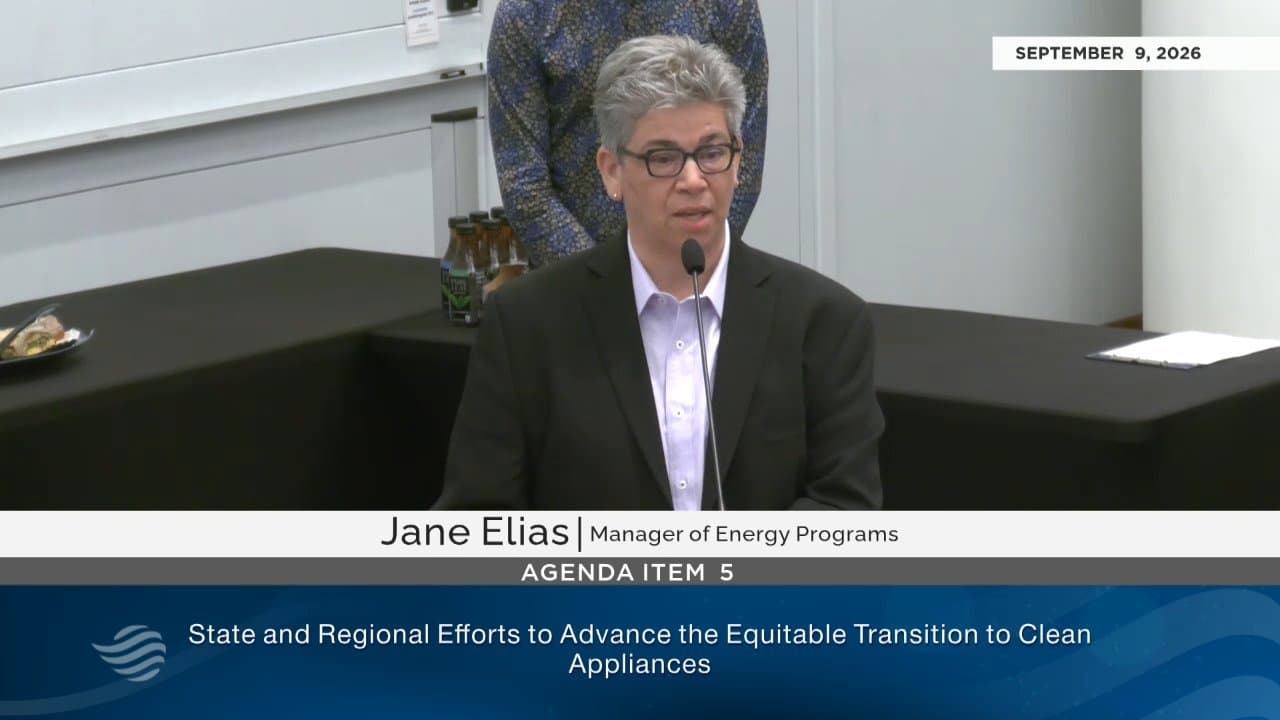
Jane Elias, BayREN's director, said the network has trained more than 250 contractors and is requesting $179M for 2028 through 2031. Kaestner said the 60-plus-partner Sprint to 96 effort works against a regional investment of about $41M a year for electrification, or $85M including efficiency programs.
Permits: SB 222, the Heat Pump Access Act by Sen. Scott Wiener, awaits Gov. Gavin Newsom's signature. The Air District, SPUR and the Building Decarbonization Coalition co-sponsored the bill, which would require a single permit and asynchronous inspections for simple heat pump projects. Fine said some provisions could take effect as early as January 2027 and others in July 2028. Gioia urged faster local action: "It seems that we should think about developing a model best practice for city and county planning departments." Fine cautioned against duplicating published guidance.
Director Gabe Quinto, El Cerrito's mayor pro tem, cited a reported $25B state deficit and asked how SB 222 would be funded. Chien said costs are mostly staff process work: "it shouldn't be too high of a cost."
Myths and emergencies: Jue asked what a homeowner should do when a water heater fails at 1 a.m. Kaestner said new 120-volt models "can serve that emergency function because you just plug them into the wall." Director Otto Lee, a Santa Clara County supervisor, asked for "something like a one pager to dispel the 10 most common myths of what the rule is." Gioia pressed staff to make Switch Is On the region's single rebate gateway. He also highlighted PG&E's Electrify My Block pilot in West Contra Costa, which offers up to $35,000 per house to retire gas lines.
What's next: Quinto requested a future PG&E presentation on block electrification and grid supply.
Public Speaks: 'Stop Swirling'
Why it matters: Commenters framed health costs from gas appliances as an affordability issue, directly countering the directors' cost concerns.
Where things stand: Roughly 37 speakers, overwhelmingly supportive, urged timely implementation:
Health voices: physicians, epidemiologists and residents living with asthma, cancer and sarcoidosis
Youth: students from Palo Alto and Los Gatos high schools
Climate and community groups: Sierra Club chapters, 350 Bay Area and the West Oakland Environmental Indicators Project, among others
Melissa Yu of the Sierra Club said more than 6,000 physical and 2,500 online signatures will be presented at the final Board vote. "We need to stop swirling around concerns that have been addressed," said David Mahler, Marin Electrification Council.
Several commenters answered directors' points directly:
Lucinda Young, an Albany resident, rebutted Director Young on rebate timing: "it took two weeks to get my rebate check from the city."
Brian Schmidt of Menlo Spark said longer heater lifespans lower annual costs but make it "all the more important that we do not delay past 2028."
Sam Fishman of SPUR previewed research showing at least $250M over three years for regional heat pump and efficiency programs, with minimal impact from federal rollbacks on upfront rebates.
The other side: Heather Bromfield, associate director at Enterprise Community Partners, thanked staff for an extended timeline for deed-restricted affordable housing but added, "we're also requesting additional flexibility measures for affordable housing, including waivers for affordable housing groups."
Decisions and stakeholder impacts: The waiver request signals possible pressure for amendments before November. Affordable housing operators, renters and low-income homeowners have the most at stake in how flexibility is written.
Warehouse Rule: Advocates Preempt Industry
Why it matters: Industry has urged delay of a warehouse indirect source rule (ISR). An ISR regulates facilities that attract diesel truck traffic rather than the trucks themselves. Advocates say the rule is already cutting NOx in Southern California.
Where things stand: During non-agenda public comment, seven speakers from Earthjustice, Communities for a Better Environment, the Center for Biological Diversity and the Sierra Club rebutted an Aug. 14 industry letter. That letter urged the District to evaluate costs first, follow San Diego's white-paper approach and rely on an industry-funded Ramboll review.
Fernando Gaetan of Earthjustice said South Coast's rule "is producing a ton and a half of NOx reductions per day already," with more than 800 electric trucks deployed.
Colleen Fitzgerald said South Coast regulators "approved over $73 million in incentives for zero emission trucks and charging infrastructure" funded by the rule's first year.
Pooja Agrawal said the Ramboll study inflates compliance costs.
Sarah Chen Small, an attorney with Communities for a Better Environment, cited "diseases and short life shortened life expectancy that communities like East Oakland have borne for decades."
Erica Xiao, also of CBE, pointed to Richmond's elevated cancer risk.
The other side: No industry speakers appeared. The item was not agendized, and no action was taken.
What's next: Advocates asked for public workshops and continued rulemaking.
R&D Permits: Faster, Not Looser
Where things stand: Kelly Crawford, deputy executive officer of engineering and compliance, outlined current options: a bench-scale lab exemption and a three-month, nonrenewable temporary permit. She compared them with South Coast's two-year research permit and New Jersey's five-year general permit. "Any special treatment that we give to these projects must remain specific, time limited and enforceable," said Crawford. Staff may revisit whether three months is realistic and add guidance and training.
Fine credited Haubert with prompting the item. He said South Coast's research permit is rarely used and rejected automatic exemptions: "what we hear a lot is, hey, it's R and D, I should be exempt." Carlson floated a sliding-scale timeline based on applicant needs and said he doesn't want to stand in the way of innovation while protecting communities. Gioia, citing North Richmond's Raven green-hydrogen project, added, "R and D can pollute as well."
What's next: No action was taken; staff will keep developing options.
Minutes: July 8, 2026, minutes approved without dissent (Gioia/Jue). Directors Dionne Adams and Lynda Hopkins did not respond to the roll call.
Bay Repair: Staff will recommend about $33M for nine clean-technology projects in Benicia and Richmond.
Grid supply: Quinto linked electrification demand to extending the state's last nuclear plant 20 years.
Looking ahead: The committee's next meeting is listed on the agenda for Wednesday, Oct. 14, 2026, at 10 a.m. at the Metro Center. The Board takes up the Rules 9-4 and 9-6 amendments in November.