
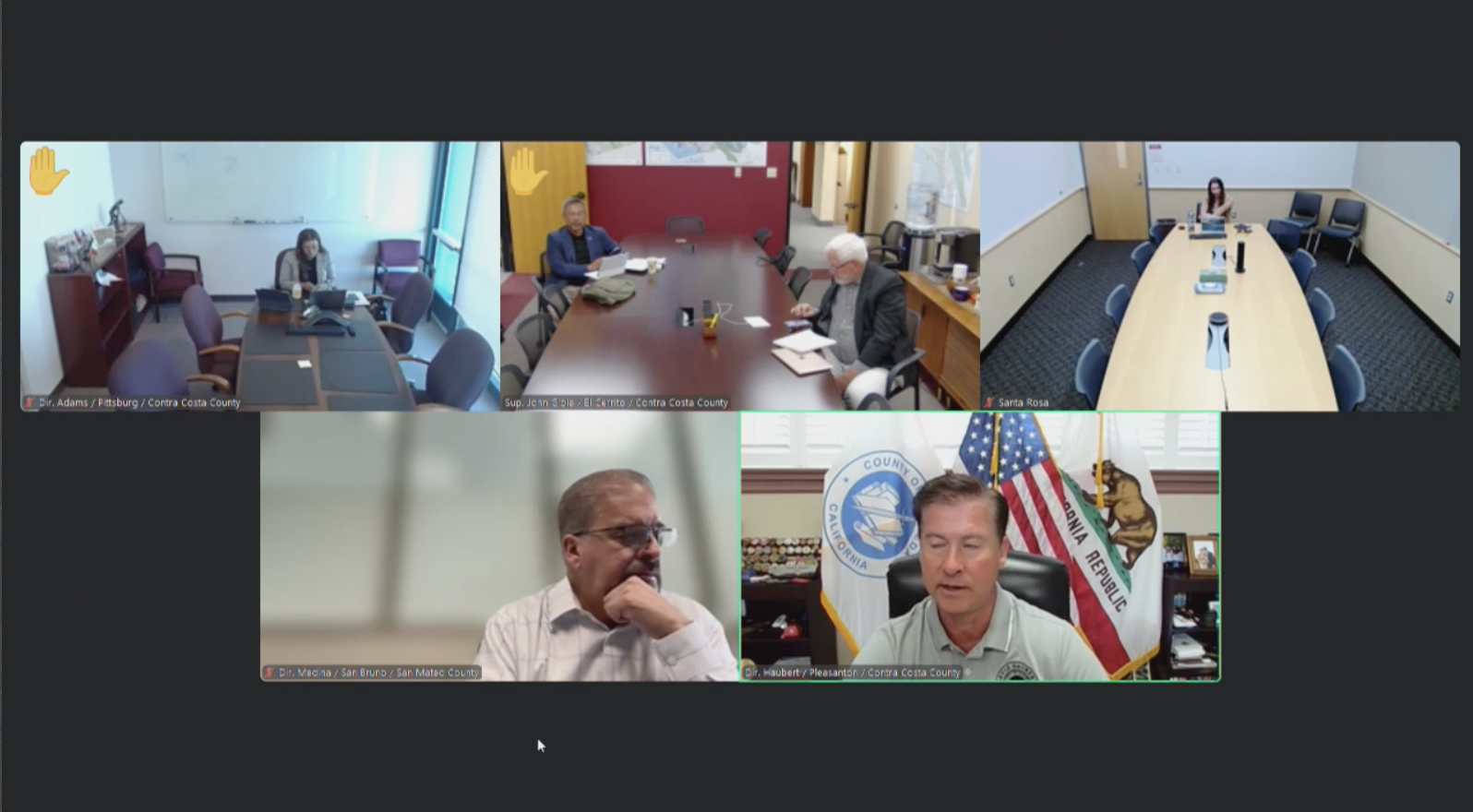
Stationary Source Committee - Jul 08, 2026 - Meeting
Stationary Source Committee • Bay Area Air DistrictJuly 8, 2026
Locunity is a independent informational service and is not an official government page for this commission.We use AI-assisted analysis and human editorial review to publish information.
Air District Advances Cost-Equity Analysis Policy for Major Regulations
The Bay Area Air District's Stationary Source Committee unanimously voted to send a first-of-its-kind socioeconomic impact analysis policy to the full board, codifying when the district must weigh job losses, consumer costs, and racial equity alongside health benefits before adopting major air quality rules. The same meeting drew passionate testimony from refinery-adjacent communities demanding stronger fence line monitoring and a coordinated push from environmental justice groups for a long-promised warehouse pollution rule.
Committee unanimously advances socioeconomic impact analysis policy requiring racial equity review on the cost side of new air quality rules for the first time
Staff unveils plans to replace Rule 1215 with stronger refinery fence line monitoring — including triennial audits, public notification, and expanded pollutant coverage
Environmental justice coalition rallies for warehouse indirect source rule, citing South Coast AQMD's model and years of unfulfilled Air District commitments
Industry and environmental groups split on whether enhanced analysis triggers will improve rulemaking or delay health-protective regulations
New Policy Puts Equity at the Center of Air District Cost Analysis
The basics: California law has long required air districts to assess the socioeconomic impacts of major regulations, and the Bay Area Air District has conducted such analyses for decades. What's new is a formal policy that standardizes the process, defines when a deeper "enhanced" analysis is required, and — for the first time — extends racial and geographic equity analysis from the benefits side to the cost side.
Why it matters: Every future Air District regulation on refineries, gas appliances, industrial facilities, and other pollution sources will be evaluated under this framework. The policy determines how the district weighs job losses and consumer cost increases against health and environmental gains — directly shaping the rules that affect 9 million Bay Area residents and the region's largest industrial employers.
Where things stand: Staff economist Leonid Bak presented the six required elements for every socioeconomic analysis: a framing statement, baseline conditions, identification of affected businesses, compliance costs, cost-effectiveness metrics, and economic impact analysis. Five triggers would kick in an "enhanced" review: projected costs above $10 million annually, facilities already subject to significant past regulation, significant small business or public impacts, broad industry-wide effects, or significant energy or housing cost impacts. The enhanced tier adds household affordability assessment broken down by income, race, ethnicity, and gender, plus a cumulative regulatory cost review.
"One of the big requests from the stakeholders who have been asking for this policy is to extend what we already do on the benefit side in terms of some racial and geographical breakdown of benefits to the cost side. So that's probably the newest piece," said Phil Fine, staff executive.
Vice Chair John Gioia pressed staff on how localized health benefits — such as Rule 6-5's reduction of refinery particulate matter near the Chevron facility — would be balanced against broader cost analysis. "How would that play out with a rule like that, where we're quantifying economic impacts, but how you're quantifying the health benefits by race — African American, Latino residents who live near the Chevron refinery, who now have 60 to 70% less particulate matter emitted from that facility?" he asked.
Director David Haubert argued the analysis must capture cascading effects when businesses close. "When businesses leave, not only do jobs leave, but our tax base erodes. We have more people on unemployment," he said, adding that as a county supervisor, the downstream social service costs are especially relevant. Haubert also pushed back on staff caution about predicting business closures, noting that in recent cases companies explicitly warned they would close — and then did.
Director Lynda Hopkins praised the codification effort and flagged the disproportionate impact on small businesses. "The common wisdom is that increasing regulatory burdens often hit small businesses harder because they have less resources to address that," she said.
Chair Ken Carlson framed the policy as a way to include everyday residents in decisions typically dominated by organized interests. "We rarely hear from the general public that's going to work every day, working hard and living their lives. We do hear it from the employees of companies. We do hear it from corporations," he said.
The other side: Environmental groups warned the five enhanced analysis triggers could slow rulemaking. Fernando Gaetan of Earthjustice cautioned: "This proposal triggers enhanced rigor when any one of five elements is present — that could affect a whole lot of important rules. I urge you to be wary of any proposal that opens the door to endless challenges over assumptions, methodologies and forecasts." Tony Sirna of Evergreen Action echoed concerns that the policy could create procedural obstacles and urged guardrails, including the incorporation of health-related economic benefits such as fewer missed work days.
Industry representatives praised the collaborative process. Tim Sbranti of the Contra Costa Building Construction Trades Council thanked staff and urged adoption, noting the policy gives policymakers deeper analysis including job and health insurance impacts. Matt Regan of the Bay Area Council cited the cost-of-living crisis and 600,000 manufacturing jobs lost in California since 2000. Meg Stern of the East Bay Leadership Council said the policy strengthens the Air District by considering both environmental and socioeconomic impacts.
Fine noted the difficulty of attributing business departures solely to regulation: "Every one of those companies that leaves, it's an individual corporate decision for different reasons. Their corporate reports had a whole bunch of reasons why they were moving." Vice Chair Gioia challenged narratives tying refinery closures to Air District rules, noting the Valero shutdown was unrelated to Rule 6-5 because Valero already had the required equipment under an EPA consent decree.
Decisions: The committee voted unanimously to recommend the Board of Directors adopt the policy. (For: 9, Against: 0, Absent: 2 — Directors Tyrone Jue and Otto Lee.)
What's next: The full board will consider the policy for formal adoption.
Stronger Refinery Monitoring Rule Takes Shape as Communities Detail Data Failures
Why it matters: Rule 1215, adopted in 2016, was supposed to ensure Bay Area refineries continuously monitored emissions at their fence lines. A decade later, community groups and Air District staff agree the rule has significant gaps in data quality, pollutant coverage, transparency, and public notification — leaving tens of thousands of residents near refineries in Benicia, Richmond, Rodeo, and Martinez with unreliable information about what they're breathing.
Where things stand: Joseph Lapka of the Air District's Meteorology and Measurement Division presented staff's plan to repeal Rule 1215 and replace its fence line monitoring provisions with a new Rule 1217. The new rule would address documented problems across five areas: data quality, transparency, accountability, pollutant coverage, and public notification. Emissions inventory requirements would shift to CARB's statewide CTR regulation to eliminate duplicative reporting. Staff received 10 comment letters containing more than 140 separate comments on fence line monitoring alone, organized into 10 themes.
Key contested issues include whether Rule 1217 should extend beyond refineries to associated facilities, whether root cause analysis and mitigation should be embedded in a monitoring rule, and competing views on open-path vs. point monitoring technologies and detection limits for hydrogen sulfide. Staff confirmed a triennial audit program would be proposed.
Vice Chair Gioia asked about fence line monitors' limitations in capturing emissions that rise above ground-level instruments — a recurring community concern. Staff noted that community air monitoring under separate state law addresses breathing-zone exposure. Director Steve Young highlighted BCAMP's concerns about refinery-chosen monitoring technology.
Community testimony was extensive and personal. Kaitlin Alcontin of Communities for a Better Environment, Richmond, detailed a striking data integrity problem: "Chevron's system is set up to publicly display a concentration of zero even if it does in fact detect and privately record a non-zero concentration. That assumes that the equipment is functioning. Current regulations permit its instruments to be down for up to nine days per quarter."
Maureen Brennan, a Rodeo fence line resident, reported that vendors use algorithms to zero out important pollutant readings, urging Air District oversight and consideration of optical tent technology. Marilyn Bardet of BCAMP said Rule 1215 allowed deceptive data reporting and demanded district auditing and standardized quality assurance. Kathy Carriage, a Benicia resident with asthma and a cancer history, urged enforcement of hydrogen sulfide rules and adoption of optical tent technology. Carrie Garon of the AB617 Richmond/North Richmond/San Pablo Community Steering Committee cited 99th percentile asthma rates and 11.6 premature deaths per year attributed to Chevron particulate matter emissions.
What's next: Staff expects to release a draft Rule 1217 later in Q3 2026, with board consideration targeted for Q1 2027.
Environmental Justice Groups Press for Warehouse Pollution Rule
Why it matters: The Air District has repeatedly committed to developing a warehouse indirect source rule across the Richmond Community Emissions Reduction Plan, the West Oakland CERP, the East Oakland CERP, the board's strategic plan, and the FY2025 budget — which funded four staff positions for the work. Community groups say continued delay means ongoing diesel pollution exposure for some of the Bay Area's most health-burdened neighborhoods.
Where things stand: More than a dozen speakers from a coordinated coalition — including Earthjustice, Sierra Club San Francisco Bay Chapter, Communities for a Better Environment, West Oakland Environmental Indicators Project, and BCAMP — urged the committee during general public comment to advance the warehouse indirect source rule.
Erin Fitzgerald of Earthjustice detailed the documentary trail of board endorsements committing the district to the rule. Imari Mars Keith of the Sierra Club shared a personal story of growing up in Bayview Hunters Point surrounded by warehouses and losing a cousin at age five to pollution. Clara Weinstein of the West Oakland Environmental Indicators Project cited 47% more asthma emergency room visits than the county average in West Oakland. Phil Mitchell, speaking for the Potrero Hill and Hunters Point District, cited Air District data showing warehouses concentrated in overburdened communities and South Coast AQMD's $30 million in community benefits generated by its warehouse rule.
Kat Zelm rebutted industry claims that a warehouse rule would drive job losses and relocations, citing South Coast AQMD implementation data showing warehouse expansion, lower fleet electrification costs, and no relocations since adoption. Kaitlin Alcontin of CBE noted CARB approved the East Oakland CERP the previous week, which commits to a warehouse indirect source rule, and urged the committee not to break commitments to environmental justice communities. Marilyn Bardet additionally called for including data centers in indirect source analysis.
Vice Chair Gioia asked staff about the timeline during committee member comments. Staff indicated a full board discussion is targeted for December 2026, citing the need for additional information on South Coast AQMD's implementation experience and other pending rulemakings.
Minor Items
Consent calendar: June 10, 2026 meeting minutes approved unanimously by roll call. (For: 10, Against: 0, Absent: 1 — Director Otto Lee.)
Kathy Carriage raised AB40 (Bonta) regarding environmental review requirements for coal train emissions through Oakland, noting coal dust impacts along rail lines including in Benicia.
Next meeting: Sept. 9, 2026, at 10 a.m. at Metro Center.