
Supervisors Press County Schools on Conditions, Approve Five-Year Road Plan
Board of Supervisors • Solano CountyNovember 3, 2026
Locunity is an independent informational service and is not an official government page for this commission. All information is sourced from public footage and an analysis of official agendas with the aid of responsible, fact-checked AI. to report an error or omission.
Solano County's schools chief spent nearly half an hour before the Board of Supervisors on Nov. 3, 2026, walking through state-mandated school condition checks. Supervisors used the time to question enrollment decline, school meals and charter oversight. The board also unanimously approved a five-year road and bridge plan and two fee increases, and it heard NAMI Solano say its county funding has dropped to zero.
- Williams settlement report draws questions on enrollment, hunger and charter schools
- Five-year capital plan and SB 1 list approved 5-0, Stevenson Bridge nears completion
- NAMI Solano says county funding fell from $325,000 to zero; board takes no action
- Recorder fees rise for the first time since 2009; English Hills fee climbs to $8,384
- Caregiver and adoption resolutions pass 5-0 as advocates press for fair pay
School Conditions Under the Williams Microscope
The basics: The Williams case was a class-action lawsuit filed in 2000 and settled in 2004. The suit alleged a "failure to provide public school students with equal access to instructional materials, safe and decent school facilities, and qualified teachers," said Dr. Nicola Parr, Solano County Superintendent of Schools. Under the settlement, county offices of education visit qualifying schools each year.
Why it matters: About 62% of Solano students are socioeconomically disadvantaged. Enrollment fell 1.2% over three years to 59,249 students, which squeezes district budgets that pay for facilities and staff.
Where things stand: Dr. Stacy Rogers, who presented with Parr, explained which schools get visits. They include campuses flagged for CSI or ATSI, the federal designations for schools needing comprehensive or additional targeted support. Schools where 15% or more of teachers lack preliminary credentials also qualify. Visitors use a state facility inspection tool. Parr's team stressed that ratings are a point-in-time snapshot. A "fair" rating can reflect emergent health and safety deficiencies, and revisits are possible.
Board questions: Supervisor, District 3 Wanda Williams asked what is driving the enrollment decline. Presenters cited housing costs. On school restroom conditions, Williams said "it's depending on where they want to put the money, which school they want to invest in more than another."
Board Chair Monica Brown raised school meals and warned, "There's going to be a lot of kids out there hungry." Brown also tied school quality to the county's broader prospects. Without strong K-12 schools and community colleges, she said, "you're not going to get economic development because people are not going to come here and invest."
Supervisor, District 4 John M. Vasquez asked about water-quality checks. Presenters said those fall outside the visits' scope. Vice Chair Cassandra James asked whether charter schools meet the same standards as district schools. Presenters said the complaint reporting requirements do not apply to charters.
What's next: The report was informational, and the board took no vote.
Road Plan Locks In Gas-Tax Priorities
Why it matters: The county's road, bridge and drainage priorities through FY2031/32 are now set. The plan also meets SB 1 gas-tax rules that require the county to submit its project list to the California Transportation Commission by May 1.
Where things stand: Matt Tuggle, Assistant Director, Department of Resource Management, outlined the SB 1 requirements. Riley Martinson, Engineering Manager, walked through the major projects:
- Farm to Market Phase 4 at Suisun Valley Road and Rockville Road, using about $1.5M in federal funding
- Chip sealing more than 30 miles of road a year
- A culvert replacement on Pleasants Valley Road
- The Stevenson Bridge rehabilitation
"We anticipate that with these projects for next year, we will be able to fully expend all the funds for the gas tax for '27-'28," said Martinson. On the bridge, he added: "It only took us 25 years, but the Stevenson Bridge Rehabilitation Project is finally finishing up."
Board questions: Williams asked whether the retrofitted bridge would last another 50 years. Staff committed to at least 75 years. Brown objected that students lack a sidewalk from the main campus along Suisun Valley Road. Staff said sidewalks are planned only at the intersection, with bike lanes along the corridor. Brown also asked about flooding on Suisun Parkway.
Decisions and stakeholder impacts: The board approved the plan and adopted the FY2027/28 SB 1 project list (For: 5 — James, Williams, Vasquez, Mitch Mashburn, Brown; Against: 0; Absent: 0). Rural drivers and agricultural shippers in Suisun Valley benefit most in the near term. Pedestrian advocates may keep pushing on the corridor's sidewalk gaps. No one spoke during public comment.
NAMI Solano: 'A Total of $0'
Why it matters: NAMI Solano says it serves more than 1,000 people a year free of charge. Three of its leaders used the public comment period to tell supervisors that the funding behind those services has disappeared.
Where things stand: "Proposition 1 ended our funding here in Solano County to a total of $0," said John McKenzie, President, NAMI Solano. He described a string of rejections:
- The group applied for a consideration grant from the board and was not selected.
- It was then directed to the Community Emergency Fund for Community Nonprofits, which is coordinated with First 5 Solano.
- At the fund's request, it revised its application, including a Medi-Cal reimbursement set-aside.
- The revised request was denied in administrative review.
McKenzie asked whether there is any path forward.
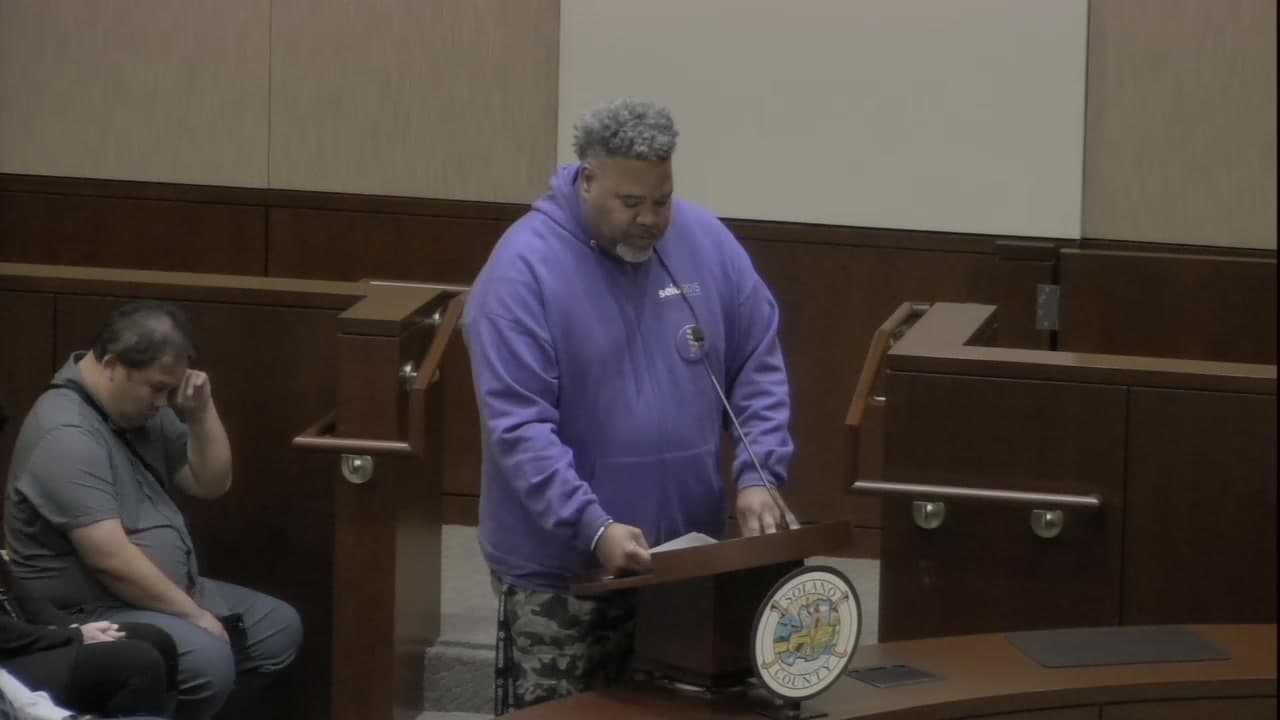
Lori Martin, Treasurer, NAMI Solano County, described how the group helped her family. "NAMI provided resources, education, and hope," she said, adding that free services depend on grants. Patty Phillips, a Family-to-Family class teacher, shared her son's diagnosis. "Going from getting $325,000 from the county to zero this year has really been devastating," she said.
Decisions and stakeholder impacts: The board took no action. The only on-record response was a remark that a board member would follow up. The families who rely on NAMI's free peer education programs are most exposed if no replacement funding emerges.
What's next: Watch for whether a supervisor brings the request back as an agenda item.
Caregivers, Adoptions Take Center Stage
Why it matters: More than 7,900 In-Home Supportive Services (IHSS) workers help more than 8,000 low-income older and disabled Solano residents stay in their homes. IHSS is the state program that pays for that in-home care.
Where things stand: The board recognized November 2026 as National Family Caregivers Month and National Care at Home Month (For: 5, Against: 0, Absent: 0). The resolution cites a 2025 AARP study estimating 63 million caregivers nationwide. Mike Watson, Social Services Manager, Solano County Public Authority, described caregivers as the people who show up at the hardest moments. A supervisor presenting the resolution shared the experience of caring for two sons with Duchenne muscular dystrophy.
The other side: Advocates tied recognition to pay. "Appreciation must be more than just words. It must include advocacy, resources, fair compensation, and continued support for the family who provide these essential services," said Carl Vincent, a member of the IHSS Advisory Committee and an associate member of SEIU Local 2015. Vincent noted that demand will grow as baby boomers age.
Adoption Month: The board also approved a National Adoption Month resolution (For: 5, Against: 0, Absent: 0). The resolution notes that about 52 Solano foster children are awaiting adoption. Neely Carpenter, Deputy Director, Child Welfare Services, introduced the county's Permanency Assessments program. "Youth of color spend more time in care and have less opportunity for permanency," said Christy Groton, Adoption Supervisor. Staff called for more openness in adoption, more education for caregivers and stronger post-adoption support.
Fees Rise After Empty Hearings
Where things stand: No one spoke at either public hearing, and both fee measures passed 5-0.
User fees: Ann Putney, Principal Management Analyst, County Administrator's Office, explained that fees recover service costs and that state law sets or caps some of them. Agriculture will revise seven pest control registration fees under state Food and Agriculture Code changes. The increases range from $5 to $50 and will raise just over $6,600.
Recorder fees: Glenn Zook, Assessor-Recorder, said recording fees have not risen since 2009. A state bill to raise them, AB 1430, was vetoed and then repackaged as AB 2224. The recorder changes are "expected to generate about $335,000 in additional revenue in the Assessor-Recorder's Office," said Putney. All of the user fee changes take effect Jan. 4, 2027.
English Hills impact fee: In 2001, the county allowed 2.5-acre parcels in English Hills in exchange for a road-improvement fee. "The handshake is that there would be a fee program that would be charged against dwelling units to pay for the increased traffic density," said Tuggle. County Surveyor Chris Ferrucci recommended raising the fee by $188 to $8,384, citing higher construction and right-of-way costs. The fee applies only to single-family homes. LNU fire rebuilds and units of 750 square feet or less are exempt. The fee adjusts every six months based on the Engineering News-Record cost index and must be reviewed every five years. Staff noted that the ADU exemptions shift costs to other fee payers. The new fee takes effect Jan. 1, 2027.
- Item pulled: Staff withdrew a new Economic Development Manager classification, which will return later. The board approved the agenda change 5-0.
- Consent calendar approved: Items included an 11.6% raise for entry-level public safety dispatchers, ARPA closeout and an $82,842 CalFresh outreach contract. Four ayes were heard, and no tally was announced.
- $115,175 CalMHSA contract: The board approved a behavioral health interoperability platform to meet state and federal care-coordination mandates.
- Fire districts report: Vacaville logged 211 incidents, Montezuma 122 calls, Suisun 108 incidents and East Vallejo 102 medical calls and 43 fires. Interim Chief Alfred Abruzzini said he hopes to bring the districts "under one umbrella."
- Honors: IT project manager Roshita Mukhia was named Employee of the Month for leading the county's .com-to-.gov transition. Retiring Probation manager Kathleen Azevedo was recognized for 25 years of service.
Looking ahead: Vice Chair James addressed two deaths in the county over the weekend. "We cannot let these incidents become normalized in our community," she said, and she announced a town hall at 2800 Georgia Street with Sheriff DeWalt. The board met in closed session on a federal lawsuit and the Public Defender appointment and reported no action. The board's next meeting is Nov. 10 at 9 a.m.