
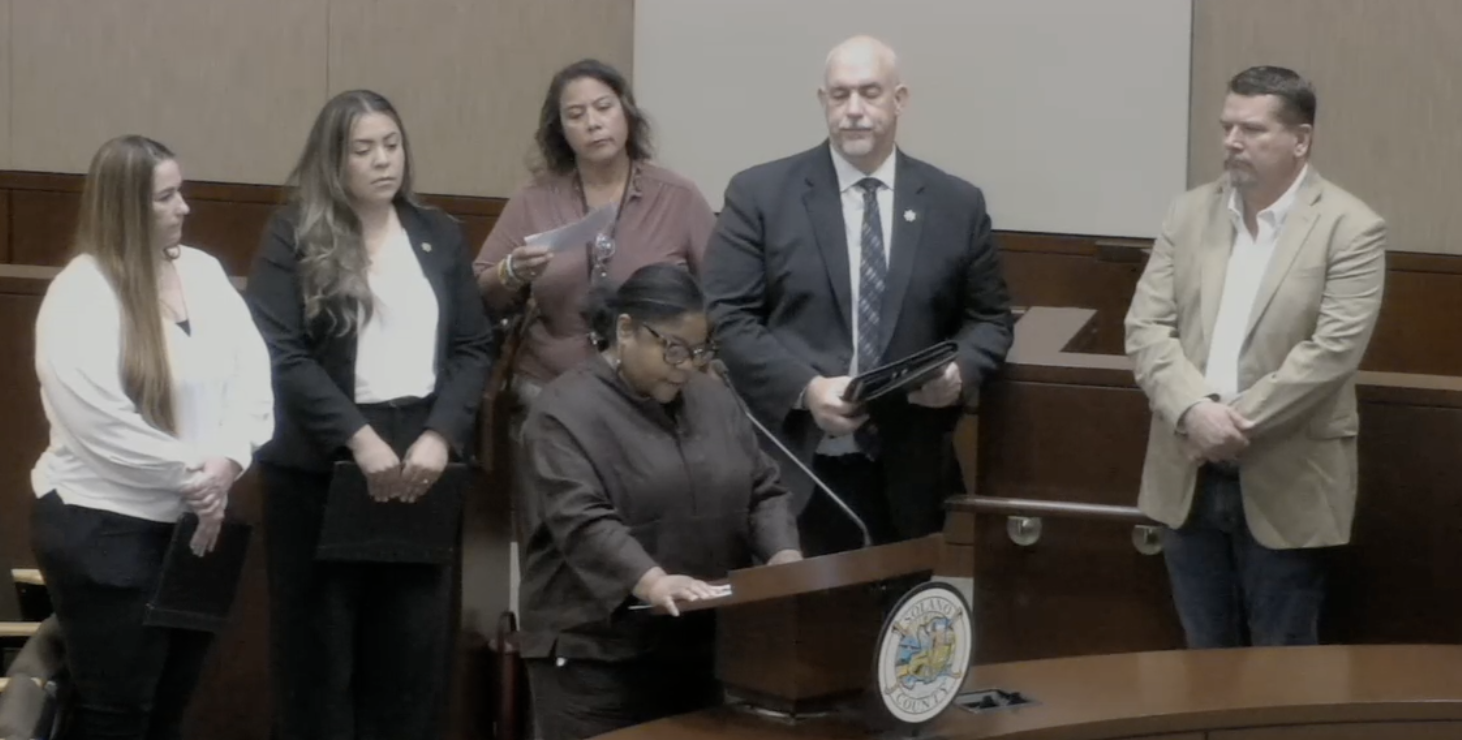
Board of Supervisors - Jun 23, 2026 - Meeting

Board of Supervisors - Jun 23, 2026 - Meeting

Board of SupervisorsSolano CountyJune 23, 2026

Sources:

Locunity is a independent informational service and is not an official government page for this commission.We use AI-assisted analysis and human editorial review to publish information.

Supervisors Push for First-in-State Data Center Tax, Place Hotel Tax Hike on Ballot

Solano County's Board of Supervisors signaled it wants to be the first county in California to impose a business license tax on data centers — and supervisors say the initial proposal of $0.12 per square foot isn't nearly high enough. The board also unanimously voted to place a measure on the November 2026 ballot that would more than double the hotel tax in unincorporated areas, authorized a lawsuit challenging the Delta Conveyance Project, and approved more than $108 million in contracts for the coming fiscal year.

  • Supervisors reject initial $0.12/sq ft data center tax rate as "very low," direct staff to return with dramatically higher numbers and research on air rights and behind-the-meter energy taxation
  • Hotel tax increase from 5% to 12% headed to November 2026 ballot for unincorporated Solano County after unanimous 4-0 vote
  • Board authorizes lawsuit against the Delta Stewardship Council over the Delta Conveyance Project certification, a major statewide water fight
  • New EMS advisory committee approved after the county's split from the regional cooperative, with hospital, fire, dispatch, and community representation
  • $108M+ in consent calendar contracts approved, with Supervisor Williams confirming homeland security grants carry no immigration enforcement strings
  • 707 Week elevated to countywide celebration after inaugural Vallejo event drew 1,800 attendees and 73 vendors

Data Center Tax: Supervisors Want Much More

The most consequential policy debate of the evening centered on how Solano County should tax data centers — massive energy consumers increasingly eyeing the county's open land and power grid.

The basics: Director of Resource Management James Vezik returned with updated analysis two weeks after the board's June 9 session. Staff proposed $0.12 per square foot as a starting rate for a first-in-California data center business license tax. Staff also recommended modest increases to wind turbine, natural gas, and biomass rates, constrained by prior PG&E litigation.

Why it matters: No California county currently taxes data centers through a business license. Solano County would set the precedent — and with hyperscale facilities of a million square feet or more under discussion, the rate structure could mean the difference between six figures and millions in annual revenue.

Where things stand: Vezik framed the $0.12 rate as a floor. "120,000 on a similar size facility seems very low," said Director of Resource Management James Vezik, noting a utility user tax on the same facility would generate $1.75 million to $4.4 million annually.

Supervisor Mitch Mashburn drove the sharpest critique, pushing for rates that match what a utility user tax would yield. "They're pillaging our resources. They're taking our wind, our power, at the expense of our residents and pushing it out there across the bay," he said of energy companies exporting power from Solano County wind farms. On data centers specifically, Mashburn argued the tax should follow the facility regardless of jurisdiction: "I want them to pay it whether it's in the county, or I want them to pay it whether it's in the city."

Supervisor Wanda Williams raised concerns about quality of life, noting data center noise impacts on residents near Rio Vista: "The data centers, they hum 24 hours a day." She urged colleagues to research behind-the-meter energy taxation — where facilities generate their own power and bypass the grid — and recommended watching a documentary on data center impacts in other communities.

Vice Chair Cassandra James pushed staff to explore taxing air rights — the vertical volume occupied by massive data center structures — asking, "Have we thought about the percentage or price per air, like air rights and what would that look like?"

Chair Monica Brown zeroed in on environmental costs: "How are we going to make sure that they don't drain all of our aquifers, let alone the fact that they are probably not cleaning up the water."

What's next: The board directed staff to return at the next meeting with a higher data center rate, research on air rights and behind-the-meter taxation, and to keep data centers in one combined ballot measure with other business license taxes rather than splitting them out. County counsel confirmed that projects starting before a potential 2028 utility tax would not be exempt from future taxes. During general public comment, Alicia Minion also urged the board to track hyperscale data center projects that could affect Solano County from neighboring jurisdictions, citing concerns about an energy provider in the Nevada/Lake Tahoe area abandoning 50,000 residential customers.


Hotel Tax Headed to Voters in November

Why it matters: The board unanimously voted to place a measure on the November 2026 ballot that would increase the transient occupancy tax in unincorporated Solano County from 5% to 12% — more than doubling the rate.

Decisions: Assistant Treasurer Denise Dix presented the resolution, which passed 4-0 with a required four-fifths supermajority (For: Brown, James, Williams, Mashburn; Absent: Vasquez). No public comment was received. The increase would align unincorporated rates more closely with those charged by cities in the county and generate significant new general fund revenue from hotels and short-term rentals.


County Sues Over Delta Conveyance Project

After returning from closed session, Chair Brown reported the board voted 4-0 to initiate litigation challenging the Delta Stewardship Council's April 2026 decision certifying the Delta Conveyance Project — a massive statewide water infrastructure proposal.

Why it matters: The lawsuit positions Solano County formally against one of California's most contentious water projects. The county's hiring of new Assistant County Administrator Alex Tengolics, who was introduced earlier in the meeting and brings Delta-related experience from Yolo County, underscores how central this issue is to the administration's priorities.


New EMS Advisory Committee Takes Shape

The basics: Following Solano County's December 2025 ordinance returning Local Emergency Medical Services Agency authority to the board — ending participation in a regional cooperative — staff presented three options for a new advisory structure.

Where things stand: EMS Administrator Benjamin Gammon outlined three paths: a locally customizable advisory committee (Option 1), a state-mandated Emergency Medical Care Committee (Option 2), or no formal structure (Option 3). Staff recommended Option 1, noting four surrounding counties use EMCCs and two use advisory committees. The proposed membership includes representatives from three hospital systems, two trauma centers, dispatch centers, city and district fire agencies, behavioral health, ambulance providers, and a community member.

Supervisor Mashburn moved Option 1, referencing public comment from firefighter Will Coelho, who earlier in the meeting delivered an emotional plea for dispatch reform after a death at Sandy Beach county park. "Who would you want responding to your family members that are dying? You would want the closest, most qualified and immediately available fire department," Coelho told the board, urging the creation of mutual aid zones that dispatch the nearest ALS-qualified paramedics with water rescue capabilities.

Supervisor Williams asked how community members would be recruited for the committee. Staff said they would announce the opportunity through quarterly EMS meetings and publicly, and that the committee can expand if warranted.

Decisions: Passed 4-0 (For: Brown, James, Williams, Mashburn; Absent: Vasquez).


Federal Grants Get Immigration Scrutiny

Why it matters: Supervisor Williams pulled two consent calendar items — the Emergency Management Performance Grant and the Homeland Security Grant Program — to ask whether accepting federal money could require the county to cooperate with immigration enforcement.

Where things stand: Sheriff's office staff explained the grants flow through CAL OES to FEMA and confirmed there are no mandates requiring immigration enforcement participation. Staff stated they would not do anything that violates state law. Williams pressed on whether the funding could push the county beyond California's sanctuary protections.

Williams said her concern was whether accepting the dollars would require participation beyond existing obligations: "My main concern was are we going to be required to now because we asked for these funding dollars be required? We already, of course, participate in things, but going above and beyond." Staff confirmed the grants have national priority spending areas but none related to immigration enforcement. Williams expressed satisfaction and voted to approve.

Decisions: Full consent calendar (Items 5–33) passed 4-0.


707 Week Goes Countywide

The board adopted a resolution elevating 707 Week — a community celebration honoring Solano County's area code — from a 2025 City of Vallejo proclamation to a countywide event running July 7–13, 2026.

Why it matters: The inaugural 2025 event in Vallejo drew 1,800 attendees, 73 local vendors, and connected 250 job seekers with 31 employers at a workforce development fair. The countywide resolution scales that model across all seven Solano County cities with SF Bay Ferry partnerships, cultural programming, and expanded economic activation.

Vice Chair Cassandra James, who sponsored the resolution, set the tone: "One of the best parts of public service is being able to elevate community-driven ideas and to ensure the people behind them are recognized."

Committee Co-Chair Andrea Portillo and Co-Chair Essex Cook presented the 2026 plans, with sponsors ranging from Kaiser Permanente and Travis Credit Union to local restaurants. Multiple community voices underscored the event's significance: Chef Renee Johnson of BlackBerry Soul announced a Soul Food Stroll, Patricia Hunter of the NAACP Vallejo Branch 1081 expressed support, and Kyria Shabazz spoke about community pride. Local historian Tony Wade noted his new book on Fairfield businesses will publish July 7, the first day of 707 Week.

Decisions: Passed 4-0.


Probation Week: Programs and Loss

Supervisor Mashburn sponsored a resolution recognizing Probation Services Week (July 19–25), and the department used the moment to showcase its rehabilitation mission.

Chief Probation Officer Dean Farah presented the department's work across roughly 100 officers, 50 juvenile correctional counselors, and support staff. Zoe Alexander described family engagement programs including the M&M Project HOPE Workshop for parents. Jessica Adcock highlighted juvenile programs — traffic court, diversion, midnight basketball, and the RISE program.

The presentation took an emotional turn when Supervisor Mashburn memorialized Teresa Ann Smith, a 20-year veteran correctional officer at the juvenile detention facility who passed away over the weekend. "She was five foot tall if she was wearing her boots and she might have weighed 100 pounds if you soaked her wet. But she was an absolute presence," he said, underscoring the sacrifices of 24/7 correctional work.

Decisions: Passed 4-0.


Minor Items

  • $108M+ in contracts approved on consent, including the $74.6 million H&SS master contract list, $18.7 million in Sheriff's contracts, and $5.6 million in Probation contracts for FY2026–27.
  • Retired annuitant mental health clinician approved for the Public Defender's holistic defense grant through May 2028, after multiple failed recruitments (passed 3-0; Mashburn briefly absent).
  • Lystek International General Manager James Dunbar challenged the county's PFAS study attached to the biosolids land application report (Item 33), arguing it inappropriately singles out biosolids as a major source when the same substances appear in household products and commercial fertilizers.
  • Chester Ogsimer, a paralegal in the Public Defender's office, recognized as Employee of the Month for July 2026.
  • Board honored Denise Kaufman upon her retirement after 28 years in H&SS, where she helped families transition off public assistance. Supervisor Mashburn also recognized retiring HR employee Frances Stokes.
  • New Assistant County Administrator Alex Tengolics introduced by County Administrator Ian Goldberg, bringing experience from Yolo County on Delta issues and labor negotiations.
  • Joseph Johnson announced the Continentals of Omega Boys and Girls Club of Vallejo will return to active status within 90 days after 14 years of dormancy, with a $5 million fundraising campaign.
  • Joseph Joyce reported a strong county fair — 80+ more junior livestock entries than last year, $70,000 more raised at auction, and no arrests. He requested Supervisor Mashburn co-sponsor the Bass Derby festival in Rio Vista after the Chamber of Commerce canceled it.
  • Chair Brown announced free food distribution for students in Benicia during the summer, criticizing federal policy that denies free summer meals to communities without enough low-income students.
Supervisors Push for First-in-State Data Center Tax, Place Hotel Tax Hike on Ballot | Board of Supervisors | Locunity