
Solano Supervisors Lock In 2027 Lobbying Agenda as Federal Cliffs Loom
Board of Supervisors • Solano CountyOctober 27, 2026
Locunity is an independent informational service and is not an official government page for this commission. All information is sourced from public footage and an analysis of official agendas with the aid of responsible, fact-checked AI. to report an error or omission.
Solano County supervisors adopted their 2027 federal and state legislative platforms 5-0 Tuesday, Oct. 27, 2026. The county's lobbyists then laid out what those priorities are up against: a Dec. 11 federal funding deadline, a looming SNAP cost shift and a possible state special session on wildfire liability. Staff also briefed the Board on a strong El Niño winter, warning that king tides alone could test levees and roads whether or not heavy rain arrives.
- 2027 legislative platforms approved 5-0, giving staff and lobbyists authority to act on bills without new votes
- Federal funding expires Dec. 11; advocates see a possible one-year delay of the SNAP/CalFresh cost shift
- Utilities push a wildfire-liability special session that the county's state lobbyist said could worsen insurance affordability
- Strong El Niño and king tides raise flood risk as the state declaration brings no new funding
- UC Cooperative Extension reports 296 volunteers but a nine-position drop after CalFresh Healthy Living funding ended
Platforms Approved, Then Warnings From Two Capitals
Why it matters: Adopted platforms let county staff and lobbyists take positions and send letters quickly without returning to the Board, as they did throughout 2026. The advocates' briefings showed how much of the county's budget depends on decisions made in Washington and Sacramento.
Where things stand: Matthew Davis of the County Administrator's Office said the 2027 platforms refine, rather than rewrite, five priorities. They are safety-net protection tied to HR 1, Medi-Cal and CalFresh; local control; water and infrastructure, including the North Bay Aqueduct and golden mussel; economic development around Mare Island shipbuilding and Travis Air Force Base; and emerging issues. “We’re not starting from scratch each year,” said Davis.
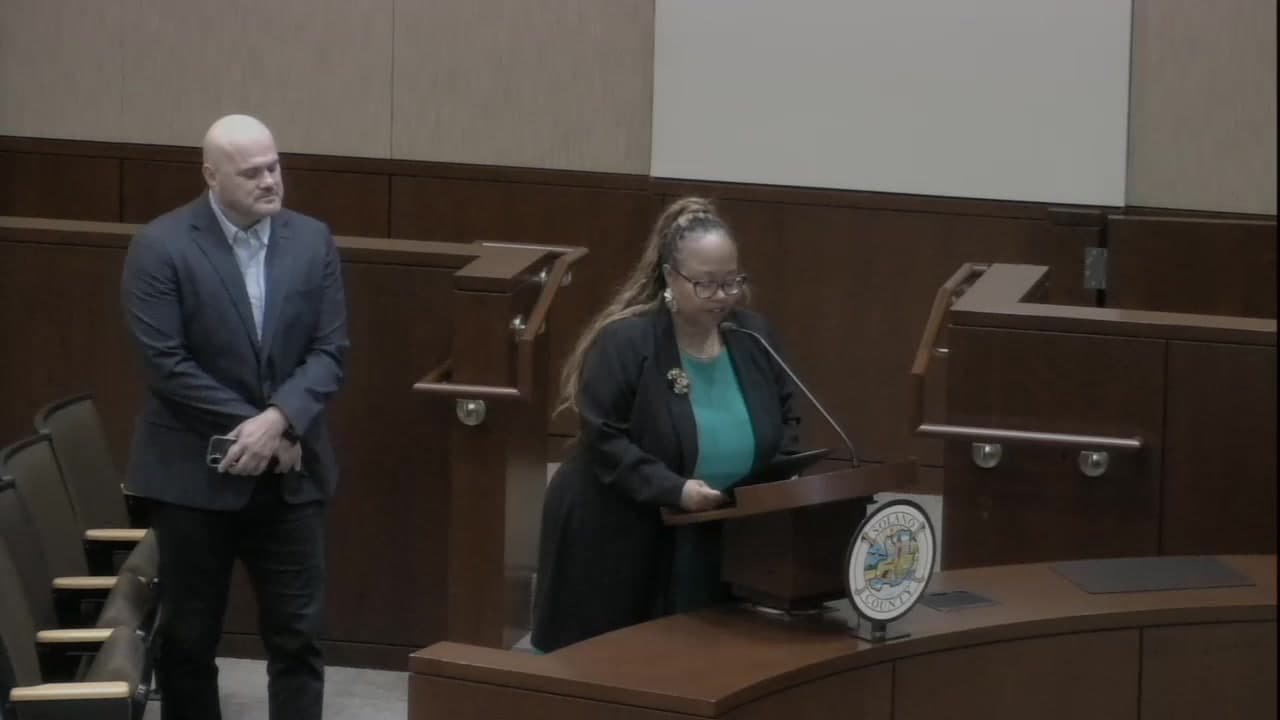
Hassan Sarsour, federal legislative advocate, Paragon Government Relations, called the platform “essentially your Magna Carta.” He said the federal government is running on a continuing resolution that expires Dec. 11, with 22 legislative days left. He cited county earmarks, including about $780,000 for a Sheriff's mobile command unit, $750,000 for water quality planning and a First 5 Solano building request.
Sarsour also flagged a federal Office of Management and Budget rule that would give political appointees more say over grants. He also pointed to surface transportation reauthorization, permitting reform that could give the county a cooperating-agency role, and a Federal Communications Commission proposal on wireline broadband.
Rachel Mackey, federal legislative advocate, Paragon Government Relations, said Farm Bill talks may delay the SNAP/CalFresh cost shift, which would cost California about $2 billion. “We could be headed towards at least a clean 1-year delay of that provision,” said Mackey. She also described a Census Bureau proposal on residence and apportionment counts.
The other side: Supervisor John M. Vasquez, District 4, pressed the advocates on agriculture's standing in Washington. “I’m talking about the cost, the input costs that agriculture right now and the loss of agricultural voices in the House and in the Senate,” said Vasquez. “A lot of ag folks are leaving the Hill,” Sarsour acknowledged.
Board Chair Monica Brown was blunter about federal treatment of the state. “I am really tired of California taking the hits because a certain person doesn’t like us,” said Brown.
Sacramento's turn: Karen Lang, state legislative advocate, SYASL Partners, said utilities want a special session on strict liability and subrogation. She warned the changes could worsen insurance affordability and concern local governments. “The utilities in particular, Southern California Edison and PG&E, are very focused on changes to our statutes when it comes to strict liability for when their equipment causes a wildfire,” said Lang.
On HR 1, Lang said, “the big hairy problem we still have to deal with is funding for medically indigent adults.” She also noted growing interest in county exemptions from a new software sales tax. Supervisor Mitch Mashburn, District 5, asked whether shipbuilding and CEQA legislation could return in a special session. Lang said special sessions are limited to set topics.
Decisions and stakeholder impacts: The vote was For: 5, Against: 0, Absent: 0. CalFresh households, Medi-Cal-dependent residents, agricultural producers and Mare Island shipbuilding interests have the most riding on how the platforms are used.
What's next: Census proposal comments are due Nov. 2. Federal funding expires Dec. 11.
El Niño Winter: Tides, Debris and No State Money
Why it matters: Past flood losses at the justice campus and lingering road damage shape this winter's preparations. Officials urged residents to sign up for Alert Solano and clear creeks and culverts early.
Where things stand: Robyn Rains of the Solano County Office of Emergency Services said a very strong El Niño does not guarantee heavy rain. “Our chances are equal either way that we’re going to get rain or not get rain,” said Rains. King tides still raise flood risk regardless of rainfall.
Rains said the state emergency declaration brought no funding or permitting waivers. “We did not receive any funding from that,” said Rains. She noted that Van Sickle and the Solano County Water Agency have proclaimed emergencies. A sandbagging machine is in procurement with grant funding.
Anthony Tave, Director, Solano County General Services, described roof, generator and floodwall work and temporary pumps at the justice campus. “We’ve reprioritized a lot of the work to our floodwalls,” said Tave. Matt Teufel, Assistant Director, Department of Resource Management, detailed road, culvert and bridge work. He stressed that the first 30 days after a disaster are the most effective window for repairs.
The other side: Supervisors pushed on gaps. Lopes Road repairs await FEMA funding. “I’m still going to lose a lane on Lopes Road,” said Brown. Mashburn flagged “a $26 million county project that is vulnerable, very vulnerable to this flood right over off of Clay Street.” He also urged using the Sheriff's inmate work crews to fill sandbags.
Other questions covered school buses, sandbag machine placement, the alternate emergency operations center, large-animal evacuation, and support for low-income and unhoused residents.
Decisions and stakeholder impacts: No vote was taken. Public commenter Charlene Schmidt thanked the county for meeting with her and for crews clearing downed branches on Meridian Road.
What's next: Residents are urged to sign up for Alert Solano, clear creeks and culverts, and prepare sandbags before storms hit.
Extension Volunteers Fill Gaps as Staff Shrinks
Karen Warburton, Area Director, UC Cooperative Extension Capitol Corridor, said staffing across three counties fell from 47 to 38. The corridor lost nine positions after CalFresh Healthy Living funding ended. “We’re now down to 38,” said Warburton.
Volunteers are filling in. Warburton reported 296 local volunteers donating “19,521 hours collectively, and that amounts to nearly $800,000 back into the community.” Local 4-H serves 323 youth in seven clubs, and new advisors now cover urban integrated pest management and viticulture.
Supervisor Wanda Williams, District 3, said residents don't know enough about these offerings. “We’re just not taking advantage of the programs that are just right here in this county,” said Williams. She said the 4-H registration link appeared broken. Warburton agreed to clarify the website and email event dates. No action was taken.
- Native American Heritage Month: Board adopted Williams' resolution 5-0; a Yocha Dehe Wintun Nation representative thanked supervisors.
- Interim fire chief pay: Fire district boards approved 5-0 a $9,999.60–$10,403.47 Suisun range plus a 3% COLA; permanent chief arrangements will return later.
- Consent calendar: Items 2-18 passed 5-0 with no items pulled and no public comment.
- Closed session: The Board discussed Vacaville parcel negotiations, Public Defender employment and Kuntz v. County of Solano; no report out was expected.
- Remembrance: Mashburn honored late jail chaplain Alvin Timothy Jackson, who died last week.
Looking ahead: The Board meets next Tuesday, Nov. 3, which is Election Day.