Board of Supervisors - Jun 09, 2026 - Meeting
Board of Supervisors • Solano CountyJune 9, 2026
Locunity is a independent informational service and is not an official government page for this commission.We use AI-assisted analysis and human editorial review to publish information.
NAMI Solano Warns of Closure as Board Advances Two Tax Ballot Measures
The Solano County Board of Supervisors packed a long Tuesday session with policy substance — advancing two November 2026 ballot measures on energy and hotel taxes, approving $365,000 in community grants while confronting the imminent collapse of the county's only free grassroots mental health provider, and receiving an economic report that painted a picture of resilient job growth shadowed by deepening inequality. The board also honored women veterans, recognized Juneteenth, and declared Gun Violence Awareness Month with powerful survivor testimony.
NAMI Solano says it will close within months after losing all funding in the Prop 1 behavioral health transition; a $250K emergency fund may be its last lifeline
Board advances November 2026 ballot measure modernizing a 30-year-old wind turbine tax and expanding it to natural gas, solar, battery storage and data centers
Hotel tax increase from 5% to 12% headed for November ballot, aligning Solano County with regional peers
Economic report projects 1,280 new jobs per year through 2030, led by healthcare, but supervisors press for comprehensive infrastructure inventory
Survivors and advocates urge support for THRIVE Act during Gun Violence Awareness Month declaration, with Solano County named as one of five state pilot regions
$365K in community investment grants awarded to five agencies for food security and behavioral health
A 41-Year-Old Mental Health Lifeline Faces Extinction
The board approved $365,000 in Community Investment Fund grants to five agencies — Food Bank of Contra Costa and Solano ($75,000), Planned Parenthood ($75,000), Innovative Health Solutions ($65,000), Food is Free Bay Area ($75,000), and Real Vista Care ($75,000) — but the most consequential moment came from the organizations that didn't receive funding.
Why it matters: NAMI Solano County, which has provided free mental health support services for 41 years, told the board it will close within months after losing all its funding in the statewide transition from the Mental Health Services Act to the Behavioral Health Services Act under Proposition 1.
Where things stand: John McKenzie, president of NAMI Solano, warned the board directly:
"Within the next few months, this agency, NAMI, the National Alliance on Mental Illness, will be forced to close."
McKenzie said the organization serves 1,000 people annually with a zero-dollar budget and questioned why organizations with budgets of $140 million received grants while his grassroots agency was shut out. He described picking up a person released from Napa State Hospital at 5 p.m. with no county services available.
Deb Demello, outgoing executive director of NAMI Solano, delivered emotional testimony, telling supervisors she was laying herself off. As a mother of two adult sons with mental illness, she described the desperate personal and community toll of the funding collapse.
NAMI wasn't alone. Tracee Stacy, manager of the Prevention & Early Access for Seniors (PEAS) program at Choice in Aging, warned that the senior mental health prevention program ends July 1 — just 21 days away — due to the same Prop 1 transition, leaving older adults without early intervention services. Stacy noted that older adults are the largest suicide demographic in Solano County. Debbie Toth, president and CEO of Choice in Aging, said no RFP has been issued, staff don't know if they'll have jobs on July 1, and the organization has raised nearly $100,000 from outside the county to bridge the gap.
The other side: Supervisor Mitch Mashburn questioned whether the CIF evaluation criteria disadvantaged smaller community-based organizations competing against well-resourced national groups. He then identified a potential solution:
"Two years ago, we set up a fund within this county and we set aside $250,000 for just such a case as this when an organization which is a nonprofit is about to tank and we need to help support them."
County Administrator Ian Goldberg confirmed the money remains available and described an application process through the CIF for emergency needs.
Decisions: The board approved the $365,000 grant allocation 4-0 (For: James, Williams, Mashburn, Brown; Against: none; Absent: Vasquez).
What's next: NAMI Solano and other affected organizations can apply for the $250,000 emergency services fund through the CIF process. The Prop 1 transition continues to create funding gaps across behavioral health services statewide.
Board Pushes to Modernize a 30-Year-Old Energy Tax — and Add Data Centers
The board directed staff to prepare a November 2026 ballot measure that would overhaul a business license tax on commercial wind turbines that hasn't been updated since 1994, expand it to cover natural gas extraction, commercial solar, and battery energy storage — and, in a significant late amendment, include data centers.
The basics: The current tax rate of 3/100 of a cent per kilowatt-hour generates roughly $56,000 per year from commercial wind operations. Had the rate been adjusted for inflation, it would yield approximately $124,000. Staff also proposed new taxes on natural gas extraction (estimated at $150,000 per year), battery storage, and commercial solar.
Why it matters: Energy companies operating in unincorporated Solano County generate significant revenue from county resources while contributing minimal tax revenue. The combined measures could generate $225,000 or more in new annual revenue. SMUD's approximately 159 turbines are exempt from the tax under a court ruling (SMUD v. County of Solano) that found the utility is not a "business" for tax purposes — and County Counsel confirmed it is too late to appeal.
Where things stand: Supervisor Mitch Mashburn argued the proposed rates were too timid.
"Y'all brought this modest amount here. I don't want modest," he said.
Mashburn also contended that energy companies "pillage our resources" without benefiting county residents. He pressed staff on whether the rate could exceed the CPI adjustment and questioned whether property taxes could apply to SMUD windmills on private land; County Counsel said likely not.
Supervisor Wanda Williams pushed the discussion further, asking why data centers weren't included.
"Where's the data centers in this? Why we can't put that in there, too? I mean, because data centers, they're looking to come our way. We need to be prepared," she said.
Williams also inquired about the SMUD appellate ruling.
The other side: Joe Joyce, president of the Central Solano Taxpayers Group, opposed new taxes generally, warning that corporate taxes trickle down to citizens through rate increases. However, he acknowledged he might take a neutral position on specific corporate-focused measures and noted the area near proposed facilities has poor electricity and internet infrastructure.
Decisions: Mashburn amended his motion to include data centers. The board voted 4-0 to direct staff to return June 23 with a formal ballot resolution (For: James, Williams, Mashburn, Brown; Against: none; Absent: Vasquez). As a general tax, the measure would require 50%+1 voter approval; ballot placement costs approximately $140,000 with an Aug. 4 deadline.
Hotel Tax Headed to the Ballot After 65 Years at 5%
The board also advanced a second November 2026 ballot measure, directing staff to prepare a resolution increasing the transient occupancy tax from 5% to 12% on lodging in unincorporated areas.
The basics: Solano County's Transient Occupancy Tax (TOT) was established in 1960 and has never been increased. It applies to 12 lodging properties plus online platforms like Airbnb in unincorporated areas. Revenue has actually declined — from $138,000 in fiscal year 2021-22 to approximately $52,000 in fiscal year 2024-25.
Why it matters: At 5%, Solano County charges the lowest TOT in the region. Vallejo charges 14%, Sacramento 12%, San Francisco 14%, and Napa 13%. The proposed 12% rate would sit in the middle of regional peers and generate approximately $58,000 in additional annual revenue.
Supervisor Mitch Mashburn noted the tax does not directly impact county residents — only visitors using county resources — and expressed support.
Decisions: The board voted 4-0 to direct staff to return June 23 with a formal ballot resolution (For: James, Williams, Mashburn, Brown; Against: none; Absent: Vasquez). Like the energy tax, the measure would require simple majority voter approval.
Economist Sees Growth — but Warns the Bottom Half Is Falling Behind
Dr. Robert Eyler of Sonoma State University presented the 18th annual Solano County Index of Economic and Community Progress, projecting approximately 1,280 new jobs per year through the end of the decade with healthcare as the dominant growth sector.
Why it matters: The data showed resilient top-line numbers — about 1,100 new workers in the past year, rising personal income outpacing declining inflation, and improved African American homeownership rates — but the details revealed a K-shaped economy where lower-income households are being squeezed.
Where things stand: Eyler explained the dynamic directly:
"Inflation is seen as a regressive tax because the percentage of your income you're paying for goods is rising as inflation rises for lower to middle income households."
Manufacturing lost jobs in the past year, though forecasts show marginal recovery. Median home prices stand at approximately $578,000, up 27% from pre-pandemic levels, with housing markets slowly declining due to mortgage lock-in effects. The county's population estimate dipped slightly in 2025, though long-term forecasts show moderate growth relative to the broader Bay Area.
Supervisor Mitch Mashburn pressed Eyler to explain the K-shaped economy concept for the public record, connecting it to sales tax ballot measures across Solano County cities that compound the burden on lower-income households. He then pivoted to what he called the county's foundational gap:
"Unless we know what we have, we have no way to know what we can build. We need to complete that study so that we know what power resources are available, where we know what water is available."
Vice Chair Cassandra James asked about cross-sector partnerships and infrastructure investments needed to support business attraction, including supply chain integration for agriculture and wine industry recovery. Chair Monica Brown raised concerns about healthcare workforce pipeline funding, warning:
"We're going to have people, especially with HR1. We have to feed them. We're required by law to take care of them in the hospital. Where's all this money going to come from?"
What's next: The presentation was informational. The call for a comprehensive infrastructure inventory covering water, power and broadband emerged as a recurring theme across multiple supervisors' remarks.
Survivors Share Devastating Testimony for Gun Violence Awareness Month
The board declared June 2026 as Gun Violence Awareness Month, but the agenda item became a platform for survivors and advocates who turned a ceremonial resolution into a policy conversation about mental health resources for gun violence victims.
Vice Chair Cassandra James introduced the resolution, honoring Hadiya Pendleton and naming local victim Jamario Baker:
"I know for our community, we are still mourning the loss of Jamario Baker, who was shot and killed while protecting his sister after graduating high school."
Three speakers delivered testimony that stopped the room. Alex, a member of Moms Demand Action, described her 5-year-old daughter asking which photo would be used to remember her if she died in a school shooting. Iman Eliaduk, whose 18-year-old son Hakeem was shot and killed in Vallejo, told the board that while her son lost his life, her family received a life sentence of grief and trauma.
Tinisch Hollins of Californians for Safety and Justice brought policy specifics, highlighting AB 2247, the THRIVE Act, which would provide free mental health services to youth up to age 25 who witness or experience gun violence.
"I've made Solano County a priority investment for this piece of legislation. When it passes, it will be a pilot for three years and Solano County is one of the five regions that we are hoping these resources will come through," Hollins said.
Decisions: The resolution passed 4-0 (For: James, Williams, Mashburn, Brown; Against: none; Absent: Vasquez). James promoted upcoming community healing events including Rock the Ride and a healing circle hosted by Broken by Violence.
Library Gets Ready for a 21st-Century Makeover
Assistant Director of Library Services Megan Wong and Deputy Director of Community Services Melissa Padaca of the Solano County Library presented a proposal to adopt BiblioCommons, replacing the library's temporary 2020-era website with a platform that merges the catalog and website into a single experience.
Why it matters: The current website was always intended as temporary. BiblioCommons offers Google-like search, staff-curated book lists, community reviews, and — critically — translation capabilities for Spanish, Tagalog and Chinese, serving the county's diverse population. Wong cited the Marinet Library System's experience: a 20% increase in material requests within one month of adoption.
Year-one costs total $161,333 — $87,397 for the website and $73,936 for the catalog overlay — on three-year contracts. Funding is already in the requested budget.
Supervisor Mitch Mashburn praised the platform's free, Amazon-like experience and suggested giving more prominence to library events and programs. Supervisor Wanda Williams appreciated the new translation capabilities. The presentation was informational; no vote was required.
Minor Items
Consent calendar (Items 4-22) approved 4-0, including a $200,000 transfer to the Housing Trust Fund, approval of the Prop 1-mandated Behavioral Health Services Act plan with a June 30 deadline, $2.47 million in IT contracts, and commission appointments. Supervisor Mashburn acknowledged Cindy Rafferty's retirement.
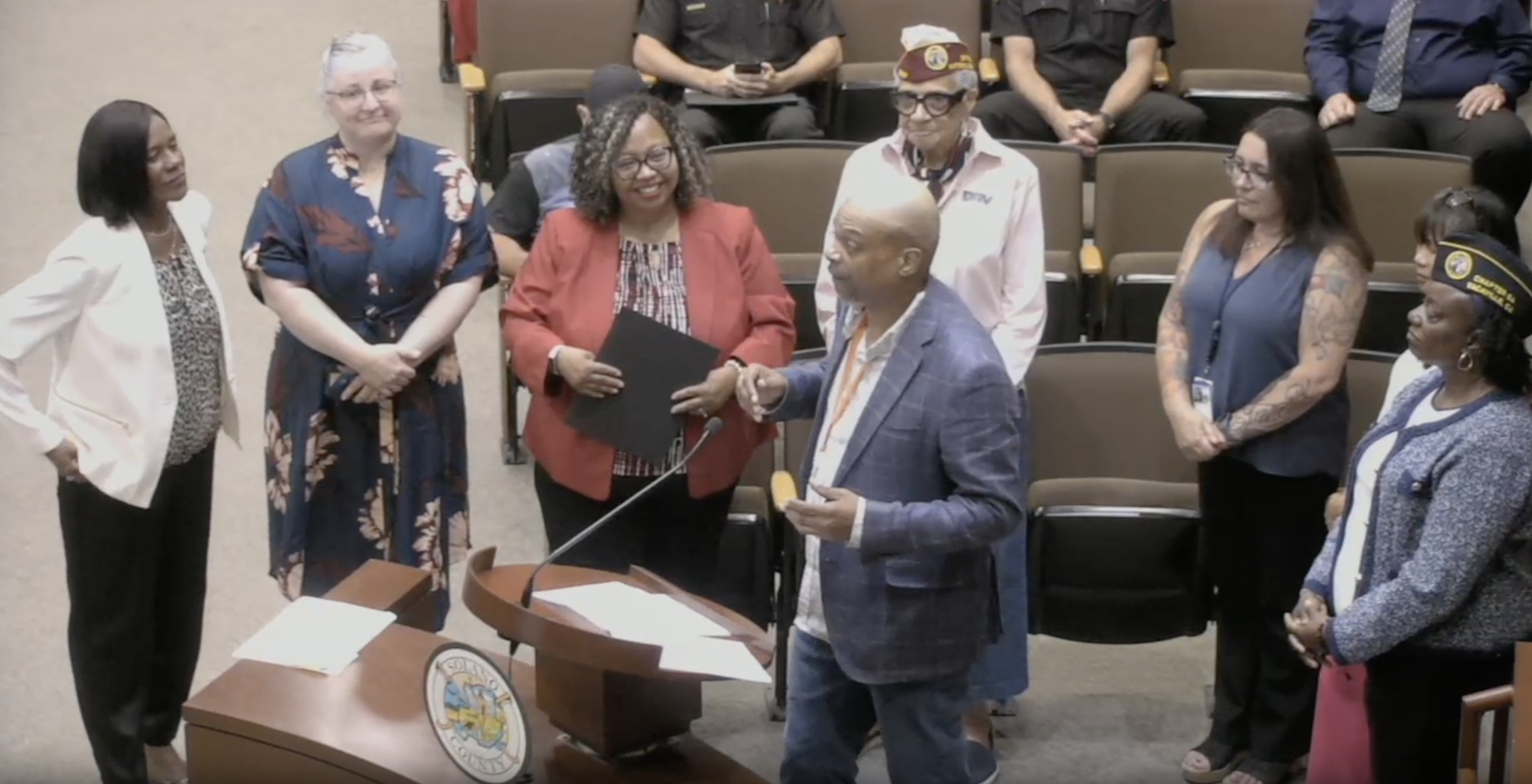
Women Veterans Recognition Day (June 12) resolution adopted 4-0, featuring remarks from Marissa Hanan, a 20-year Air Force veteran and VA service representative, and Al Sims of county veteran services.
Juneteenth Day resolution adopted 4-0; Supervisor Williams issued a separate proclamation honoring the Suisun City Youth Commission for organizing annual celebrations since 2022. David Knott accepted on behalf of the committee.
Rhonda Rashawn Smith of the NAACP Vallejo Branch announced a June 20 blood drive in partnership with the Red Cross, highlighting sickle cell disease needs.
HR Director Nyjah Edwards introduced new county Safety Analyst Jennifer Hoot, who brings 30 years of safety and compliance experience including 11 years with OSHA.
Supervisor Williams announced her election as ABAG vice president and her re-election to the Board of Supervisors.
Closed session on labor negotiations for the county and IHSS Public Authority produced no reportable action.