
Board of Supervisors - Mar 10, 2026 - Meeting
Board of Supervisors • Solano CountyMarch 10, 2026
Locunity is a independent informational service and is not an official government page for this commission.We use AI-assisted analysis and human editorial review to publish information.
Prosecutors, Defenders and Caregivers Warn Board: Pay Crisis Threatens Public Safety
Solano County supervisors heard an urgent and emotional parade of public employees and caregivers demanding competitive wages at their March 10 meeting, with DA and public defender attorneys documenting a 20% pay gap and in-home care providers calling the county's 50-cent raise offer "an offense." The board also unanimously banned heavy commercial trucks from 18 rural roads and celebrated the county's social workers and agriculture industry before adjourning to closed-session labor talks with no reportable action.
- DA and public defender attorneys warn 6% raise over three years will trigger another staffing exodus while surrounding counties offer 12%
- IHSS caregivers say Solano's $18.10/hour wage trails Napa's $20.50, and every dollar in raises brings back $0.86 in state and federal funds
- Board bans heavy trucks from 18 county roads after years of pavement damage from commercial rigs leaving I-80 and I-505
- Social workers spotlight field dangers: 37% face verbal assaults, 14% physical attacks, while housing and child welfare systems strain
- Farm Bureau president plans to lobby Congressman Thompson on federal specialty crop classification that shortchanges California fruit and nut growers
"We Won't Back Down": Attorneys Demand Pay Equity as Contract Talks Stall
Five attorneys from the District Attorney's and Public Defender's offices — along with their labor representative — used public comment to deliver a coordinated, deeply personal appeal to the Board of Supervisors as Unit 1 contract negotiations remain unresolved.
Why it matters: Solano County's prosecutors and public defenders handle the most serious criminal cases in the county — child sexual assault, domestic violence, homicide, and mental health competency — and they say they are paid roughly 20% below the Bay Area average. A retention crisis three years ago hollowed out both offices; speakers warned the board that the county's current offer of 6% over three years would widen the gap as neighboring counties raise pay 12% over the same period.
Where things stand: Deputy District Attorney Elaine Kuo, an 11-year veteran who prosecutes domestic violence and child sexual assault, described the last pay crisis in stark terms: "We watched as attorneys in every stage of their career left to commute 20 minutes in the opposite direction to make 20% more and work 20% less." She told the board the office cannot afford a repeat. "Unit one cannot go back. And that's why we won't back down."
Prosecutor Will Moser, just finishing a four-year rotation in the sex crimes unit with five consecutive child sexual assault trials, framed the issue through the lens of victims: "What's best for the victims of this community is making it so we can retain talent in the best way possible. Retain and recruit the best talent. The way we do that is by making our office competitive." He named seven Bay Area counties — Napa, Marin, Contra Costa, Alameda, Santa Clara, San Francisco and San Mateo — that offer better pay.
On the defense side, Public Defender Ricky Estrada, a Vallejo native, said his caseload has ballooned since arriving in 2022: "I came from Marin County, the public defender's office, and I saw my caseload go up double, almost triple." Deputy Alternate Public Defender Sayuri Takagawa quoted federal case law on the constitutional role of public defenders and warned that losing experienced attorneys would force the office to rebuild again — at the community's expense. Attorney Martin Malik, a 14-year veteran focused on clients with mental illness, described the looks on parents' faces when their children are in the system, and asked the board to invest in retention before it's too late.
The other side: Unit 1 Labor Representative Costa Karostenzi put numbers to the argument: Unit 1 pay sits 20% below the Bay Area average, 14–15% below surrounding counties, and 8% below the county's own comparable-agency studies. "The current offer is 6% over three years. But what we know is that all the counties around us and all the counties that even the Solano looks at are going to go up 12% over three years." He invited every supervisor to meet with the bargaining team.
What's next: The board adjourned to closed session on labor negotiations with no reportable action. Both Unit 1 and IHSS provider contracts remain unresolved, and public pressure from both groups dominated the meeting.
IHSS Caregivers: 50-Cent Offer Leaves Millions in Federal Dollars on the Table
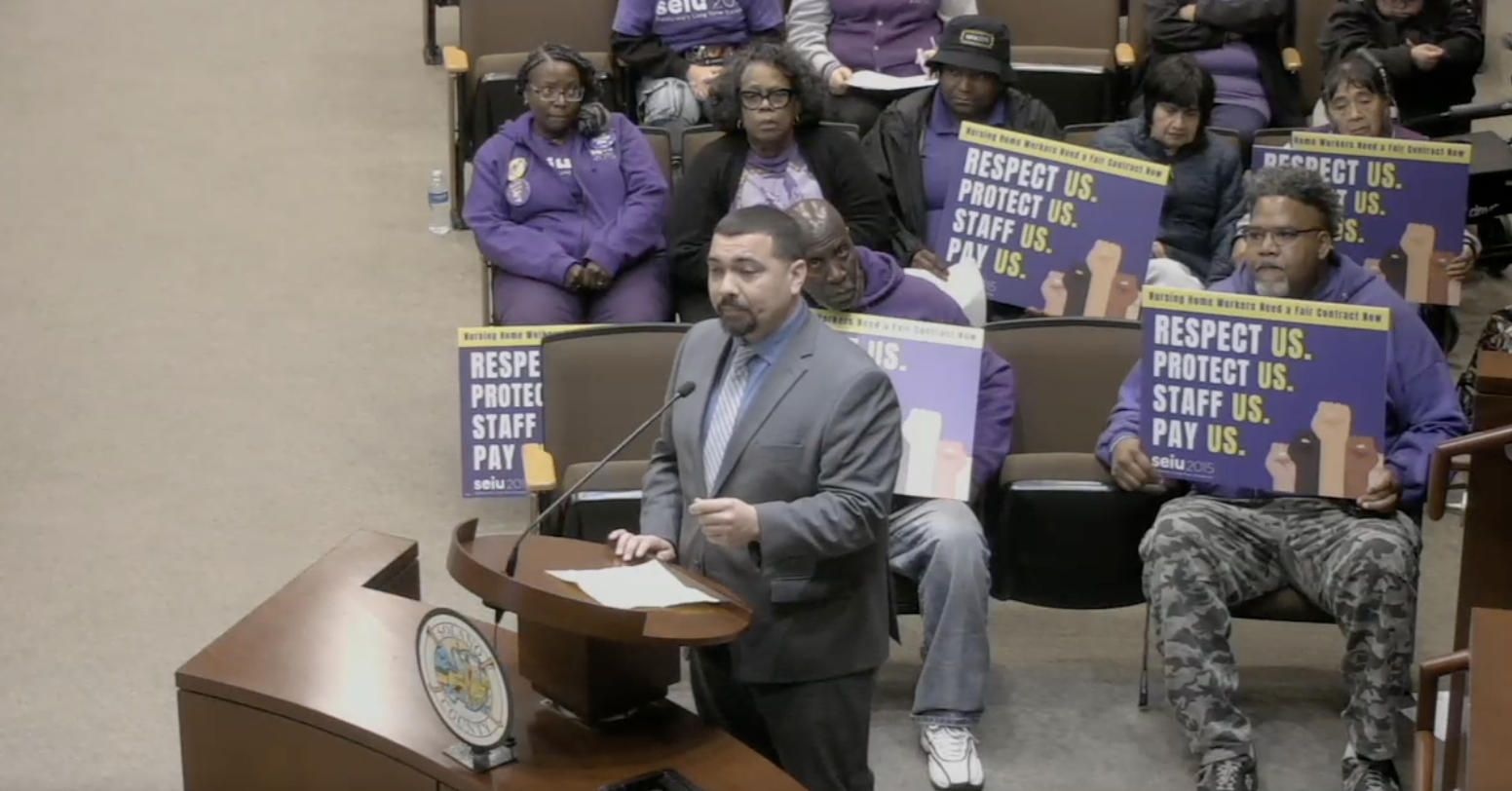
Two in-home care providers from SEIU Local 2015 made the fiscal — and moral — case for a larger wage increase during public comment.
Why it matters: More than 7,000 Solano County families rely on the In-Home Supportive Services program to keep loved ones with disabilities and aging family members out of institutional care. Caregivers are currently paid $18.10 per hour — compared with $20.50 in Napa County and $19.05 in Yolo County — and the county's offer after eight months of bargaining amounts to a 50-cent raise.
Where things stand: Minerva Pena, a six-year IHSS provider who cares for her own daughter with special needs and serves on the SEIU Local 2015 bargaining team, laid out the math: "Every $1 you all choose to contribute to caregiver wages bring $0.86 back to Solano County from state and federal funding sources." She said the union's proposal would generate more than $12 million in state and federal funds over three years and $4 million in new local economic activity. Speaking at the board for the fifth time, Pena called the 50-cent offer "an offense."
Baltazar Dispo, a 90-year-old retired physician and 10-year SEIU Local 2015 member who cares for his wife who has Alzheimer's, asked the board to raise pay not by 50 cents but by $3.
What's next: IHSS wage negotiations continue in closed session alongside the Unit 1 attorney contract. The fiscal-multiplier argument — that every local dollar invested returns $0.86 in state and federal matching funds — puts pressure on the board to weigh the true cost of a low offer against the federal dollars left unclaimed.
Board Bans Heavy Trucks From 18 County Roads
Trucks Cut Through the County
After years of resident complaints and accelerated pavement destruction, the Board of Supervisors unanimously adopted Traffic Order 438, establishing 7-ton load limits for commercial trucks on 18 county roads. Agricultural trucks are exempt.
Why it matters: Commercial trucks have been leaving congested I-80 and I-505 corridors to use narrow county roads as shortcuts — routes never engineered for heavy loads. New distribution centers near I-505 and aggregate hauling for development in Dixon and Benicia have intensified the problem.
Where things stand: Assistant Director of Resource Management Matt Tuggle walked the board through the engineering rationale: "Heavy trucking on a road can turn it over in a year or two. I mean, we can see heavy damage happen quickly." The affected roads include the Winters-Dixon corridor (Seavers, Weber, Boyce, Gandini, Wolfskill), the "tree streets" (Maple, Walnut, Poplar, Willow) near the residential Leisuretown community, and Lake Herman Road near Benicia. Trucks with delivery manifests to locations on restricted roads retain legal access. Signage will take approximately two months to install, giving the California Highway Patrol enforcement authority.
Supervisor Wanda Williams praised the effort: "I want to thank resource management for actually putting in these low limits for the roads for these trucks. I know how damaging they can truly be."
The McCormick Road question: Supervisor Mitch Mashburn raised concerns about McCormick Road near Rio Vista, which drivers use to avoid Highway 12 backups. Tuggle acknowledged the dilemma: "McCormick's tricky because by intent it might need to actually perform a truck route function. But until it's actually built, we don't want to designate it one way or the other." A Phase 3 gravel section remains incomplete, and Caltrans has pushed the SHOP program — which would fund Highway 12 improvements — to 2029. Mashburn suggested the state should help fund McCormick Road completion since it effectively serves as a state highway reliever.
Decisions: Traffic Order 438 passed 4-0 (For: Brown, James, Williams, Mashburn; Absent: Vasquez).
Board Honors County's Social Workers Amid Stories of Danger and Crisis
The board adopted a resolution recognizing March 2026 as Social Work Month, but the real weight of the item came from three of Solano County's more than 150 social workers who described what the job actually looks like.
Child Welfare Social Worker Amy Seaborn cataloged the hazards: "About 37% of our social workers, our victims of verbal assaults and threats. Psychological aggression as well. 62% of social workers deal with this within a year." She noted that 14% face physical assaults annually and that social workers enter homes "unarmed" with "clipboards and pens."
Jessica Bennett Roberts, who works in the Housing Support Program helping people facing homelessness, brought a unique perspective — she is a former CalWORKs recipient herself. She challenged the systems she now navigates on behalf of clients: "It is important to mention that many of our current systems, welfare, housing, reentry, every system, are not designed for forward trajectory." She described bridging the gap between clients' barriers and a housing market with sky-high rents.
Paolo Diancin from the In-Home Supportive Services division described how the IHSS program allows people with physical and mental disabilities to remain in their own homes with compensated caregivers rather than entering institutional settings.
The resolution passed 4-0 (For: Brown, James, Williams, Mashburn; Absent: Vasquez). Deputy Director Neely Carpenter introduced the speakers.
Ag Day: Farm Bureau Takes Aim at Federal Crop Classification
Supervisor Williams presented a resolution recognizing March 24 as Ag Day and March 15–21 as Ag Week, noting agriculture encompasses approximately 67% of Solano County land, with commodities exported to 41 countries and contributing more than $460 million annually.
Farm Bureau President Cliff Howard used the moment to push a federal policy issue: "I find it kind of offensive that we say that fruits and nuts, which are part of a healthy, balanced diet, are specialty crops." California produces roughly 65% of the nation's fruits and nuts, yet they receive a fraction of the federal subsidies directed at Midwest commodity crops. Howard announced he would raise the issue the following day at a roundtable with Congressman Thompson.
Executive Director Miranda Jackins of the Solano County Farm Bureau thanked the board and stressed the importance of partnerships between local government and the agriculture community.
The resolution passed 4-0 (For: Brown, James, Williams, Mashburn; Absent: Vasquez).
Minor Items
- Consent calendar approved 4-0, including a Medic Ambulance contract extension with a new franchise fee. Supervisor Mashburn thanked Medic Ambulance for extending service while the county completes its competitive bid process.
- Vacaville Fire Protection District special district consent calendar approved 4-0.
- Fairgrounds community garden: Joseph Joyce of the Solano County Fairgrounds announced plans to establish a community garden on fairgrounds land by next year, building on the Food is Free program that serves families twice weekly with lines around McCormick Hall. He said the garden would open access to agricultural grants and complement the fair's junior livestock program.
- Closed session on labor negotiations (Unit 1 attorneys and IHSS providers) produced no reportable action. The board does not meet again until March 24.