Board of Supervisors - Mar 03, 2026 - Meeting
Board of Supervisors • Solano CountyMarch 3, 2026
Locunity is a independent informational service and is not an official government page for this commission.We use AI-assisted analysis and human editorial review to publish information.
IHSS Workers Demand Living Wages as County Faces Brewing Labor Crisis
The Solano County Board of Supervisors' March 3 meeting was dominated by emotional testimony from caregivers and county employees who say they can no longer afford to live where they work — a workforce crisis unfolding just as federal and state lobbyists warned that billions in safety-net funding could evaporate under HR1. The board approved a deputy sheriff union contract and a garbage rate increase but took no action on the wage demands, heading instead into closed-session labor negotiations.
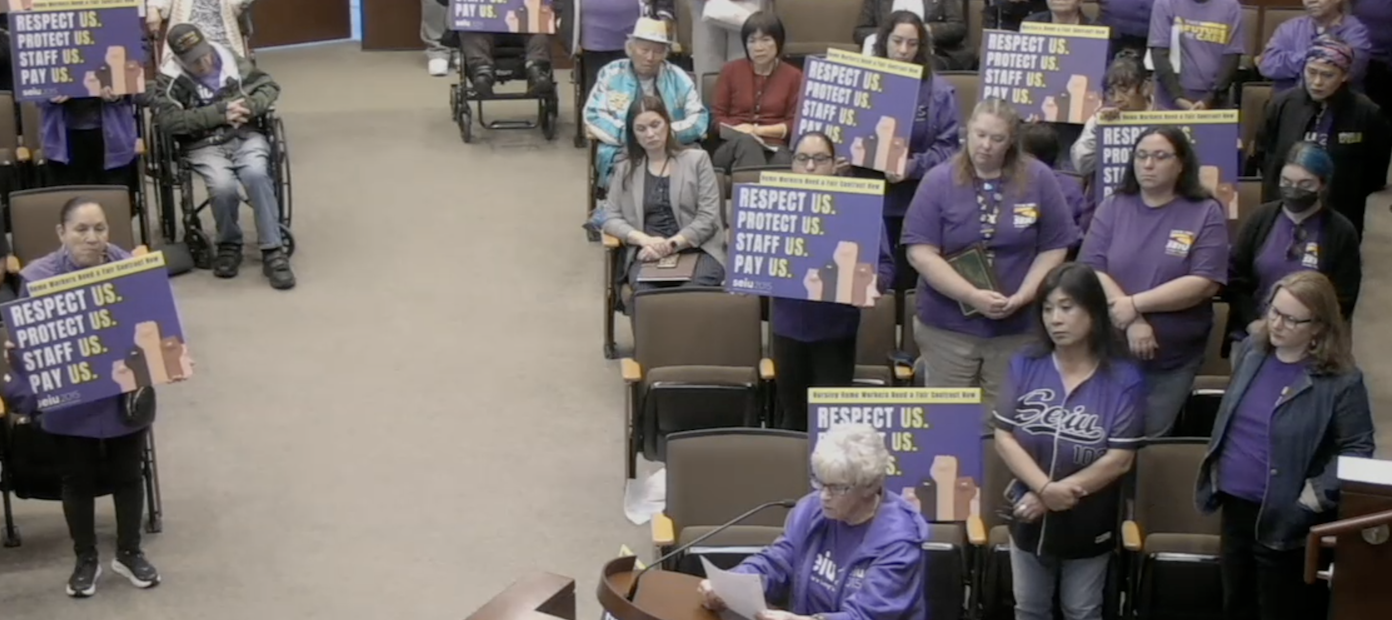
Eight IHSS caregivers and union members flood public comment demanding wages above $18.10/hour, citing neighboring counties already paying $20+
Federal HR1 threatens $10.6 billion hit to California counties, with Solano's 39% federally and state-funded budget directly at risk
Board approves deputy sheriff contract through October 2028 with pay parity protections ensuring deputies get any COLA other units negotiate
3% garbage rate hike adopted after Prop 218 hearing draws just 20 protests out of 5,818 affected parcels
County submitting $7.5 million in federal earmark requests, including $4 million for a Vallejo community resource building
Suisun Valley traffic study signals future Saturday harvest-season congestion near Solano College as winery and hotel development proceeds
Caregivers Say They Can't Survive on $18.10 an Hour
Eight speakers from SEIU 2015 and SEIU 1021 lined up during public comment to deliver the meeting's most pointed message: in-home supportive services workers who care for 7,000 vulnerable Solano County residents are being paid wages that force them onto the same safety-net programs their clients use.
Why it matters: IHSS caregivers earn $18.10 per hour — more than $2 below what Napa and Sonoma counties pay. Speakers warned the wage gap is driving experienced caregivers to neighboring jurisdictions, threatening care for elderly and disabled residents who depend on the program to stay out of costly nursing facilities.
Where things stand: The county has reportedly offered a 50-cent raise. Union members called that figure an insult. "A 50-cent raise would add only $100 a month," said Julia Hahn, a public commenter, who noted average one-bedroom rent in the county runs $1,600 and that IHSS workers earning roughly $2,900 a month cannot make ends meet without relying on services like the food bank.
Minerva Chavez, an SEIU 2015 bargaining team member and IHSS provider for her disabled daughter, framed the investment in fiscal terms: every $1 the county puts toward caregiver wages brings back $0.86 in state and federal matching funds. She said the union's proposal would generate $12 million in external funding over three years and $4 million in local economic activity.
Sherry Williams, an IHSS worker, offered the most personal testimony. She described being forced out of the county after her mother passed away, losing housing and her car, and facing dangerous work situations with no backup. She told the board that in over 30 years, the county has given IHSS workers only four raises — while supervisors received an 18% raise in 2025.
Leticia Guerrero, an SEIU 2015 advocate, called in with data from an Alameda County study estimating $182 million in economic output from raising IHSS wages to $20 per hour. She noted that wage increases reduce caregiver turnover by up to 30%.
Kathy Mazingo, a 20-year IHSS provider, requested a financial audit of IHSS funds over the past 10 years and asked why IHSS is not included in the county budget, requesting a raise of $1.25 to $1.50 per hour.
Carl Vinson, an SEIU 2015 volunteer, warned the board directly that he would campaign against unsympathetic officials in midterm elections.
Decisions: The board took no public action. It entered closed session later in the meeting on IHSS and county labor negotiations. No report out was provided.
What's next: IHSS contract negotiations continue behind closed doors. The volume and coordination of public testimony suggest SEIU 2015 and SEIU 1021 are escalating pressure ahead of what could become a protracted fight.
County Workers Paint a Picture of Staffing Crisis
The IHSS wage fight was not the only labor pressure point. Three county employees from SEIU 1021 described a broader workforce retention crisis spanning libraries, mental health services, and other departments.
Why it matters: When county workers leave for better-paying jurisdictions, service delivery suffers — and residents bear the consequences.
Where things stand: Natasha North, a children's librarian with the county since 2002, said she routinely trains new librarians who then leave for higher pay elsewhere. She described colleagues in their 30s who still live at home because they cannot afford rent.
Jennifer Lariviere, an SEIU 1021 member and Vallejo resident, told the board she once called Mobile Crisis for a person experiencing a mental health emergency and was told the responder would be a volunteer — not a dedicated staff person. The anecdote underscored how staffing shortages have hollowed out frontline services.
Simone Arnett, an SEIU 1021 member, called on the board to stop hurting employees through healthcare benefit changes and to reach a fair contract agreement.
HR1 Looms as Biggest Fiscal Threat to Counties in a Generation
The board received a sweeping federal and state legislative update that placed one issue above all others: the potential impact of HR1 on county budgets.
The basics: HR1 is the House reconciliation package that proposes cuts to Medicaid, SNAP, and CalWorks. The California State Association of Counties estimates those cuts would cost California counties $10.6 billion collectively.
Why it matters: Solano County's budget is 39% federally and state funded. If Medicaid coverage lapses for hundreds of thousands of Californians, counties become the payer of last resort for hospital care, eligibility processing, and safety-net services — with no state plan yet to backfill the gap.
"It's the biggest thing hanging over counties going into 2026, and these are very high stakes for your fiscal health and being able to pay your bills and take care of as many people as you can," said Karen Lane, the county's state lobbyist.
Federal earmarks: Rachel Mackey and Hassan of Paragon Government Relations reported that the county is submitting roughly $7.5 million in earmark requests, including $4 million for a Vallejo community resource building, $1.5 million for a First 5 Center in Fairfield, and $2 million for stormwater infrastructure. Deadlines for submissions were imminent.
The lobbyists also briefed the board on the BASICS Act, which would require state departments of transportation to sub-allocate bridge formula and road safety funding directly to local governments, bypassing Caltrans's discretion. Supervisor Wanda Williams, District 3, asked Representative Garamendi to sponsor the bill.
On housing, the Senate was voting on the 21st Century Housing Act, which includes provisions on private equity purchases of single-family homes and a Build Now Act that could penalize CDBG grantees failing to meet housing growth metrics. Supervisor Cassandra James, District 1, raised concerns about mid-sized counties competing for housing dollars: "Mid-sized counties can't compete with larger counties such as LA or San Francisco or even Alameda County where they are fast-tracking building some of their affordable housing."
Chair Monica Brown, District 2, pressed on the Older Americans Act — not reauthorized but still funded — and challenged the notion that tariff revenue would fund maritime programs: "You're telling me that the tariffs that should go back to the people that paid them is where they're thinking the funding source is going to come from."
State Budget, Ballot Initiatives, and PG&E Municipalization
Karen Lane delivered a comprehensive Sacramento update covering budget pressures, ballot threats, and utility policy.
Why it matters: Two ballot initiatives are likely qualifying for November that could reshape county governance: the Local Taxpayer Protection Act, which would make local taxes harder to pass (1.3 million signatures submitted), and a voter ID requirement. Lane warned the tax measure directly threatens the board's ability to raise revenue. The California Chamber of Commerce also has a CEQA reform initiative at 25% of required signatures.
Where things stand: On the state budget, Lane noted the governor based revenue projections on optimistic stock market assumptions. The Legislative Analyst's Office had forecast an $18 billion deficit but subsequently adjusted estimates upward by $5 billion.
On utilities, SB875 by Senator Wiener would streamline municipalization of PG&E infrastructure. Supervisor Mitch Mashburn, District 5, expressed direct interest regarding the Dixon substation: "If our county owned the Dixon substation and had the ability to make that hub a transit point for electricity that PG&E had to pay us to use, we might be able to address some of the issues we have in our county." Lane cautioned that "going up against PG&E is a daunting task."
Chair Brown expressed frustration about Care Court funding, noting the governor is threatening counties that haven't enrolled enough participants despite bed shortages and insufficient Prop 1 dollars. "I am not happy with Gavin in so many things, but this is one of them. He wants to threaten. He's threatened to pull funding from counties," she said.
SB872 by Senator McNerney proposes $300 million for Delta levy repair and state water project subsidence. On vehicle miles traveled, AB1421 merely extends a study deadline — not a new tax.
Board Approves Deputy Sheriff Contract With Pay Parity Clause
The basics: The board unanimously approved a new memorandum of understanding with the Solano County Deputy Sheriff's Association covering Unit 3 (law enforcement employees) and Unit 4 (law enforcement supervisors). The MOU runs from March 3, 2026, through Oct. 28, 2028.
Why it matters: Side letters guarantee pay parity — any cost-of-living adjustment negotiated by other county bargaining units will automatically extend to deputies. The provision effectively ensures that the SEIU 1021 contract fight currently underway has direct implications for law enforcement compensation.
HR Director Nyjer Edwards presented the agreement. Both units ratified it. There was no public comment or board discussion.
Decisions: Approved 4-0 (For: Chair Brown, Supervisor James, Supervisor Williams, Supervisor Mashburn; Absent: Supervisor John M. Vasquez).
3% Garbage Rate Hike Sails Through With Minimal Protest
The basics: After a Proposition 218 public hearing, the board adopted a 3% inflationary rate adjustment for solid waste, organics, and recyclables collection in unincorporated Solano County.
Why it matters: Four haulers serve different parts of the county — Mount Diablo Resource Recovery, Recology Vacaville Solano, Recology Vallejo, and Republic Services. The previous 10-year contract (2014–2024) built in a fixed 3% annual adjustment; the one-year extension that followed had 0% inflation. This action restores the inflationary increase. Residential customers will pay $0.82 to $1.19 more per month depending on cart size; commercial increases range from $2.05 to $5.19 per month.
Narcissa Antal of the Department of Resource Management presented the item. Of 5,818 affected parcels, only 20 written protests were received — far short of the 2,910 needed for a majority protest.
Supervisor Mashburn asked whether the county could consolidate four hauler contracts into one: "Is there a methodology by which we can consolidate those contracts into one so that we have one provider that's providing for the entire county rather than have to divide that up four ways?" He also requested franchise fee revenue data; the county currently collects 5% on gross receipts, a rate unchanged since 2003.
Decisions: Approved 4-0 (For: Chair Brown, Supervisor James, Supervisor Williams, Supervisor Mashburn; Absent: Supervisor Vasquez).
Suisun Valley Traffic: Fine Now, Trouble Brewing on Saturdays
Matt Tuggle, Assistant Director of Resource Management, presented a traffic capacity analysis of Suisun Valley Road commissioned in December 2023 and conducted by TJKM.
Where things stand: The corridor, divided into five segments from the county line to Solano College, generally operates at Level of Service A through C. After the congestion management lane opened on I-80, Suisun Valley traffic slightly improved. But 10-year buildout modeling — including wineries, tasting rooms, and boutique hotels — projects that Saturday harvest-season conditions in Segments A and B (Solano College to Rockville Corners) could degrade to Level of Service D through E. Ninety percent of traffic enters from the south.
What's next: The county has secured Priority Conservation Area grant funds from MTC for design of Segment A improvements, including shoulder widening, a sidewalk connector, and a transit stop. Staff proposed exploring a transit bus route from Solano College through Rockville Corners. Supervisor Williams asked about Rockville Road safety near Patuino Water; planning is underway but paused until the park generates more traffic. Chair Brown asked about bicycle safety near the community college.
Minor Items
Consent calendar approved 4-0. Included a donation for the Junior Livestock Auction at the Solano County Fair. Jill from the Solano County Fair announced the fair runs June 11–14 with the theme "Stars, Stripes and Carnival Lights" for the nation's 250th birthday.
Red Cross Month proclaimed. Vincent, Executive Director of the American Red Cross North Bay Chapter, accepted the resolution, noting 90% of Red Cross work is performed by volunteers at a 13-to-1 ratio. Approved 4-0.
Women's History Month resolution adopted 4-0. Supervisor Williams highlighted that the Solano County Office of Education Board is the only all-female board in the state. Dr. Nicola Parr, the county's first African American superintendent, was honored. Vernell Bromfield, co-chair of the Commission for Women and Girls, spoke about Black maternal infant health and birth justice work.
Weights and Measures Week resolution adopted 4-0. Agricultural Commissioner Ed King described his team's inspection of more than 7,000 commercial devices annually, including gas pumps across 150+ stations. This year's inspection seals are red, white, and blue for the nation's semi-quincentennial.
2025 Counties Care Food Fight results: Solano County employees raised $55,755, winning the Big Apple Trophy for the sixth consecutive year. Combined with Contra Costa ($67,404), the competition generated $123,160 for the Food Bank of Contra Costa and Solano, which serves approximately 27,000 households per month. Since 2004, the two counties have raised over $2.7 million combined.
Supervisor Williams reported on NACo conference attendance and detailed her federal earmark requests: "$4 million to complete the community resource building in Vallejo, $1.5 million to support programs and services for our new First 5 Center, and $2 million for stormwater infrastructure planning and design initiatives."
Board entered closed session on labor negotiations with county employees and IHSS Public Authority. No report out was provided.