Governing Board - Sep 15, 2026 - Meeting
Governing Board • San Ramon Valley Unified School DistrictSeptember 15, 2026
Locunity is a independent informational service and is not an official government page for this commission.We use AI-assisted analysis and human editorial review to publish information.
District Ends Year $5.2M Ahead, but Enrollment Cliff Threatens Every Dollar
The San Ramon Valley Unified School District closed its books $5.2 million better than expected — and promptly heard a warning that the surplus may already be spoken for. With enrollment down nearly 5,000 students since the pandemic and still falling, the board approved financial reports, labor agreements, and a textbook sufficiency resolution while fielding pointed frustration from its teachers' union over wages that haven't budged.
$5.2M budget surplus may be consumed by enrollment losses — the district is already running 150 students below projection, and every 100 students lost costs $1.3M annually
Teachers' union president tells the board 1,700 educators have received no raise while the cost of living climbs and classroom support falls short
Cal High teacher demands a textbook replacement plan, citing math and social studies materials adopted as far back as 2002
Board ratifies four labor agreements aligning classified employee work years with CalPERS audit rules and updating layoff protections
Students push for sodium-ion battery study and environmental education center, flagging the district's low climate literacy score
Parent calls on SRVUSD to lead on AI-era education, asking what graduates should be capable of when artificial general intelligence arrives
The Budget Is Up — but the Floor Is Moving
Assistant Superintendent/CBO Vince Morales delivered the longest and most consequential presentation of the night: the 2025–26 unaudited actuals for a general fund exceeding $500 million.
Where things stand: Unrestricted revenue came in about $3 million (1%) above target, while unrestricted expenses landed $2 million (0.71%) below budget. The combined $5.2 million positive variance falls to the bottom line as one-time funds. "Unrestricted site came in, the revenue came in 1% higher of target about $3 million," said CBO Vince Morales.
On the restricted side, the biggest shift was a $5 million electric bus grant deferred to next year because PG&E has not completed charging station infrastructure. Buses are expected to arrive in October or November; a state mandate requires full fleet electrification by 2035. Child Nutrition Services turned a profit for the first time under universal meals, allowing the district to charge $400,000 in indirect costs. Site and athletic donations totaling $9.3 million also carried over.
Why it matters: The surplus sounds healthy until placed against the enrollment picture. "If you look at 2019-20, we were almost 32,000 students. And today in 26-27, about 26,000 projected. We lost 5,000 students since the pandemic," Morales told the board. In the first 12 days of school, enrollment was running roughly 150 students below even those reduced projections. "Keep in mind that every 100 students lost is an ongoing revenue loss of about $1.3 million," he warned, adding there is "a very, very good chance" the board will need to reserve the entire surplus to cushion out-year revenue declines.
Superintendent Cammack underscored that the decline is structural, not a sign of families choosing other schools. "Every year we have fewer and fewer students entering the district at the TK and kindergarten level because the national and state level birth rates are at historic lows," he said, adding that every enrollment drop triggers corresponding reductions in staff and services under the state funding formula.
Trustee Laura Bratt praised the business team's precision, saying the close match between estimated and unaudited actuals — across 12,000 lines of ledger data — was critical for confidence. "Building back that trust and knowing that we have a team that can make these estimates in such a close way is really important for me," she said.
Decisions: The board accepted the unaudited actuals unanimously (For: 4, Against: 0, Absent: 1 — Trustee Shelley Clark). Auditors begin work within two weeks; audited financials return to the board in January.
What's next: The first interim report will include Supplemental Early Retirement Program (SERP) savings analysis and updated multi-year projections. Morales also announced plans to deploy business services staff to school sites as liaisons.
Union President: 'Our Educators Haven't Received a Raise'
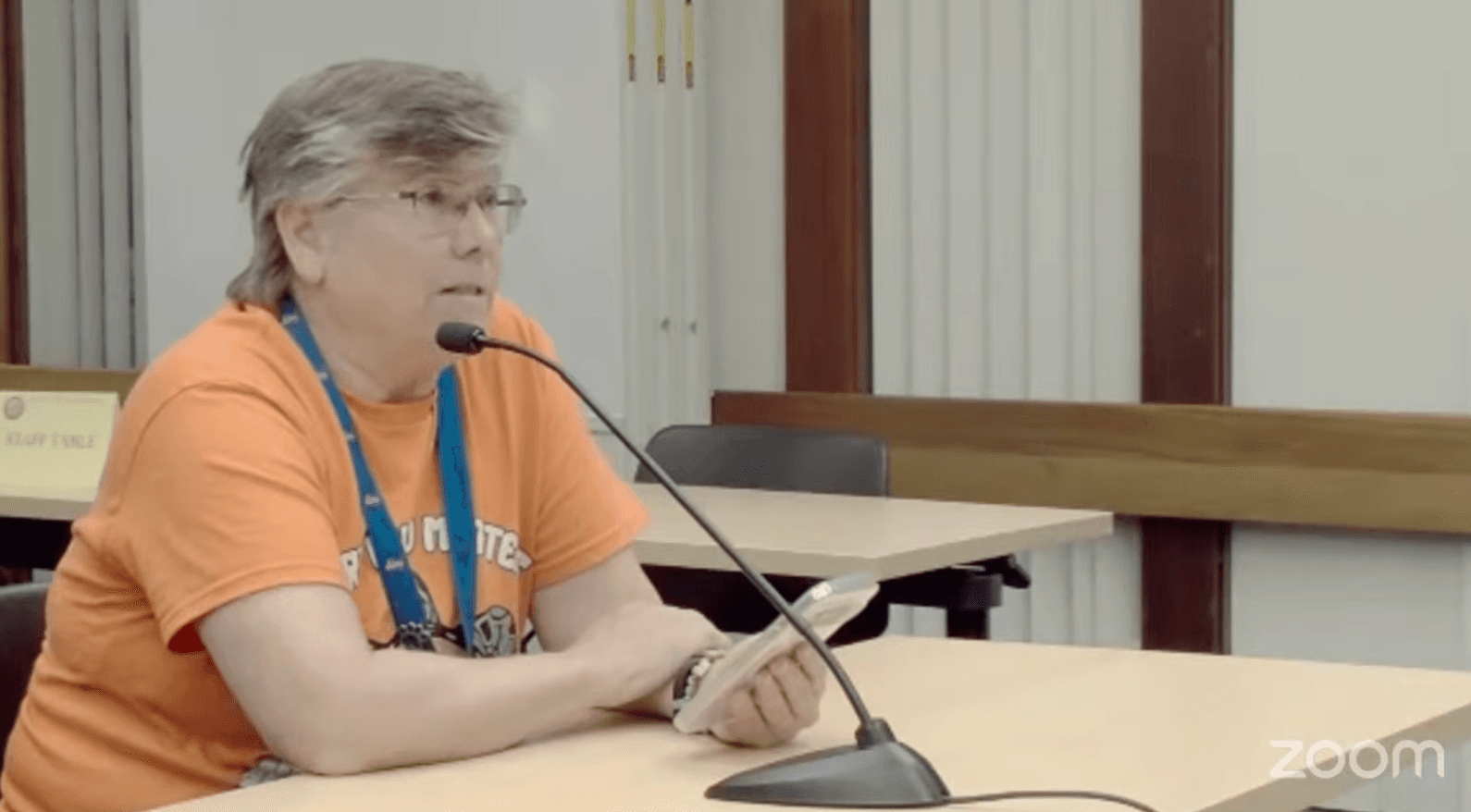
SRVEA President Laura Finkov used her association report to deliver a blunt message on behalf of the district's roughly 1,700 certificated employees.
Why it matters: The union's public frustration, delivered the same night the board heard about a $5.2 million surplus, sharpens the tension heading into future contract negotiations. The district's enrollment-driven fiscal constraints could make responding to compensation demands difficult.
Where things stand: "Our educators haven't received a raise. While the cost of living continues to soar, there isn't enough support in our classrooms," Finkov told the board. She said members also feel the district's furlough day could have been restored sooner. "They believe the furlough day could have been restored earlier, relieving employees of months of unnecessary uncertainty and stress rather than waiting until the last minute."
Finkov emphasized she was not being negative but fulfilling her duty to represent members, and asked the board and management to demonstrate they value educators "not just in words, but in priorities and in decisions."
She opened her remarks with a land acknowledgement recognizing Orange Shirt Day (Sept. 30) and shared a personal connection to Indian boarding school history. "For me, this history is personal. My mother grew up at the Stewart Indian School in Nevada," she said.
CSEA President Tammy Castelluccio also spoke, previewing the 260-day side letters and layoff language agreements coming before the board later in the agenda.
Outdated Textbooks Pass Legal Muster, but Teacher Demands More
The board held a public hearing and then adopted Resolution 42-26-27 certifying that every student has a textbook or digital equivalent for 2026–27, as required under the Williams Settlement. But the legal standard drew sharp criticism from the classroom.
The basics: The Williams Settlement requires districts to annually certify that students are not sharing textbooks or relying on photocopies. Sufficiency is measured by matching per-classroom enrollment against textbook or digital license counts.
Where things stand: Lucas Westmoreland, a teacher at California High School, told the board that compliance is not the same as quality. "Under Williams, sufficiency simply means having enough copies so students aren't sharing or relying on photocopies. But technical sufficiency does not equal educational quality or modern framework alignment," he said.
Westmoreland cited high school math texts adopted in 2005–2006 — now two state framework iterations old — and social studies texts from 2002–2007 that lack nearly a quarter century of historical developments. AP course materials are also misaligned with College Board updates. "While state law mandates an automated replacement pipeline for K-8, high schools rely on local board action. Without a structured replacement plan, our high schoolers are left using materials adopted in some cases decades ago," he said, asking the board to direct staff to embed a multi-year replacement plan in the Local Control and Accountability Plan.
The other side: Superintendent Cammack acknowledged the challenge but noted funding constraints. "Before LCFF was implemented, we did receive categorical money from the state for textbook adoptions — that went away under LCFF," he said. He added that the fiscal impact varies widely: updating a singleton AP course is far cheaper than replacing texts for high-enrollment U.S. history sections. He committed to developing a framework and schedule for planned adoptions.
Student Board Member Samira Shosalamova asked how sufficiency is measured and was told it is based on matching enrollment to available textbook or license counts per classroom.
Decisions: Resolution 42-26-27 was adopted unanimously (For: 4, Against: 0, Absent: 1 — Trustee Clark).
What's next: The superintendent indicated staff will begin thinking through a textbook adoption schedule and its fiscal implications.
Students and Parent Push Forward-Looking Policy Ideas
Three public commenters brought proposals that could shape future board agendas.
What Should a Graduate Know in the Age of AI?
Brian Kelly, a parent of two freshmen, urged the board to confront how education must change as artificial intelligence advances. "What should we teach a child when extraordinary intelligence is available to everyone on demand?" he asked.
Kelly argued that 2030 graduates will be judged differently. "Our students will increasingly be valued not for what they know, but for what they can build. The questions they can ask, the decisions they can make, and the human beings they've become," he said, proposing the board agendize the question: "What should a graduate be capable of to thrive in the AI world of 2030?"
Superintendent Cammack responded positively, offering to connect Kelly with the district's director of technology and executive director of curriculum and instruction, noting the ideas align with SRVUSD's existing learner profile.
Sodium Batteries and Solar Storage
Sasha Levy, a junior at San Ramon Valley High School representing the SRV Future Earth Initiative, proposed that the district install sodium-ion battery backup systems to capture excess solar energy from its existing panels. She explained that sodium batteries are safer than lithium (no thermal runaway risk), cheaper due to salt's abundance, and less environmentally harmful in production. Benefits include emergency backup during grid outages and peak shaving to reduce electricity costs. She requested the board authorize a preliminary feasibility study.
Environmental Literacy Gaps
Alex Ruiz, a senior at San Ramon Valley High School and participant in the California Youth Climate Policy Leadership Program, flagged the district's Environmental and Climate Literacy Action Indicator score: just 12.5 out of 30. "The Environmental and Climate Literacy Action Indicator status for our district is only a 12.5 out of 30," he said, identifying deficiencies including no garden-based education, no environmental field trips, and no district environmental committee. He proposed that the planned sale of the 699 Orchard property include an RFP provision requiring the buyer to build a community environmental education space.
Superintendent Cammack expressed interest in both students' proposals.
Four Labor Agreements Shore Up CalPERS Compliance
The board approved a package of labor agreements addressing two distinct issues: retirement compliance and layoff protections.
The basics: CalPERS — the state retirement system — can retroactively audit how districts calculate the work year for classified employees, sometimes changing rules four to seven years after an employee retires. If the district's 260-day work year definition does not match CalPERS expectations, both the district and individual retirees can face financial penalties.
Where things stand: Items 11.3 and 11.4 are side letters with SEIU Local 1021 and CSEA Chapter 65 (Units 2 and 3) adjusting the 260-day work year to align with CalPERS requirements. The superintendent emphasized these carry no negative financial impact to employees and are purely for compliance. CSEA President Castelluccio confirmed the side letter "will no longer create an issue with our 12-month employees when they retire."
Items 11.5 and 11.6 are separate successor agreements with CSEA Unit 3 and Unit 2, respectively, updating layoff process language through June 2028.
Decisions: All four items passed unanimously (For: 4, Against: 0, Absent: 1 — Trustee Clark).
Vista Grande's Data-Driven Model Delivers Results
Principal Ozzie Durgan showcased Vista Grande Elementary's "culture of responsiveness," built around data dives, schedule restructuring, and a character education program.
A key innovation: moving all three TK classes to morning sessions, freeing TK teachers' afternoons to provide targeted reading support for kindergarten and first graders identified through mid-year DIBELS screening. Fourth- and fifth-grade teachers use a "teaming model" that groups students flexibly by need.
Results: ELA scores grew 7–11 points across third through fifth grades. Math schoolwide performance hit 77%. Science CAST scores rose from 62% to 69%. The Positivity Project character program, in its first full year, helped produce a 97% student safety rate on the California Healthy Kids Survey and a 9-point increase in student connectedness.
Trustee Laura Bratt praised the approach: "I really appreciate the rigor involved in what you shared and then that you have the data to show that it's working must be so validating for everybody who has worked so hard."
Durgan was named SRVUSD Elementary Principal of the Year; PE teacher Austin Glimme was named district Teacher of the Year.
Property Deal, Labor Contracts and a New Principal Head to Closed Session
The board's brief open session served as a prelude to a dense closed-session agenda touching district finances, staffing and employee contracts.
The basics: Under California's Brown Act, school boards must publicly announce closed-session topics before meeting privately. Board President Susanna Ordway read the full agenda aloud, covering five items that span the district's major operational fronts.
Where things stand: The highest-profile items include a real property negotiation at 3130 Crow Canyon Place between the district and B Clinical Inc., with Superintendent CJ Comet serving as the agency negotiator on price and terms of payment. The board also entered private labor talks with four employee groups — Servia, CSEA, SEIU and unrepresented employees — with Melanie Jones as the district's agency representative. "Agency representative are Melanie Jones and employee are with Servia, CSEA, SEIU and unrepresented," said Board President Susanna Ordway before calling for a motion to approve the agenda.
Additionally, the board took up the appointment of a new principal at Tassajara Hills Elementary under Government Code §54957, a leadership change that directly affects families in that attendance area.
Why it matters: The property negotiation with B Clinical Inc. could reshape the district's facility footprint and carry significant fiscal implications. Labor talks across multiple bargaining units will set compensation and working conditions for a broad swath of district employees — from classified staff to unrepresented workers — at a time when school districts statewide face budget pressures. And a principal appointment, while routine on paper, signals a leadership transition at a neighborhood school.
The board also addressed one case of anticipated litigation under Government Code §54956.9(d)(2) and reviewed two claims (#677044 and #677039) for possible rejection, either of which could result in future legal exposure.
Decisions: A motion to approve the closed session agenda passed unanimously (For: 4, Against: 0, Absent: 1). Board Members Laura Bratt (Area 3), Rachel Hurd (Area 5), Jesse Vanzee (Area 1) and Board President Ordway (Area 4) all voted yes. Board Member Clark was absent.
What's next: Outcomes from closed session — if any reportable action is taken — would typically be announced at the next open session. The property negotiation, labor contracts and principal appointment will each carry downstream impacts for students, staff and district finances in the months ahead.
Minor Items
Closed session: The board appointed Jamie Shackelford as principal of Tassahara Hills Elementary effective Sept. 28, 2026, and approved a Fifth Amendment to a lease with B Clinical.
October resolutions previewed: Director Justin White presented five proclamations for Filipino American History Month, Safe Schools Month, Red Ribbon Week, Week of the School Administrator, and National Bullying Prevention Month. Safe Schools programming will include education about the Caroline anonymous tip line and Catapult system.
Student Senate update: Student Board Member Samira Shosalamova reported that the student senate has launched subcommittees on mental health, physical health, and curriculum.
Consent agenda approved unanimously, including student teaching agreements. A public commenter questioned whether the district excludes religious universities; Superintendent Cammack clarified partnerships include public (Cal State East Bay), private, and Lasallian institutions (including St. Mary's College), noting it is "incredibly more difficult year after year to obtain teaching candidates."
Cardiac screenings: Free heart screenings for ages 12–25 at San Ramon Valley High School on Oct. 3, with 400 slots — the first offered in seven years. Board members also promoted the Run for Education and an upcoming candidates forum.