City Council - Mar 30, 2026 - Special Meeting
City Council • San PabloMarch 30, 2026
Locunity is a independent informational service and is not an official government page for this commission.We use AI-assisted analysis and human editorial review to publish information.
San Pablo Advances Rent Review Program and Local Housing Preference
San Pablo's City Council used a special meeting to lay the groundwork for two new housing policies — a rent review process for increases exceeding 7% and a local resident preference for subsidized affordable housing — signaling a concerted push to strengthen tenant protections beyond state law. The council also joined a nationwide opioid settlement and heard pointed allegations of procedural violations at a recent planning commission hearing on a cannabis dispensary.
Council directs staff to build a rent review program covering all residential rentals, including mobile homes, with a January 2027 target
Mayor wins unanimous support for local resident preference in affordable housing projects receiving city funds
Community member alleges Brown Act violations at planning commission hearing on cannabis dispensary near mosque
San Pablo joins national opioid settlement, expects roughly $2,000 for drug abatement programs
Rent Review Program Takes Shape With 7% Trigger
The council's main action of the evening was adopting a resolution amending the FY 2025–27 priority work plan to direct staff to develop a rent review ordinance — a new layer of tenant protection that would apply to all residential rentals in San Pablo, including mobile home space rentals.
The basics: The proposed program would create a public hearing process whenever a landlord raises rent by more than 7% within a 12-month period on units not already covered by statewide rent control. Tenants would have 30 days after receiving a rent increase notice to file a review request. A city-appointed advisory rent review board — made up of tenants, homeowners and a neutral housing professional — would hear testimony and issue a non-binding recommendation.
Why it matters: California's Tenant Protection Act caps annual rent increases at 5% plus local inflation (up to 10%) for covered properties, but exempts many units, including single-family homes and newer buildings. San Pablo's program would fill those gaps and create a structured forum for disputes — without imposing hard caps.
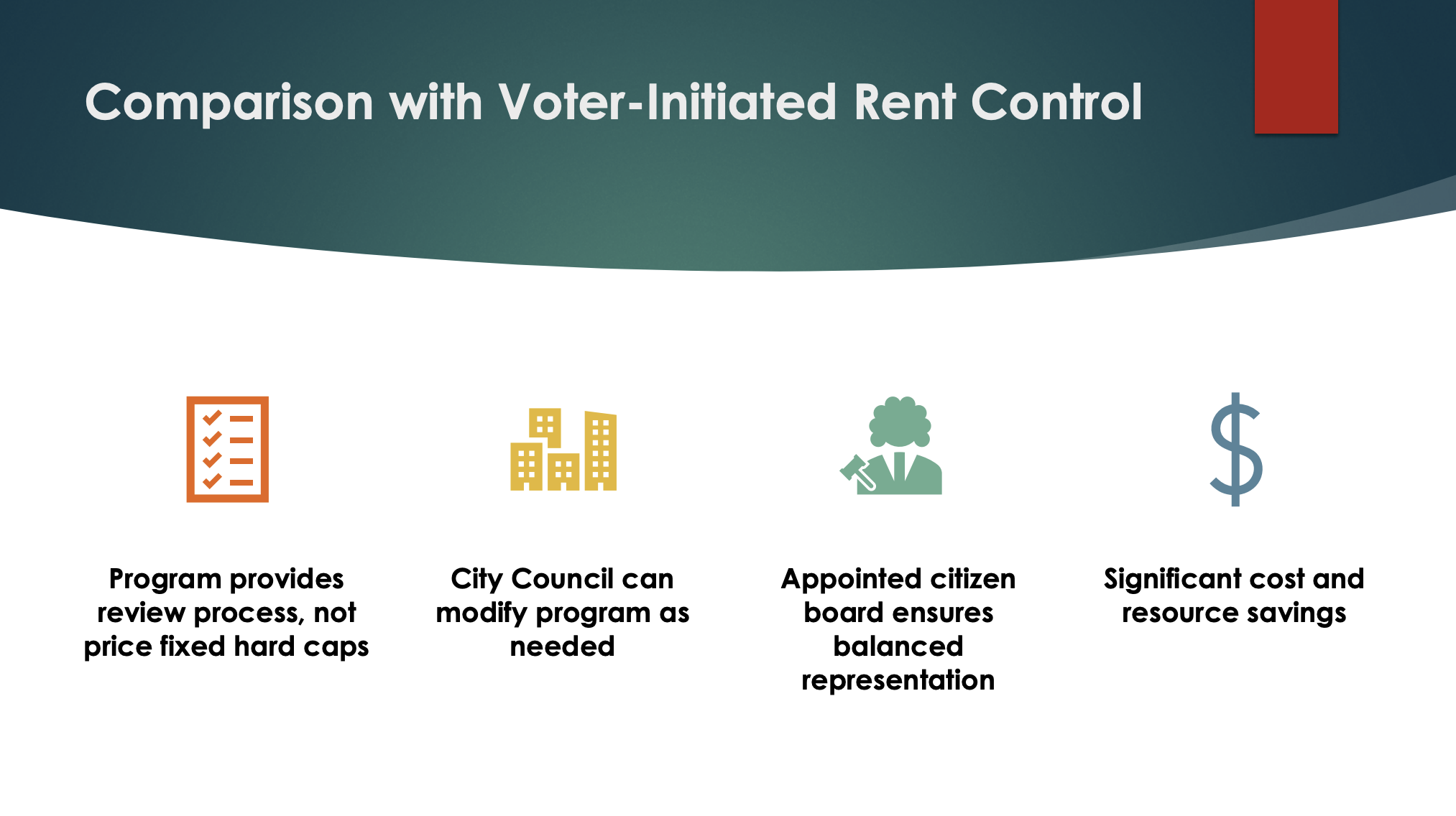
Where things stand: Economic Development and Housing Manager Kieron Slaughter presented the program concept, noting it was modeled after existing programs in Fremont and San Leandro. He drew a sharp distinction from voter-initiated rent control.
"If you compare it to voter-initiated rent control, this program provides a rent review process and not price fixing nor not arbitrary hard caps. The city council has the authority and the ability to amend the program through the years if there needs to be amendments," said Slaughter.
The enforcement mechanism has teeth despite the board's advisory role.
"What is binding is if either party fails to participate in good faith, then it either would validate or invalidate that rental increase notice," Slaughter explained.
Slaughter emphasized the program is designed to serve both sides:
"We do want to strike a balance — tenants have additional protections not covered by state law and housing providers have a reasonable framework where they don't feel like their hands are tied to receive a reasonable return on their investment."
Mayor Elizabeth Pabon-Alvarado reinforced the balanced approach, framing the program as collaborative rather than punitive.
"This is not really about a punishment. It's not law. We're just saying we want to work with both parties, the renters and the homeowners," she said.
She shared an example of a property owner who hadn't raised rent in five years and then needed a 7% or 8% increase — the kind of situation the review process is designed to mediate fairly.
City Manager Matt Rodriguez noted the Economic Development, Housing and Projects Management Standing Committee — consisting of Councilmember Arturo Cruz and Councilmember Patricia Ponce — reviewed the proposal on Feb. 19, 2026. Staff has been developing tenant protections since last summer.
On costs, Slaughter said the program could be funded through fees on housing providers, a general fund subsidy or by redirecting funds from a sunsetting rental registry program.
Decisions: Councilmember Rita Xavier moved to adopt the resolution; Councilmember Ponce seconded. The vote was 3-0 (For: Xavier, Ponce, Pabon-Alvarado; Absent: Cruz, Pineda).
What's next: Staff will develop the full ordinance with stakeholder input from both tenants and housing providers, targeting implementation by Jan. 1, 2027.
Mayor Pushes Local Resident Preference for Affordable Housing
In a separate motion, Mayor Elizabeth Pabon-Alvarado asked the council to amend the work plan to pursue a policy requiring developers who receive financial assistance from the city's Housing Successor Agency to set aside a portion of new affordable units for San Pablo residents.
Why it matters: As new affordable housing projects come online with city subsidy, the policy would give current San Pablo residents priority access — directly addressing displacement concerns in a community where housing costs continue to pressure long-term renters and families.
City Manager Matt Rodriguez clarified this was a work plan amendment, not a final ordinance.
"The fact that it's getting in the work plan just escalates our staff desire to bring something back for formal consideration within the next 90 days to help with affordable housing development in our community," he said.
Decisions: Councilmember Ponce seconded the motion. It passed 3-0 (For: Ponce, Xavier, Pabon-Alvarado; Absent: Cruz, Pineda).
What's next: Staff will return with a formal policy or ordinance within 90 days.
Resident Alleges Brown Act Violations Over Cannabis Dispensary
During oral communications, public commenter Hamad raised a series of concerns about a cannabis dispensary recently approved by the planning commission, alleging procedural violations and public safety risks.
Hamad claimed that 25 participants on Zoom were silenced during the planning commission hearing and that in-person comment was limited to one minute per speaker — conditions he said violated the Brown Act and SB 707.
He also challenged the commission's use of a CEQA exemption, arguing the dispensary's proximity to a mosque warranted a full environmental study.
"There's a mosque with hundreds of people every single day. 500 families served, youth programs daily after school as well as on Sunday. Kids cross that corridor every single day to get to this mosque. And the dispensary is right there," Hamad said.
His comments also touched on cross-jurisdictional traffic impacts, organized crime risks including ramming raids at other dispensaries, potential RLUIPA religious land use violations, loitering near an AC Transit bus stop and questioned the city's reliance on dispensary revenue to offset a $5 million deficit tied to the police station project.
Mayor Elizabeth Pabon-Alvarado noted the item was not on the agenda and the council could not respond. The allegations could foreshadow an appeal or legal challenge to the planning commission's decision.
Minor Items
National opioid settlement: The council voted 3-0 in closed session to authorize San Pablo's participation in a nationwide settlement with six pharmacy distribution companies (MDL No. 2804). The city's estimated share is approximately $2,000, all of which must be spent on approved drug abatement activities. The City Attorney noted this follows prior, larger settlements with major manufacturers.
Closed session on real property negotiations: The council met in closed session regarding 1820 Rum Rail Blvd. (Novan Development Corporation). No reportable action was announced.