
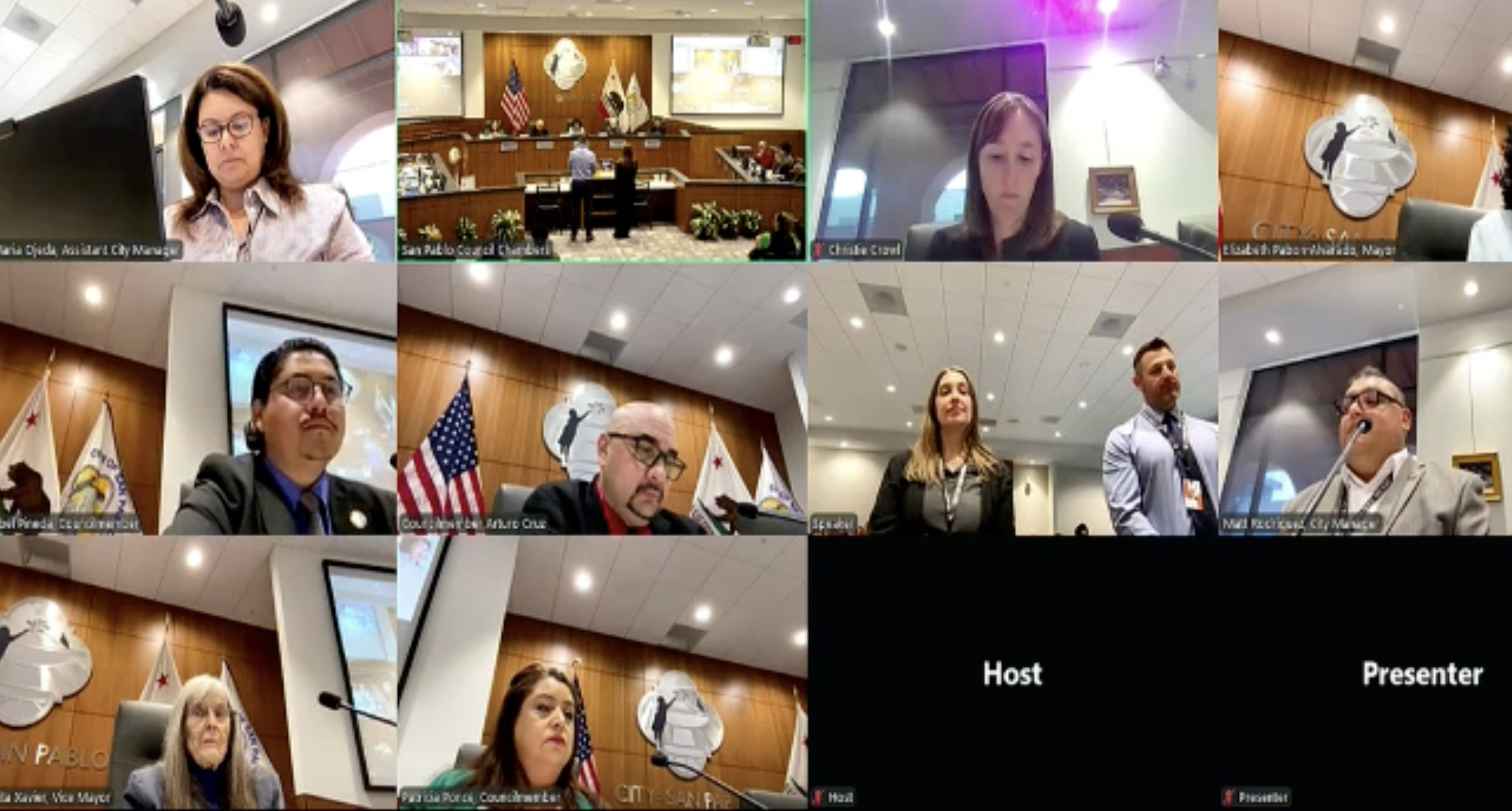
City Council - Jun 15, 2026 - Meeting
City Council • San PabloJune 16, 2026
Locunity is a independent informational service and is not an official government page for this commission.We use AI-assisted analysis and human editorial review to publish information.
Council Orders Fiscal Study on Rent Control Initiative After Heated Debate
San Pablo's City Council certified sufficient petition signatures for a sweeping rent control and just cause eviction initiative but pumped the brakes on placing it directly on the November ballot, voting instead for a 30-day fiscal impact study that drew sharp criticism from tenant advocates. The two-hour debate — featuring eight public speakers, a failed motion, and pointed exchanges between council members — sets up a consequential July vote on whether the most expansive tenant protection measure in the city's history goes to voters.
Council votes 4-1 for fiscal impact study on rent control initiative after motion for direct ballot placement fails 2-3
Eight public speakers clash over 47-page tenant protection measure as Rising Juntos pushes for immediate action and California Apartment Association warns of $10M implementation costs
$120,000 in community grants awarded to 25 nonprofits; mayor recuses from both votes due to conflicts of interest
Street lighting assessment renewed at frozen 1995 rates; general fund covers over half of $2M annual district cost
City celebrates 536 scholarship awards as federal stimulus funding expires
Rent Control Showdown: 30-Day Fiscal Study Ordered as Advocates Cry Delay
A citizen-initiated petition to impose rent control and just cause eviction protections on all San Pablo rental housing — including mobile homes — cleared its first procedural hurdle but faces an additional 30-day wait before reaching the ballot.
The basics: The 47-page initiative, organized by Rising Juntos, would cap annual rent increases, establish just cause eviction rules, require relocation payments, create tenant safety plans, anti-harassment protections, right-of-return provisions, and a new administrative enforcement program. A revised notice of intent was filed in December 2025, and on June 10 Contra Costa County elections officials confirmed 2,441 valid signatures — nearly double the 1,325 required.
Why it matters: The initiative would create what staff described as the most restrictive rent control system in California. A Redwood City analysis of a nearly identical measure estimated implementation costs up to $10 million, and Acting City Attorney Christina Kroll noted the measure creates extensive regulatory infrastructure well beyond rent caps.
Where things stand: City Manager Matt Rodriguez laid out three options: adopt the ordinance outright (Option A), place it on the November 2026 ballot (Option B), or order a Section 9212 fiscal impact report first (Option C). Staff recommended Option C.
"Rent control makes up fewer than two pages of this 47-page initiative," said Jennifer Rizzo, California Apartment Association representative. "The rest creates a much broader regulatory system covering evictions, relocation payments, tenant safety plans, right of return buyout, anti-harassment rules, hearings, enforcements, remedies and program administration."
Rovi Antonio, representing rental property owners, cited the Redwood City precedent:
"Redwood City's preliminary economic impact report found that implementing and administrating the program could cost up to $10 million in that city."
He also noted that affordable housing was not expressly exempt from the initiative's requirements.
Tenant advocates pushed back forcefully. Berta Alvarez of Rising Juntos said immigrant families and seniors are suffering the most from rising rents and landlord intimidation. Tomas Espinoza, Rising Juntos, framed the study as a stalling tactic rather than due diligence. Rhea Laughlin, also with Rising Juntos, urged immediate adoption, arguing the status quo is failing renters who face displacement. Resident Anna Romero described sharing a single room and bathroom on a fixed income and urged the council to act. Linda Jackson, a long-time resident, said San Pablo's renters support the city economically and deserve stabilization.
Property managers Gerald Stokely and Rolanda Wilson urged Option C, warning that excessive relocation payments and mandates could push small landlords out of the rental market while large corporations absorb the costs.
The other side: Councilmember Abel Pineda made the most forceful case for skipping the study, calling Option C redundant.
"I actually see Option C as a redundancy in the situation. And I think about it through the lens of saying, how many years have we talked about this?" he said.
He argued the community organized on its own after the council declined to act:
"The people got together, organized amongst themselves, and actually collected quite a significant amount of signatures, if you really put that into perspective."
Councilmember Arturo Cruz took the opposite view and accused Rising Juntos of failing to educate residents about existing lease protections:
"From everything I've been listening to for the past few months — that's not educated. There are people about leases, and I think you're exploiting these people right now."
Rodriguez drew a key distinction between the city's prior preliminary analysis and what the law requires:
"The preliminary analysis that was done in 2024 was not a Section 9212 report. It did not do the full impact analysis as required on the election code."
Vice Mayor Rita Xavier said her priority was straightforward:
"My first concern is the financial health" of the city.
Mayor Elizabeth Pabon-Alvarado defended the fiscal study in broader terms:
"This council has a fiduciary responsibility to all residents of San Pablo. Any policy that affects housing, city revenues, administrative costs, property values, economic development or future housing supply deserves a thorough fiscal impact analysis."
Decisions: The council first voted unanimously (5-0) to certify the petition signatures — a legally required step. Pineda then moved for Option B (direct ballot placement), seconded by Councilmember Patricia Ponce. That motion failed 2-3 (For: Pineda, Ponce; Against: Cruz, Xavier, Pabon-Alvarado). Cruz then moved for Option C, which passed 4-1 (For: Cruz, Ponce, Xavier, Pabon-Alvarado; Against: Pineda).
What's next: The Section 9212 fiscal impact report is due within 30 days. The council will consider ballot placement at its July 6 or July 13 meeting.
$120K in Grants Awarded as Mayor Steps Aside
The council distributed $120,000 in community foundation grants to 25 nonprofit applicants — but the vote required an unusual procedural split after Mayor Elizabeth Pabon-Alvarado disclosed conflicts of interest.
Why it matters: Grant funding increased from $100,000 to $120,000 this fiscal year after council action in January added $20,000 for events. For the first time, grant recipients are now barred from seeking additional city council fee waivers during the grant cycle — closing what staff described as a double-dipping loophole.
Where things stand: Funding comes from four sources: $75,000 from the general fund, $25,000 from the Linton Band of Pomo Indians under a municipal services agreement, $15,000 from Republic Services under its franchise agreement (restricted to AB 939 environmental projects), and $5,000 from the San Pablo Senior Advisory Board. A five-member review committee — including Vice Mayor Rita Xavier and Councilmember Arturo Cruz plus community members Sarah Ortega, Hennevva Calloway, and Vicky Chong — evaluated the 25 eligible applications, which collectively requested $233,143. Individual awards ranged from $5,000 to $10,000.
Community Services Director Greg Dwyer said the program now uses a new scoring rubric that awards more points for inter-agency collaboration. He also confirmed to Councilmember Abel Pineda that mid-year and end-of-year reporting requirements track outcomes and that new applicants are entering the program.
The mayor recused herself from Part 1 because she serves as treasurer for Way of Life, one of the grant recipients. She also recused from Part 2 due to a connection to the Latina Center, which serves as a fiscal agent for another awardee. Xavier presided over the Part 1 vote.
Decisions: Both resolutions passed 4-0 with the mayor recused. City Manager Matt Rodriguez previewed an upcoming cannabis benefits MOU program:
"The council will be getting an overview on our cannabis benefits MOU program that has to do with expanding resources to nonprofits."
Assessment District Renewed at 1995 Rates; General Fund Absorbs the Gap
The council unanimously approved the annual levy for the Street Lighting and Landscape Assessment District No. 1982-1, but the numbers underscore a growing structural imbalance.
Why it matters: Total estimated maintenance costs for the district — covering public street lighting, landscape medians, street trees, sidewalk repairs, street sweeping, and parks including John Davis Park, Rumoral Sports Park, and the Senior Center — run approximately $2 million per year. Assessments generate only $950,000, leaving the general fund to cover over $1 million, or more than 50% of the total.
Maxwell Goins of Francisco and Associates, the city's district engineer, laid out the math:
"District assessments are currently levied at the maximum assessment rate and will provide $950,000 in revenue for the district in fiscal year 2627. Assessment rates have not increased since 1995."
A typical single-family home pays $75 per year.
Raising rates would require a Proposition 218 vote — a process City Manager Matt Rodriguez said is dead on arrival:
"Right now it's not viable in this environment to go back to your property owners and ask for an increased property assessment, especially in the wake of the failure of Measure G."
The city is pursuing two alternative strategies: an Enhanced Infrastructure Financing District (EIFD) and a Regional Alternative Compliance program for stormwater that could generate credits to offset costs. Councilmember Arturo Cruz asked about sustainable funding for parks; Rodriguez confirmed that once McNeil Park is constructed, its maintenance costs will be added to the district.
Decisions: The resolution passed 5-0 (For: Cruz, Ponce, Pineda, Xavier, Pabon-Alvarado; Against: none). No public comment was received.
Minor Items
Parks Make Life Better Month: Council proclaimed July 2026 as Parks Make Life Better Month as part of a statewide California Park and Recreation Society campaign. Community Services Director Greg Dwyer noted that Public Works staff are working to secure grants for McNeil Park construction.
Scholarship program finale: The city will issue 155 scholarship awards on June 25 in partnership with the San Pablo EDC, completing a three-year program that has distributed 536 awards using federal stimulus funds. City Manager Rodriguez said the city hopes to sustain the program for the next 10 years through a future funding mechanism.
Oral communications: A local Mountain Mike's Pizza owner thanked the council and EDC for community involvement and offered continued partnership.