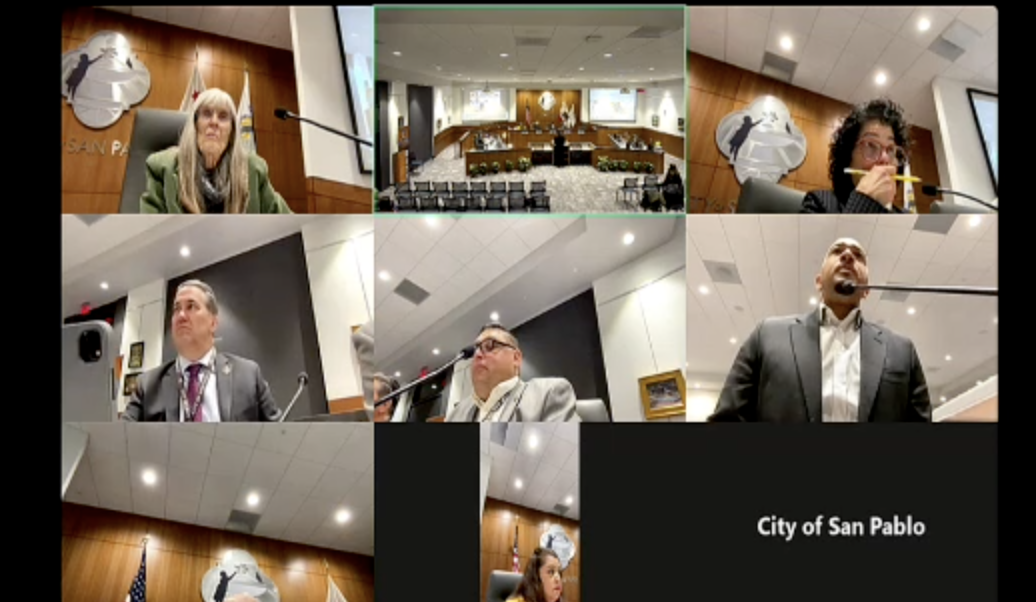
City Council - Apr 06, 2026 - Meeting

City Council - Apr 06, 2026 - Meeting

City CouncilSan PabloApril 6, 2026

Sources:

Locunity is a independent informational service and is not an official government page for this commission.We use AI-assisted analysis and human editorial review to publish information.

Council Overrides Planning Commission, Approves Cannabis Dispensary After Marathon Hearing

San Pablo's City Council reversed the Planning Commission and greenlit the city's second cannabis retail store after a heated two-and-a-half-hour public hearing that drew roughly 35 speakers — pastors, parents, union leaders, a former mayor, and an addictions counselor — to debate whether a dispensary belongs steps from Contra Costa College. The marathon meeting, which ran past 11:45 p.m., also produced two zoning code changes aimed at unlocking housing near I-80 and cleaning up a dead-letter gas ban, a pointed accountability exchange with the regional energy provider, and a new planning commissioner.

  • Council unanimously approves Embark cannabis retail store at 14501 San Pablo Ave., reversing a 3-1 Planning Commission denial after ~35 speakers weigh in
  • Mayor presses MCE on rates, fossil-fuel claims and executive pay, signaling deepening scrutiny of the community energy agency
  • I-80 air quality overlay loosened to allow housing and schools with enhanced ventilation, removing a decade-old barrier to state-mandated housing targets
  • Yanad Burrell appointed to Planning Commission hours after Council overturned the body's cannabis decision
  • Retiring planning director honored after six years of rezoning over 150 properties and certifying the housing element

Embark Cannabis Store Approved Over Fierce Neighborhood Opposition

San Pablo's second cannabis dispensary is coming to Mission Plaza — and it took four council members, a packed chamber, and nearly three hours to get there.

The basics: Embark, a cannabis retailer operating 17 stores across California, appealed the Planning Commission's 3-1 denial of a conditional use permit for a retail storefront at 14501 San Pablo Ave., the former 7-Eleven site. Associate Planner Noel Maxson delivered a detailed staff report confirming the site meets all city-adopted buffer requirements: 750 feet from K-8 schools, 1,250 feet from high schools, and 1,000 feet from other cannabis businesses. Staff recommended approval.

Why it matters: The decision establishes San Pablo's second licensed cannabis retail location under Measure M, the voter-approved framework. It also sets a precedent: the Council is willing to override its own Planning Commission when staff finds an applicant meets the legal standards — even against a wall of community opposition.

Two Sides of San Pablo Avenue

The public hearing exposed a deep rift. Opponents — including pastors, educators, parents, a substance abuse professional, and at least one former Middle College High School student — centered their arguments on proximity to Contra Costa College and its embedded Middle College High School.

"That is 7,303 transitional age youth that will have access within walking distance of cannabis," said Michael Hamilton, a public commenter who described himself as a 42-year addictions professional. Pastor Patterson cited rising THC concentrations — up to 90–95% in concentrates — and argued the store would compound existing problems. Melanie Beasley challenged the city's buffer measurement, calculating the distance from the Contra Costa College sign to the proposed site at 522 feet, well below the required 1,250 feet.

Elliot Lawrence, a former Middle College High School student, argued the buffer should be measured from the entire Contra Costa College campus, not just the administrative building, since students attend classes across the whole campus.

One resident, Heather Dolan, raised a different concern: she reported that someone from Embark came to her door with a printout of her opposition comment, knowing her full name, and questioned how her personal information was shared.

Supporters marshaled labor and economic development arguments. Althea Brennan, a lead organizer with UFCW Local 5, said Embark provides union jobs with healthcare, controlled entry, and trained security. Joe Summers of the Contra Costa Labor Council endorsed the appeal, emphasizing the company's commitment to union-represented workers. Josh Hannah, the council's executive director, argued regulated retail is safer than the illegal market, citing 2020 popcorn lung cases from unregulated vape pens.

Former Mayor Genoveva Calloway, who serves on Embark's Community Advisory Board, praised the company's pre-approval community engagement and proposed investment in youth programming and small business loans. Jonathan Leong, Embark's local owner-partner, also spoke in support.

The Applicant's Case

Embark CEO Lauren Carpenter presented for 15 minutes, citing the company's 17-store track record, union contract with UFCW Local 5, a 1% gross receipts community investment fund, and extensive security infrastructure.

"Operating these businesses are a privilege. They're not a right," Carpenter said, emphasizing that the license is conditional and continuously evaluated. In her rebuttal, she struck a more conciliatory tone: "You can't fight fear with facts because that inherently feels dismissive. These are people's very real experiences." She added that Embark has never had a youth access incident in 17 locations.

The Buffer Question, Settled

The city attorney clarified the legal standard: the buffer is measured from the property line of the parcel containing Middle College High School's administrative offices, not from the broader Contra Costa College campus. Under that method, the site complies.

Decisions

All four present council members voted to grant the CUP (For: 4, Against: 0, Absent: 1 — Councilmember Abel Pineda absent).

Councilmember Arturo Cruz cited Measure M voter support: "Measure M was voted by the San Pablo voters. Those people came out and voted for this."

Councilmember Patricia Ponce pledged personal oversight: "It was very clear that if they came to our neighborhood and they acted in bad faith against the community, I will pull the plug."

Mayor Elizabeth Pabon-Alvarado framed the vote around harm reduction: "Cannabis already exists in our community. This decision is about whether it remains unregulated and is brought to a controlled, legal and accountable environment."

What's next: The resolution approves the CUP with conditions including on-site security, a Community Advisory Board seat for a neighborhood representative, 180-day check-in meetings with staff, and compliance with all operator permit performance standards. Councilmember Cruz motioned for approval, seconded by Vice Mayor Rita Xavier.


Mayor Grills MCE on Rates, Transparency and Fossil-Fuel Claims

The basics: MCE, the community choice energy agency serving San Pablo since 2015, presented a general update on its programs. Kiara Donato of MCE reported that 88% of San Pablo customers are enrolled, and the agency has distributed $229,000 in EV rebates, funded 21 EV charging stations, and delivered $297,000 in energy efficiency rebates. MCE's board recently approved a 14% rate reduction effective April 1 and an additional $10 million for its MCE Cares bill-relief credit program.

Why it matters: Community choice aggregation programs pool customer buying power for cleaner energy, but the model only works if rates remain competitive with the incumbent utility. The mayor's questions signal the city's highest official shares growing public concern about the agency's transparency.

Where things stand: Mayor Pabon-Alvarado turned the presentation into an accountability session. She noted that over the past several months, "there have been multiple reports and public discussion raising concerns around financial performance, governance and transparency related to MCE." The mayor pressed on four points: (1) MCE rates currently exceed PG&E bundled rates due to the PCIA exit fee increase; (2) the newly formed financial committee was a recent response to public scrutiny, not a longstanding practice; (3) prior messaging claiming 100% fossil-free service was inaccurate; and (4) executive compensation transparency is lacking.

Donato acknowledged rate parity challenges and the PCIA fee issue but could not answer questions about energy portfolio composition or executive compensation on the spot, promising follow-up.

The other side: Councilmember Ponce noted she will serve on the MCE board this year. Vice Mayor Xavier highlighted being a 100% Deep Green customer since 2013. Councilmember Cruz asked about workforce development partnerships, and MCE confirmed collaborations with the county, BayREN, and San Pablo EDC.

What's next: MCE committed to providing follow-up answers to the mayor's questions. The exchange suggests the council may push for more rigorous oversight of the agency's governance and rate-setting.


I-80 Air Quality Overlay Loosened to Unlock Housing Sites

Why it matters: A 2015 zoning overlay banned residential and sensitive uses — schools, daycare, hospitals, parks — within 500 feet of I-80. That restriction has blocked housing development on parcels the city needs to meet its state-mandated Regional Housing Needs Allocation targets by 2031.

Where things stand: Outgoing Community Development Director Elizabeth Libby Tyler presented the amendment, developed in consultation with the Bay Area Air Quality Management District. The changes allow residential and sensitive uses subject to enhanced ventilation, sound transmission reduction, landscape buffers, and transportation demand management. Tyler explained the original ordinance was overly restrictive and inconsistent with BAAQMD definitions and practices. The Planning Commission recommended approval 5-0 on Feb. 24.

Decisions: Council approved the first reading unanimously (For: 4, Against: 0, Absent: 1).

What's next: The ordinance returns for second reading on consent calendar.


Yanad Burrell Appointed to Planning Commission

Why it matters: The appointment came just hours after the Council reversed a Planning Commission decision, and council members were explicit about what they wanted in a new commissioner.

Where things stand: Two applicants — Yanad Burrell and Joseph Donaldson — interviewed past 11 p.m. for the four-year term vacated by Commissioner Paul Morris. Burrell highlighted her MPA and healthcare administration degrees, near-completion of a doctorate in transformative social change studying redlining and aging water infrastructure, and six years on the AB 617 Community Steering Committee. Donaldson cited experience in strategy and operations across healthcare, technology, finance, and the public sector, including consulting for the City of New Orleans on the Claiborne Corridor revitalization.

Councilmember Cruz explicitly connected the appointment to the evening's cannabis appeal, noting the commission needs members who can make difficult decisions. All four council members selected Burrell.

Decisions: Approved unanimously (For: 4, Against: 0, Absent: 1). Burrell was sworn in at approximately 11:40 p.m. Her term runs April 2026 through April 2030.


Minor Items

  • Consent calendar approved unanimously (4-0), including a 4% salary increase for the City Attorney effective April 16, 2026, disclosed under Brown Act requirements before the vote.
  • Closed session on real property negotiations for 1411 Rum Rill Blvd. yielded no reportable action.
  • Autism Awareness Month proclaimed for April 2026. Chief Boobar introduced the San Pablo Police Department's second-year autism awareness patch campaign. Dr. Rebecca Nanyanjo, executive director of the Regional Center of the East Bay, described services for individuals with intellectual and developmental disabilities, serving approximately 30,000 families across Alameda and Contra Costa counties. Chris Hansen, associate director of client services, noted autism incidence has risen to 1 in 31 children.
  • Retiring Community Development Director Elizabeth Libby Tyler honored with a proclamation recognizing 47 years in the planning profession. Tyler oversaw the general plan update, housing element certification, creation of the Rum Rill corridor plan, and right-zoning of over 150 properties. She was the first woman in Illinois recognized as a Fellow of AICP. "I looked at that zoning map when I first got here and I thought, some of these properties are not zoned for what their potential is," Tyler said.
  • All-electric building requirement formally repealed on first reading (4-0). The provision, adopted in January 2023, was never enforced after the Ninth Circuit's California Restaurant Association v. City of Berkeley decision preempted local gas bans. Returns for second reading on consent.
  • UC Berkeley intern Fatima Montano presented her year-long internship with the Community Services Department, including standardizing three years of San Pablo Scholarship Program data on the CitySpan platform and monitoring Beacon Community School site reports. City Manager Matt Rodriguez noted nearly 400 scholarships have been issued in three years, with a professional evaluation by HTA due to Council in May.
  • City Manager Rodriguez announced San Pablo is the first city on the West Coast — and second in the nation — with a fully equipped EV trash truck fleet for residential services. A media event is planned for April 20.
  • During general public comment, Kevin Munoz Dimas praised the city's Measure S on-the-job training program. Paul Frank and Linda Jackson separately raised concerns about mobile home residents being denied grants because their dwellings were classified as trailers. Chivi Tat, owner of Grocery Outlet San Pablo, thanked the city and the San Pablo EDC for business support. B.L. Moore introduced herself as the new PG&E point of contact for the city.
Council Overrides Planning Commission, Approves Cannabis Dispensary After Marathon Hearing | City Council | Locunity