
City Council - Apr 20, 2026 - Meeting

City Council - Apr 20, 2026 - Meeting

City CouncilSan PabloApril 20, 2026

Sources:

Locunity is a independent informational service and is not an official government page for this commission.We use AI-assisted analysis and human editorial review to publish information.

Council Advances Affordable Housing Preference Study, Digital Sign Code Update

The San Pablo City Council covered significant ground at its April 20 meeting, approving a study into whether the city can legally require developers to give local residents priority in new affordable housing — a move that could reshape who gets access to publicly funded units. The council also introduced a sign code amendment for digital fuel pricing, celebrated a landmark environmental milestone, and honored a retiring 32-year public works veteran.

  • Council orders study of local resident preference for affordable housing built with city low-mod funds — legal and practical hurdles loom

  • Sign code amendment introduced to let gas stations display digital fuel prices, prompted by a state-funded green fuels conversion

  • San Pablo hits 96% trash reduction to creeks and expands paid resident cleanup ambassador program citywide with $200,000 Caltrans grant

  • Five EV garbage trucks launch for residential collection under Republic Services franchise agreement

  • 32-year Public Works veteran honored with retirement proclamation


Could San Pablo Residents Get First Dibs on New Affordable Housing?

The council unanimously adopted a resolution adding Policy 312 to its FY 25-27 priority work plan, directing staff and special legal counsel to determine whether the city can require a local resident preference in future development agreements where developers seek financial assistance from the Housing Successor Agency's Low and Moderate Housing Asset Fund.

Why it matters: If the policy proves legally feasible, San Pablo residents could gain priority access to a share of affordable housing units funded with public dollars — a direct benefit from the city's housing investments in a region where housing competition is fierce.

Where things stand: The concept is straightforward — prioritize locals — but the legal and financial details are not. The Brian Hickey, City Attorney, confirmed the general legality of local preference provisions but flagged significant structural questions: What percentage of units would be set aside? Would it function as a hard reservation or an application-stage preference?

"In general, it's going to be legal. The issues are really a couple. One, how do you structure the policy? So if it's a set aside for current residents, we'd be looking at the percentages to be set aside," said Hickey.

The other side: The greater concern is practical. Affordable housing developers typically layer multiple funding sources — state tax credits, federal programs, private financing — and some of those sources restrict or prohibit local preferences. Set the bar too high, and developers may not be able to pencil out their projects.

"Most affordable housing developers are receiving funding from different sources and those that source funding may have restrictions on how much of a local preference there can be," Hickey cautioned. "There might be an amount that's not practical because affordable housing developers wouldn't be able to receive certain funding if they have too much of a preference."

City Manager Matt Rodriguez reinforced the need for flexibility:

"We need to make sure there's flexibility. Not have a set standard that applies across the board. It has to be incorporated in a way that doesn't restrict them from pursuing other financing sources because these have multiple layers of funding."

Mayor Elizabeth Pabon-Alvarado pressed on what happens if the legal analysis comes back unfavorable, asking whether staff would return to the council if the policy proves unworkable. Rodriguez said the feasibility study is targeted for completion by the end of the fiscal year in June 2026. The mayor also confirmed the policy would not apply retroactively to existing development agreements.

Councilmember Arturo Cruz asked about Section 8 voucher portability — specifically whether current voucher holders from other jurisdictions could claim local preference. Rodriguez confirmed that the county housing authority administers Section 8, a separate program from what this policy would cover.

Decisions: The resolution passed 3-0 (For: Cruz, Xavier, Pabon-Alvarado; Absent: Ponce, Pineda).

What's next: Staff and outside counsel will conduct the feasibility analysis and return to council with findings. The policy would only take effect through future development agreements — meaning no immediate changes for projects already in the pipeline.


Digital Fuel Pricing Gets Green Light at Gas Stations

The council introduced an ordinance amending San Pablo Municipal Code Section 18.04.050 to add fuel pricing signs to the short list of exemptions from the city's digital sign prohibition. Currently, only clocks and temperature displays are exempt.

Why it matters: The amendment was triggered by a specific business need — HP Gas at 2526 San Pablo Dam Road received state funding to offer green fuels and must display digital pricing on its existing pylon sign — but it applies citywide to all gas stations.

Where things stand: Planning Manager Sandra Castaneda Marquez emphasized the amendment's narrow scope.

"This will not open the door for any other digital signs in the city. It is a very narrow exemption that would just include the price of fuel for gas stations in addition to clocks and temperature signs," she said.

Castaneda Marquez explained that HP Gas's existing sign is in poor condition and that the station needs digital capability as part of its state green fuels grant. The prices displayed would be static, changing only once or twice per week — no animation, no flashing. Under current code, changing prices on a manual pylon sign requires hiring a crane.

The Planning Commission approved the recommendation 4-1, with one member absent, on March 24. Staff found the amendment consistent with the General Plan, economic development policies, and CEQA-exempt.

Councilmember Arturo Cruz expressed support, noting the station sits at a main entry point to the city. Mayor Elizabeth Pabon-Alvarado asked clarifying questions about monument sign options and freeway visibility.

No public comments were received during the hearing.

Decisions: The ordinance was introduced 3-0 (For: Cruz, Xavier, Pabon-Alvarado; Absent: Ponce, Pineda). Final adoption will be placed on a future consent calendar.


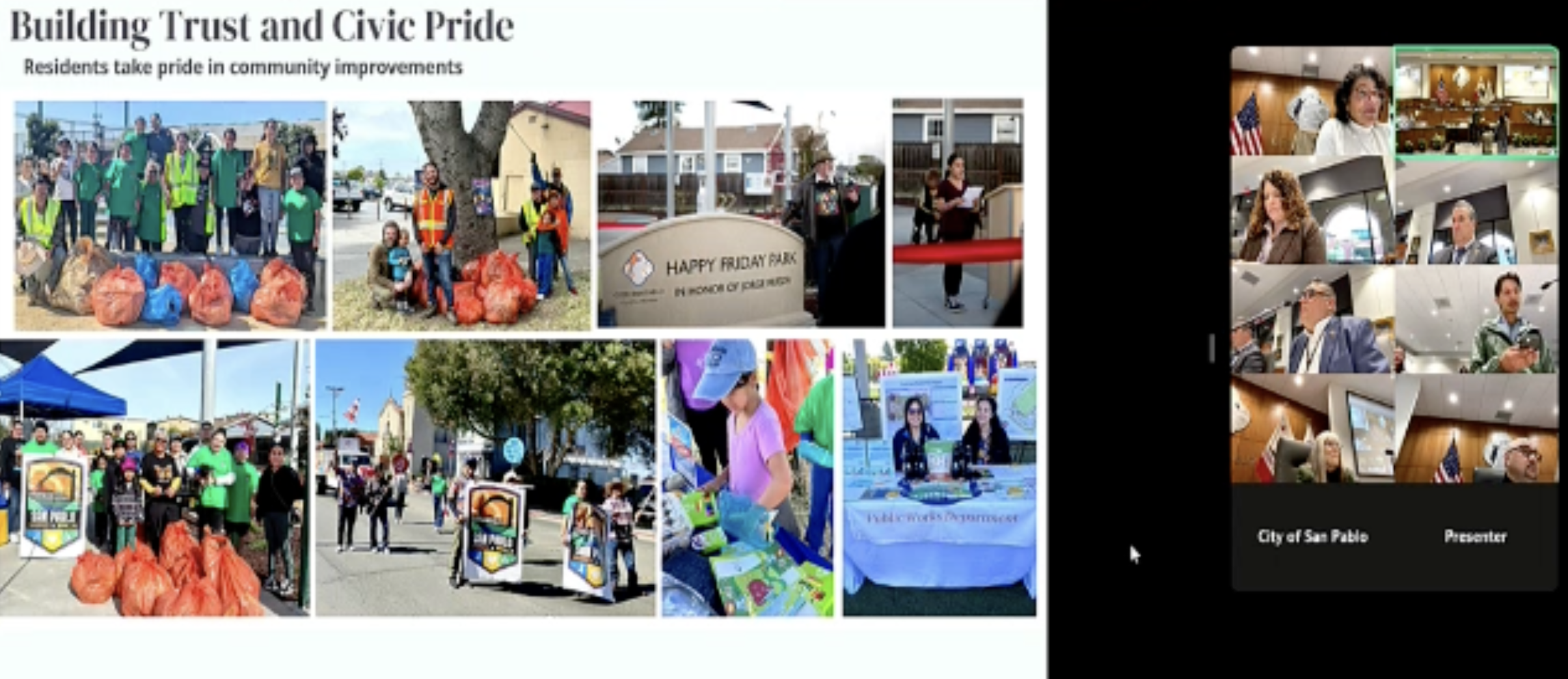
San Pablo Doubles Down on Community Cleanup With $200K Caltrans Grant

San Pablo has achieved a 96% reduction in trash reaching its creeks — just 4 percentage points from full compliance with a San Francisco Bay Regional Water Quality Control Board mandate — and is now scaling its grassroots cleanup program citywide with a $200,000 Caltrans Community Cleanup and Employment Pathway Grant.

The basics: The San Pablo SHINES (San Pablo Brilla) beautification campaign uses trash capture devices in storm drain inlets to intercept debris before it reaches waterways. But many inlets can't accommodate the devices, and some streets discharge directly into creeks, making community-led cleanups essential to closing the gap.

Why it matters: The expansion tests whether paid resident ambassadors — not just city crews — can sustain the final push to full compliance while building neighborhood pride and workforce skills.

Where things stand: A 2024 pilot in Old Town, funded by a Caltrans Clean California Local Grant, hired three residents at $2,000 stipends each. Environmental Program Analyst Itzel Oceguera-Gomez detailed the results:

"Three folks that year were able to collectively organize nine litter cleanup events. They cleaned up over 3,500 gallons of litter and they removed about four tons of trash during a single mini dumpster day event that we piloted at Downer Elementary."

Visual trash assessments showed the Old Town area improved from high to low/medium trash scores. The program also surfaced a key outreach lesson.

"We quickly realized that they don't necessarily have their neighbors on social media as followers, and so we had to pivot that idea. Something that really worked is for folks who felt comfortable going door to door and actually talking to their neighbors," Oceguera-Gomez said.

For 2026, the program expands from one neighborhood to six zones with six resident champions who will host 18 total cleanup events. Additional grant-funded activities include partnerships with Earth Team and SOS Richmond for creek cleanups, illegal dumping cameras, and workforce development. New solid waste programs under the Republic Services franchise include expanded curbside bulky item pickup (three per year), increased dump vouchers ($120), more mini dumpster days, and a forthcoming Eco Action Packs lending toolkit.

The new champions — Maria Alvarado (returning from the pilot), Sarah Dicken, Christian Perez, Jemiah Fitzgerald, and Jasmine Oropesa — introduced themselves to the council.

Environmental Program Manager Amanda Booth addressed council questions about grant timelines. Council members asked about trash capture device maintenance (three to five times per year) and safety equipment for volunteers. Councilmember Arturo Cruz asked about the budget breakdown, learning that $3,000 goes to Earth Team for fiscal sponsorship.

This was a presentation item; no formal vote was required.


Honoring 32 Years of Service: Lek Soungpanya

The council presented a retirement proclamation to Leck Soungpanya, who served 32 years as a full-time employee in the San Pablo Public Works Department, rising from intern draftsperson to Senior Public Works Inspector before retiring in December 2025.

Born in Laos and arriving in the U.S. as a child in 1975, Soungpanya attended Contra Costa College before being hired as an intern in 1992. His career spanned capital improvement plan drafting, encroachment permits, stormwater compliance inspections, and serving as the city's traffic signal technician.

Mayor Elizabeth Pabon-Alvarado read the proclamation:

"Throughout your career, you didn't just inspect projects, you set the standard. You led with integrity, upheld excellence and ensured that every project met the highest level of quality."

Public commenter John Joya praised Soungpanya's impact beyond city hall, including helping design the Laotian Temple in Richmond.

"We are stronger as a country because of our immigrants. We are stronger because of people who've come here and enriched who we are as a nation, a state, a county, a city, and who make us stronger and better," Joya said.

Soungpanya reflected on his time at a small city:

"Working for larger cities doesn't mean you will learn a lot. Smaller cities, I learn a lot. I grew up here pretty much like home. I learned everything I knew here because I get to touch on a little bit everything."

Councilmember Arturo Cruz and Vice Mayor Xavier offered congratulations and thanks.


Minor Items

  • Consent calendar adopted 3-0 with no items pulled for discussion.

  • EV trash truck fleet: City Manager Rodriguez highlighted the same-day launch of five electric garbage trucks for residential collection under the Republic Services franchise agreement — a first for the area. "We have the first EV trash truck fleet for residential collection," Rodriguez said. Councilmember Cruz also praised the partnership during council assignment reports.

  • Community schools update: Joyce Sinatra, BACR Community School Manager, reported that chronic absenteeism dropped up to 13.1% at Helms and 12.9% at Dover over three years, while suspensions fell below 2% at Downer, Dover, and Riverside. The attendance trend was interrupted this school year when students stayed home during a strike. End-of-year academic data will be presented in June.

  • Council Members Patricia Ponce and Abel Pineda were absent from the meeting; all votes passed 3-0 among the three members present.

Council Advances Affordable Housing Preference Study, Digital Sign Code Update | City Council | Locunity