
San Pablo Council Rallies Behind Beacon Schools as Sales Tax Shrinks
City Council • San PabloNovember 3, 2026
Locunity is an independent informational service and is not an official government page for this commission. All information is sourced from public footage and an analysis of official agendas with the aid of responsible, fact-checked AI. to report an error or omission.
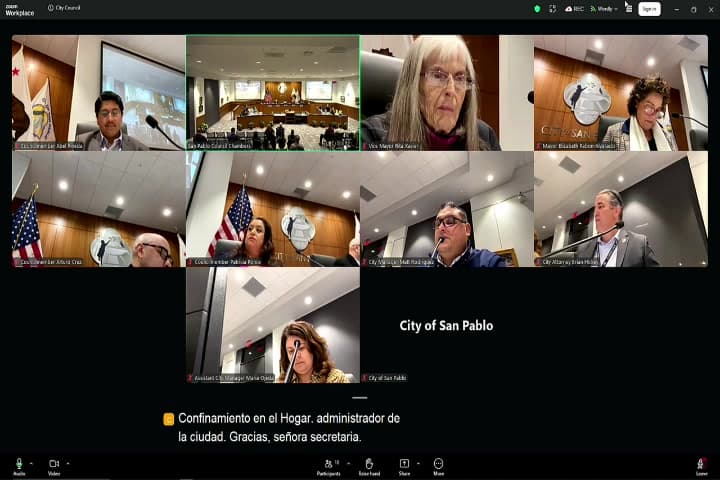
San Pablo's flagship school partnership drew a packed public comment period on Nov. 2, 2026. About 15 parents, teachers, students and college partners urged the City Council to protect Beacon Community Schools as the sales tax that funds it prepares to drop by half. The council took no funding action but pledged continued support, then approved a cannabis-funded small business loan fund.
- Beacon evaluation shows gains: 308 youth served, events up from 48 to 81, and suspensions below the district rate
- About 15 speakers urge sustained Beacon funding; the mayor says it would be "the last program that we cut"
- 3-2 vote trims speaker time from 3 to 2 minutes on the Beacon item
- Measure S sales tax falls from a half-cent to a quarter-cent, squeezing the Beacon funding model
- Working Solutions CDFI wins a 5-year contract to run a cannabis-funded loan fund at a 7% borrower rate
Beacon Schools: Strong Numbers, Louder Ask
The council received Public Profit's evaluation of the Beacon Community Schools Initiative for fiscal year 2025-26. It was the longest item of the night, running more than an hour.
The basics: Beacon is a 15-year partnership among the city, West Contra Costa Unified School District and nonprofit Bay Area Community Resources (BACR). It funds Beacon directors at six San Pablo schools and supports work at Richmond High School. Measure S, formerly Measure Q, provides most of the money.
Where things stand: Senior Consultant Sylvia Kwan of Public Profit reported that direct programming reached 308 youth, up from 280, or about 10%. Community events grew from 48 to 81, suspensions fell below the district rate, and all Beacon directors returned for 2025-26. Need remains high: 95% of students meet at least one high-need criterion. Chronic absenteeism also stayed high, which Kwan linked partly to the teacher strike and family fears of deportation.
That raised a money question from Councilmember Arturo Cruz: "Does it matter if they're excused or unexcused when it comes to funding?" Kwan replied, "My understanding is that it depends, right? If it's not excused, you don't get the funding."
An organized show of support: Beacon directors, BACR staff, teachers, students, parents and Contra Costa College partners spoke one after another. "We urge you to invest in our Beacon directors today and forever," said M. Joy Diaz Noriega, a fourth grade DLI teacher at Downer Elementary School. Wendy Gonzalez, a fifth grade teacher at E.M. Downer Elementary School, tied her request to families' fear of immigration enforcement. Delonio Revels, program coordinator for African American Male Leadership at Contra Costa College, described a college-pathway mentoring program at Helms Middle School: "Let's keep the money flowing."
Students credited the SALT and Young Black Leaders groups with building their confidence. Fernanda Vazquez, parent group president at Dover Elementary School, spoke in Spanish and credited her Beacon director with GED classes and workshops for parents.
The other side: No speaker opposed the program. The only friction was over procedure. "I'd like to propose that we narrow it to 2 minutes each," said Mayor Elizabeth Pabon-Alvarado. The motion passed (For: 3 — Cruz, Xavier, Pabon-Alvarado; Against: 2 — Ponce, Pineda; Absent: 0).
Decisions and stakeholder impacts: Council members were unanimous in their praise. Councilmember Abel Pineda said "investments in education is always and will always be the right thing to do." Councilmember Patricia Ponce said "right now is a more important time because of the district cuts that are hurting all of our students so much." She added that immigration enforcement had hit the community that day and said she hoped parents would not keep children home. Vice Mayor Rita Xavier called Beacon a model: "It's something other cities should do." The mayor said she was surprised by the funding fears, noted that no cut had been discussed and pledged that "this will be the last program that we cut."
Families and BACR staff left with a political commitment, but the council did not set aside any money.
The Measure S Math Behind the Anxiety
Why it matters: The fears voiced in public comment have a fiscal basis. Measure S is nearing its five-year mark and will fall from a half-cent to a quarter-cent sales tax.
Where things stand: City Manager Rodriguez said the city's shared funding arrangement with the San Pablo Economic Development Corporation cannot be sustained at the current rate. Other partners contribute as well. The school district pays about $122,000 a year through a memorandum of understanding, and BACR matches the city's contribution. The district has its own Measure V on the ballot, which he said would provide $10 million a year over nine years.
The other side: "But there has not been a discussion yet by the council to date regarding reducing funding," Rodriguez said.
What's next: The size of any future gap was not quantified. Beacon's funding outlook will hinge on the reduced Measure S revenue and the outcome of Measure V.
Cannabis Money Seeds a Small Business Loan Fund
The mayor pulled this contract from the consent calendar, and it drew a 36-minute interrogation of the deal terms.
The basics: Under agreements with the city, San Pablo's three licensed retail cannabis operators pay 1% of gross retail revenue as a community benefit. Half goes to nonprofits and half to a small business revolving loan fund, "using a revenue source that's not general fund but from the retail cannabis operators," Rodriguez said.
Where things stand: The item went through the Economic Development and Housing standing committee twice. An RFP was released in May, and interviews were held in September. Staff recommended a 5-year pass-through agreement with Working Solutions CDFI.
Eligible borrowers include San Pablo startups, nonprofits, cooperatives, employee-owned businesses and street vendors. Sarah Razavi of Working Solutions explained the terms. The standard 11% rate is bought down to 7% fixed using 10% of the pool, and another 5% covers administration. Loans run three years under $10,000 and five years above that amount, with averages of about $24,000 to $28,000. Interest income goes to the administrator as part of its fee, and principal returns to the fund.
"Our loan rates are going to be much more attractive than what's out there on the market now," said Kieron Slaughter, Economic Development and Housing Manager.
The other side: "I know as a business owner who's struggling, especially with restaurants, 7% is really high," Mayor Pabon-Alvarado said. She also pressed staff on how loans can be used and on success measures. She asked about the EDC's earlier loan program as well, which was funded by federal ARPA dollars that are now exhausted. Slaughter acknowledged that success metrics have not been set. Annual reports and a 5-year evaluation are planned. Rodriguez noted that the interest-as-fee arrangement differs from the draft agreement.
Decisions and stakeholder impacts: The motion passed with no public comment. Cruz, Ponce, Pineda and Pabon-Alvarado voted yes; Xavier's vote could not be confirmed. Small businesses gain a new source of capital outside the general fund, while Working Solutions earns its fee from loan interest.
What's next: Expect the first annual report to test the mayor's question: Will struggling mom-and-pop businesses borrow at 7%?
- Consent calendar approved on a 5-0 roll call; Xavier abstained on Item 15 (Loud Family Community Development).
- Nov. 4, 2026 proclaimed Shelter-in-Place Education Day for Contra Costa CARE's 25th annual school drill; CARE offers training free.
- Victor Veruman, maintenance and operations superintendent, named APWA Northern California's 2026 Facilities and Grounds Manager of the Year.
- Immigrant Know Your Rights workshop on Nov. 5 at the Community Center, hosted by police, the EDC and partners.
- Veterans ceremony on Nov. 10; city offices close Nov. 11; dumpster day on Nov. 21 at 2600 Moraga Road.
Looking ahead: The mayor asked the city manager to invite the Latina Center to present on its work serving San Pablo women. The council next meets Nov. 16.