
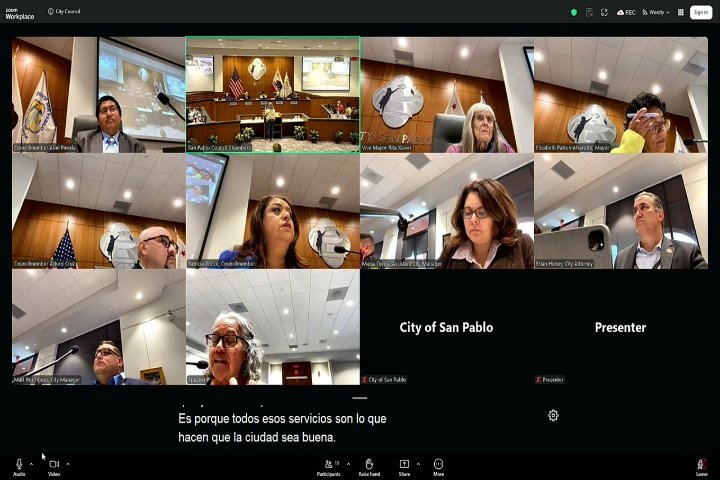
City Council - Jul 13, 2026 - Special Meeting

City Council - Jul 13, 2026 - Special Meeting

City CouncilSan PabloJuly 14, 2026

Sources:

Locunity is a independent informational service and is not an official government page for this commission.We use AI-assisted analysis and human editorial review to publish information.

San Pablo Sends Sales Tax and Rent Control to November Ballot

San Pablo's City Council placed two measures before voters in a single night: a temporary sales tax to close a $4.4 million structural deficit, and a citizen-initiated rent control ordinance that would cap rents on more than 7,000 units — but cost up to $2.4 million a year to run. The council's decision to add cost estimates to the rent control ballot question signals the majority's concern that one measure could undermine the other.

  • Council unanimously places half-cent sales tax on November ballot to sustain services as casino revenues — 59% of the general fund — stagnate
  • Citizen-initiated rent control ordinance heads to voters after council insists on adding program cost estimates to the ballot question
  • Police employees' union backs the sales tax, calling it a 10-year bridge for public safety staffing and retention
  • Rent control debate draws sharp divide: tenant advocates from Rising Juntos urge immediate adoption; California Apartment Association and property managers warn of supply reductions and unsustainable costs
  • Council Member Pineda's bid to use ballot language without cost figures dies for lack of a second; majority prevails 4-0

A Tax to Keep the Lights On

Why it matters: San Pablo balanced its current budget only by cutting $2.6 million in spending and drawing $2 million from emergency reserves — a one-time fix the city manager called unsustainable. Casino San Pablo, which supplies nearly 59% of general fund revenue, has delivered $3.3 million less over four fiscal years, and competing casinos pose an existential threat to that revenue stream.

Where things stand: The council voted 5-0 to place a 10-year, stepped sales tax on the Nov. 3, 2026 ballot. The measure would levy a half-cent transaction-and-use tax for the first five years, step down to a quarter-cent for five more years, then terminate — generating roughly $2 million annually in the early phase. A citizen oversight committee and mandatory audits are built into the measure. Because it is a general-purpose tax, it required a four-fifths supermajority to place on the ballot and will need only a simple majority of voters to pass.

City Manager Matt framed the urgency bluntly: "This is at the cost of $4.4 million worth of a structural deficit that had to be eliminated using a combination of $2.6 million in cost reductions and another $2 million with the one-time use of emergency reserves."

He added that the existing Measure S sales tax will shift down a quarter-cent in October 2027, costing another $1 million. "We will lose $1 million worth of sales tax revenue due to that shift. And that's already been adopted by the voters previously. So this would be a new sales tax measure we're proposing for the next 10-year period from 2027 to 2037."

Even with the new tax, San Pablo's total sales tax rate would remain among the lowest in West Contra Costa County — currently 9.50%, compared with higher rates in neighboring cities.

Voter Survey: Support Is Fragile

Dr. G. Gary Manross of Strategy Research Institute presented a scientific poll of 300 likely voters. A flat half-cent tax polled at just 45% likely support — below the threshold campaigns typically need. But when pollsters offered a stepped structure — half-cent for five years, quarter-cent for five years, then terminating — support climbed to 51.5%.

The strongest messages: all revenue stays in San Pablo, non-residents who shop locally also pay, and an independent citizen oversight committee ensures accountability. The weakest: threatening service cuts. "The city will be forced to cut back on services and programs if this doesn't pass — only 42% of your mainstream said that'll make me more likely to support," Dr. Manross warned. He also revealed a striking awareness gap: "83% of your opinion leaders are not aware of the fiscal challenges facing you. It's absolutely essential that you reach out to your community and let them know of these challenges."

Police Back the Measure

Two representatives of the San Pablo Police Employees Association spoke in support. Sean Ray, speaking for the management bargaining unit, described the measure as a "responsible 10-year bridge" and pointed to new economic engines — cannabis dispensaries, a regional training facility, and casino expansion — that could eventually replace the tax. Eugene Kolosov, association president, emphasized that financial stability directly affects recruitment, retention and morale.

Long-time community advocate Genoveva Calloway also endorsed the measure, vouching that Measure S oversight proved money was spent as promised.

Decisions: The council voted 5-0 on two separate roll calls — first to receive and file the SRI survey results, then to adopt the resolution placing the tax on the November ballot (For: Mayor Elizabeth Pabon-Alvarado, Vice Mayor Rita Xavier, Councilmember Arturo Cruz, Councilmember Patricia Ponce, Councilmember Abel Pineda; Against: none).

What's next: The campaign must now educate voters on the city's fiscal condition — a task the survey data suggests is urgent, given that two-thirds of mainstream voters and more than four-fifths of opinion leaders say they are unaware of the budget shortfall.


Rent Control Goes to Voters — With a Price Tag Attached

The basics: In December 2025, tenant advocacy group Rising Juntos and community organizers filed a notice of intent for a rent stabilization and tenant protection ordinance. By May 2026, proponents had gathered 2,441 certified signatures — more than enough to qualify the measure. On June 15, rather than adopt the ordinance outright or immediately place it on the ballot, the council ordered an independent analysis under Elections Code §9212. That report, prepared by RSG Solutions, was the centerpiece of the night's longest and most contentious debate.

Why it matters: The initiative would impose what Jennifer Rizzo of the California Apartment Association called "the most restrictive rent control system, limiting annual rent increases to 60% of CPI or 3%, whichever is lower." It would also ban rent banking, require just cause for evictions, mandate relocation assistance, impose tenant safety plans, and regulate buyout agreements. Unlike some neighboring jurisdictions, the ordinance creates no independent rent board — the city itself would administer the program, with appeals going directly to the City Council.

What the Report Found

RSG Solutions consultant Sarah Court told the council approximately 7,189 rental units would be covered — 4,079 fully subject to rent stabilization, and 3,110 partially covered for tenant protections only. That includes roughly 2,273 single-family homes. If the state's Costa-Hawkins Rental Housing Act were ever repealed, fully covered units would jump to 6,695.

The fiscal hit: "Under current state law, those estimates range from approximately $1.1 million to $2.4 million annually, with staffing ranging from approximately 3.2 to 7.9 dedicated full-time staff," Court said. She added that the initiative is generally consistent with the city's Housing Element goals but that academic research on rent control's impact on housing production is mixed: "Overall, the research reaches mixed conclusions, with some studies finding limited impacts on housing production and others identifying effects on housing supply and development."

The ordinance would not directly produce new housing or contribute to the city's Regional Housing Needs Allocation targets.

Public Comment: A Community Divided

Opponents and supporters lined up in roughly equal numbers, and the testimony was emotional on both sides.

Genoveva Calloway, who had backed the sales tax minutes earlier, opposed the rent control initiative. She argued it creates a fiscal catch-22: the city needs revenue, yet the rent control program could cost as much as — or more than — what the sales tax generates. She said both tenants and landlords deserve protection, but restrictions could lead to deferred maintenance and blight.

Ruthie Abelson Olivas criticized a provision requiring housing providers to fund legal services that tenants could then use against them in proceedings, and warned that without an independent rent board, disputes would burden the City Council and staff.

Jennifer Rizzo of the California Apartment Association noted the ordinance provides no exemption for deed-restricted affordable housing or Section 8 units — unlike similar laws in neighboring cities — which she said could threaten project financing. She added that the fees written into the ordinance would not cover actual program costs.

Joe Stokely of Stokely Properties cited research showing rent control leads to slower rental housing growth and conversions out of the rental market. He shared that clients in Concord and Antioch have already chosen to sell rather than rent under similar regulations. He noted San Pablo market rents increased at only 60% of CPI over six years, suggesting the market is not producing the runaway increases the ordinance targets, and that tenants already have protections under AB 1482, the state's existing rent cap law.

Rolanda Wilson, a property manager operating in several comparison cities, said that one client decided to sell rather than rent that very morning upon learning of the ordinance's requirements. With 58% of San Pablo homes occupied by renters, she warned that even modest supply reductions would be significant.

On the other side, Linda Jackson, a San Pablo renter, delivered an emotional plea. She questioned why the city spent $32,000 on a consultant when it could ask residents directly and challenged property managers opposing the measure to say whether they actually live in San Pablo.

Ms. Rosas of Rising Juntos framed housing as a human right, saying families live in fear of unexpected rent increases from corporate landlords and that behind every signature are low-income, immigrant families and seniors seeking dignified housing.

Ria Lina, Executive Director of Rising Juntos and a co-sponsor of the initiative, urged the council to adopt the ordinance outright rather than place it on the ballot: "So today we're asking you not only to certify these signatures, but to adopt these protections immediately and stand with the people who brought us to this moment."

Clara Faria, an elderly resident, emotionally addressed the council about needing help with rent, directing her frustration at Councilmember Cruz for what she described as personal kindness that had not translated into supportive votes.

The Ballot Language Fight

After receiving the §9212 report on a 4-0 vote (Ponce had departed), the council turned to how the measure would appear on the ballot — and the discussion became its own policy battle.

Councilmember Pineda argued the initiative aligns with goals the council has previously supported and moved to adopt the staff-recommended resolution — which used ballot language without cost estimates. "This is something that the council has previously discussed, supported. We do seek and have concern with the way things have been, and we know that things should and could change," he said. His motion died for lack of a second.

Mayor Pabon-Alvarado pushed back forcefully. She emphasized that 2,273 single-family homes would be affected — a fact she said proponents had minimized — and insisted voters deserve to see the price tag. "I would like to ask if we can actually add in there or replace some of the language so that voters can see how much this is going to cost, which, based on the report, is $1.8 million to $2.3 million," she said.

Councilmember Cruz then moved to adopt the resolution with revised ballot language that includes estimated program costs and authorizes the mayor and vice mayor to draft ballot arguments opposing the initiative. Vice Mayor Xavier seconded.

Decisions: The revised resolution passed 4-0 (For: Mayor Pabon-Alvarado, Vice Mayor Xavier, Councilmember Cruz, Councilmember Pineda; Absent: Councilmember Ponce). The city attorney confirmed the measure requires a simple majority of voters.

What's next: San Pablo voters will decide both measures on Nov. 3, 2026. The council's authorization for the mayor and vice mayor to author opposing arguments means voters will see official city opposition alongside the initiative on the ballot — an unusual move that underscores the majority's concern about fiscal sustainability. With the rent control program potentially costing as much as $2.4 million annually, and the sales tax projected to generate roughly $2 million per year, the math will be front and center in the campaign ahead.

San Pablo Sends Sales Tax and Rent Control to November Ballot | City Council | Locunity