City Council - Jun 15, 2026 - Special Meeting
City Council • San PabloJune 16, 2026
Locunity is a independent informational service and is not an official government page for this commission.We use AI-assisted analysis and human editorial review to publish information.
San Pablo Adopts Hybrid Meeting Rules Ahead of State Deadline
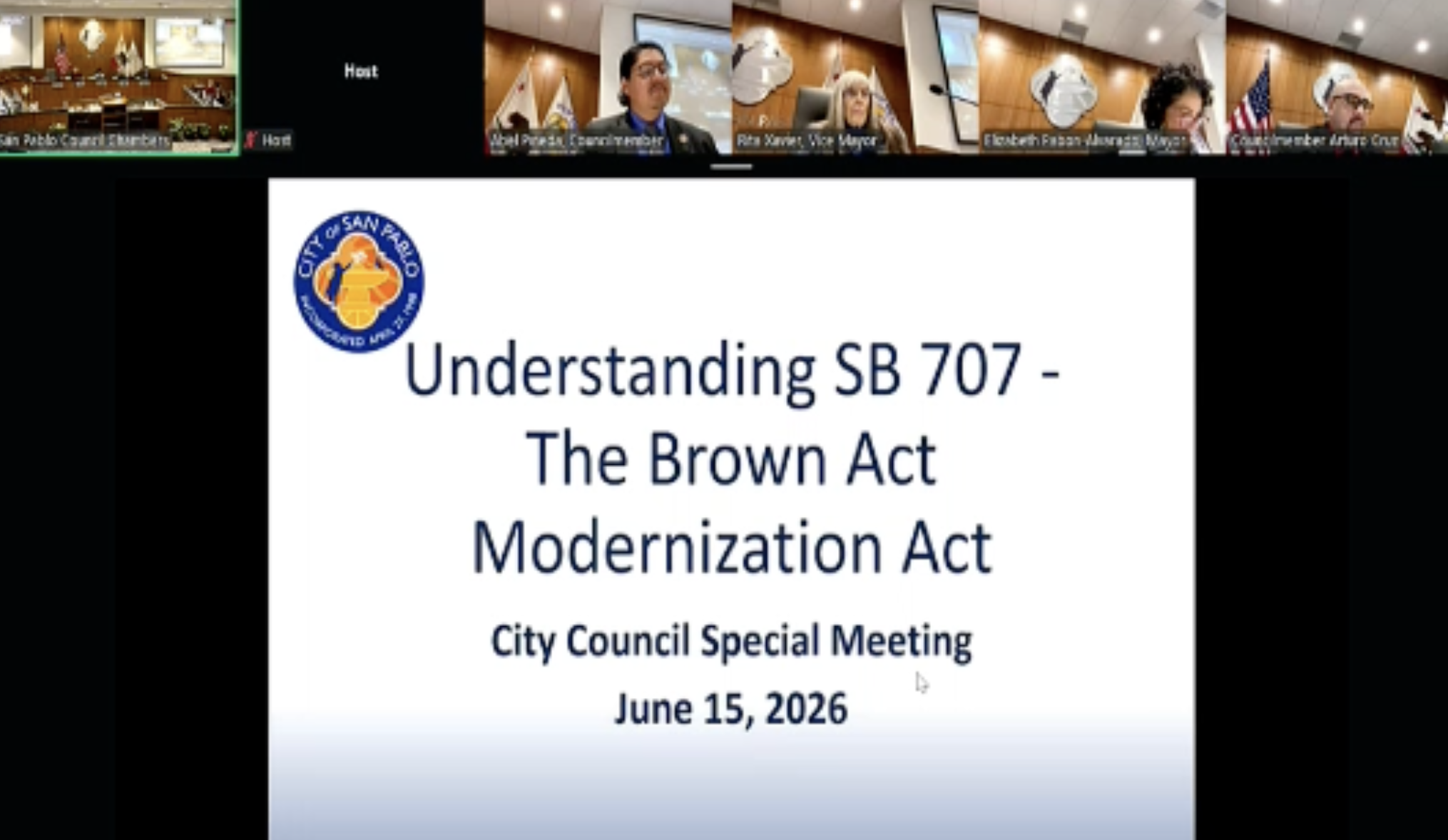
San Pablo's City Council convened a special meeting to get ahead of California's SB 707 — the Brown Act Modernization Act — which requires cities to open their meetings to remote public participation with real-time translation by July 1. The council unanimously approved a technology disruption policy that will govern what happens when the internet goes down mid-meeting, locking in compliance with just weeks to spare.
Council adopts SB 707 technology disruption policy 4-0, establishing mandatory procedures for handling remote access failures during hybrid meetings
Real-time Spanish captioning and translated agendas now required for all San Pablo council meetings under the new state law
Council members gain remote participation rights for "just cause" — childcare, illness, disability — without disclosing home addresses
Concerns raised over hateful speech during remote public comment; city attorney drafting updated scripts to handle disruptions
New State Law Forces San Pablo Into Hybrid Meeting Era
The basics: SB 707, which took effect Jan. 1, updates California's Ralph M. Brown Act to require cities with populations over 30,000 in counties over 600,000 to provide two-way remote public participation at council meetings. San Pablo, located in Contra Costa County, meets both thresholds. The law also mandates real-time closed captioning in English and Spanish, translated agendas in the majority non-English language, and a public bulletin board where community members can post their own translated agendas.
Why it matters: The legislation fundamentally changes how San Pablo conducts its public meetings. Residents who cannot attend in person — whether due to work, disability, childcare or transportation barriers — will now have a guaranteed right to participate remotely. The Spanish-language requirements reflect the city's demographics and expand access for a significant portion of the community.
Where things stand: Assistant City Manager Maria Ojeda delivered a detailed presentation on the law's requirements and the city's readiness. She confirmed that technology upgrades are already underway, including Wordly translation software for in-chamber attendees and Zoom's language selection feature for remote participants, along with increased internet bandwidth.
"We are prepared to implement effective July 1st. And as you've seen, we've already implemented some of those elements recently," said Ojeda.
The resolution the council adopted focuses specifically on the mandatory technology disruption procedure — one of SB 707's most operationally significant requirements. When remote access fails during a meeting, the council must recess for at least one hour while staff makes a good faith effort to restore connectivity. After the recess, the council may take a roll-call vote finding that a good faith effort was made and proceed, or vote to continue affected items to a future date.
"No further action by the City Council during a technological interruption and we must take a recess," Ojeda explained.
Remote Participation and Just Cause
The law also creates a framework for council members themselves to participate remotely for qualifying reasons — military service, childcare, disability, unplanned work travel or non-emergency illness — a limited number of times per year. Members participating remotely must appear on camera with functioning audio and disclose anyone over 18 present in the room, but are not required to post their home address.
Councilmember Arturo Cruz asked whether a doctor's note would be required and how much advance notice a council member must give before participating remotely. City Manager Matt Rodriguez clarified that SB 707 eliminates the prior requirement under AB 2449 to post remote participation on the agenda in advance.
Hateful Speech and Translation Accuracy
Cruz also raised a pointed concern about online disruptions:
"I have a concern regarding inappropriate or hateful speech during our meetings. What precautions are we taking to prevent this kind of disruption?"
Staff said they are working with the city attorney to draft updated procedural scripts for handling such incidents during remote public comment.
Mayor Elizabeth Pabon-Alvarado pressed on a different vulnerability — translation accuracy. She noted that English and Spanish translations do not always carry identical meaning and asked which language would prevail in any legal dispute.
Ojeda said the law sets a "good faith effort" standard, not a perfection standard:
"The city is not liable if something is incorrect. The law does not state that or make cities liable for that."
Decisions: The resolution passed 4-0 (For: Cruz, Pineda, Xavier, Pabon-Alvarado; Absent: Ponce). The meeting adjourned at 5:19 p.m.
What's next: San Pablo must have all SB 707 requirements — hybrid meeting access, real-time bilingual captioning, translated agendas and the technology disruption protocol — fully operational by July 1.