
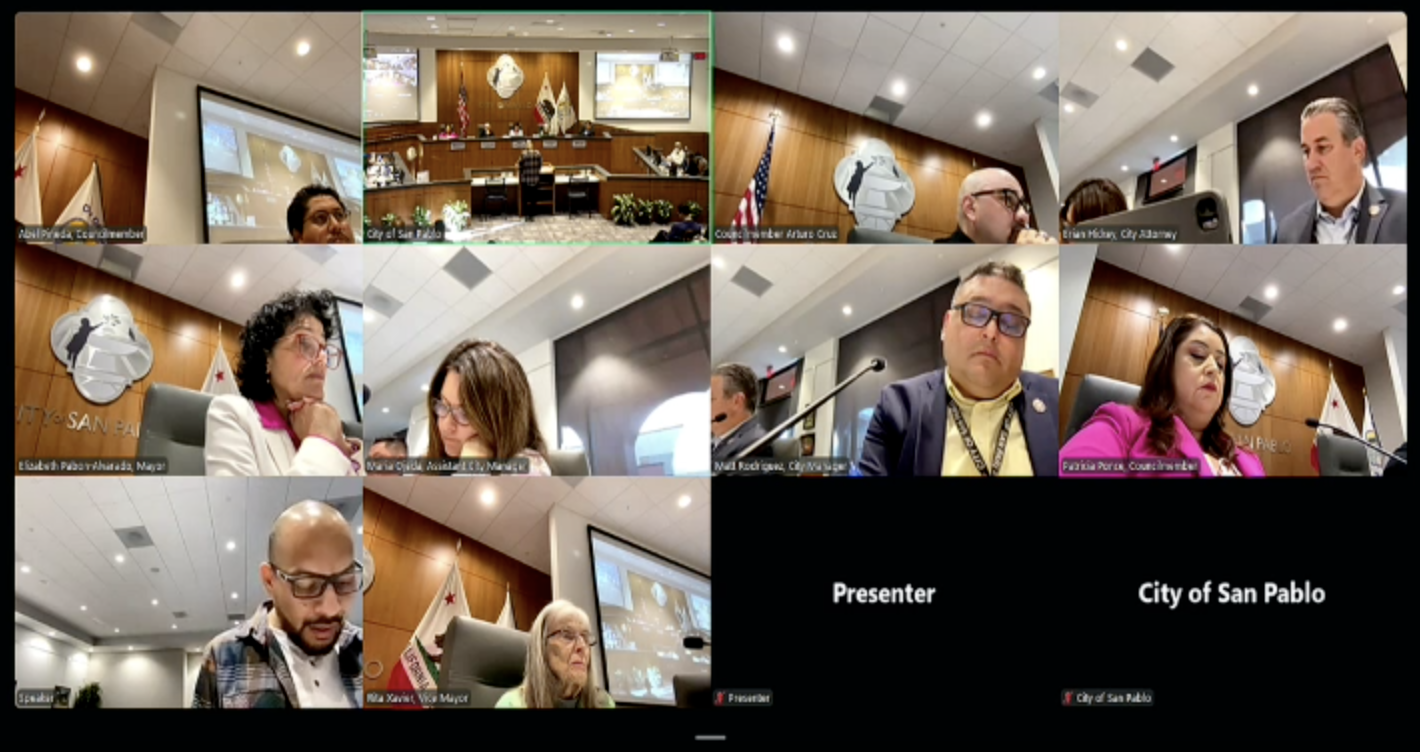
City Council - Jun 03, 2026 - Special Meeting

City Council - Jun 03, 2026 - Special Meeting

City CouncilSan PabloJune 3, 2026

Sources:

Locunity is a independent informational service and is not an official government page for this commission.We use AI-assisted analysis and human editorial review to publish information.

Council Unanimously Greenlights STIIIZY Dispensary, Denying Mosque's Appeal

San Pablo's City Council devoted an entire special meeting to a single, emotionally charged question: Should a cannabis dispensary open 50 feet from a mosque? After more than two hours of public testimony and a detailed staff presentation, the answer was a unanimous yes — a 5-0 vote that upholds the city's cannabis siting framework and sends a clear signal that religious institutions will not receive the same buffer protections as schools.

  • STIIIZY cannabis dispensary at 13041 San Pablo Avenue approved after council denies appeal from the Islamic Society of West Contra Costa County

  • Mosque community rallies with 500+ petition signatures and $4,500 in donations but cannot overcome staff finding that all legal requirements were met

  • 18 public speakers pack the hearing — roughly a dozen oppose the dispensary on moral, safety, and youth-exposure grounds while union members defend STIIIZY's labor practices and security record

  • Council sets precedent: religious institutions will not be added to cannabis buffer zones, a decision that could shape future dispensary siting citywide


A Dispensary, a Mosque, and 50 Feet of Contested Ground

The basics: The Islamic Society of West Contra Costa County appealed the Planning Commission's March 24 approval of a conditional use permit for STIIIZY Inc. to operate a retail cannabis dispensary at 13041 San Pablo Avenue. The mosque sits approximately 50 feet across Ream Avenue from the proposed site. The appeal, filed April 2, triggered a full public hearing before the council.

Why it matters: San Pablo's cannabis ordinance buffers dispensaries from K-8 schools (750 feet), high schools (1,250 feet), and other cannabis businesses (1,000 feet) — but deliberately excludes religious institutions. Associate Planner Griffin Dempsey explained the rationale plainly: "Religious institutions were not a buffered use. Buffering of these uses would have resulted in a de facto citywide ban on cannabis retail, which runs counter to the City Council's intention to allow retail cannabis uses in the city."

Staff found the project met every legal requirement — zoning, buffer distances, parking (25 spaces provided versus 19 required), and CEQA exemption under existing facilities. Staff recommended denying the appeal and upholding the CUP.

The Mosque's Case: "We Function Like a School"

The appellant team, representing the Islamic Society, built its case on three pillars: youth proximity, quality-of-life impacts, and fundamental land use incompatibility.

Kashif, speaking on behalf of the mosque, told the council the facility runs daily youth programming: "We have multiple youth programs ranging from the ages 4 to 17 years old. These are not just in-and-out kind of programs. These are literally programs that are on a continuous basis." The mosque hosts five daily congregational prayers, seven days a week — a schedule the appellants said makes it functionally equivalent to a school.

A second appellant representative pressed the legal argument, contending that the very conditions placed on the permit — security vestibules, cameras, guards — prove the use is inherently different from ordinary retail: "The fact that there will be security, the fact that there will be a vestibule and all of these mitigations merely vindicates that this is distinguishable from other retail locations." In a closing rebuttal, the representative urged the council to recognize the mosque's educational function: "Our religious institution does function akin to a school. We have established curriculum, we have administration."

The appeal effort was substantial — over 500 petition signatures and more than $4,500 raised from community donations — reflecting deep mobilization within the mosque community.

STIIIZY's Response: No Alternative, No Youth Sales, Union Jobs

Toc Sato, president of STIIIZY Incorporated, told the council the company operates 62 stores with zero documented youth sales. He emphasized a unionized UFCW workforce earning a minimum of $19.50 per hour with benefits, and said the company had already reached out to the mosque to begin a dialogue: "We've reached out to the mosque and the organization multiple times already to start a dialogue. And we are very open to amending our operations."

On the question of relocation, Sato was blunt: the city's strict buffers leave almost no viable sites. "The city with the density and the very strict buffers that the city of San Pablo already has made it really impossible," he said.

Cyrus Pye, vice president of STIIIZY, focused on the legal standard, arguing the appeal failed to identify any code violation: "No new land use evidence was submitted, no code violations were identified, and no expert analysis was provided contradicting staff's findings." Pye detailed the proposed security infrastructure — bollards, scissor gates, 47 cameras, and 24/7 armed guards.

Community Voices: Morality, Safety, and Jobs Collide

The public comment period drew 18 speakers and became the hearing's emotional center of gravity.

Opposition from the mosque community was organized and forceful. Azeem Thomas, affiliated with the East Bay Youth Authority and Masjid Rahman, cited the proximity to youth and a nearby casino, raising concerns about parking and safety for his 9-year-old child. Mohammed Bahia, the mosque's imam and youth coordinator, spoke to the moral contradiction of teaching youth a drug-free life with a dispensary 50 feet away. Mian Jalal, a 27-year-old San Pablo resident, put it simply: why can cannabis not be near schools but can sit 50 feet from a mosque where the same youth are present?

Arwa Asif, representing the West County Alcohol Policy Coalition and Contra Costa Health, broadened the lens, citing existing substance use disparities in San Pablo and Richmond and noting the mosque's 30-plus years of community presence. Lugman Sabir cited lawsuits against STIIIZY, including claims related to cannabis-induced psychosis, deceptive youth marketing, and federal Delta-8 violations. Zohab cited Glassdoor reviews showing a 2.8 out of 5 overall rating for the company and a 32% CEO approval rating.

Supporters rallied around labor and economic development. Freddy Farias, an organizer with UFCW Local 5, praised STIIIZY's security and consistency across locations. Abelia Gonzalez and Ryan Holmes, both UFCW representatives, testified to the value of the collective bargaining agreement. Sonia Rivas, a former city redevelopment employee, noted the property's long vacancy and expressed trust in professional staff recommendations.

Council Deliberation: Legal Framework Holds

Council members spent relatively little time debating and focused instead on confirming the legal foundation.

Councilmember Abel Pineda asked the city attorney directly whether the applicant had met all conditions and received an affirmative answer. He then framed the decision around voter intent: "My understanding and everything that I've seen here today, it seems that they have met the conditions that were set forth by the city, also abiding to our ballot measure as well." He noted Measure M — the city's cannabis tax measure — passed with 72.65% of the vote.

Councilmember Patricia Ponce struck a more cautionary tone, directing her remarks at the applicant: "If this is approved, you work in good faith with the community. It's important to work with our communities." She warned that permits can be pulled at any time and urged STIIIZY to participate in the city's Economic Development Corporation and follow through on youth prevention commitments.

Vice Mayor Rita Xavier said she had no public safety concerns: "I don't have any concerns about public safety. I am sure that there will be no problems."

Mayor Elizabeth Pabon-Alvarado stated her preference for regulated cannabis over unregulated street sales and cited the drug's medicinal value before moving to approve the CUP.

Decisions: The motion to deny the appeal and approve the conditional use permit with the attached resolution passed 5-0 (For: Councilmember Cruz, Councilmember Ponce, Councilmember Pineda, Vice Mayor Xavier, Mayor Pabon-Alvarado; Against: none; Absent: none).

What's next: STIIIZY will proceed with its third San Pablo retail cannabis permit under the approved CUP. The Islamic Society received no formal conditions addressing its concerns about youth proximity or prayer-time conflicts. The council's decision sets binding precedent: San Pablo's cannabis buffer zones apply to schools and other dispensaries — not to religious institutions — a framework that will govern any future siting disputes between dispensaries and community institutions.

Council Unanimously Greenlights STIIIZY Dispensary, Denying Mosque's Appeal | City Council | Locunity