
San Pablo Advances Zoning Rewrite to Ease Small-Lot Homes, Food Trucks
City Council • San PabloNovember 17, 2026
Locunity is an independent informational service and is not an official government page for this commission. All information is sourced from public footage and an analysis of official agendas with the aid of responsible, fact-checked AI. to report an error or omission.
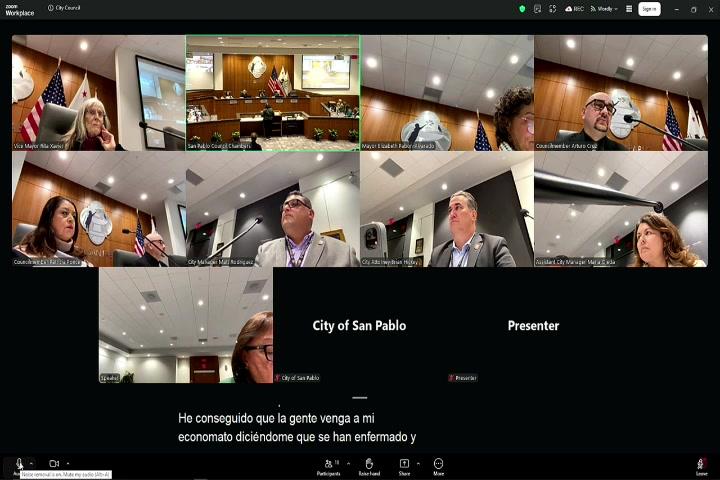
The San Pablo City Council on Nov. 16, 2026, advanced a broad rewrite of its zoning code. The changes would double how long building permits stay valid, loosen rules for building on smaller lots and route all food truck permits through a single approval path. The 4-0 vote to introduce the ordinance came the same night food business owners pressed the council on unpermitted street vendors. The council also agreed to spend about $30,000 a year to keep Spanish-language services that state law no longer requires.
- Zoning overhaul introduced 4-0: permits extended to 4 years, small-lot rules eased, and food trucks streamlined
- Permitted food businesses say unpermitted street vendors are gutting sales, with one owner reporting revenue below $50,000
- Council keeps live interpretation and Spanish agendas under a voluntary, roughly $30,000-a-year plan after SB 1187 dropped the mandate
Zoning Rewrite Targets Permits, Small Lots and Food Trucks
Why it matters: The Title 17 amendments implement the city's housing element and General Plan 2035 and cut approval costs for homeowners and builders. The state is separately pushing cities to streamline their zoning.
Where things stand: Staff and developers told the city the current two-year maximum permit life was too short. The ordinance extends it to four years: two years to act on the permit, plus a possible two-year extension.
The package also:
- Reduces minimum parcel sizes for development
- Streamlines height, roof and second-floor setback rules
- Clarifies minor adjustments and removes them for fences
- Raises fence height limits, with transparency requirements
- Tightens fence rules for commercial front yards
- Expands lighting standards from parking lots to all properties
- Defines who gets notice of zoning administrator decisions
- Revises home-occupation rules
Under the new lighting rules, often called a dark skies ordinance, all properties would need shielded fixtures and would face limits on light spilling onto neighboring lots. Notice of zoning administrator decisions would go to adjoining properties and the Planning Commission.
"It would generally make it easier for someone to expand and build new homes on smaller lots in San Pablo," said Community Development Director Alan Tai.
Food trucks get one path: Today, food trucks face two approval routes. Applicants go to the Planning Commission in two zoning districts and the zoning administrator in two others. Under the ordinance, all food truck permits would go to the zoning administrator.
"This will lower the barrier for food trucks to obtain permits and operate legally, while still providing sufficient scrutiny for food truck applications," said a city planner.
Councilmember Arturo Cruz tied the item to earlier complaints from food truck owners. "Are food trucks required by law to show their permits on their fronts or windows?" he asked. A staff member said "the DMV registration and the health department permit should be displayed at all times." Staff added that display conditions could be written into a truck's administrative use permit.
Mayor Elizabeth Pabon-Alvarado asked about sales tax reporting, how the changes affect existing businesses and when ordinances are revisited. Staff said the city issues a business license only after a seller's permit and health permit are on file.
The City Manager said the rewrite was not a reaction to any particular complaint. "This is not based on complaints. It's based on trying to facilitate and optimize our zoning code to coincide with the goals under the General Plan 2035," the City Manager said.
The other side: Resident Irania Delamora was the only public commenter at the hearing. "Lighting regulation and fencing regulation looks like it may be too strict," she said. She also cautioned against making fences too tall.
Decisions and stakeholder impacts: The council waived first reading and introduced the ordinance by roll call (For: 4 — Cruz, Ponce, Xavier, Pabon-Alvarado; Against: 0; Absent: 1 — Pineda). Small-lot owners and builders gain more time and fewer setback hurdles. Mobile food vendors get a single, more predictable permit route. Property owners with outdoor lighting will face new shielding standards.
What's next: Second reading is expected on the consent calendar at the next meeting, scheduled for Dec. 7, 2026. Staff said more zoning amendments will return in the spring. The ordinance file is on Legistar.
Food Truck Owners Sound Alarm on Street Vendors
Why it matters: Permitted operators say they are losing income to competitors who skip fees, inspections and taxes. But enforcement is split. Street vendors are protected under state law and fall outside city planning authority, and some activity is happening in county territory.
Where things stand: During public comment, Deborah Garcia, owner of La Palmeta Commissary, said unpermitted vendors are selling food on the street without permits, without using a commissary and without paying taxes. She said she has heard of illness complaints.
"All their sales have gone down because of the street vendors that don't have these permits," Garcia said of the permitted trucks she serves.
Jose Gutierrez, owner of Tacos Estilo Chavinda, described the losses in personal terms. "My food truck used to make 6 figures a year and now we can't even touch $50,000," he said. Gutierrez said he called code enforcement and the health department more than 50 times without an adequate response.
Mayor Pabon-Alvarado said the city would look into the complaints. She noted that Terra Hills is a county area.
During the zoning hearing, staff separated the two groups. Food trucks on private property need a use permit and must notify neighbors. "Street vendors are a different story," a staff member said, explaining that the city lacks planning authority over them.
The other side: Delamora urged patience over penalties for vendors working toward compliance. "I believe it's important to give people time to get a permit, at least a year," she said. She warned against immediate ticketing.
Decisions and stakeholder impacts: The council took no action on enforcement. Simpler food truck permitting in the zoning rewrite may help operators who follow the rules. It does not address unpermitted sidewalk sellers. The mayor asked staff to keep watching for effects on existing businesses.
What's next: Residents and business owners can watch whether staff report back on enforcement coordination with Contra Costa County.
City Pays to Keep Language Access the State Dropped
The basics: SB 707 amended the Brown Act, California's open meetings law, effective October 2025. The city adopted Resolution 2026-082 on June 15, 2026, and complied by July 1, 2026. SB 1187 later eliminated several of those requirements, including translated agendas, a designated physical posting space and an electronic agenda request system.
Why it matters: San Pablo is choosing to go beyond state law, using its own money, to preserve language access and public participation.
Where things stand: After a Nov. 2 briefing, the council asked staff for a plan to voluntarily keep some service levels. Assistant City Manager Maria Ojeda presented the plan. Its pieces:
- Wordly live interpretation, about 3,600 minutes, about $5,000
- Spanish-translated agendas posted online and on a bulletin board
- DocAccess website accessibility and translation software, $10,000
- Equipment maintenance plus backup internet, $13,000
- Continued outreach and Legistar access
- Removal of the unused outdoor public-posting bulletin board
The plan also carries about $2,000 in staff time. Staff said about $5,000 can be absorbed in the existing budget.
Ojeda asked the council to "approve the proposed voluntary post-SB 1187 operational plan with an annual starting cost of $30,000." The remaining $25,000 would come from one-time money: either the FY 26-27 multi-departmental fund or the City Manager contingency reserve. That means one-time dollars are covering the first year of a cost staff described as annual.
The other side: Mayor Pabon-Alvarado pushed back on the price tag. She said cost had not been part of the council's earlier discussion. "I just didn't know it was going to be $30,000 annually, and it's my responsibility to go in and check," she said.
The mayor also clarified the history. Before SB 707, the city did not translate agendas but hired a translator as needed. Ojeda confirmed: "We were not providing translated agendas to the public until the law required us to do it for SB 707."
The City Manager framed the requirements as a cost the state handed down without paying for it. "This is all unfunded mandate stuff. We're not getting any funding from the state to implement it," the City Manager said.
Decisions and stakeholder impacts: The council approved the plan (For: 4 — Cruz, Ponce, Xavier, Pabon-Alvarado; Against: 0; Absent: 1 — Pineda). Spanish-speaking residents keep live interpretation and translated agendas. Residents with disabilities keep accessibility tools. Remote viewers gain backup broadcast reliability. No member of the public commented.
What's next: Watch whether the ongoing roughly $30,000 cost moves into the regular budget once the one-time funds are spent.
Minor Items
- Consent calendar passes 4-0: The council approved items 4–9, with Pineda absent. The items include a county senior congregate meals agreement, part-time pay updates for the minimum wage effective Jan. 1, 2027, five-year CalRecycle grant authority and expanded HDL sales tax auditing to cover Measure R.
- Opioid settlement session canceled: The 5:30 p.m. closed session on the Albertsons opioid settlement was canceled for lack of a quorum. The decision on whether to participate remains pending.
- Lung cancer awareness: The council proclaimed November 2026 Lung Cancer Awareness Month. Sydney Lay of the American Lung Cancer Screening Initiative said only 16% of high-risk Californians are screened.
- Fiestas Patrias honor: The council recognized Arvind Sharma of San Pablo Sportsman Liquor for his award-winning storefront and proclaimed Sept. 12, 2026, Fiestas Patrias Day.
- Cooking oil recycling: Resident Irania Delamora promoted a cooking oil drop-off on Bloom Drive and asked the city for a cash incentive for recycling oil.
Looking Ahead
The council adjourned to Dec. 7, 2026, in memory of the sister of a city human resources risk manager. Final adoption of the zoning ordinance is expected at that meeting.