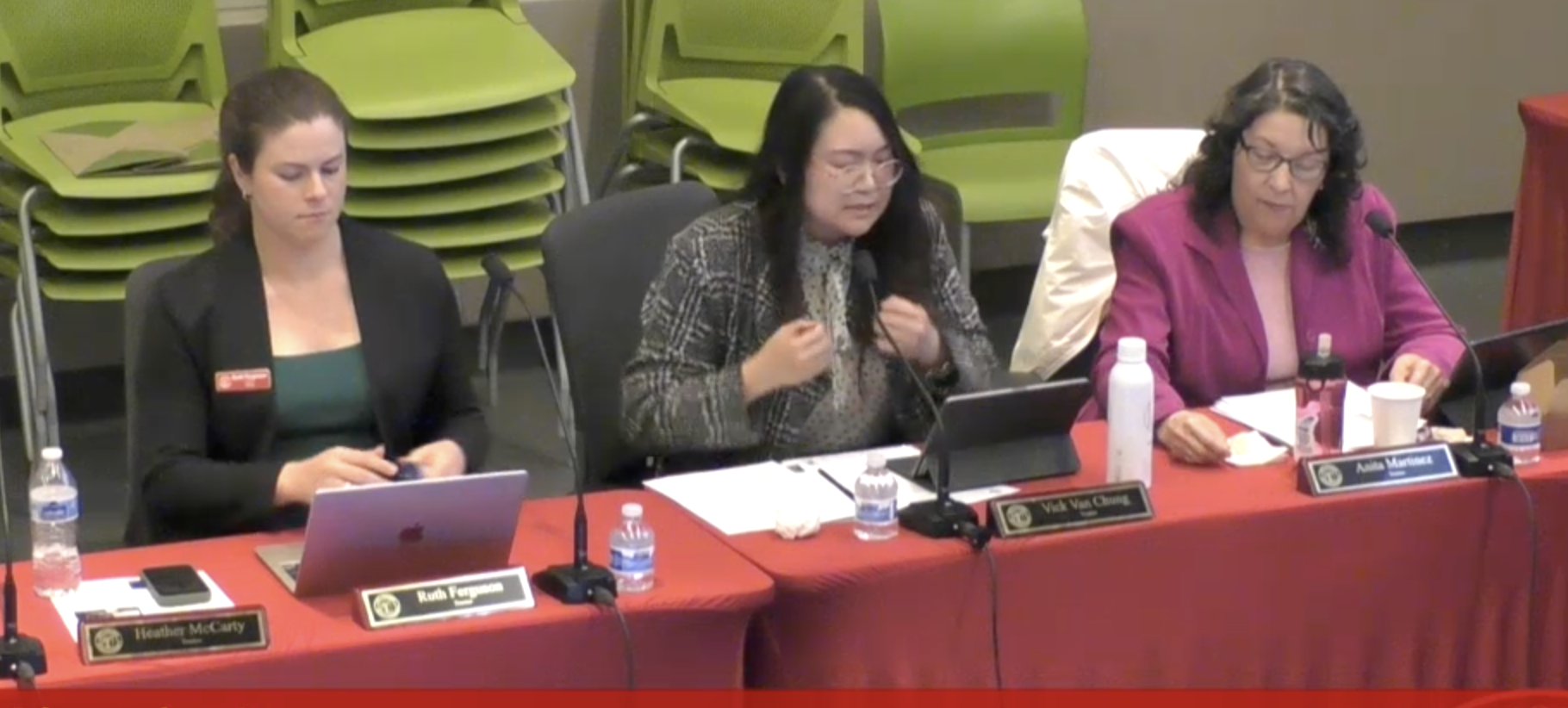
Governing Board - Mar 26, 2026 - Regular Meeting
Governing Board • San Francisco City CollegeMarch 26, 2026
Locunity is a independent informational service and is not an official government page for this commission.We use AI-assisted analysis and human editorial review to publish information.
Downtown Campus Faces Shutdown as State Funding Deadline Looms
The San Francisco City College governing board confronted the imminent loss of $2.2 million in state funding for its downtown campus at a marathon meeting that stretched past midnight, with roughly 30 speakers pleading to keep the city's most transit-accessible college location open. The board also sparred over proposed cuts to the Free City tuition program, heard the launch of a student worker union, and honored the legacy of beloved faculty member Lauren Mueller.
- Downtown campus set to lose $2.2M in state center funding as enrollment falls far short of the 1,000 FTE threshold, with the deadline expiring July 1
- Free City program faces a $2.5M budget cut under a new city proposal that would also impose a FAFSA requirement the board says could deter vulnerable students
- Students announce formation of a student worker union, citing CCSF's 15-hour weekly cap as the lowest among all California community colleges
- Faculty union opens bargaining with full-time salaries ranked in the bottom 40% statewide as its top priority
- Board unanimously honors late faculty member Lauren Mueller, establishing the Beloved Fellow Scholarship for interdisciplinary studies students
Downtown Center's $2.2M Funding Crisis
The basics: Under the California Student Centered Funding Formula, a community college campus must generate at least 1,000 full-time equivalent students (FTEs) to qualify as a state-funded "center" — a designation that currently delivers $2.2 million annually to CCSF's downtown location in the Tenderloin. An emergency condition allowance has temporarily waived that threshold, but it expires July 1, 2026.
Why it matters: The downtown center is CCSF's most accessible campus for immigrants, working adults, and formerly incarcerated students from more than 40 countries. Administration says the center generated only 325 FTEs in 2025-26 — less than a third of the requirement — and that reaching 1,000 FTEs would demand approximately 6,750 enrolled students and $2.6 million in additional instructional spending. Vice Chancellor Julian Legioso and Vice Chancellor David Yee presented the financial picture while outlining a plan to shift non-credit ESL classes to the Chinatown-North Beach center, pushing that grandfathered site from roughly 811 to 1,000 FTEs, which could yield $500,000 to $1.2 million in new funding.
Where things stand: Approximately 30 speakers — students, faculty, former student leaders, and retired administrators — opposed the administration's plan to pause operations at the downtown site. Speaker after speaker argued that the enrollment decline was the predictable result of years of disinvestment: course offerings dropped from 86 sections in 2018-19 to just 20 in the current semester. Multiple speakers invoked prior campus closures at Alemany/Civic Center, Fort Mason, and John Adams non-credit — all of which, they said, led to permanent student loss rather than transfers.
"While the Chancellor has stated that we are not reducing non-credit sections, that's not factually correct. Our total instructional offering has been reduced by 12 FTEF," said Jessica Bucksbaum, ESL Department Chair.
ESL Coordinator Krista Lewis challenged errors in the administration's presentation, noting six computer labs on the fifth floor went unmentioned. Former Downtown ASC Vice President Ryan Pan, calling in from Washington, D.C., described his own transformation from ESL student to think tank researcher at the downtown campus and warned that closure would erase possibilities for future immigrants.
The other side: Vice President Luis Zamora offered the board's most direct public explanation of the crisis: "The downtown center got special state funding that our other centers did not get. It was based off of a number called FTEs, which is not how many — excuse the phrase — butts are in the seats, but it's full-time equivalent students." Zamora also reassured the community: "No faculty is going to be laid off. Obviously they're going to have to be shuffled somewhere else at the discretion of the administration with consultation with SEIU and AFT."
Retired administrator Leslie Smith proposed attributing online class FTEs to the downtown center and converting it to a "site" rather than a center, but administration clarified that California Code of Regulations Section 58771 prohibits moving online course attribution between sites for apportionment purposes. Smith also warned the district about its broader hold-harmless trap: "You will never get COLA and you will never get growth and you will never be able to balance your budget because unless you want every single salary to stay the same, you need COLA."
Retired business faculty member Susanna Atwood noted that under hold-harmless, CCSF's $166.7 million allocation is guaranteed regardless of center changes, urging more detailed financial analysis before action.
Trustee Anita Martinez delivered pointed criticism of the administration's timeline: "If this problem was known three years ago, why wasn't it brought to the board's attention three years ago? So that we could have developed a strategy." Martinez also connected the downtown crisis to a broader institutional pattern: "It appears that the college is contracting in a particular way. It's contracting in the number of non-credit courses that are offered. And that's a shame in this year in particular because non-credit adult ed was founded in 1856 in this city." She noted the Mission campus had recovered from 115 to over 1,000 FTEs with proper leadership investment.
Trustee Vick Van Chung delivered an emotional apology: "I want to apologize to the downtown community. I want to apologize to the Tenderloin community. We could have done better."
Student Trustee Angelica Campos captured the mood among students: "There's a general sense of distrust right now. And I want to think about the ways that we increase trust in the future."
Decisions: No formal board action was taken. The item was informational, but the board requested additional data on non-credit funding, Adult Education Program allocations, and future use of the building for continued discussion.
What's next: The administration's operational pause takes effect when the emergency condition allowance expires July 1. The board signaled this warrants further deliberation, but no follow-up date was announced. The gap between 325 and 1,000 FTEs remains insurmountable in the near term without a fundamentally different approach.
Free City Faces $2.5M Cut as Board Resists FAFSA Mandate
Why it matters: Free City — the signature program that made CCSF the first free community college in the nation — currently operates on approximately $9 million in city funding administered through the Department of Children, Youth and Their Families (DCYF). The mayor's office has proposed reducing that to $6.5 million while expanding eligible expenses to include debt waivers, other fees, and indirect costs. But the reduced budget would force painful tradeoffs.
Where things stand: Board President Aliya Chisti briefed the board on the Free City Oversight Committee's recent meeting where DCYF laid out the proposal. A FAFSA requirement was included with an exemption for undocumented students, but board members and advocates worried it would still deter enrollment among vulnerable populations.
Chisti pushed back firmly on the budget framing: "The program does not cost $6.5 million. It never costed $6.5 million. This program has been operating for almost four or five years under this new model." She emphasized that the core of the program — tuition waivers and grants — must be preserved.
Trustee Susan Solomon suggested the board pass a resolution by April 9 to establish priorities before the April 17 Oversight Committee special meeting. Free City founding member Alyssa Messer urged the board and oversight committee to speak in one voice to strengthen the chancellor's negotiating position with the city. Zamora expressed openness to FAFSA with exceptions.
BSU President Brianna Smith pressed the board to center students in negotiations: "I hope that in these board meetings that are going this late, that we're thinking about the care of the community and those who are attending, including the students who are part of the board."
What's next: The board may draft a resolution by April 9 ahead of the April 17 Oversight Committee special meeting. The mayor's budget is not yet final.
Students Launch Union, Citing Lowest Work Hours in State
Why it matters: CCSF caps student employment at 15 hours per week — the absolute lowest among all 116 California community colleges, according to a statewide audit cited by student organizers. In a city where minimum wage barely covers rent, students say the cap forces impossible choices.
Where things stand: Madison Rauch, organizing chair of CCSF Students for Justice, announced the formal pursuit of the CCSF Student Worker Union (CCSF SWU) following Gavilan College's precedent as the first community college student worker union in the state.
"We are the absolute, absolute lowest in the state by a lot. The next step is 19 hours per week and the average is in the mid-20s," Rauch said.
Student worker Jing Shi spoke on four items — Free City, downtown campus, the union, and kitchen access — describing the reality of working two student jobs to afford living in San Francisco. Student Kelvin Ekman raised concerns about student workers being denied the ability to post on official CCSF social media and lacking security access badges.
Student Trustee Angelica Campos called for reevaluating how student workers are treated, saying they should not feel "infantilized or treated like a second class."
What's next: The students are seeking voluntary recognition of their union from the administration. No timeline for a response has been set.
Faculty Union Opens Bargaining With Pay as Top Priority
Why it matters: CCSF's full-time faculty salaries rank in the bottom 40% of all community colleges statewide, according to the union — a gap that threatens the college's ability to recruit and retain educators during a period when enrollment recovery depends on instructional quality.
Where things stand: AFT 2121 Vice President Robin Pugh presented the union's sunshine document, developed through a membership-wide bargaining survey. The 14-member bargaining team represents credit and non-credit faculty, including counselors, librarians, and part-time instructors. Top priorities include competitive pay, job stability for part-time faculty increasingly treated as "gig workers," and collaborative bargaining.
"Full-time faculty salaries at City College are currently in the bottom, bottom 40% of the state. That's got to change," Pugh said. She also noted the union has a better track record than the college on budget projections and acknowledged the chancellor's commitment to a new tone in labor relations.
What's next: The sunshine document received its first read as an informational item. Formal bargaining negotiations are expected to begin in the coming months.
Board Honors Lauren Mueller, Establishes Beloved Fellow Scholarship
The board unanimously approved a resolution celebrating the legacy of Lauren Mueller, a faculty member who founded Poetry for the People, Trauma in the Arts, and multiple ethnic studies programs at CCSF. Professor Maggie Harrison of Women's and Gender Studies presented remotely, describing Mueller's contributions to hundreds of poets and her work establishing programs in Middle East/SWANA studies, Pacific Islands studies, and the groundwork for Native American and Indigenous studies.
The resolution calls on the chancellor to work with faculty to fund an annual celebration and invites the seven annual Beloved Fellow Scholarship recipients to the board's final meeting each year. The Interdisciplinary Studies department is petitioning to become the Department of Critical Resistance and Ethnic Studies.
BSU President Brianna Smith spoke emotionally about Mueller's impact on her journey as a student leader and poet.
Decisions: Approved unanimously (For: 8, Against: 0, Absent: 0).
First Sean Monterosa Scholarship Recipients Honored
Board President Aliya Chisti opened the commendation by reflecting on the 2020 board resolution honoring Sean Monterosa — a CCSF student killed by Vallejo police — and her personal commitment to making a scholarship in his name a reality. "I just had made a promise to myself that this resolution was like, we had to make the scholarship happen. I don't know how, but we just had to do this in his memory," Chisti said.
Ashley and Michelle Monterosa spoke about nearly six years of advocacy, including murals and the renaming of a street in Sean's honor. Recipient Tabari Morris, managing editor of the SF Bayview, spoke about using journalism to address injustice. Recipient Yenia Jimenez, pursuing Latin American studies, described how the scholarship supports justice-system-involved individuals. Vice President Zamora expressed interest in a mural at City College.
Minor Items
- $24,000 EEOC settlement: Board approved settlement paying Moira Sullivan $24,000 to release all claims in an employment discrimination case, announced during the closed session report.
- Interim communications hire approved 7-1: Trustee Martinez cast the lone no vote, citing concerns about spending during uncertain financial times (For: 7, Against: 1, Absent: 0).
- Consent agenda approved unanimously: Items 11 through 15 passed, excluding item 11F (pulled for a missing form) and 14A (separated for individual vote) (For: 8, Against: 0, Absent: 0).
- Board self-evaluation: Staff member Kristen Charles presented a draft evaluation instrument; the board discussed adding a professional development question to strengthen accreditation compliance.
- Campus safety concerns: Student Trustee Campos raised reports of sexual harassment affecting female and queer students and highlighted upcoming prevention trainings.
- Student Success Center kitchen dispute: Multiple students protested construction enclosing a communal kitchenette — the only student-accessible sink, microwave, and community fridge outside of bathrooms. Chancellor Messina and Dr. Cooper Wilkins clarified the construction was part of the original building plan, the space would remain accessible during business hours, and a temporary microwave relocation was in progress.
- Meeting adjourned in memory of Andrea Shorter and Elaine Johnson. The board extended its session three times — to 10:30 p.m., 11:30 p.m., and finally 11:59 p.m. — to complete its agenda.