
Faculty, Unions Press City College on Pay as Layoff Plan Stalls
Governing Board • San Francisco City CollegeOctober 22, 2026
Locunity is an independent informational service and is not an official government page for this commission. All information is sourced from public footage and an analysis of official agendas with the aid of responsible, fact-checked AI. to report an error or omission.
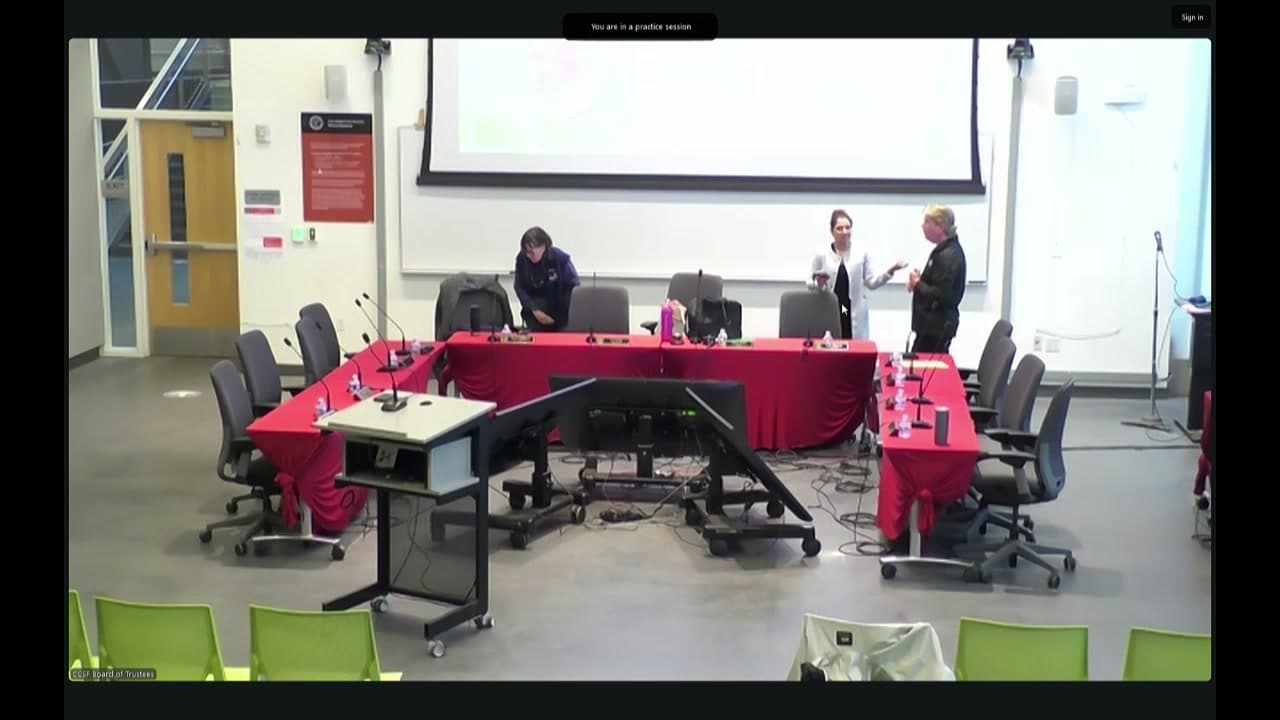
Faculty, unions and students filled the City College of San Francisco Board of Trustees' Oct. 22, 2026, meeting to demand raises, more full-time hiring and spending from reserves they put near $72M. Later that night, trustees rescinded approval of an HR layoff resolution and the Acting Chancellor pulled it. The board also ratified administrator stipends that had never come to open session, ordered an audit and approved a $350,000 Acting Chancellor contract.
- Sixteen public commenters pressed for a fair contract, calling the district's 3% counteroffer inadequate
- HR layoff resolution pulled after a 7-0 rescission and a failed 0-7 continuance
- Administrator stipends ratified 7-0, with an internal audit promised by Dec. 3
- Acting Chancellor David Yee's $350,000 contract approved 7-0
- Free City reaches 93% participation as trustees demand cost details before city talks
- Speakers call for reopening the shuttered downtown center and equal services at regional sites
Labor's Message: Spend the Reserves
Why it matters: Faculty and staff tied pay directly to program capacity. Speakers cited faculty shortages in nursing, chemistry, public health, construction management and ESL. The union also challenged how the board defines its pro-labor commitments.
Where things stand: The pressure began in union reports. "It would take a 20% raise just to bring faculty salaries back to the same level of buying power we had in 2007," said Robin Pugh, President, AFT Local 2121. She added that "a 3% counter with the district's current financial position is completely unreasonable."
It continued through public comment. The clerk reported 16 comments, and Board Chair Aliya Chisti set a two-minute limit. Faculty described a pattern of attrition:
- Chemistry has lost seven full-time faculty since 2019, said Tori Glenn, and students are turned away from nursing prerequisites.
- Community and Public Health fell from 15 full-timers to six, said Janie Skinner, a member of the bargaining team.
- Construction Management has one full-time professor and loses part-time industry instructors over pay, said Guillermo Luzardo.
- Clinical experience isn't recognized in nursing step placement, which hurts recruitment, said Damian Martin.
Skinner said the district moved from 2% to 3% without justifying either figure. "The district has offered a measly 2% without any backup of why 2% is exactly the right number for the district," she said. She asked trustees to make the budget transparent.
Coalition muscle: The labor movement's regional and state leadership showed up. "I'm here on behalf of both unions that are out there asking for a fair contract now," said Jeff Freitas, President, CFT. His asks included AI protocols and protections for immigrant students. "When you have a $72 million surplus and you're not spending it on changing students' lives, there's a problem," said Kim Tavalloni, Executive Director, San Francisco Labor Council.
Tiana Tillery, a UESF paraeducator vice president, pointed to her union's four-day strike. She called for transparent financial reporting and good-faith bargaining.
Students joined in: Student leaders cast faculty working conditions as student learning conditions. "Between $70 and $74 million, we have the money," said Evangela Brewster, Student Vice Chancellor and Black Student Union president. Student Chancellor Sophia Flores Guevara asked for budget transparency students can understand. Student workers Homia Jones and Esther Mondesir asked for livable wages for educators and student workers.
The other side: The district didn't present a bargaining position or respond to the reserve figures during the meeting. The $72M number came from speakers, not staff.
Decisions and stakeholder impacts: The board took no action on bargaining. AFT 2121 and SEIU 1021 members, part-time faculty and students in high-demand programs carry the most at stake. Their united front with the Labor Council, CFT and UESF raises the political cost of a prolonged dispute.
What's next: Bargaining continues. No date was announced.
HR Layoff Plan Collapses on the Dais
The basics: Staff proposed laying off two HR operations employees for "lack of work." Their positions, classifications 1224 and 1813, would be replaced with two 1244 generalist positions.
Where things stand: "HR is asking for elimination of two positions on the HR operations team to replace them with two 1244 positions," said Associate Vice Chancellor Coleman. Coleman argued the current specialist model leaves no backups.
Trustees probed the job descriptions, the "lack of work" rationale and civil service bumping, which lets laid-off employees displace others in comparable jobs. Trustee Heather McCarty asked whether bumping could reach citywide. Staff said bumping is possible. They added that a no-layoff provision in a recent city SEIU contract for PCS employees would need review with the city's Department of Human Resources.
The other side: Support for the concept didn't extend to this plan. "I do support a generalist service delivery model," said Trustee Vick Van Chung. But Chung said he was troubled that the plan reduces union-represented positions. "I'm going to vote against this because it is not clear to me how this is going to be done," said Trustee Susan Solomon.
Decisions and stakeholder impacts: Vice President Luis Zamora had moved approval, with Chisti seconding. Zamora then reversed course. "I will also be voting no on it because I would like to have that clarity," he said.
The board rescinded the motion (For: 7, Against: 0, Absent: 0). Zamora then moved to continue the item to Nov. 5, 2026, but urged a no vote, and it failed (For: 0, Against: 7, Absent: 0). The Acting Chancellor pulled the item. Both HR positions remain for now.
What's next: Any revised version must address bumping and union representation before it returns. No date was set.
Stipends Ratified, With an Audit Attached
Why it matters: Administrator stipends had not previously come to open session. That made the vote a corrective step and a test of the board's spending oversight.
Where things stand: Under the ratified schedule, vice chancellors receive $900 a month and associate vice chancellors receive $500 a month for district travel. Both groups also get a $60 monthly cell phone stipend. The stipends end June 30, 2027, and a feasibility analysis is due before then. Chung confirmed that no other stipends are allowed unless approved in open session.
Earlier, SEIU's chapter president framed the stakes. Maria Salazar Colon, President, SEIU Local 1021, SFCCD Chapter, asked for an impartial review of hiring qualifications, a stipend audit and a contract-compliance review. "We are not asking the board to accept allegations without evidence," she said.
The other side: Trustees voted yes but with reservations. "I would like to request assurance that there was no in-district travel of any administrator who is getting a stipend that they also invoiced and got reimbursed for," said Solomon. A staff member offered an internal audit by the Dec. 3 meeting.
"Anything that regards approval of things that cost money must come to the board," said Trustee Anita Martinez. Chung said the vote formalizes "a benefit to just administrators."
Decisions and stakeholder impacts: The ratification passed (For: 7, Against: 0, Absent: 0). Zamora moved it and McCarty seconded.
Trustees then approved Acting Chancellor David Yee's contract by the same 7-0 margin, on a motion by Martinez seconded by Chung. The terms include a $350,000 salary, a $900 monthly expense stipend, a $60 phone stipend and administrator benefits. The contract is effective Oct. 5, 2026, until the board terminates it. Solomon noted that Yee's stipend covers expenses incidental to district business, wording that differs from the VC and AVC stipends.
What's next: The internal audit is due by Dec. 3.
Free City Thrives; Trustees Want the Fine Print
Why it matters: Free City now reaches most students. Trustees warned, however, that the city can pull its funding at any time.
Where things stand: "21,837 students are eligible for Free City, and we're currently at 20,251," said Vice Chancellor Clint Cowden, which works out to 93% participation. Staff cited 79% of students eligible, more than 33,000 awards and 85,000 enrollments.
Chisti flagged the risk built into the agreement with the city. "The boilerplate language of the MOU is really strong that they can pull funding at any time," she said. She asked administration to fill in Appendix A, which covers tuition and grant costs, notice before funding is pulled, a cost floor, administrative cost and clawback terms. She wants that ideally by the Nov. 5 meeting and before a Dec. 5 oversight meeting.
Solomon said there still needs to be clarification on which version of the MOU the subcommittee will review. Public commenter Alisa Messer welcomed the board's involvement. "We see how effective it is when we're all speaking with one voice," she said.
What's next: MOU meetings with the city are set for Nov. 6, 9 and 15.
Downtown Closure Draws Equity Challenge
Where things stand: Faculty, students and residents asked the board to revive the shuttered downtown center. ESL faculty member Christa Lewis said the ESL workgroup is not a participatory-governance body. She asked that downtown revitalization be placed on the next board agenda, citing earlier requests from Martinez, Chung and Solomon.
"We need to stop closing classes at various centers and then blaming the students for not showing up for locked doors," said public commenter Michael Adams. Adams also raised gentrification concerns.
Lydia Hernandez, president of the Mission Campus Associated Student Council, raised an accreditation risk tied to the Accrediting Commission for Community and Junior Colleges. "Under ACCJC Standard 2C, equity mandates that support services need to be comparable at all institutional sites, not solely at the Mission Campus," she said.
Decisions and stakeholder impacts: The board took no action. Speakers said working-class ESL students and residents near the Mission, Chinatown and John Adams sites bear the burden.
Minor Items
- Parcel tax: Chisti and McCarty previewed a resolution to prepare renewal before the 2032 expiration. It calls for quarterly reports at minimum and an election no later than November 2028, and returns for action later.
- Closed session: The board rejected one government claim, with six votes in favor and one abstention.
- Muller scholarship: Trustees honored seven inaugural Lauren Muller Beloved Fellows in Interdisciplinary Studies.
- Consent agenda: Approved by acclamation, including Sikh Awareness Month and Diwali resolutions and Dr. Sandy Chang's women-in-engineering trip to Boston.
- Minutes and absences: Five sets of minutes and four trustee absences were approved; the May 28 minutes correction moves to Nov. 5.
Looking Ahead
The board meets again Nov. 5, 2026. Free City MOU talks with the city follow Nov. 6, 9 and 15. The stipend audit is due by Dec. 3, and the Free City oversight meeting is set for Dec. 5.