Governing Board - Aug 13, 2026 - Meeting
Governing Board • San Francisco City CollegeAugust 13, 2026
Locunity is a independent informational service and is not an official government page for this commission.We use AI-assisted analysis and human editorial review to publish information.
CCSF Surplus Hits $17.4M as State Audit Questions $71M in Reserves
The CCSF Governing Board spent a marathon five-hour open session Aug. 13 confronting a triple bind: a state auditor's report questioning why the college is sitting on $71 million in reserves, a non-credit enrollment collapse threatening the pipeline for credit programs, and a looming accreditation midterm review that will test whether the institution has truly moved past its years of crisis. With the budget adoption deadline just weeks away, the board must now decide how to spend down its surplus — and who benefits.
- $17.4M surplus in first draft budget draws scrutiny as state audit criticizes community college reserves
- Non-credit enrollment plunges 12.3% with ESL losses at every center; Mission campus sees steepest drop
- ACCJC overhauls accreditation standards from 127 to 30, previewing CCSF's fall 2027 midterm review
- Faculty union representative calls out bottom-40% salaries while classified spending jumped 15%
- Trustees probe bond-funded facilities change orders at John Adams Center, Wellness Center and Student Success Center
Reserves Under the Microscope
Why it matters: A state audit released Aug. 6 and headed to the legislature questions whether community colleges with large reserves are shortchanging students — and CCSF, with $71 million in the bank and a growing surplus, is one of six colleges named.
Where things stand: New Vice Chancellor of Finance Shannon Carter — less than a month into the role — presented the first draft of the FY 2026-27 adopted budget. The projected surplus grew from $11 million at the tentative stage to $17.4 million, driven by additional state revenue still being analyzed. A 4.31% cost-of-living adjustment (2.87% statutory plus 1.44% discretionary) raised CCSF's hold-harmless funding floor to $169.1 million. But personnel costs of $181 million consume 88% of the budget, leaving a structural gap relative to apportionment.
Trustee Chung zeroed in on the $6 million swing between tentative and adopted projections. "That's a massive cushion to write on both ends. What's important is working as close to the actual so that we are investing as much resources for our students and our community," he said.
Trustee Martinez devoted significant time to reading from the state auditor's report on community college reserve funds, quoting its central finding: "Although maintaining sufficient funding reserve is important for districts' fiscal health, when districts accumulate reserves beyond their needs, they miss opportunities to spend on programs to better support students." She pressed the chancellor on whether CCSF had completed the risk analysis the auditor recommended, noting the college's 5% minimum reserve target is well below the report's recommended 17%. Martinez asked when the board would see a concrete plan to reduce excess reserves and whether reserves should appear as a separate budget line item.
The other side: Chancellor Messina said CCSF received more favorable remarks than other audited colleges and pledged to share the full report with all trustees. She committed to bringing proposals that distinguish between one-time spending and ongoing obligations. "Some of the discussion points that we will be bringing are what are some one-time things that we can do to support students and our college out of these one-time funds versus what are some ongoing commitments and how could those be funded," she said, adding that staff would also bring aggressive plans for categorical fund spending.
Public commenters sharpened the stakes. Abigail Bornstein, representing full-time faculty interests, told the board that full-time faculty salaries rank in the bottom 40% statewide while classified spending rose 15% year over year compared with just 2% for certificated staff. Leslie Smith questioned a five-year capital outlay plan that showed no faculty hiring and an 18% productivity increase. Merilee Hearn asked about interest earned on reserves and cited State Chancellor Sonia Christian's concern that districts are increasing savings at the expense of student instruction.
What's next: The board must adopt the final budget by Sept. 15. The chancellor committed to sharing the full state auditor report and returning with proposals for deploying surplus and reserve funds.
ESL Enrollment in Freefall Across All Centers
Why it matters: Non-credit students — especially those in ESL — are the primary feeder into CCSF's credit programs. Losing them threatens enrollment revenue and the college's core mission of serving immigrant and working-class communities.
Where things stand: Vice Chancellor David Yee reported mixed summer 2026 results. On the credit side, resident FTEs rose 4.8% and fill rates improved from 84.5% to 87.8%, with in-person modality seeing significant gains while online enrollment declined. The largest credit gains came in kinesiology, Asian American studies and behavioral sciences. Transitional studies posted strong numbers thanks to improved dual-enrollment partnerships with SFUSD for credit recovery.
But non-credit enrollment fell 12.3%, with FTEs down 4.9%. ESL enrollment declined at every center. Trustee Chung flagged the Chinatown campus in particular: "When you look at ESL in Chinatown, even though we only dropped two sections, there's a hundred less students. It's a significant change in capacity." He requested a deeper synthesis of why enrollment is declining and what outreach differed semester over semester.
Chancellor Messina acknowledged the Mission campus decline was the administration's biggest puzzle. "The biggest anomaly for us that we are researching that we need to bring back to you is what specifically happened at the Mission center because that's where we saw the biggest drop, which was a surprise to us." She explained the administration had adopted a new demand-driven approach to adding sections, after the previous year's strategy of front-loading sections resulted in higher faculty costs with no enrollment gain.
Trustee Martinez praised Yee's work but warned against thinking enrollment can be easily restored, quoting a former vice president of instruction: "Enrollment is not like a faucet. With a faucet, you can turn the water off and then you can turn it back on. It comes right back. With enrollment, you can't do that."
Vice President Zamora expressed concern about a direct correlation between reducing sections and reducing enrollment. Student Trustee Wong asked questions about outreach strategies. Public commenters Lydia Hernandez and Leslie Smith cited inadequate student services, lack of childcare, limited evening and weekend classes, and insufficient community outreach as barriers. Smith warned the board that non-credit is the biggest feeder for credit programs and that California has the second-highest adult illiteracy rate nationally.
What's next: Administration committed to investigating the Mission campus decline and returning with section fill-rate data. Fall 2026 enrollment is currently tracking slightly down, though Yee expects a bump from a new attendance accounting method known as the SAM formula.
Accreditation Gets a New Playbook
Why it matters: CCSF's accreditation history includes devastating sanctions that nearly shuttered the institution. With the college's midterm report (called an ICER) due fall 2027 and the next site visit in fall 2030, understanding the new framework is essential for trustees who bear direct responsibility under two of the four new standards.
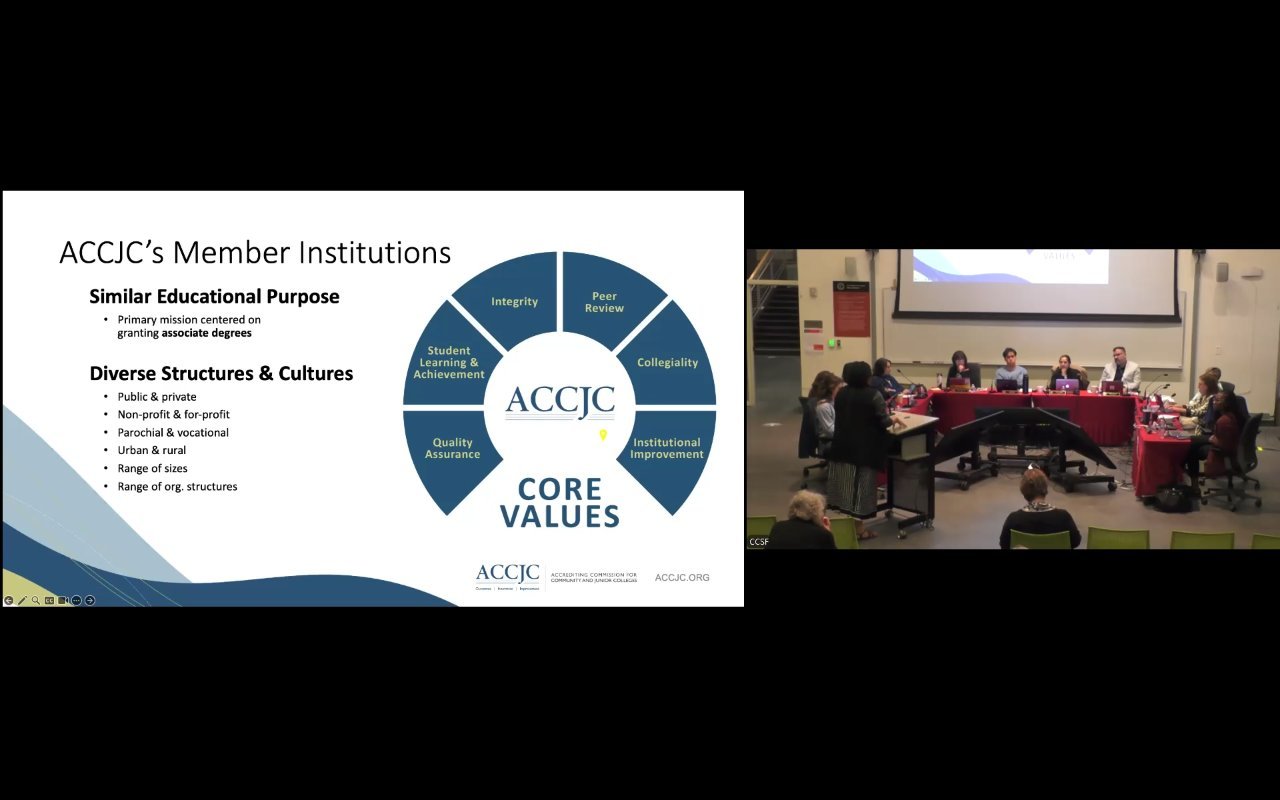
Where things stand: ACCJC Vice President Nicoana Shaw delivered a workshop-style presentation to the board covering the commission's reformed peer review process. The headline number: "We used to have 127 standards. We have 30 now. You're welcome," Shaw said. The new framework uses appreciative inquiry rather than what Shaw described as the old "gotcha" approach. Site visit teams have been cut from 10 to 5 members, and the process features a two-semester timeline with early evidence submission windows.
Shaw organized the standards like a house: Standard 1 covers mission, Standard 2 covers student services, Standard 3 covers resources and finance, and Standard 4 covers governance. The board's primary responsibilities fall under Standards 1 and 4. She emphasized that accreditation is about documenting process, not just outcomes. "The what is easy to answer. What are you doing? We're educating students. To know how is the part that we want you to master. Because then you have the facility to be able to change, to pivot when new situations arrive."
Trustee Solomon acknowledged the weight of CCSF's history. "I truly appreciate that we've been told that the gotcha cycle has changed. I don't think we can underestimate the real trauma that people at this institution have experienced in the past 15 years or so because of the ACCJC." She asked Shaw to add a question about what the board is doing well alongside areas for improvement.
Shaw addressed a concern about ACCJC's scope being limited to associate degree-granting institutions, and Chancellor Messina clarified that this reflects the commission's federal scope, not a limitation on CCSF's broader mission.
Public commenter Merilee Hearn used the accreditation discussion to advocate for restoring older adult education, noting the program was cut by over 90% and never restored. Lydia Hernandez urged the board to prioritize campus equity, citing closed centers and dropped ESL classes.
What's next: CCSF's midterm ICER is due fall 2027. Shaw will serve as the college's primary ACCJC liaison. The next full site visit is scheduled for fall 2030.
Public Commenters Sound the Alarm on Enrollment and Access
During general public comment, four speakers pressed the board on declining enrollment and campus closures. Leslie Smith cited a loss of more than 5,300 FTEs since 2017-18, including a 43% decline in female enrollment, a 61% decline among women over 50 and a 54% decline in Asian enrollment. She urged the college to reopen classes in neighborhoods. Lydia Hernandez criticized the Diligent board materials website for restricting access to documents once meetings begin, calling it a violation of the spirit of the Brown Act, and complained about the downtown campus closure. Madeline Mueller advocated for CCSF's arts programs, citing AI-generated data showing California's arts and entertainment industry contributes $288 billion annually. Alyssa Messer urged the board to keep the Free City program on its agenda amid recent leadership changes.
Minor Items
- Resolutions: Hispanic Heritage Month and Patriot Day/National Day of Remembrance resolutions received first reads; no action taken.
- John Adams Center (10B): The Division of State Architect required additional structural analysis of the century-old building's wood framing, necessitating a certified "wood grader" — a detail that drew laughter from the board. Associate Vice Chancellor Vasquez briefed trustees on the change order.
- Wellness Center (10C): A roofing analysis expanded in scope after underground water intrusion and worn expansion joints were discovered, requiring additional design and construction administration from Stantec Consulting.
- Student Success Center (10D): Trustee Chung pressed for specifics on a vaguely described "user-added scope" change order, learning it included security and privacy improvements to exposed stairwells. He urged more detailed descriptions for the bond oversight committee.
- Farming Hope MOU (9G): Leslie Smith noted CCSF closed its regular culinary arts program at the downtown campus but now has funding for a new partnership, and questioned a reference to enrollment fees in a non-credit program.
- Indigenous Peoples Day: Vice President Zamora requested the observance be listed on the academic calendar; the board discussed creating a more inclusive observance calendar separate from the academic calendar.
- Closed session: The board entered closed session unanimously (8-0) and reconvened at 7:52 p.m. with no reportable actions.
- The meeting was extended to 10:30 p.m. and adjourned at 10:26 p.m. (For: 7, Against: 0, Absent: 1 — Trustee Martinez had departed).