Governing Board - Jun 05, 2026 - Meeting

Governing Board - Jun 05, 2026 - Meeting

Governing BoardSan Francisco City CollegeJune 5, 2026

Sources:

Locunity is a independent informational service and is not an official government page for this commission.We use AI-assisted analysis and human editorial review to publish information.

CCSF Board Retreat Exposes Governance Gaps, Budget Risks, and Meeting Dysfunction

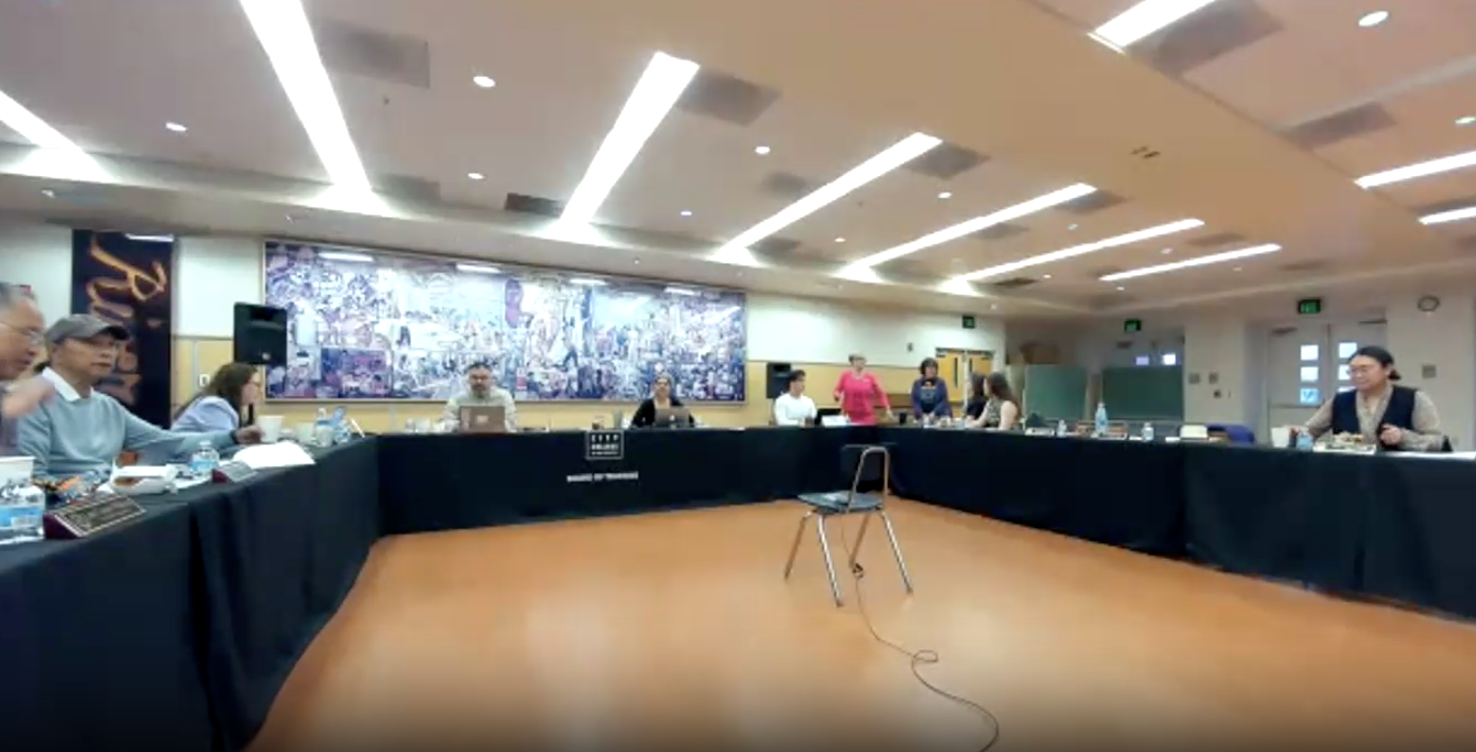
The CCSF Board of Trustees spent an all-day retreat confronting a set of interconnected challenges: a tentative budget that masks structural deficits, a self-evaluation showing college leadership has declining confidence in the board's ability to stay in its lane, and an agenda-setting policy that remains entangled with prior accreditation warnings. The June 5 session also produced a consensus that the board's own marathon meetings — regularly running past 9 p.m. — need structural reform.

  • $10.8M current-year surplus masks looming deficits as multi-year projections show reserves shrinking to one-third of current levels by 2029-30 without a parcel tax renewal or enrollment growth

  • Board self-evaluation reveals widening trust gap with college leadership, as the lowest-scored item — trustees refraining from directing staff — dropped from the prior year

  • Agenda-setting policy debate stalls over whether the board president's role is "consultation" or "conjunction," with legal counsel warning the latter exceeds Brown Act authority

  • Trustees push to end marathon meetings, floating time limits, advance question submission, and converting committee-of-the-whole sessions into action-capable meetings

  • New student trustee Ian Wong sworn in, becoming the sole student voice on the board and the Free City Oversight Committee


Budget Preview: Surplus Today, Structural Crisis Ahead

Why it matters: CCSF's hold-harmless funding from the state keeps revenue flat while costs rise. Without a parcel tax renewal or meaningful enrollment growth, the district's reserves could erode to dangerous levels within four years.

CFO Dr. Ligioso presented a preliminary tentative budget for FY 2026-27, built from the ground up with departmental input for the first time.

The headline number — a $10.884 million projected surplus for the current fiscal year — is significantly above the $4.4 million originally budgeted. But much of the gap traces to one-time corrections, not operational improvement: prior-year state adjustments, approximately $5 million in position control savings from unfilled positions, and a reclassification of the Mission campus lease out of the unrestricted general fund into a dedicated Fund 49.

"I take full responsibility that I didn't pay closer attention to that because that should have not happened," said CFO Dr. Ligioso, referring to the position control errors that went undetected between tentative and adopted budgets.

The tentative FY 2026-27 budget shows a slight surplus, but the multi-year outlook is sobering. If spending patterns remain unchanged — and without any salary increases factored in — reserves could drop to less than a third of current levels by 2029-30. Key assumptions include the Student Centered Funding Formula staying at $66.7 million, a 4.31% cost-of-living adjustment (2.87% statutory plus 1.44% contingent on AB 8065 implementation), and a parcel tax renewal estimated conservatively at $15.5 million, down from the current $20 million. The parcel tax election would not occur until 2028, meaning new revenue wouldn't flow until after that — and the ballot measure itself would cost approximately $500,000 to place before voters.

Trustee Anita Martinez pushed for structural reform, asking whether budget and planning functions could be reunited. "Could there be a consideration to bring the planning and the budget together as it once was so that planning informs budget, budget informs planning," she said.

The other side: A public commenter strongly urged the board to abandon what she characterized as fiscal austerity and pivot to enrollment growth, recalling that she was the first to propose the parcel tax in 2010. She argued that closing the downtown campus was a mistake given that 40% of small businesses and 60% of city revenue are concentrated downtown, and warned that hoarding reserves while cutting programs could jeopardize hold-harmless funding as other districts grow beyond funded levels.

Utility costs add another pressure point: SFPUC rate increases range from 7.8% to 21% across categories. Trustee Heather McCarty questioned the parcel tax revenue timeline and confirmed that "associations" helping with the campaign refers to external campaign funding, since district funds cannot legally be used.

What's next: The tentative budget moves to a committee meeting before the June 25 formal adoption. Final budget adoption is required before Sept. 15.


Self-Evaluation: College Leadership Sees a Board That Overreaches

The basics: Board Policy 1.23 requires an annual self-evaluation. Consultant ABC Charles presented findings comparing trustee self-assessments against college leadership responses.

Why it matters: The lowest-scoring item — Question 14, which asks whether trustees refrain from directing the work of college employees — received a 2.4 from college leadership and declined from the prior year. This is the exact issue that triggered a prior ACCJC accreditation warning.

Where things stand: Compared to last year, trustees expressed greater concern about board-chancellor role boundaries, standards of practice, meeting effectiveness, and trustee interactions. Trustees rated themselves higher than college leadership on every question, though the gap narrowed slightly. Three areas of improvement emerged with strong consensus from both groups: clarifying governance and administrative roles, enhancing effectiveness as a unified board, and improving meeting efficiency.

On progress toward board goals, trustees felt they had advanced on budget and fiscal responsibility, accreditation, and safety — but saw less progress on board relations, DEI and social justice, and educational quality and student success.

"I really wanted to flag that for us because that is our lowest score from leadership. And that's concerning. And it dropped," said Trustee Heather McCarty.

Trustee Anita Martinez provided critical institutional context, noting the board has had four chancellors during Board President Aliya Chisti's tenure and faced five ACCJC recommendations — three specifically about board functioning. "We've also had within Trustee Chisti's time, three, maybe four CEOs. And that means we've had to, as a board, learned how to walk alongside four different CEOs, all with very different management personalities," she said.

The other side: Trustee Susan Solomon raised a deeper concern: that fear of ACCJC reprisal is chilling legitimate board inquiry. "I don't feel like I can speak as freely as I'd like. And that's because of the fear of the ACCJC. We have to filter so much of what we do through that," she said.

Board President Chisti pushed back on the idea that asking questions constitutes overreach. "I can't imagine them being so punitive about, like, how dare you ask a question? How dare you conduct your meeting in this way when they should be viewing that we're actually trying to understand," she said.

Trustee Vick Van Chung took a different angle, arguing that the board spends too much energy policing governance lanes and too little addressing institutional problems. "I often find that the way that we are so insistent on trying to figure out and seek out another specific authority to outline what is within our role and what is the chancellor's role — we take so much time trying to figure that out as opposed to addressing the issue at hand," he said.

A public commenter criticized the board for lacking enrollment growth goals under its budget and fiscal responsibility category, calling it embarrassing that CCSF is the worst-performing college in the state for serving its population.

Decisions: The board identified three focus areas for the coming year — governance role clarity, unified board effectiveness, and meeting efficiency — which will guide professional development and norm-setting.


Board Goals: Keep Them, but Prove They Matter

Why it matters: The consultant recommended a "radical" step — eliminating separate board goals entirely and relying instead on institutional goals approved through the education strategic plan. The board pushed back, keeping its three-year goals but demanding that every future presentation explicitly link to institutional plan metrics.

Where things stand: Trustee Solomon posed the fundamental accountability question: "We get the information, we ask questions. We know based on the data how the college is doing with academic excellence and student success. We're monitoring it. We're paying attention. Then what?"

Chancellor Dr. Messina drew a clear line on accountability. "I do not believe you are overstepping if you are directing me to review and make changes as appropriate because what we have identified is clearly not working based on the data we share," she said — while cautioning that trustees should not specify exact operational actions.

Trustee Chung proposed a concrete model, citing the Los Angeles Community College District's practice. "When I look at the LA district's board agenda, they actually within every agenda item mentioned the institutional goal that they are" addressing, he said.

Vice President Luis Zamora noted that most of the first-year focus areas are already being addressed through existing work. Trustee Martinez advocated for bringing planning and budget processes closer together in the governance structure.

Decisions: The board reached informal consensus to keep its existing three-year goals, better tie presentations to institutional plan metrics, explore merging planning and budget oversight, and use the three self-evaluation improvement areas as annual board effectiveness objectives.

Two public commenters weighed in on governance. Evangela Brewster urged the board to use the student trustee as a conduit to student concerns. Commission President Lydia Hernandez described student governance as sometimes symbolic rather than substantive, noting that students come to the board as a "last resort" when their voices are not heard through regular governance channels.


Agenda-Setting Policy: One Word Divides the Board

The basics: Board Policy 1.09 governs how items get placed on the CCSF agenda. The prior ACCJC accreditation finding specifically cited the board for placing agenda items without chancellor consultation. An ad hoc committee of Trustees Solomon and McCarty proposed revisions.

Why it matters: Getting the language right is critical for the next accreditation review. The central question — whether the agenda should be prepared "in consultation with" or "in conjunction with" the board president — carries real power implications.

Where things stand: Proposed changes included clarifying the 21-day calendar deadline for trustee-requested items, changing "modify" to "shorten" regarding the chancellor's discretion on deadlines, and deleting vague "best interest of the district" language.

General counsel advised that the Brown Act delegates agenda-setting authority to the chancellor and that "consultation" is the statutory language; changing to "conjunction" would give the board president powers not in the law.

Trustee Solomon preferred "conjunction" since neither term is legally mandated. Trustee Chung initially backed "conjunction" to create more balance. Vice President Zamora initially supported "conjunction" but reversed his position after hearing the legal analysis.

Board President Chisti emphasized the need for a collaborative process with clear escalation paths for disagreements.

The ACCJC finding was read aloud during the discussion: "Agenda items were often placed on the agenda by the President of the Board of Trustees without consultation with the Chancellor."

What's next: The matter was referred back to the ad hoc committee, which is scheduled to meet the following Monday.


Marathon Meetings: A Board That Can't Stop Talking to Itself

Why it matters: CCSF is among the few community colleges whose meetings regularly run past 9 p.m. The chancellor noted that most peer institutions complete their business in one meeting per month, and that running two full business meetings creates tremendous administrative workload.

Where things stand: Vice President Zamora named the problem bluntly. "I could tell you the part that's taking the most time is our comments. It's our comments," he said, proposing time limits and advance question submission.

Trustee McCarty cited the San Francisco Unified School District model: three-minute trustee limits per item with a paused clock for staff responses, plus a shared document for pre-submitted questions. "I just think it's really disrespectful to make people wait around to make comments after 9 p.m., especially for people who show up in person," she said.

Trustee Martinez suggested reconstituting standing board committees — such as a policies committee — that would meet before the regular session to handle first reads and editing. Trustee Chung proposed trial periods for different efficiency techniques and converting committee-of-the-whole meetings to allow action items.

"Every college that I know of has one business meeting a month and they get their business done," said Chancellor Dr. Messina.

What's next: The chancellor's office will prepare options for restructuring meetings — including committee-of-the-whole conversion versus maintaining two business meetings — for a future board discussion. Board norms were deferred to a future retreat.


Minor Items

  • New Student Trustee Ian Wong was sworn in by Board President Chisti at the start of the retreat; former Student Trustee Angelica Campus called in remotely to congratulate Wong and offer ongoing mentorship. Wong will also serve on the Free City Oversight Committee.

  • The board voted to adjourn to closed session, which lasted approximately 107 minutes. No reportable actions were taken.

  • The board voted to extend the meeting to 4 p.m. on a motion by Vice President Zamora.

  • Discussion of board norms and professional development was deferred to a future retreat due to time constraints.

CCSF Board Retreat Exposes Governance Gaps, Budget Risks, and Meeting Dysfunction | Governing Board | Locunity