Governing Board - Jun 11, 2026 - Meeting

Governing Board - Jun 11, 2026 - Meeting

Governing BoardSan Francisco City CollegeJune 11, 2026

Sources:

Locunity is a independent informational service and is not an official government page for this commission.We use AI-assisted analysis and human editorial review to publish information.

CCSF Faces Structural Deficits as $592M Budget Reveals Flat Revenue and Rising Costs

The City College of San Francisco Governing Board spent more than five hours Wednesday wrestling with the fiscal math that will define the institution's next decade: a $592 million tentative budget that projects deficit spending beginning next fiscal year, reserves potentially cratering from 33% to 9%, and a $20 million-a-year parcel tax that trustees aren't sure voters will renew. Meanwhile, census-based heat maps revealed that the San Franciscans who need adult education the most live in neighborhoods with the least access to CCSF.

  • $592M tentative budget projects structural deficits starting FY 2027-28 as flat revenue collides with rising compensation costs

  • Parcel tax renewal in 2028 is a make-or-break moment — losing $20M a year would be "catastrophic," yet the board is pushing for budget scenarios that assume it won't arrive on time

  • Adult education heat maps expose access deserts in the Sunset, Richmond, and Bayview, where the highest-need populations have the least transit access to CCSF centers

  • Public commenters demand Downtown campus ESL restoration, reporting 70% of summer classes already full

  • Bond List Revision #5 earmarks $20M across 20 facilities projects and captures $8M in interest earnings

  • Board plans Brown Act training and ACCT conference after expressing frustration with existing professional development


The Budget Math: 90% Goes to People, and the Numbers Don't Add Up

Vice Chancellor Julian Ligioso laid out a sobering financial picture for FY 2026-2027 during a lengthy study session that consumed the bulk of the evening.

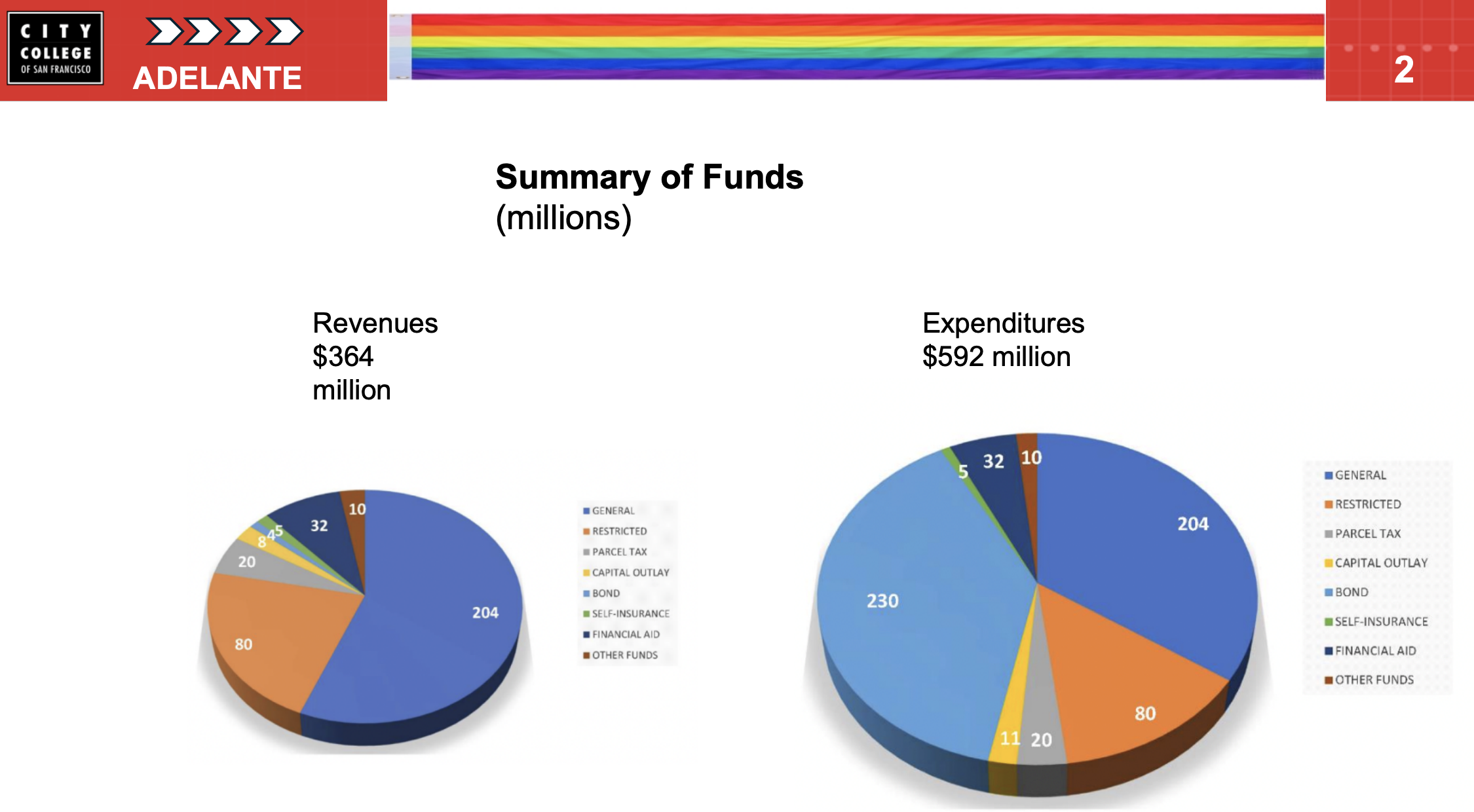
The basics: CCSF's tentative budget totals $592 million in expenditures across all funds against $364 million in revenue. The unrestricted general fund — the money the college controls — spends 90% on compensation, leaving roughly 5% truly discretionary. The current fiscal year will close with 32.6% reserves, boosted by one-time salary savings and prior-year adjustments, but that cushion begins eroding next year.

"So you'll be accepting a budget that has $592 million in expenditures. Between all funds we're only taking in about $364 million," said Ligioso.

Why it matters: The district operates under the state's hold-harmless provision, meaning it receives funding based on a historical formula rather than its actual enrollment under the Student Centered Funding Formula (SCFF). That arrangement keeps revenue flat even as compensation costs climb. A 4.31% cost-of-living adjustment — combining a 2.87% statutory COLA with a 1.4% discretionary increase tied to the AB 65 paid disability leave mandate — pushes expenses up while income stays put.

Key assumptions baked into the multi-year projections include 2% annual enrollment growth, reaching the SCFF by 2029-30, and — most critically — renewal of the parcel tax at $119 per parcel (up from $99) in a 2028 ballot measure. The parcel tax currently generates $20 million annually.

"But if we were to lose it, that's $20 million a year. A year. And that would be deficit," Ligioso warned.

Trustees Push Back on Optimism

Trustee Heather McCarty voiced what several board members appeared to be thinking: the budget rests on too many favorable assumptions. When she confirmed with staff that losing the parcel tax would be devastating, she added bluntly:

"That's catastrophic for us."

Board President Aliya Chisty pushed for a more conservative posture, urging staff to model as if parcel tax revenue doesn't arrive until 2031 rather than 2029.

"I think when we are doing our assumptions, I think that we assume this additional amount doesn't come in until 2031," she said.

Vice President Luis Zamora backed that approach, citing the state controller's cautionary fiscal update and flagging recent disruptions like the "ghost students" incident.

"There's been a number of things that happened this year and last year that we did not anticipate, like ghost students. It's the unknown things that worry me, not so much what we can predict," he said, later adding: "I am in support of President Chisty's doomsday version of the budget."

Public Commenters Challenge the Numbers

Abigail Bornstein, a public commenter, pressed the board on three specific budget items:

  • approximately $2.5 million in annual receivable write-offs totaling $8 million over three years

  • an unexplained 13% increase in classified salaries compared with flat certificated salaries

  • the continued erosion of full-time faculty.

"We once had 800 full-time faculty and now are approaching just 350, while positions continue to be eliminated and pay remains among the lowest in the state," Bornstein said.

Ligioso acknowledged that position control had been overstated, taking personal responsibility.

"We had salary savings because of our position control being a little bit overstated. And I take full responsibility for that," he said.

Chancellor Kimberlee Messina offered a pragmatic counterpoint on the savings question, noting that organizational restructuring is yielding only modest results.

"We are making reductions, but we are not saving millions of dollars. Between all of those reorganizations, we might be saving a million a year," she said,

Messina emphasized that enrollment growth, foundation fundraising, and grant opportunities must drive the financial turnaround.

Trustee Vick Van Chung cautioned against creating additional reserve categories that could pull money away from the college's most urgent need — growing enrollment enough to reach the SCFF.

"I do caution on continuing to create additional funds that pulls away from our ability to focus investing those dollars to actually get us onto SCFF, which should be, I think, one of our top priorities," he said.

Decisions: The tentative budget was presented for informational purposes only. Formal acceptance is scheduled for the June 25 board meeting following review by the Planning and Governance Council on June 23. The district is budgeting $250,000 over two years to support a 2028 parcel tax ballot measure campaign.

What's next: The Planning and Governance Council reviews the budget on June 23, with formal board acceptance on June 25.


Access Deserts: Heat Maps Reveal Who CCSF Isn't Reaching

Director Stephanie Chouinard delivered a data-rich presentation on CCSF's California Adult Education Programs (CAEP) that put a geographic face on the college's equity challenges.

The basics: CCSF receives 90% of the San Francisco regional CAEP consortium allocation, with SFUSD receiving 10%. The state defines seven eligible program areas: adult basic education, adult secondary education, ESL, short-term career technical education, programs for adults with disabilities, workforce preparation, and K-12 parent support. CAEP funds must supplement — not supplant — existing college spending.

Why it matters: Census-based heat maps prepared by WestEd showed that the households with the greatest need — those lacking high school diplomas, earning low wages, and with limited English — cluster on the city's edges: the Sunset, Richmond, Lakeshore, and Bayview Hunters Point. CCSF centers, meanwhile, sit along the central transit corridor. Evening access is particularly limited.

"The west side, this is not a surprise. This has been a problem for the college for a long time. The west side has little to no reach. The Sunset, Richmond and Lakeshore," said Chouinard.

Carryover, Pilots, and Pathway Building

A significant portion of the discussion focused on CAEP carryover funds that accumulated during COVID due to operational disruptions, hiring delays, and a prior leadership decision to halt categorical spending on supplemental instruction. Chouinard confirmed no funds are at risk of expiring.

"Currently no funds are at risk of expiring. CAEP funds have a 30-month shelf life," she said. A spend-down plan targets reaching a 20% carryover threshold by 2028-29.

The college is piloting ESL classes at Bret Harte School in the Bayview through a partnership with SFUSD, and Chouinard outlined strategies for rebuilding noncredit CTE and integrated education and training pathways. The budget allocation breaks down to roughly 15% for structural support, 23% for departmental and programmatic costs, and 16% for instructional supplements.

Metrics Show Progress — and Gaps

Outcome data showed improvement in educational functioning level gains and transitions to credit programs since the pandemic, though the percentage of students employed six months after exit declined as enrollment grew faster than employment outcomes. Median annual earnings of adult education graduates reached approximately $54,000, still below San Francisco's $62,000 living wage.

Trustee Anita Martinez connected the data to enrollment strategy:

"Every time we cease offering classes in some part of the city, we are going to impact credit enrollment," she said.

Martinez noted that 30% of San Francisco's population consists of older adults who both need services and vote regularly.

Board President Aliya Chisty proposed exploring an inter-campus shuttle to connect underserved populations to CCSF sites, particularly for evening students. Trustee Vick Van Chung asked staff to investigate whether the noncredit-to-credit transition decline was already underway before the pandemic.

Chancellor Kimberlee Messina reminded the board that facilities and enrollment are intertwined:

"If students are freezing to death and can't take their classes or the elevators don't work and they can't get there, or there are rats running through their classroom, our enrollment's not going to go up either."

Leslie Smith, a retired faculty member and former head of institutional research, urged the board during public comment to look outward.

"Reach out to the community and build enrollment," she said, emphasizing that transit access is one of the most critical factors limiting growth.

What's next: Staff will investigate the noncredit-to-credit transition decline and explore transit access solutions, including CBO partnerships and potential use of SFUSD school sites as satellite access points.


"The Problem Has Never Been Under-Enrollment": Public Demands Downtown ESL Restoration

Two former CCSF employees delivered pointed testimony during general public comment, challenging the college's reduced programming at its Downtown campus.

Christa Lewis, former ESL coordinator at the Downtown campus, reported that 70% of the 10 ESL classes starting June 15 at the Downtown location are already closed to new students because enrollment exceeds capacity. She argued the problem has never been under-enrollment but rather underutilization, under-scheduling, a 50% reduction in building hours, and inadequate staffing.

Leslie Smith, a retired faculty member and former head of institutional research, reinforced Lewis's testimony with institutional data: ESL classes are enrolling up to 65 students per class — far above the 15-student standard for language instruction. She noted that 50% of degree earners at City College started in noncredit ESL, and that 40% of small businesses and 60% of city revenue come from downtown San Francisco, making a downtown presence essential.

The testimony directly contradicted any rationale that declining enrollment justifies reduced programming at the Downtown campus and underscored the geographic access concerns raised later in the adult education presentation.


Board Professional Development and Retreat Planning

Trustees expressed frustration with existing training from the Community College League of California (CCLC) and agreed to pursue more interactive, governance-focused development. The board tentatively agreed to combine a Sept. 10 budget hearing with Brown Act training. Trustee Heather McCarty proposed inviting the Academic Senate for California Community Colleges (ASCCC) to conduct college-wide training on the "10+1" collegial consultation framework — a training trustees would also attend. Trustee Anita Martinez requested a session on new accreditation standards; Chancellor Kimberlee Messina confirmed a presentation by an ACCJC vice president is planned for August. The board is also considering the ACCT Leadership Conference in Chicago in October as a more substantive alternative to CCLC events.


Minor Items

  • Trustee Susan Solomon excused from the meeting due to hardship (For: 5, Against: 0, Absent: 2).

  • Student Trustee Ian Wong approved to participate remotely from the ASCCC Leadership Institute (For: 4, Against: 0).

  • Board recessed to closed session; no reportable actions were taken.

  • Bond oversight committee (CBOC) annual report for FY 2024-2025 found CCSF in full compliance with Prop A 2020 bond requirements. No audit findings.

  • 28 firms responded to an RFP for the architectural services pool for facilities capital improvement and maintenance projects; slated for consent on June 25.

  • Parking structure CEQA certification advances with 19 public comments addressed and a mitigation monitoring plan; formal adoption on June 25.

  • Bond List Revision #5 earmarks approximately $20 million across 20 projects — including Batmale Hall studies and Student Union railing repairs — and recognizes more than $8 million in interest earned on bond proceeds. Board President Chisty questioned why bond interest is held by the City and County rather than directly by CCSF.

  • Five-year capital outlay plan (2028-2032) priorities unchanged, with the Diego Rivera Performing Arts Center at No. 1.

  • Balboa Reservoir airspace rights: Developer needs a right-of-entry permit for a construction crane over CCSF property; legal review ongoing.

  • Trustee Martinez asked about the 750 Eddy seismic upgrade project and whether bond funds could be reallocated if the project is not pursued; staff confirmed the board has authority to move projects within the bond list.

CCSF Faces Structural Deficits as $592M Budget Reveals Flat Revenue and Rising Costs | Governing Board | Locunity