
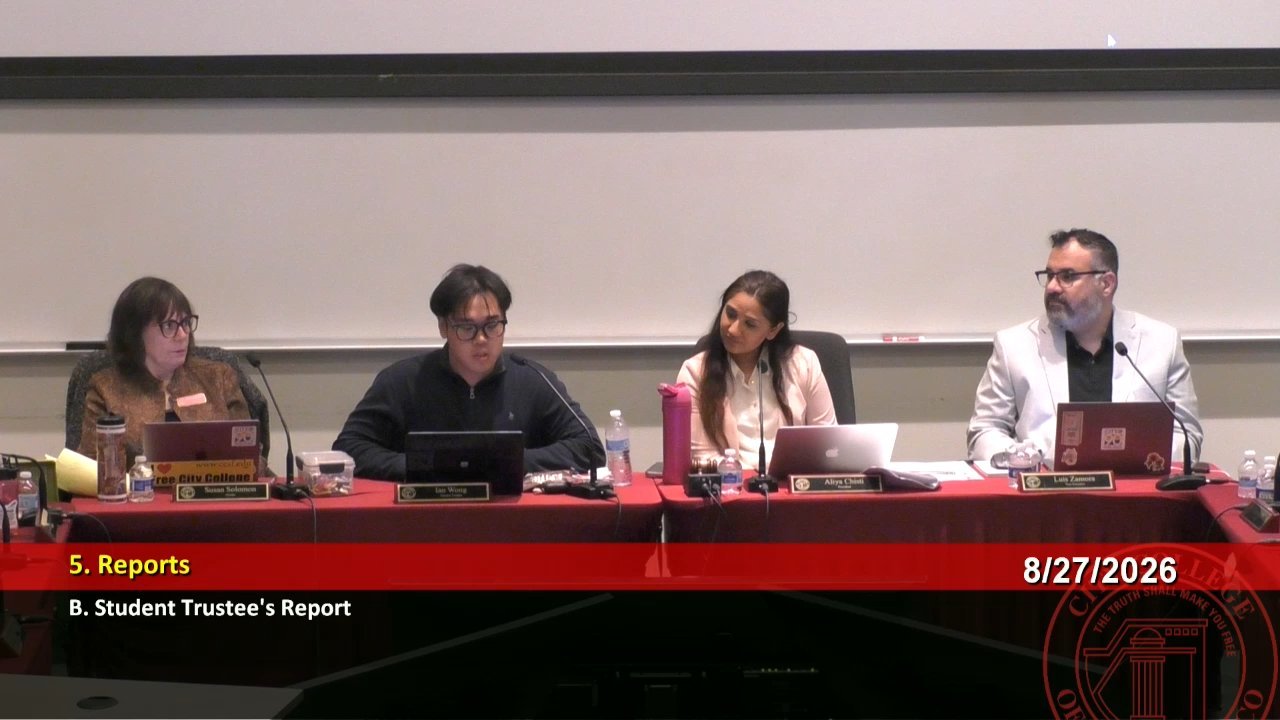
Governing Board - Aug 27, 2026 - Regular Meeting

Governing Board - Aug 27, 2026 - Regular Meeting

Governing BoardSan Francisco City CollegeAugust 27, 2026

Sources:

Locunity is a independent informational service and is not an official government page for this commission.We use AI-assisted analysis and human editorial review to publish information.

City College Board Confronts $24M Deficit Projection Amid Contractor Racism Claims and Contract Fights

The fall semester's opening meeting of the City College of San Francisco Governing Board became a marathon session that laid bare the institution's central tension: how to survive a looming fiscal cliff without starving the enrollment growth that is the only way out. Trustees heard a sobering multi-year budget forecast, deferred two contentious contracts, and received explosive testimony from Black contractors who say they were racially targeted at a bond-funded construction site in Bayview Hunters Point.

  • Budget projections show a $24M structural deficit by 2029-30 as health costs outpace flat revenue, with $47.1M in reserves at risk of being consumed in three years

  • Bayview contractors allege racial slurs and police were called when they asked for a business card at the Evans campus construction site

  • Board rejects open-ended legal contract with outside law firm AALRR, demanding a not-to-exceed spending cap before approval

  • Chancellor Messina receives rolling three-year contract on a 5-2 vote in closed session

  • Students, faculty, and labor leaders sound alarm on enrollment crisis, with FTEs down 24% since 2017-18 and neighborhood centers losing classes, counseling, and basic supplies

  • HR restructuring draws HIPAA violation warnings as labor groups allege anti-worker practices and pressured retirements

  • Special meeting set for Sept. 10 to formally adopt the FY 2026-2027 budget before the Sept. 15 deadline


The Fiscal Cliff: $24M Deficit Looms

Vice Chancellor Shannon Carter presented multi-year financial projections that gave the board its starkest picture yet of where City College is headed financially.

The basics: The FY 2026-2027 budget is essentially balanced — $207.4M in revenue against $207.2M in expenditures — with a 34.85% reserve ($72.2M). But that equilibrium is temporary.

Why it matters: Starting in FY 2027-28, a structural deficit of $6.6M emerges, growing to $16.6M and reaching $24M by FY 2029-30. The culprit: health and welfare costs growing at 6% annually while revenue stays flat under California's hold-harmless funding. Without corrective action, $47.1M in reserves would be consumed in three years, dropping the fund balance from 35% to roughly 11%.

"In fiscal year 2627, revenues are projected at approximately $207.4 million, while total expenditures and transfers are approximately $207.2 million. In other words, we're a bit balanced, but barely," said Carter.

She warned:

"If the assumptions hold and no corrective actions are taken, approximately $47.1 million of our unrestricted reserve will be consumed over the next three years."

Where things stand: The board has been deliberately building reserves to bridge the gap until the state's student-centered funding formula (SCFF) takes full effect in 2029-30. Trustee Susan Solomon defended the strategy:

"We've done that work because some of that is in the service of transition to the student-centered funding formula that will come upon us in 29-30."

But Trustee Vick Van Chung challenged the administration's growth targets, noting that the enrollment growth commitment has already been rolled back.

"It was a commitment to have an enrollment increase by 3% and a reach of 5. But even within this budget report, it says 2 to 3 and there's no mention of 5. I've just seen a rollback of this," he said.

The other side: Four public commenters pushed back hard on the reserve-building approach. Leslie Smith noted that CCSF has dropped from 22,000 to about 17,000 FTEs since 2017-18 — a 24% decline — and argued enrollment growth is the only real solution. She pointed out that K-12 districts and the city/county cap reserves at 10%, well below CCSF's 35%.

Abigail Bornstein analyzed the budget and found academic salaries rose only 2% while every other employee classification showed double-digit increases, and questioned $8M in receivable write-offs over three years.

Retired faculty member Susanna Atwood cited the state auditor's August report, which found CCSF consistently produces unreliable budget projections — running large surpluses year after year despite forecasting deficits. AFT Local 2121 President Robin Pugh put it bluntly:

"AFT caught on to this really quickly. We noticed, we fought these harmful practices and now the state auditors have noticed our budgets are reliably unreliable."

Board President Aliya Chisti acknowledged the converging pressures:

"We need to think about the parcel tax for 2028. We have to think about Free City ending in 2029. We have to think about this that's going to happen around that time."

What's next: The board approved a special meeting for Sept. 10 to formally adopt the budget before the Sept. 15 state deadline. The budget book is expected by Sept. 1, giving trustees and the public roughly 10 days to review before the vote.


"They Called Us Thugs": Bayview Contractors Allege Racism at Evans Campus

Two speakers delivered some of the meeting's most emotionally charged testimony, alleging racial discrimination by the general contractor building City College's new Evans campus in Bayview Hunters Point.

Why it matters: The Evans campus is part of CCSF's $845M bond-funded construction program. The allegations raise serious community trust concerns for an institution building a major facility in one of San Francisco's historically Black neighborhoods.

Where things stand: James A. Bryant, a former SEIU 790 leader and City College graduate, told the board that on Aug. 25, he and other local Bayview contractors visited the Evans campus site to request business cards from workers employed by Giant Construction, an Oakland-based general contractor. He said they were called "thugs," told to leave the neighborhood, and had police called on them.

Demetrius Williams, president of the San Francisco Hyper Local Building Trades Contractors Collective, corroborated the account. He said his group had previously done a job walk at the campus and submitted bids but never heard back from Giant Construction.

The board discussed the district's Small Local Business Enterprise (SLBE) policy, which targets 30% local subcontracting — Giant reportedly achieved 33%. But the incident highlighted a gap between policy targets and genuine community inclusion. Board President Aliya Chisti requested a formal board presentation on the SLBE policy, the Project Labor Agreement, and how "local" is defined.

Decisions: Alberto Vasquez, the district's facilities administrator, committed to following up directly with the contractor. He also told the board:

"We're exploring new technology that will help us with our RFP process, our bidding process, making awareness out there, actually sending the invitation out, opposed to using, let's say, the SF Examiner right now."

What's next: The board will receive a presentation on contracting equity policies at a future meeting.


Enrollment Down 24%: The Squeeze on Neighborhood Centers

Enrollment emerged as the thread connecting nearly every major item on the agenda — from the budget projections to the downtown center shutdown to the equity crisis at neighborhood campuses.

Why it matters: Enrollment growth is the only policy lever that can resolve the structural deficit and sustain CCSF through the transition to performance-based state funding. Yet the institution has lost nearly a quarter of its student base in under a decade.

Where things stand: Student Chancellor Sofia Flores-Guevara told the board that students at Mission and Chinatown campuses face technology barriers, language barriers, and a lack of basic resources — snacks, tampons, adequate staffing — that Ocean Campus students take for granted. She flagged a WESTED study showing high community demand for English language learner education and workforce training.

Mission Campus Associated Students President Lydia Hernandez offered the evening's most visceral testimony.

"75 students in a class without desks. And they're still coming. But guess what? Then we wonder, why does enrollment go down?" she said.

She described half-day counseling, no childcare, and broken promises of shuttle service and Clipper cards at neighborhood centers.

Department Chairs Council President Darlene Alioto offered a small bright spot, reporting that faculty see more students on campus than at any time since COVID — but added that the numbers haven't yet shown up in computer tracking.

"Faculty are saying that they have more students this semester than they have had since COVID. So it's a mystery why computer numbers are still saying that we are a bit lower than we were last year," she said.

Chancellor Kimberlee Messina announced a new educational strategic planning process launching this fall, which will include listening sessions college-wide and is intended to serve as the vehicle for addressing the enrollment crisis.


Downtown Center Shutdown Draws Faculty, Public Fury

The administrative decision to cease scheduling classes at City College's downtown center — made without a public study or participatory governance process — drew sustained criticism.

Why it matters: The downtown center served as a critical access point for inner-city ESL and workforce training students. Its closure reduces enrollment and access for the college's most vulnerable populations.

Where things stand: ESL faculty member Krista Lewis told the board that no publicly available study on scheduling, attendance, staffing, or equitable access was conducted before the decision. She noted the Academic Senate unanimously approved a resolution calling for participatory governance on the downtown center's future, and pointed out the district accumulated a $27M surplus while curtailing growth.

Marilee Hearn described the closure as an "administrative wrecking ball" destroying a community built on providing inner-city students with accessible credential-building. Mission Campus Associated Students President Lydia Hernandez emphasized that ESL noncredit students are always "the first to be displaced" when budgets tighten.

AFT President Robin Pugh demanded transparency: "The college community needs to hear more detailed plans about the future of our downtown center or even how that future will be determined."


Board Rejects Blank-Check Legal Contract

The ratification of a legal services contract with the law firm Atkinson, Andelson, Loya, Ruud & Romo (AALRR) for FY 2026-2027 became a flashpoint over fiscal accountability.

Why it matters: The college has spent millions on outside legal counsel while cutting positions and classes. Multiple trustees and labor groups see a spending cap as essential.

Where things stand: Trustee Susan Solomon pulled Item 13A from the consent agenda for a separate discussion. AFT President Robin Pugh had urged the board not to approve what she called a "blank check" — the contract listed hourly rates but no total dollar cap.

Trustee Vick Van Chung refused to vote without a number:

"I am not comfortable voting for this contract without an actual number attached to it."

He cited a June 2025 precedent when the board limited AALRR to $300,000 and required a return visit.

General Counsel Amy McLellan explained that the college is trying to transition away from AALRR, has not assigned new business to the firm, and is using them only for pre-existing matters and two labor negotiations. She said she is building a slate of smaller firms and that a new contract with LCW is forthcoming.

Decisions: The board voted by acclamation to continue the item to the next regular meeting, with a requirement that a not-to-exceed cap be included.


HR Restructuring Sparks HIPAA Warnings, Labor Pushback

The administration's move to a "generalist service delivery model" in Human Resources drew sharp criticism from multiple labor leaders.

Why it matters: If injury reports are being sent through unsecured email as alleged, the district faces potential federal penalties and personal liability for employees.

Where things stand: Classified Senate President Michael Medina-Snider reported that faculty don't know who to contact for occupational health issues, the risk manager position is unclear, and accident injury reports are being directed to an unsecured email address.

"You do not send medical records through our email system. We are not only personally liable for doing it, but the college is liable," he warned, citing two known violations and threatening to report the college.

SEIU Local 1021 President Maria Salazar-Colon accused the administration of anti-labor practices.

"We have received testimony from senior experienced workers stating that they are being pressured to retire," she said, alleging the restructuring eliminates union positions.

Decisions: The related HR layoff resolution (Item 9A) was pulled from the agenda and deferred to the next regular meeting, giving labor groups more time to organize.


Chancellor's Contract Extended on 5-2 Vote

In closed session, the board voted 5-2 to amend Chancellor Kimberlee Messina's employment agreement to a rolling three-year contract contingent on satisfactory annual board evaluations. The two dissenting trustees were not identified by name in the public report.

The board also unanimously approved settlements in two lawsuits: Nims v. CCSF and E. Reyes v. CCSF.


Minor Items

  • Meeting minutes from May 7, May 28, June 5, June 11, June 25, and Aug. 13 approved 7-0 by roll call.

  • Consent agenda covering travel approvals, facilities contracts, celebratory resolutions, and personnel actions approved by acclamation (Items 10-16, excluding 13A and 16A).

  • General Counsel contract amendment (Item 16A) continued to next meeting after Trustee Solomon identified missing track changes and a typo in which termination "with cause" was mislabeled as "without cause." The amendment would remove the requirement for the General Counsel to become a licensed California attorney. (For: 6, Against: 0, Absent: 1 — Trustee Martinez stepped out.)

  • Free City College program update noted funding is secured for the current year, but the MOU expires in 2029.

  • Annual grants report presented by Dean Maureen Harrington with no questions from trustees.

  • Rosario Villasana, child development faculty, raised construction dust and parking issues at child care spaces at Ocean Campus and John Adams.

  • Michael Adams, a licensed pilot, urged the board to reopen the aircraft mechanics program, citing a national shortage and the fact that nearby Alameda's program is at capacity.

  • Lydia Hernandez read a resolution requesting the board designate October Professional Development Day as Indigenous Peoples Day.

  • Derek Lack announced plans to pursue a major grant for City College from the mayor's office.

City College Board Confronts $24M Deficit Projection Amid Contractor Racism Claims and Contract Fights | Governing Board | Locunity