Governing Board - Apr 23, 2026 - Regular Meeting
Governing Board • San Francisco City CollegeApril 23, 2026
Locunity is a independent informational service and is not an official government page for this commission.We use AI-assisted analysis and human editorial review to publish information.
Save Downtown Campus Rallying Cry Dominates CCSF Board Meeting
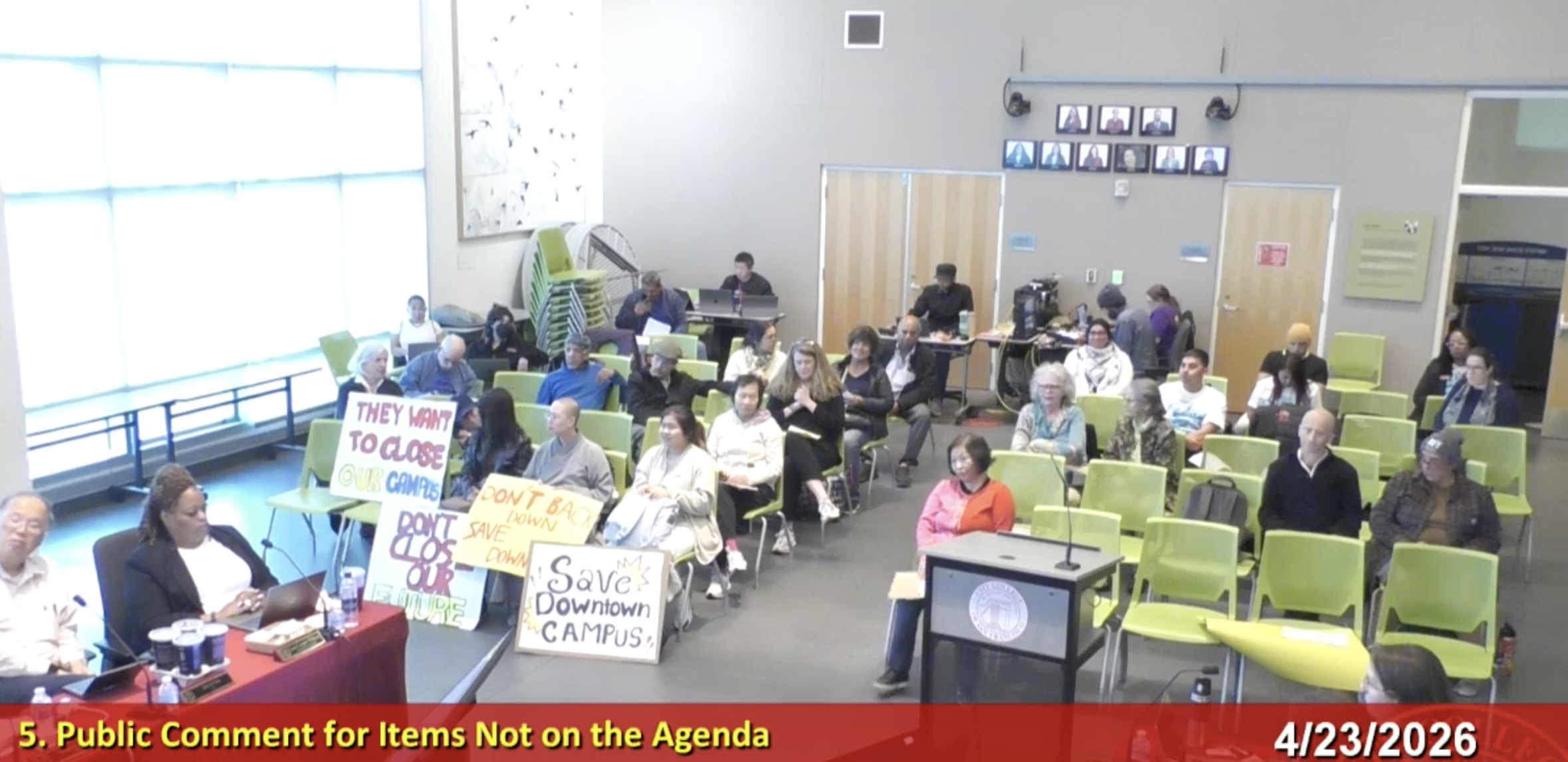
Students, faculty and community members packed the April 23 board meeting to demand the reversal of a decision to halt instruction at City College's Downtown Campus — a fight that has now consumed four consecutive meetings without the board formally taking up the issue. Meanwhile, trustees confronted a troubling fiscal picture: millions in restricted state funds sitting unspent while city funding for the Free City tuition program slides toward unsustainability.
Eight public speakers demand board reverse Downtown Campus closure, warning that past campus shutdowns caused 80% student attrition
AFT 2121 reports district rejected nearly all of its Downtown bargaining proposals, calling the process "performative"
Board passes resolution insisting any revised Free City MOU preserve long-term funding as city cuts threaten to slash support from $16M to $6.8M
Former Supervisor Gordon Mar suggests a ballot measure to guarantee Free City funding if the city keeps walking back commitments
College has spent only 44% of prior-year restricted funds, prompting trustee outrage and fears of state clawback
Reserve policy BP 8.01 approved unanimously, setting an 8.35% floor and 16.7% ceiling trigger
Pilot climate survey finds 14% of students experience racial tension, 40% of it in classrooms
Community Demands Board Act on Downtown Campus
For the fourth consecutive meeting, the fight over the Downtown Campus consumed the room — and for the fourth consecutive time, the board could not formally discuss it because it was not on the agenda.
The basics: In March 2026, the administration announced a "temporary pause" on instruction at the Downtown Center effective fall 2026. Since then, a coalition of ESL faculty, current students, retirees, union leaders and community advocates has showed up at every board meeting demanding transparency and reversal.
Why it matters: The Downtown Campus is San Francisco's most transit-accessible college site, serving ESL and non-credit students — many of them immigrants, older adults and people experiencing homelessness. Faculty say a Wested needs assessment documented unmet demand for ESL and digital literacy classes downtown. Past closures at the Civic Center and John Adams campuses resulted in devastating attrition: roughly 80% of students never transferred or persisted.
Where things stand: Eight public commenters delivered urgent, often emotional testimony. Kevin Cross, a 36-year ESL instructor, warned the board that the Civic Center closure gutted his program: classes that once had 30-plus students shrank to single digits. He argued the same would happen to the Downtown Campus, accusing the college of "double speak" in claiming to support students while removing their access.
Public Commenter Eddie Escoto, a student at City College, was blunt about the political stakes:
"We no longer want to be on your menu. We want a seat at the table."
Michael Adams, a public commenter who identified himself as a city planner, asked whether a developer had designs on the Downtown building and urged trustees to take responsibility rather than blame successive chancellors. He asked the audience to stand so the board could see "who their client is."
Jolene, a public commenter and 10-year ESL student at the Downtown Campus, called it her "second home" and said the closure felt "like you breaking my heart."
Christa Lewis, an ESL faculty member who coordinates classes at Downtown, backed Trustee Anita Martinez's earlier request to formally agendize the issue at a regular meeting. Lewis warned that email discussions among board members about the agenda item could violate the Brown Act.
The other side: The administration has characterized the halt as temporary and necessary given enrollment challenges, but no administrator spoke publicly during this meeting to rebut the wave of criticism. AFT 2121 President Mary Bravewoman delivered the sharpest institutional critique during constituent reports, revealing that the district had redlined the union's entire impacts bargaining proposal except for culinary equipment relocation.
"This is not how bargaining works," she said, calling the process "performative" rather than genuine.
She asked pointed questions about who heads the task force determining the campus's fate, what data it is using, and why Downtown does not appear on recent organizational charts.
Academic Senate President Katia Fuchs offered a more measured but pointed observation:
"How you do a thing is almost as important as the thing itself. This is why clarity and intention in communication matter."
She praised Vice Chancellor David Yee's transparent approach to a separate reorganization effort — an implicit contrast with the opacity surrounding the Downtown decision.
Student Trustee Angelica Campos reported attending a rally outside the meeting and said she has not seen a clear plan for reopening.
"I know we continue to talk about we need to temporarily cease classes at Downtown center, but I have not yet seen a clear plan on what we are planning to do to make sure that Downtown center can reopen."
What's next: Martinez formally requested that the Downtown Center be placed on a future regular meeting agenda, with detailed written questions submitted to the Chancellor about the decision process, budget considerations and alternative strategies. Until it is agendized, the board cannot take formal action — a procedural reality that has frustrated advocates for over a month.
Board Demands City Preserve Free City Funding
The board passed a resolution drawing a line in the sand on the Free City tuition program, insisting that any revised agreement with the city preserve a long-term funding commitment — even as the money behind the program has eroded dramatically.
The basics: Free City provides free tuition to all San Francisco residents attending CCSF. It is funded through a memorandum of understanding with the city's Department of Children, Youth and Their Families. The original 10-year MOU provided roughly $16 million annually. That figure has already been cut to $9.3 million and is now proposed at $6.8 million to $7.3 million.
Why it matters: If funding continues to decline, the college will either have to absorb the shortfall from its own budget or fundamentally redesign the program — potentially ending free tuition for thousands of San Francisco residents.
Where things stand: Vice Chancellor Julian Ligioso reported that the City Controller's Year 5 audit found the college met all audit objectives and resolved an internal control finding about indirect billing language. The college gets to keep the $6-plus million it had billed. But the favorable audit obscures the real problem: shrinking city commitment.
Board President Aliya Chisti reported that the city appears to be separating the MOU from the budget process, which she strongly opposed. She proposed strengthened resolution language affirming that any MOU revision must preserve "a long-term funding commitment" to address the cost of the core program structure.
Public commenters sharpened the urgency. Alisa Messer, a member of the Free City College Oversight Committee speaking as a public member, argued the MOU and budget cannot be separated, noting the audit "hides in footnotes" that the city has not met its own commitments.
Former San Francisco Supervisor Gordon Mar, who negotiated the original 10-year MOU, reminded the board that in 2019 faculty and students withdrew a proposed charter amendment in exchange for the city's funding promise — a "grand bargain." He warned:
"If the city continues to walk away from these promises, we may need to revisit putting a guaranteed funding stream for City College directly before the voters on a future ballot."
Decisions: The resolution passed by acclamation as amended.
What's next: An oversight committee meeting is expected where the city will present a formal MOU — potentially at funding levels more than 50% below the original commitment. The ballot measure idea floated by Mar could gain traction if the city's offer falls short.
Millions in Restricted Funds Unspent as State Threatens Clawback
A nine-month budget update revealed a jarring contradiction at the heart of CCSF's finances: the college routinely says it does not have enough money, yet millions in restricted state funds earmarked for students are going unspent.
Why it matters: Restricted categorical funds — money designated for specific programs like disabled student services, adult education and foster youth support — cannot be spent on anything else. But they can be taken back if they are not used. The state has already clawed back $9,000 from a foster care program, and the state Chancellor's office has contacted CCSF's Disabled Students Programs and Services unit warning that future allocations may be withheld.
Where things stand: Vice Chancellor Julian Ligioso reported that at the nine-month mark, the college had spent only 44% of prior-year restricted funds.
Trustee Susan Solomon did not mince words:
"At every meeting we're told we don't have enough money. And now we're being told we can't spend some of our monies fast enough. It's outrageous. It's absolutely outrageous."
She singled out adult education funding as particularly egregious.
Trustee Anita Martinez requested a comprehensive report on the adult education grant, including restrictions, historical spending patterns, who supervises it and why non-credit faculty are excluded from spending decisions. Trustee Heather McCarty expressed concern about systemic prevention. Trustee Vick Van Chung asked about root causes, including staff turnover and lack of coordination between finance and program offices. Vice Chancellor Lisa Cooper Wilkins noted that program directors previously did not understand what restricted funds could be used for and were sometimes charged to the unrestricted fund instead.
Deal math: On a brighter note, Ligioso reported the college plans to issue approximately $175 million in bonds by January 2026 and has proactively contacted the county tax assessor about timing.
What's next: The board expects a detailed report on the adult education grant and broader improvements in restricted fund management before additional allocations are put at risk.
Reserve Policy Sets Floor and Ceiling Guardrails
The board unanimously approved a revised reserve policy that creates accountability in both directions — requiring explanations when reserves are too low and when they are too high.
The basics: BP 8.01 governs how CCSF prepares its budget and manages financial reserves. The state requires a 5% minimum reserve, which translates to roughly $10 million on a $200 million unrestricted budget.
Why it matters: CCSF has faced accreditation scrutiny over inadequate reserves in the past. But trustees have also argued that excessive reserves represent money being hoarded at students' expense. The new policy addresses both concerns with a dual-trigger framework.
Where things stand: Associate Vice Chancellor Kristen Charles presented the second read of BP 8.01 with an 8.35% reserve minimum — equivalent to approximately one month of operating expenses — and trigger language incorporated from a prior meeting. Trustee Susan Solomon then proposed a new amendment: if the unrestricted general fund reserves are projected to rise above the board's 16.7% goal, the Chancellor must provide a written explanation and develop a spending plan, reflected the districts multi-year budget plan.
The other side: Abigail Bornstein, a public commenter, criticized trustees who had supported a 5% floor, arguing it represents less than one month of operating expenses and would be fiscally irresponsible. She noted voters rejected Proposition O, signaling they want fiscal responsibility.
Decisions: The Solomon amendment passed 8-0 by roll call. The full policy as amended also passed 8-0 (For: 8, Against: 0, Absent: 0). BP 8.01 now goes to the Participatory Governance Council for review.
Climate Survey Establishes Baseline — With Caveats
A pilot campus climate survey painted a largely positive picture of student experience at CCSF, but troubling findings on racial tension and a dismally low response rate raised questions about whether the numbers tell the full story.
The basics: Dr. Pam Mery presented results from the Spring 2023 pilot, using the RP Group's new California community college-focused survey instrument. This is CCSF's first standardized climate survey and establishes baselines tied to the board's DEI goals.
Why it matters: The survey found 73% of students feel enough support to focus on educational goals, 70.7% feel a sense of belonging, and 90% contribute to class discussions. But 14% of students reported feeling racial tension on campus — and 40% of those incidents occurred in classrooms, with 56% committed by other students and 36% by instructors. Ten percent said racism is a problem at CCSF.
Where things stand: Only 400 students out of roughly 26,000 completed the survey, making disaggregation by race, campus or program statistically impossible. Student Trustee Angelica Campos reported that Black students at the Success Forum were surprised the positive numbers were so high, saying the results did not reflect their lived experience.
Lydia Hernandez, a public commenter, raised concerns about campus-specific climate differences, noting that support services are concentrated at Ocean Campus while other campuses experience greater inequity. Trustee Heather McCarty asked about plans to increase response rates; Mery described efforts including incentives, flyers and targeted outreach.
What's next: A conditions-for-completion survey is currently in the field with some overlapping questions. The full climate survey is planned for re-administration in Spring 2027.
Minor Items
Guardsman 90th Anniversary proclamation approved, honoring CCSF's student newspaper and retiring journalism professor Juan Gonzalez and his 40-year career; recognition date set for April 30.
Foster Care Awareness Month resolution approved and directed to be transmitted to the Human Services Agency; Alonzo Alvarez Solorio of the Next Step program announced upcoming events including the first-ever Bay Area foster youth conference at Los Medanos College on May 2.
Jewish American Heritage Month resolution approved as amended, with a public commenter noting re-emerging exclusionary practices facing Jewish students on campuses.
AAPI Heritage Month resolution approved, with presenter highlighting challenges to birthright citizenship and immigration restrictions.
Sexual Assault Awareness Month resolution continued to next regular meeting after competing amendment documents could not be reconciled; Trustee Chung expressed disappointment it would not pass during April.
Student trustee privileges reauthorized for 2026–27; Student Chancellor Heather Brandt flagged that current board policy language may inadvertently disqualify DSPS students from running, prompting a legal review.
Consent agenda (items 16–20, covering travel, academic affairs, facilities, student affairs and HR) approved by acclamation. Trustee Martinez pulled travel items for discussion and requested a comprehensive report on travel spending by funding source as a potential area for budget cuts.
BP 1.10 (public participation), consolidating two existing board policies and adding alternate speaker provisions and non-debatable procedural motions, forwarded to PGC by acclamation. Remaining Chapter 1 board policies deferred to the next meeting.
CCCT Board election: Board selected five candidates to recommend for the statewide trustee board election.
Closed session: Board voted 6-0 to reject a government claim, with Trustee Chung abstaining.