
CCSF Board Adopts $72M-Reserve Budget as Faculty, Students Demand Action on Pay and Services
Governing Board • San Francisco City CollegeSeptember 10, 2026
Locunity is an independent informational service and is not an official government page for this commission. All information is sourced from public footage and an analysis of official agendas with the aid of responsible, fact-checked AI. to report an error or omission.
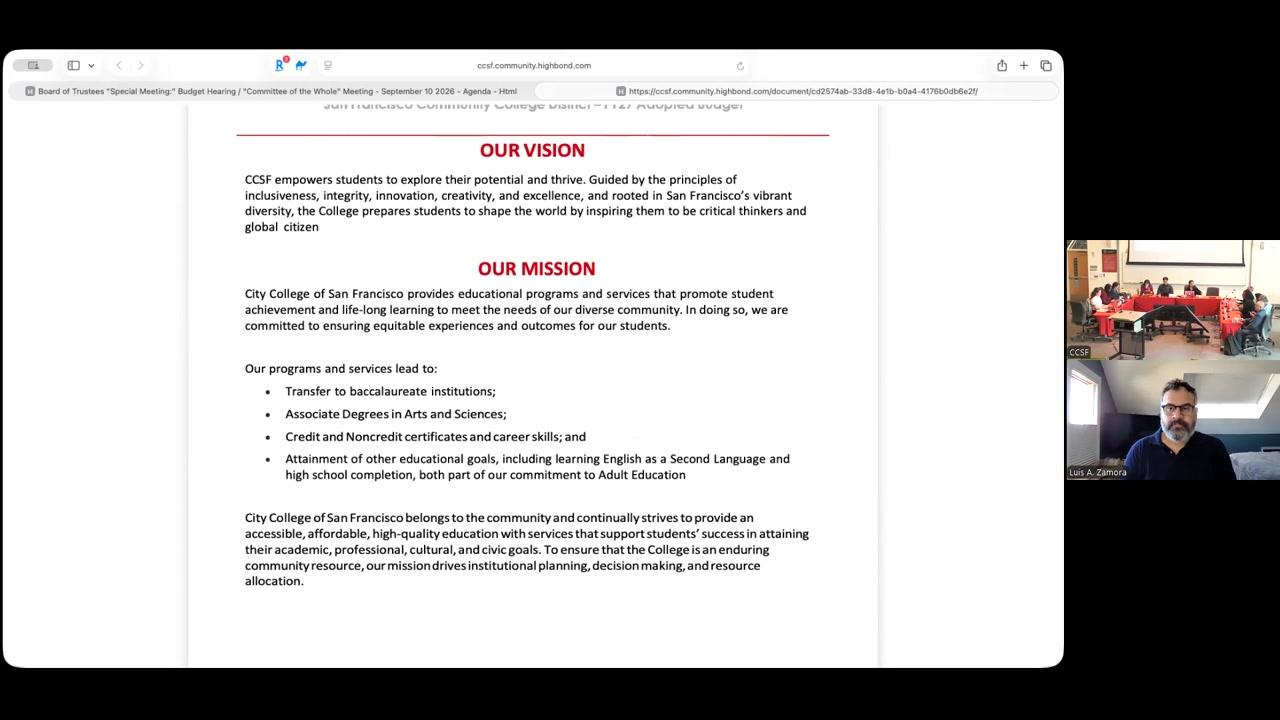
The City College of San Francisco Board of Trustees adopted its FY 2026-27 budget with $72 million in reserves on Sept. 10, approving the spending plan over sharp objections from the faculty union, disability services staff, and students who described a college sitting on cash while classes go unscheduled, tutors go unhired, and wheelchair users cannot open the doors to their own offices. The marathon meeting — which stretched past 10:30 p.m. — surfaced deep tensions over how the district deploys its resources as it approaches a critical state funding transition.
- Board adopts FY 2026-27 budget projecting $288K surplus and $72M ending fund balance amid faculty and public outcry over stagnant salaries and insufficient class sections
- AFT 2121 president and faculty caucus document structural surpluses while full-time faculty pay ranks in the state's bottom 40%
- DSPS staff warn of ADA violations as wheelchair users cannot independently access the disability services office, citing the Cherry v. CCSF settlement
- Students describe missing tutors, eliminated lab aid jobs, and waitlists of 451 for a single English course
- Public commenter challenges removing the California Bar Exam requirement from the General Counsel's contract after apparent non-performance
- Board sunsets two ad-hoc committees, transitioning policy review to the Community College League of California
$72 Million in Reserves, Zero in Raises: Budget Passes 6-0-1
Why it matters: The state auditor has found that CCSF accumulates large surpluses without spending plans. AFT 2121 documents that full-time faculty compensation ranks in the bottom 40% statewide — a reality this budget does not resolve, even as the district holds reserves designed to bridge a looming revenue cliff.
Where things stand: Vice Chancellor Carter presented the annual budget, projecting a $288,000 operating surplus and an ending fund balance of $72 million. The reserve strategy is deliberate: CCSF expects to exit "hold harmless" state funding — a mechanism that has protected the district's revenue despite enrollment declines — around FY 2029-30. The $72 million is intended to cushion that transition.
But the budget's narrative language stated it "assumes no general salary increases over the projection period," a formulation that alarmed trustees and infuriated the faculty union. Chancellor Messina clarified that the omission reflected ongoing negotiations, not a policy decision: "If this budget is approved, it does not mean that we are precluded from negotiating and offering a salary increase. That is not the intent of it not showing up in these numbers."
That explanation did not satisfy Trustee Susan Solomon, who said the messaging nearly cost the budget her vote. "I was worried enough about the issue of 0% raises that I thought about voting no on the budget," she said. Solomon also cited the state auditor's finding that "by not budgeting all available funds that exceed their reserve needs, districts may be missing opportunities to improve student outcomes."
The Faculty Side
Public comment was extensive and pointed. Abigail Bornstein, representing the full-time faculty caucus, charged that the budget bypassed the full participatory governance process and documented spending increases in every major unrestricted fund category except faculty compensation. Robin Pugh, AFT 2121 president, laid the core grievance bare: "You have years and years and years of documented structural surpluses. And yet again, we don't see any space for faculty raises here. This is unacceptable."
Public commenter Rick Baum brought the sharpest fiscal challenge, pointing to a $14 million gap between last September's projected surplus and actual results: "That's almost an astonishing 14 million more than anticipated last September. How could your figures be so far off?" He cited 451 students on waitlists for English C1000 alone and called the disconnect between budget language and class scheduling "very shameful and very contrary to your purpose and role at this college."
Student Impact
Paulette Brown, a DSPS student with dyslexia and long COVID, told the board she has been unable to get a tutor for multiple semesters: "I've been going and asking for a tutor. A tutor, whoever can help me. And I have no help." Public commenter Leslie Smith urged a growth strategy centered on student services, noting ESL classes with 75 students and long waitlists. Public commenter Lydia Hernandez described helping 30 students who did not know they had a CCSF email address, and characterized unspent categorical funds as potentially illegal.
Budget Mechanics Under Scrutiny
Trustee Vick Van Chung questioned a jump in services and operating expenditures from $7 million actual to $21 million budgeted. Staff explained this was driven by categorical fund deferrals that must be budgeted for spending. Chung also challenged the averaging methodology for lab aid funding, which resulted in a decrease from $1.2 million to about $800,000. The Chancellor maintained there were no cuts — only no increases.
Trustee Anita Martinez asked whether the administration has a budget process for deploying reserves toward classes, services, or collective bargaining, and flagged that Mayor Lurie's recent 14% raise for city workers puts pressure on CCSF's negotiations with many of the same unions.
Vice President Luis Zamora requested that future budget books include historical prediction-versus-actual comparison data so trustees can evaluate the reliability of projections.
Vice Chancellor Carter acknowledged the budget did not complete the full participatory governance council process, taking "full responsibility" and noting the PGC Budget Committee was consulted but the larger body was not, due to calendar timing.
Decisions: The board adopted the budget 6-0-1 (For: Trustee Solomon, Trustee Chung, Trustee Ferguson, Trustee Martinez, VP Zamora, President Chisti; Abstain: Student Trustee Wong; Absent: Trustee Heather McCarty). The Chancellor agreed to clarify the budget narrative's salary language.
What's next: Faculty contract negotiations remain ongoing, and the next bargaining cycle will test whether the board's stated openness to raises translates into dollars. Trustees asked for improved budget transparency in future documents, including prediction-versus-actual comparisons.
Wheelchair Users Can't Open the Door: DSPS Staff Warn of ADA Failures
Why it matters: Under the Cherry v. CCSF settlement, the district must maintain strict ADA standards. Failure to install automatic doors exposes CCSF to renewed legal liability — and, staff testified, daily indignity for students and employees with disabilities.
Where things stand: Three DSPS staff members delivered coordinated testimony describing persistent accessibility barriers across CCSF campuses. DSPS staff member Kathy Williamson Choi told the board that the DSPS office, cafeteria, certain classrooms, and restrooms lack automatic doors. When staff requested them, she said, facilities responded that existing doors "meet ADA standard" — but argued they are barely wide enough for a full-size electric wheelchair and risk staff injury when held open manually.
DSPS counselor Savio Chan, who has a disability, called the district's response "ableist behavior" and said DSPS was excluded from planning a recent Flex Day keynote on accessibility — an event he characterized as tokenism: "By reducing our needs to compliance, leadership dismisses our lived experiences and expertise. CCSF continues to literally close the door on us."
DSPS staff member Jasmine Moser noted that an automatic door was installed for a non-essential space on a different floor while their requests were denied. Student Vice Chancellor Evangela Brewster also raised scooter access limitations in the Student Success Building.
What's next: The Cherry v. CCSF settlement creates ongoing legal exposure. No board action was taken, but the coordinated testimony put the administration on notice that compliance gaps remain unresolved.
Students Describe a College That Can't Serve Them
Why it matters: Declining enrollment is CCSF's central fiscal risk. Public commenters argued that under-spending on student services creates a vicious cycle: fewer services drive students away, which drives down funding, which leads to fewer services.
Where things stand: Across both the budget hearing and general public comment, a pattern emerged. Paulette Brown returned a second time to describe a faculty complaint against a Spanish instructor who is not submitting accommodation forms for DSPS students, resulting in missed tests. She said she experienced retaliation after complaining to the department chair.
Student Vice Chancellor Evangela Brewster stated that students arrived in the second week of the semester to find their lab aid jobs had been eliminated. Public commenter Lydia Hernandez described campus centers lacking counselors, financial aid offices, and adequate DSPS hours. Public commenter Marilee Hearn reminded the board that the Academic Senate passed a resolution in May requesting a special committee to evaluate the Downtown Center's status — a request she said has gone unanswered.
What's next: The administration maintains there were no cuts to lab aid positions, only no increases. Trustees signaled interest in more granular reporting on student services spending. The Downtown Center question remains unresolved.
Bar Exam Requirement Quietly Dropped From General Counsel's Contract
Why it matters: The General Counsel is responsible for enforcing district contracts. Removing a stipulated performance requirement after apparent non-compliance raises public trust questions about governance standards.
Where things stand: During public comment on consent item 15.A — a second reading of a contract amendment — public commenter Abigail Bornstein argued the board was being asked to remove the California Bar Exam requirement from the General Counsel's employment contract. She stated the existing agreement, approved in February, required the General Counsel to sit for the bar exam in July, and that based on statements at the August meeting, this did not occur. She called it "non-performance under the contract" and asked whether the board would "enforce the existing contract or rewrite it after the fact."
What's next: The item received its second read and is expected to come up for a formal vote at the next regular meeting.
Board Sunsets Two Ad-Hoc Committees
Where things stand: VP Zamora reported that the Advocacy Ad-Hoc Committee should be sunsetted, as the board has been pursuing advocacy through other channels. Trustee Solomon expressed disappointment that the committee produced only one report in over 18 months, and presented a comprehensive status report on the Board Policies Ad-Hoc Committee's work reviewing Chapter 1 policies. Chancellor Messina explained that the Community College League of California's Dr. Wright will now review all board policies to separate procedures from policy directives, with legal counsel review before governance approval. Trustee Ruth Ferguson supported sunsetting, noting the work had become duplicative.
Public commenter Lydia Hernandez urged greater transparency around the board's advocacy efforts and better communication with students about how to participate.
What's next: Policy review work transitions to CCLC for professional synthesis. No formal timeline was specified.
Minor Items
- Legal services contract with AALRR received its second read with a board-requested not-to-exceed cap of $300,000 for FY 2026-27. Final vote expected at the next meeting.
- Domestic Violence Awareness Month resolution received its first read; Trustee Solomon requested removing the "celebratory" label, noting domestic violence awareness is not a celebration. Staff agreed to change the categorization.
- Indigenous Peoples' Day resolution received its first read as part of the consent agenda.
- EEO Annual Certification Report was presented as informational, but the designated presenter had left the meeting. President Chisti flagged the report's utilization analysis as an opportunity for proactive diversity tracking among tenure-track faculty, not just a compliance exercise. Questions deferred to the next meeting.
- May 2027 board meeting proposed to shift from May 27 to May 20 to avoid a conflict with commencement. Formal vote at a future meeting.
- Public Records Act request: CCSF student Andre Bakhtin told the board that the General Counsel denied a Public Records Act request with a broad exemption claim, and that requested financial aid counter footage was not preserved despite a preservation notice.
- No reportable actions from the first closed session. The board adjourned at 10:36 p.m. after a second closed session.