Governing Board - Apr 10, 2026 - Meeting
Governing Board • San Francisco City CollegeApril 10, 2026
Locunity is a independent informational service and is not an official government page for this commission.We use AI-assisted analysis and human editorial review to publish information.
Board Tackles Reserve Policy, Free City Funding Cuts as Students Fight for Downtown Campus
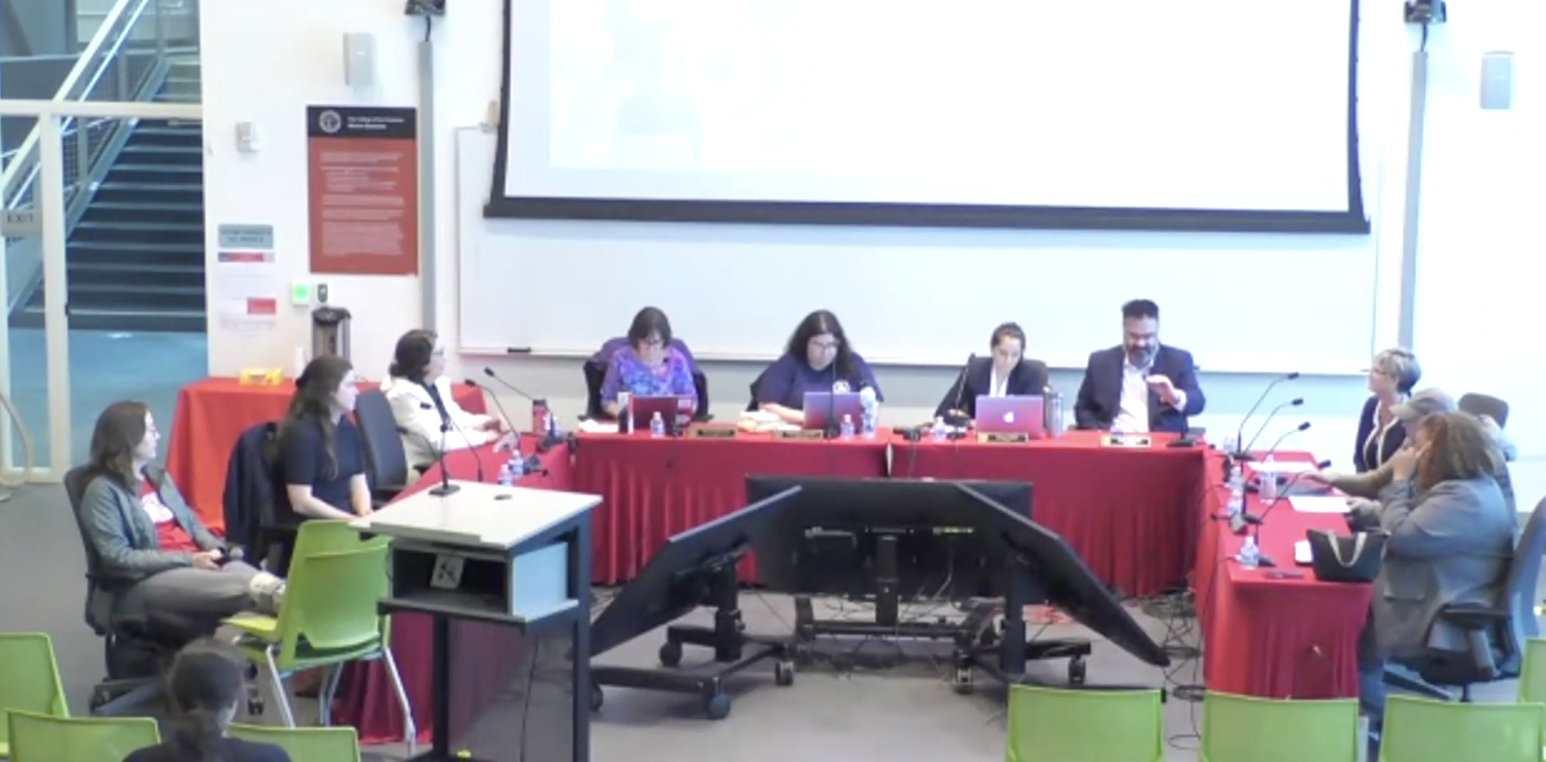
The CCSF Governing Board's April 10 meeting stretched past six hours as trustees debated how much money to keep in the bank, heard impassioned testimony from dozens of students demanding the college save its downtown campus and drop charges against a student organizer, and advanced a resolution pushing back on the city's proposed 30% cut to Free City funding.
- Board majority backs raising the reserve floor from 5% to 8%, setting up an April 23 action vote on a fiscal policy that divided trustees 4-3
- Dozens of students and community members rallied to block the closure of CCSF's downtown campus, accusing the administration of starving enrollment rather than growing it
- Student organizer Madison Rash's suspension drew sharp condemnation from more than a dozen speakers who called it retaliation for union activity
- Free City resolution advances to defend tuition-free program against the city's proposed cut to $6.48 million — far below the $9.3 million the college says it needs
- Sexual Assault Awareness Month resolution continued to April 23 after proposed amendments sparked a debate over whether the board can direct the Chancellor on spending
- Project Survive celebrated 33 years of peer-led sexual violence prevention, with national recognition and a new doula training course
Fiscal Reserves: The Numbers That Will Shape CCSF's Future
The meeting's most consequential policy debate came near the end — fitting for a board that acknowledges its meetings run too long — when trustees took up the question of how much money CCSF should hold in reserve.
The basics: Board Policy 8.01 currently sets a 5% reserve floor for the district's operating budget. An ad hoc committee of four trustees recommended keeping that floor while adding a 16.7% goal. President Aliya Chisti proposed raising the floor to roughly 8%, or one month of operating expenses.
Why it matters: The reserve level determines how much budgetary cushion CCSF has against enrollment drops, state funding changes, or economic downturns — and how much is available to invest in students and programs right now. With CCSF stuck at the state's minimum funding floor and receiving no cost-of-living adjustment, Vice Chancellor Dr. Julian Ligioso warned the college is headed for deficit spending within a year if nothing changes.
"Our revenues are stagnant or flat, while expenditures continue to go up. By next year we will be deficit spending if nothing else changes in our spending pattern, just because of step and column movements," said Dr. Ligioso, Vice Chancellor of Finance.
Where things stand: A 4-3 board majority — President Chisti, Vice President Luis Zamora, Trustee Heather McCarty, and Trustee Ferguson — coalesced around the 8% floor with a 16.7% goal. The policy would also include trigger language: when reserves fall below 16.7%, the Chancellor must explain the shortfall and present a restoration plan.
VP Zamora was the sharpest voice against keeping 5%.
"It's just irresponsible, and I think we're supposed to be showing people that we've learned from mistakes and we're trying to plan ahead," he said.
The other side: Trustee Vick Van Chung, Trustee Anita Martinez, and Trustee Susan Solomon preferred keeping the 5% floor to preserve spending flexibility. Trustee Martinez framed it in terms of institutional morale and the college's relationship with voters.
"I think that if we say that we are going to have a higher floor, but there are services or instruction that people need, and we say we can't go there because we have this higher floor — that sends a different message to our internal community," Trustee Martinez said.
Trustee Chung argued the college needs room to invest in enrollment growth: "We need that much flexibility to grow our enrollment to the point where we can actually get COLA."
Public commenters weighed in forcefully. Leslie Smith argued the 2008 recession was overcome not by building reserves but by serving students and going to voters for the parcel tax and Prop 30. Elisa Messer of AFT Local 2121 called a 25% reserve "outrageous," noting the $18 million difference between 16.7% and 25% could serve students, and that only basic-aid districts maintain reserves that high.
Additional agreed-upon changes include removing the word "balanced" from budget submission requirements to acknowledge anticipated deficit spending and adding "additional" before "deficit" in the super-majority vote paragraph.
What's next: The revised BP 8.01 returns April 23 as an action item to be sent through the Participatory Governance Council.
Students Mobilize to Save Downtown Campus
The longest single stretch of the meeting belonged to the public. Approximately 25 speakers took the microphone — most limited to one minute by President Chisti — and the dominant theme was the impending closure or suspension of classes at CCSF's downtown campus.
Why it matters: The downtown campus is the only CCSF location easily accessible by public transit for many immigrant, working-class, and disabled students, particularly those enrolled in ESL courses. Speakers argued that declining enrollment was not a sign of low demand but rather the result of the administration's failure to market courses, add new offerings, or schedule classes during afternoons, evenings, and weekends.
Krista Lewis asked the board to restore course offerings and create a growth plan for a comprehensive and sustainable downtown program. Li Jun Wang, an ESL student, asked whether CCSF studied what happened to students after previous campus closures and whether alternatives were explored before the decision.
Harry Bernstein drew a pointed comparison: when the Chinatown campus's funding was threatened, the administration intervened to save it. He urged similar treatment for downtown, suggesting reserves could be deployed.
Chancellor Messina did not directly respond to the downtown concerns during the public comment period. Trustee Martinez later requested that the downtown campus issue return for formal board discussion.
Students Condemn Suspension of Worker Organizer
Interwoven with the downtown campus testimony was an equally passionate defense of Madison Rash, a student worker and lead organizer of the CCSF Student Worker Union Core Organizing Committee.
The basics: According to testimony read by Student Trustee Campos, Rash was suspended by campus police Officer Jonathan Colby after the Chancellor's Office declined to meet with the student worker committee. Multiple speakers said Colby contacted Rash after hours, demanded a statement, and suspended her without following due process.
Speakers from Students for Justice, the Queer Resource Center, the Black Student Union, and other groups made four demands: drop all disciplinary actions against Rash, retract the referral to the District Attorney, provide written confirmation that CCSF police cannot suspend a non-threatening student, and reaffirm the board's commitment to free speech.
Ari Valoro, a student worker from the QRC, directly challenged the board to answer whether campus police have the authority to unilaterally suspend students. Nina Friedman, a faculty advisor at the Women's Resource Center, called the contact inappropriate and the suspension unjust.
Chancellor Messina said the administration could not comment on specifics: "Commenting on the specifics and making specific demands when something is in due process, both on the student conduct side and on the legal side, is something that we are not allowed to comment on or draw conclusions on at this point in time."
Speakers also cited a student worker audit published the prior week showing CCSF student workers had the lowest allowable working hours and lowest weekly earning potential of any community college in the state. Several called for voluntary recognition of the Student Worker Union.
Free City Resolution Pushes Back on Proposed 30% Funding Cut
President Chisti presented a first-read resolution documenting the Free City program's origins in the 2017 MOU with the city and its impact on students who now make up the majority of the CCSF student body.
Why it matters: The city is proposing to allocate $6.48 million for Free City — well below the $9.3 million the college says is needed to sustain the program. That gap could force the district to impose FAFSA requirements or reduce tuition waivers, contradicting the program's original accessibility mission.
Elisa Messer of AFT Local 2121 told the board the proposed cut to $6.5 million represents a 30% reduction from the current year and more than 60% from what the MOU originally promised. Harry Bernstein warned that requiring FAFSA could exhaust students' eligibility for graduate programs and noted the mayor is separately proposing to reduce the real estate transfer tax — the revenue source behind Free City.
Student Trustee Campos proposed adding specific dollar figures from the Free City Oversight Committee. Trustee Martinez requested language about the Prop W funding source. VP Zamora noted the instability of ERAF (Education Revenue Augmentation Fund) as a revenue stream.
President Chisti asked general counsel Amy McClellan to review the MOU's legal enforceability. McClellan said it "depends" — some MOUs function as contracts, others are precursors.
What's next: The resolution returns April 23 with amendments, positioning the board to formally advocate for full funding ahead of a meeting with the city's oversight committee.
SAAM Resolution Sparks Governance Boundary Debate
What began as a routine Sexual Assault Awareness Month resolution became an extended negotiation over how far the board can go in directing the Chancellor.
Trustee Chung and Student Trustee Campos proposed three new "be it further resolved" clauses: expecting the Chancellor to fully fund and expand funding for sexual violence prevention, relying on the expertise of Women's and Gender Studies to overhaul Title IX policies, and requiring a schedule by June 2026 with a progress report by April 2027.
VP Zamora objected that language "expecting the Chancellor to fully fund" constitutes directing operational spending. Chancellor Messina reinforced the distinction: "To specifically direct a funding without that context of all of our funding processes and policies is, to me, very much directing the how and not the what."
Trustee Chung pushed back, arguing that past informal conversations between administrators haven't produced results: "I've also seen softer conversations that are had between multiple administrators and chancellors that have not led to more than just that discussion. There's like, 'yes, we should do more.' And then nothing was delivered."
The board collaboratively softened the language: "fully fund" became "explore opportunities to expand funding," "relying on the expertise and direction" became "honoring the expertise," and the specific June 2026 deadline was replaced with quarterly updates. The word "perpetrator" was replaced with "persons using abuse."
Trustee Solomon moved to continue the item to April 23, which passed 7-0.
Project Survive: 33 Years of Prevention Work
Shellamuzel Cervantes presented the Celebration of Success on Project Survive, housed in CCSF's Women's and Gender Studies department, itself 55 years old. The peer-led program conducts approximately 200 classroom presentations annually in English, Spanish, and sometimes Cantonese and Mandarin across all campuses.
Its offshoot, Expect Respect San Francisco, has run three-day workshops in SFUSD high schools for 20 years. A doula training course was developed in partnership with Sister Web and the Health Education department. Four peer educators were accepted to attend the URGE reproductive justice summit in Washington, D.C.
Trustee Martinez highlighted the program's national recognition in Ms. Magazine. Trustee Chung noted the healing impact for educators themselves. The presentation revealed that the mentorship component, HAMCOS, was funded through student equity but only ran for one semester per year due to inconsistent funding — a point that would resurface in the SAAM resolution debate.
Board Wrestles With Six-Hour Meetings
In a discussion that itself illustrated the problem, the board spent considerable time examining why its meetings regularly stretch past six hours.
President Chisti identified gray areas in board policy interpretation, public comment procedures, and agenda development. Outside counsel Matt confirmed the Chancellor has delegated authority to interpret board policies, while the chair's interpretation prevails on meeting procedures.
Trustee Solomon read Board Policy 1.10, revealing that reducing public comment time requires a majority board vote — not just the chair's discretion. "Thirty minutes shall be the usual maximum time allotment for public speakers on any one subject on the agenda, regardless of the number of speakers. At the discretion of a majority of the board, this time allotment may be decreased or extended," she read.
VP Zamora raised concerns about the inability to verify comments read on behalf of absent speakers. Trustee Chung suggested having items appear before the board more than once and proposed mapping topics on the calendar at the annual retreat.
The board's June 5 retreat was confirmed, with a survey to finalize times. General counsel Amy McClellan clarified that BP 1.11 gives the president authority to reduce per-speaker comment time.
Minor Items
- Lesbian Visibility Week resolution approved unanimously with a friendly amendment from Trustee Chung adding "CCSF students" to a whereas clause. A flag-raising ceremony is set for April 20 at 9:30 a.m. at the Cloud Hall Reading Garden. Professor Maggie Harrison of the LGBTQ Studies department presented the resolution.
- HR consent agenda approved 6-0 (Trustee Martinez absent for the vote), including administrative appointments and three retirements honored for a combined 72 years of service.
- Board self-evaluation instruments accepted by acclamation, with revisions including a new professional development question. Presented by AVC Kristin Charles.
- AFT Local 2121 sunshine document completed its second read with no board action. Harry Bernstein provided public comment noting part-time faculty earn 86% pro-rata pay, lack job security, and disproportionately bear the budget burden, criticizing the union for lacking a vision to close the gap.
- Chapter One board policy revisions continued to April 23 due to time constraints; trustees were asked to submit amendments to AVC Charles.
- A public commenter named Ellen raised a Brown Act compliance concern, noting that closed session agendas for real estate matters lacked required details including the property, negotiating parties, and discussion scope.