
City College Restores Lab Aide Budgets, Targets 20-Hour Student Work Weeks
Governing Board • San Francisco City CollegeOctober 8, 2026
Locunity is an independent informational service and is not an official government page for this commission. All information is sourced from public footage and an analysis of official agendas with the aid of responsible, fact-checked AI. to report an error or omission.
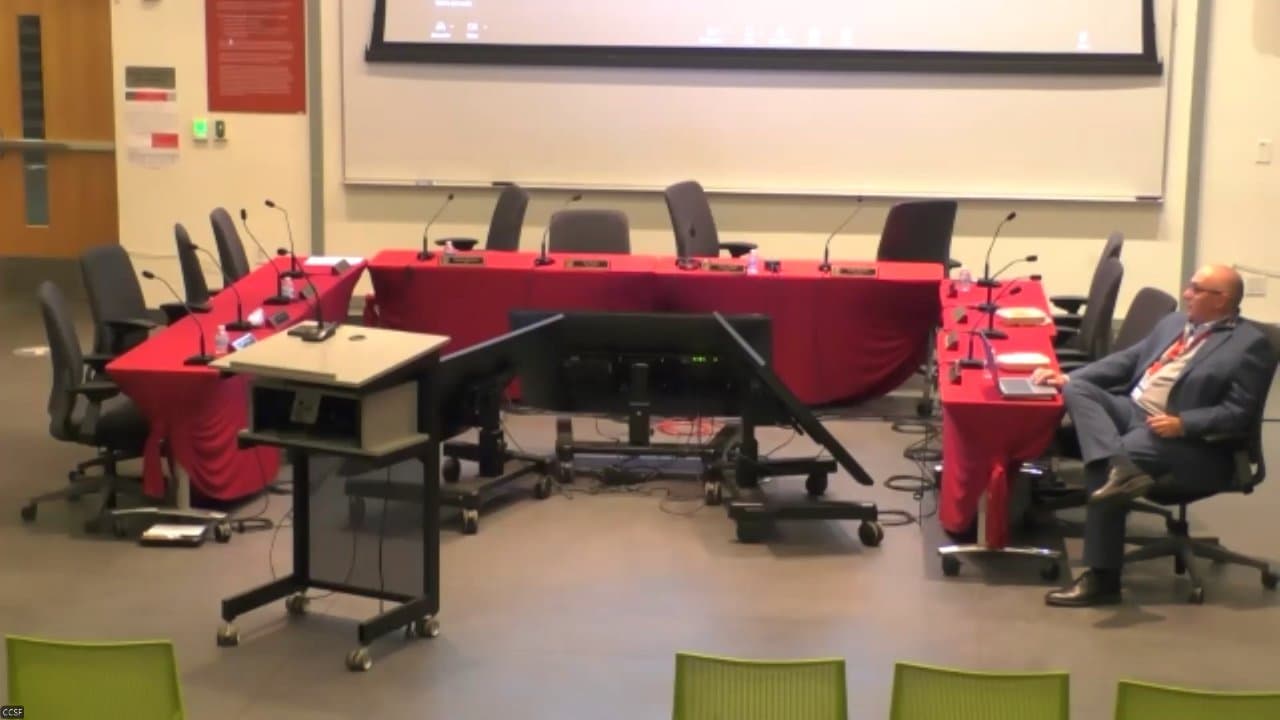
After months of shifting numbers, City College of San Francisco's finance chief told trustees Oct. 8, 2026, that departments will get back their lab aide money and that student jobs may move toward 20 hours a week by July 1, 2027. The update came at a Committee of the Whole meeting of the Governing Board where student union organizers, faculty and trustees pressed on headcounts, equity gaps and who gets a real voice in college decisions. No policy votes were taken. Most items, including the heritage month resolutions and the contract and curriculum first reads, return Oct. 22.
- Lab aide budgets restored, adding just under $300,000 after an April-to-September budget scramble
- Student workers organizing a union push the board to lift CCSF's 15-hour weekly cap
- Equity gaps narrow but persist in transfer-level math and English; trustees ask what works
- Academic Senate lays out its 10+1 role as a student leader calls participation "symbolic"
- Downtown Center pressure builds as speakers say the paused campus lacks a shared-governance process
Lab Aide Money Comes Back, With a Mea Culpa
Why it matters: Lab aides are student workers who staff labs and departments. Shifting allocations destabilized both department budgets and student paychecks. The next step could lift the 15-hour cap and set the funding formula for 2027-28.
Where things stand: Shannon Carter, Vice Chancellor of Finance and Administration, said departments' requested increases were collected in April but never made it into the tentative or adopted budgets. Instead, the administration used a 3-year average, and Carter acknowledged communication was poor.
"The lab aide allocations were changed several times from April to September," said Carter.
The Department Chair Council recommended restoring FY25-26 amounts. The administration then gave each department the higher of that figure or its Oct. 1 loaded budget, adding just under $300,000 combined. The 3-year average is now paused pending talks with chairs.
The administration plans to gather information this fall, design a new approach in spring and hit a July 1, 2027, target, with a focus on 20-hour weeks. Carter cited roughly 621, 700 and 700 student workers in recent years, with 351 tracked for fall 2026.
"We definitely are owning the cause of the situation as Vice Chancellor Carter has indicated," said the Acting Chancellor, who added that next year's formula is not finalized.
The other side: Madison Roche, lead organizer of the Aspiring CCSF Student Worker Union, said in general public comment that organizers had been declined a meeting with the chancellor. She told trustees CCSF is the only California district capping student work at 15 hours and said that cap is board policy, not a state or federal rule. Roche cited an organizer audit of 15 districts showing many use general funds for lab aides.
During the item, Roche said the board lacks headcount data. She opposed the 3-year average and opposed adding classified staff in place of student workers. She also asked for a hold-harmless commitment. Angelica Campos, a member of the CCSF Student Worker Union, asked for breakdowns by federal work-study, CalWORKs and lab aide funding. Merrilee Hearn, a public commenter, asked for firmer "will" language and for answers on why the figures changed so often and who changed them. She said department chairs should have been consulted.
Decisions and stakeholder impacts: This was an informational item, so no vote was taken. Departments get stability this year. Student workers get a stated target but no guarantee yet that longer hours won't shrink the workforce. Trustee Vick Chung urged that any change ensure "we don't reduce the number of student workers." Trustee Susan Solomon pressed on the formula, the dates and the clarity of the slides.
What's next: The formula and the 15-hour cap will be revisited for 2027-28. Because the cap is board policy, trustees can place it on a future agenda directly.
Equity Gaps Narrow, but Board Asks What Works
Why it matters: Persistence and completion of transfer-level math and English are formal board goals. Gaps for Black and Latinx students remain even after completion rose under AB 705, the state placement reform that moved students into transfer-level courses.
Where things stand: Dr. Pam Mary of CCSF reported persistence of 61% to 63% over five years. She said there is no persistence gap for Black or African American students, the focus population of the college's student equity plan.
"We appear to have closed or be closing that gap," said Mary.
English completion rose from about 44% before AB 705, then plateaued. The gap narrowed from 0.11 to 0.07. Erin Denny, Dean of Arts, Communication, and Languages, described merging co-requisite support into a single transferable course that drops from 6 to 5 units, along with placement challenges and low-cost materials. Sean Wiggins, Math Department Chair, described math lab support, embedded tutors and professional development.
"Just having that in-the-moment support is really important," said Wiggins.
The other side: Trustees zeroed in on who never enrolls. Chung flagged a drop in math attempts from 1,715 to 1,305.
"If they're not attempting at all, then there's definitely — we're not reaching our equity goals," said Chung.
Trustee Heather McCarty noted that "this is lower than the system-wide average of persistence." Board President Aliya Chisti asked how the board can tell which levers work and tie goals to measurable targets. "I guess I'm just curious to know how we move the needle," she said. Denny responded that the evaluation is whether the gap closes.
What's next: Mary said a separate presentation could address enrollment and attempt declines. Trustees requested follow-ups on persistence, access and enrollment.
Senate Explains 10+1 as Students Seek Real Seat
The basics: The "10+1" is the set of academic and professional matters defined in state regulations. Under Board Policy 2.08, the board must rely primarily on Academic Senate advice on those matters. The "9+1" is the parallel list for students.
Where things stand: Katya Fuchs, Academic Senate President, walked trustees through the Senate-of-the-Whole model, the Executive Council and the RRP Handbook. She noted the Curriculum Committee is the only Senate body subject to the Brown Act. "Committees don't decide, committees propose," said Fuchs. She suggested a communication loop for when trustees have concerns about a recommendation, acknowledging that "governance is messy."
The other side: Lydia Hernandez of the Student Associates Council said processes are hard to navigate and that student participation on committees is treated as symbolic rather than real. Krista Lewis, ESL faculty, urged the board to implement the Senate's shared-governance resolution on the downtown campus without delay. She said the chancellor's workgroup is not participatory governance.
What's next: McCarty, Solomon and Chung asked about effectiveness, terminology and support for student leaders. Fuchs promised a more in-depth presentation later. In his trustee report, Chung urged regular outreach to student leaders.
Downtown Center Stays Paused, and Unresolved
Why it matters: Classes at the 4th and Mission center are paused with no reactivation date. Speakers fear the issue will get buried in the Educational Strategic Plan.
Where things stand: Lewis noted the center sits on Ramaytush Ohlone land in the SOMA Pilipinas cultural district. Speaking on the Native American and Filipino American heritage month resolutions, she asked whether they reaffirm inclusion while that location is closed. Hearn said a Downtown Center committee the chancellor promised has not materialized. Michael Adams, a public commenter, urged trustees to question consultants about a planning approach known as SOAR, which he said omits the weaknesses and threats examined in a traditional analysis. Adams said ignoring past errors invites repeating them.
What's next: "It would be good to have an update on the downtown center," said Solomon. Chisti said the update is on the list and that a meeting should be mapped. No date was set. Trustees also asked for a running list of board requests so they are not lost as membership changes.
Counsel's Reporting Line Gets a Second Look
The review of the FY26-27 organizational chart turned into a debate over legal independence. Chisti pointed to the San Francisco Unified School District, where counsel has dotted-line reporting to both the superintendent and the board, and asked about capacity. General Counsel McClellan said "the EEO/Title IX coordinator has about 15 to 20 open cases at a time." McClellan also cited an uptick in litigation and a desire to reduce reliance on outside counsel. The Acting Chancellor said the college will explore the question. Chung called it "the best organizational chart I've seen in the 5 years I've been on the board."
Minor Items
- Closed session: Motion by Chung, seconded by Student Trustee Wong, passed (For: 6, Against: 0, Absent: 2 — Martinez, Zamora). No reportable actions; adjournment passed 5-0, with Wong also absent.
- Travel fees: Chung asked why two of three nursing staff attending the Nov. 12-14 OADN convention in San Antonio had registration fees waived. Carter said the travel form is being revised with the Academic Senate.
- Curriculum and grants: Trustees raised concerns about deactivations including BIMA, journalism and child development. Chisti welcomed SF Human Rights Commission funding for a midwifery program.
- Ellucian/CampusLogic renewal: Chung could not open the 2027-28 contract attachment; the contract returns Oct. 22 as an action item.
- Deferred: The "just cause" absence for Vice President Luis Zamora was deferred.
Looking Ahead
On Oct. 22, trustees take up the Native American Heritage Month, Filipino American History Month and Sikh Awareness and Appreciation Month resolutions, along with the curriculum, grant and contract items heard Oct. 8. Watch for the student employment redesign this spring, ahead of its July 1, 2027, target.