Public Works and Transportation Committee - Mar 10, 2026 - Meeting
Public Works and Transportation Committee • OaklandMarch 10, 2026
Locunity is a independent informational service and is not an official government page for this commission.We use AI-assisted analysis and human editorial review to publish information.
Staff, Unions, and Business Leaders Unite Against Parking Division Breakup
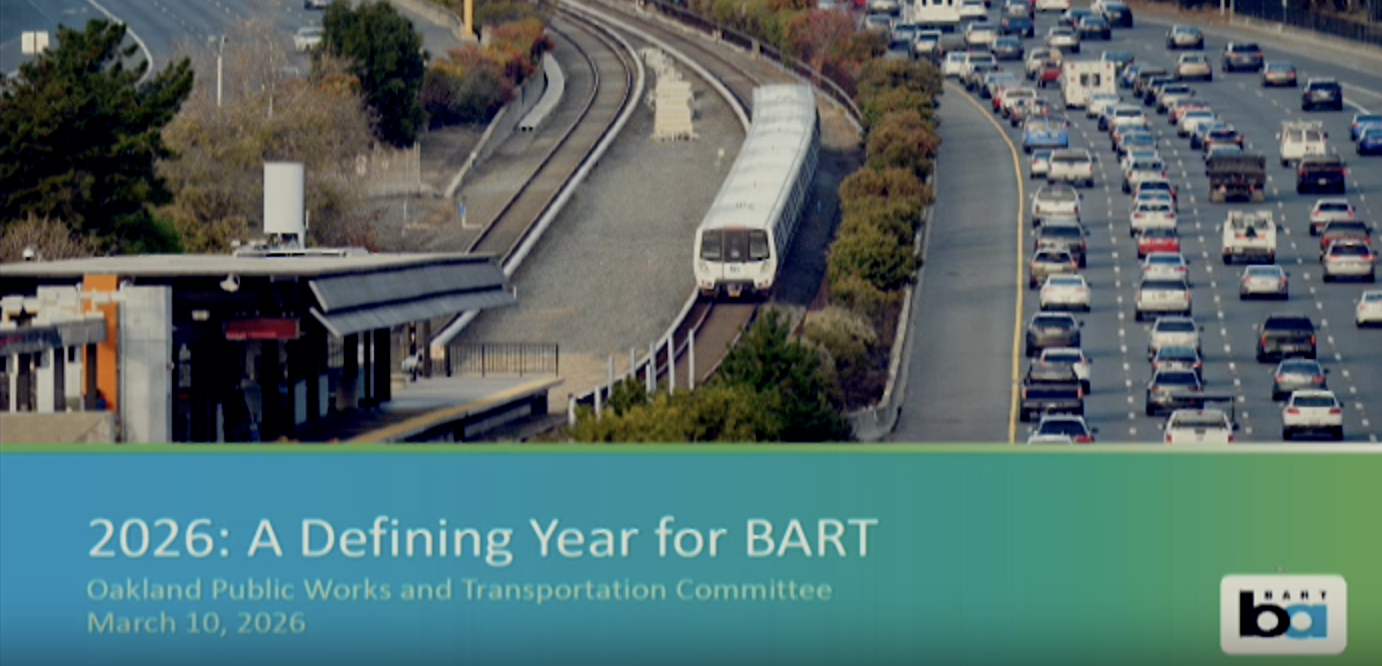
Oakland's Public Works and Transportation Committee became a rallying point for dozens of city workers, union members, and business advocates who packed the chamber to oppose a plan to dismantle the Department of Transportation's parking division — while BART directors delivered a stark warning that train service could end entirely without a November ballot measure.
- Overwhelming opposition stalls DOT parking reorganization as employees, unions, BIDs, and transit advocates line up against moving enforcement to Finance and abandoned vehicles to OPD
- BART warns of potential shutdown: 800+ layoffs, 9 PM closures, one remaining line, and 30% fare hikes if a November sales tax measure fails
- $80.5 million in state housing funds approved for two affordable projects — Liberation Park and 285 12th Street — at no cost to the city's general fund
- Caltrans agreement pulled after highway construction displaces at least 20 unhoused residents into Chinatown and Jack London with no plan
The Parking Fight: A Division United Against Its Own Dissolution
In the longest and most heated discussion of the evening, the committee heard more than a dozen speakers — not one in favor — on the administration's proposal to break up OakDOT's Parking Division. The plan would move parking enforcement and the Parking Citation Assistance Center to the Finance Department, and shift the Vehicle Enforcement Unit to the Oakland Police Department.
The basics: The reorganization was presented as a supplemental informational report by Finance Director Brad Johnson, who walked the committee through parking revenue data spanning two decades. Johnson argued that closer alignment between citation issuance and the collections process could improve efficiency. Two new positions — a parking administrator and a parking supervisor — would cost approximately $240,000 combined.
Why it matters: Oakland faces a $120 million budget deficit, and parking operations generate tens of millions in annual revenue across meters, garages, fines, and parking taxes. Opponents argued the proposal would create $750,000 in duplicative management costs, disrupt a division that delivered 30–35% revenue increases last fiscal year, and reverse the 2021 Reimagining Public Safety task force recommendation to keep parking functions in OakDOT — all without a single demonstrated cost saving.
Workers Make the Case
The public comment period was dominated by current and longtime OakDOT employees who described chronic understaffing as the real problem, not organizational structure.
Chernell Smith, a 37-year city employee, testified that public service representatives had been cut from 24 in 2003 to just 4, and that enforcement officer shortages directly reduce both meter and citation revenue. Tammy Byrd, a parking meter collection supervisor with 16 years of service, explained that meter collection is 80% field work conducted in coordination with meter repair — a link that would be severed by moving collections to Finance. Her unit, she said, has only two collectors covering the entire city, with a frozen position unfilled for more than three years.
Jimmy Bluford of the Vehicle Enforcement Unit reported that since separating from OPD, response times for abandoned vehicles were cut by more than half, removals increased nearly 30%, and service requests surged from 10,000 to 28,000. Dante Hollowell, an SEIU 1021 shop steward and parking enforcement officer, said union members support staying in DOT and offered revenue-generating ideas like partnering with local businesses for private property enforcement.
Unions, BIDs, and Advocates Align
The opposition crossed traditional fault lines. Kirby Olson, a Local 21 union member, delivered the most detailed public comment, citing the 30–35% revenue increases and a 2.8% decline in sales tax to argue that parking is outperforming the broader economy. "Listen to your staff from both SEIU and Local 21 who are standing here united along with the BPAC, our bike and ped advocates, and our business improvement districts to oppose this," said Olson. He urged the committee to forward the report on non-consent and vote no on the parking administrator salary ordinance at the Finance Committee on March 24.
Sivlan Houser, chair of the Oakland BID Alliance representing 11 business districts reinvesting over $13 million, praised the engagement of city employees and called parking enforcement integral to commercial district success. Brooke Levin, former Public Works Director, raised pointed questions about why the reorganization was being pursued outside the budget cycle and without a fiscal analysis of the costs to move functions to OPD and Finance.
Razu Engin, speaking on behalf of the Bicycle and Pedestrian Advisory Commission, said the commission sent a formal letter requesting the reorganization be put on hold, calling the proposal "half-baked" after multiple information requests. Kevin Dally of Transport Oakland noted the report still lacked a rationale for the move and cited the 2021 Reimagining Public Safety recommendation. Anaya Rose, a District 1 resident, opposed moving enforcement to OPD, citing the police department's existing overtime cost overruns and concern that police control would lead to more towing rather than safer streets.
Committee Members Push Back
Councilmember Charlene Wang presented her own inflation-adjusted analysis of parking revenue, finding that parking tax and garage revenue increased after DOT took over in 2017, though parking fines declined.
Councilmember Noel Gallo delivered an extended defense of DOT staff, emphasizing the neighborhood-level value of parking operations including school safety. "The crossing guards used to be under the police department, and we took that action and brought it under the Department of Transportation because you see the children, you know what the needs are," said Gallo. He also warned the Finance Department about providing accurate budget numbers, referencing past surprises of sudden deficits.
Chair Zac Unger laid out his preferred compromise: Finance handles collections, billing, and the customer service counter; DOT keeps meters, ticketing, and rights of way; OPD tows only truly stolen cars; and DOT retains abandoned 72-hour vehicles. "I don't see a lot of support for this. My colleagues remain skeptical and we need a strong affirmative case made for why this would be an improvement," Unger said.
Decisions: The committee voted 4-0 to forward the report to the March 16 Special City Council on non-consent — ensuring a full council debate rather than a quiet consent approval. The parking administrator salary ordinance faces a separate vote at the Finance Committee on March 24.
What's next: The full council will take up the parking reorganization at the March 16 Special City Council meeting. Opponents are organizing to oppose the parking administrator salary ordinance at the March 24 Finance Committee.
BART's Existential Warning: Pay Now or Lose the System
The basics: BART faces a $376 million operating deficit beginning in fiscal year 2027, driven by remote work's lasting impact on fare revenue — down $300–$400 million compared to pre-pandemic levels. Senate Bill 63 authorized a five-county sales tax ballot measure for November projected to provide $310 million annually, but if voters reject it, the consequences would be severe.
Why it matters: BART District 7 Director Victor Flores and Director Rayburn presented operational improvements — a 41% drop in crime, new fare gates reducing evasion, fleet modernization, 90% rider satisfaction — alongside transit-oriented development in Oakland including 97-unit senior housing at Lake Merritt, a 557-unit mixed development, and Mandela Station. But none of it closes a gap that would require ridership to more than double.
Where things stand: Director Rayburn laid out the alternative service plan in stark terms. "We would close at 9 PM seven days a week. Weekend service would be spared, but we would open on Saturdays at 8 AM," said Director Rayburn. Service would be reduced to a single line — Richmond to Berryessa — with fares rising 30% and more than 800 employees laid off. Safety and cleanliness would be cut.
By fiscal year 2027–28, additional cuts could escalate further. "The final cut is that BART would end service, and that is incredibly bleak," Rayburn said.
Councilmember Noel Gallo asked about the timeline and BART's coordination with cities, underscoring Oakland's dependence on the system.
Decisions: The committee voted 4-0 to receive and file the report.
What's next: The November ballot measure is the critical decision point. Oakland residents and regional leaders will be watching the campaign closely as BART ramps up public outreach on the stakes.
$80.5 Million in State Funds for Affordable Housing
The committee unanimously approved two resolutions to accept state Affordable Housing and Sustainable Communities program grants totaling more than $80 million. Liberation Park will receive $44.7 million (Round 8) and the 285 12th Street housing project will receive $35.9 million (Round 9). Project Manager Craig Rafael noted the funds had already been awarded by the state, and council approval was needed to affirm compliance with state requirements. The projects include units for low-income and special-needs residents.
Decisions: Approved 4-0 and forwarded on consent to the March 16 Special City Council.
Minor Items
- Feb. 24 meeting minutes approved, 4-0.
- Caltrans agreement withdrawn: Councilmember Wang pulled the Oakland Alameda Access Project item after construction displaced at least 20 unhoused residents from under a highway into Chinatown and Jack London Square with no relocation plan. "We have got to do better," Wang said. The item was placed on the pending list with no date specific.
- General public comment: Ms. Asada raised concerns about public parking confusion at City Hall, city employees taking home city cars, and faded road striping on Keller Avenue where tape is being used instead of paint.