
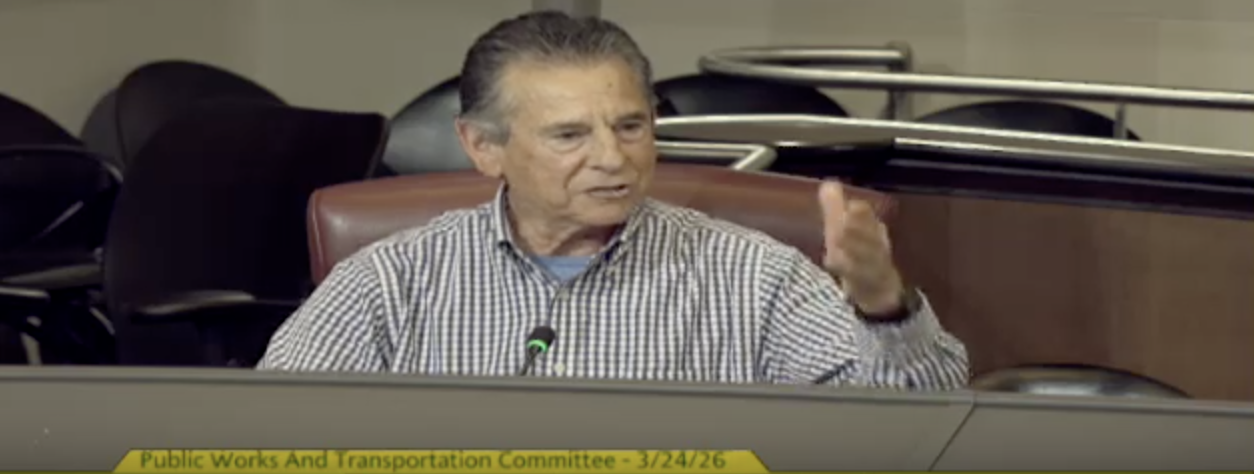
Public Works and Transportation Committee - Mar 24, 2026 - Meeting
Public Works and Transportation Committee • OaklandMarch 24, 2026
Locunity is a independent informational service and is not an official government page for this commission.We use AI-assisted analysis and human editorial review to publish information.
Oakland Advances Sweeping Illegal Dumping Crackdown With Higher Fines, Drones, and DMV Holds
Oakland's Public Works and Transportation Committee unanimously forwarded the city's most aggressive illegal dumping enforcement package in years — doubling fines, deploying AI drones, and backing a state bill to let the DMV collect unpaid citations. But every council member and public commenter who spoke landed on the same uncomfortable truth: without the staff and working vehicles to enforce the law, even the toughest rules may not clean Oakland's streets.
- Illegal dumping fines doubled, with daily penalties up to $1,000/day added for commercial and hazardous waste dumping, as committee advances amended ordinance
- State bill backed to hold vehicle registrations until dumping fines are paid — a model that more than triples collection rates for parking tickets
- $150,000 AI drone pilot approved to detect and classify dump sites across Oakland's worst-hit neighborhoods without facial recognition or license plate tracking
- Bicycle and pedestrian fatalities drop to a near five-year low of 11, but Black Oaklanders remain 2–3x more likely to die in traffic
- 39th & Telegraph to be commemoratively renamed for Bishop Charley Hames Jr., who led Beebe Memorial Cathedral for over 20 years
Oakland's Four-Part Dumping Crackdown Heads to Full Council
The committee spent the bulk of its March 24 meeting on three interlinked agenda items designed to attack illegal dumping from different angles — tougher local fines, state-level collections, and AI-powered detection. All three passed 4-0 and head to the April 14 special city council meeting on consent.
The basics: Oakland picks up two to three times more trash per capita than neighboring cities. The city spends $24 million annually on dumping remediation, yet enforcement remains chronically understaffed — only five of seven enforcement officer positions are filled, and the city has just 36 dumping cameras.
Higher Fines, Vehicle-Based Liability
Why it matters: The amended ordinance (Item 7) doubles the penalty structure to $1,500 for a first offense, $2,000 for a second, and $5,000 for a third. It also makes transporting waste without a license plate a violation and ties liability to the vehicle rather than the driver — a direct response to dumpers who remove, cover, or swap plates.
Where things stand: Chair Zac Unger, Councilmember, District 1, framed the ordinance as a tool targeting commercial-scale abuse, not casual littering: "We are targeting illegal dumping, not incidental littering. This is not for folks who throw a candy wrapper out the window of their car, although don't do that either. Your grandmother would not approve."
Councilmember Charlene Wang, District 2, successfully amended the ordinance on the floor to restore daily civil penalties of up to $1,000 per day for dumping that constitutes a commercial quantity or contains harmful waste. The amendment includes a rebuttable presumption that dumping occurred five days before discovery — meaning penalties can accumulate before anyone reports the pile.
The other side: Councilmember Ken Houston, District 7, argued the fines should go even higher: "A person that puts a bag of trash on the street should be $5,000. And a person that puts contaminated should be $10,000. And a person that pushes hazardous, $20,000 and jail time." Houston showed committee members photographs of dumping in front of his mother's house.
Public commenter Mary Forte, a member of the Illegal Dumping Organizing Committee, credited a January rally of nearly 1,000 people at Allen Temple Church for bringing the ordinance forward. She flagged that the city's proposed fine schedule is lower than the one Alameda County Supervisor Nate Miley has proposed ($2,500/$5,000/$10,000).
Decisions: The amended ordinance passed 4-0 (For: Gallo, Houston, Wang, Unger; Against: 0; Absent: 0) and was forwarded to the April 14 council on consent.
DMV Collections: SB 1218
Why it matters: The resolution supports State Sen. Jesse Arreguín's SB 1218, which would amend the California Vehicle Code to require resolution of illegal dumping fines before vehicle registration renewal — the same mechanism already used for parking tickets.
Rebecca Kaplan, Project Manager for Illegal Dumping in the City Administrator's Office, explained the current gap: Public Works issues citations, unpaid ones go to finance collections, and many are simply never paid. "When that is done for other things like parking tickets, it more than triples the rate of people paying initially," she said.
Councilmember Brown, joining via Zoom, emphasized the statewide applicability and urged Oakland to rally support from other cities.
The other side: Houston cautioned the tool has limits. "In my district, we know that the people that dump don't have a license plate. We know that they cover it up, we know that they take it off, we know that they use stolen vehicles," he said. Wang raised the disbanded OPD traffic enforcement unit and questioned whether any agency is actively enforcing against unregistered vehicles.
Decisions: Passed 4-0 (For: Gallo, Houston, Wang, Unger; Against: 0; Absent: 0); forwarded to the April 14 council on consent.
$150K AI Drone Pilot
Why it matters: The Aerbits pilot would spend $150,000 — 0.6% of Oakland's $24 million annual dumping expenditure — on 72 drone flights over six months, covering 1,440 linear road miles across 5–10 square miles of the city's worst hotspots. Drones fly at 120–150 feet, photograph streets and sidewalks, and use AI to detect, classify (tires, mattresses, etc.), and measure dump piles with centimeter-grade GPS. No facial recognition or license plate reading is used. Original images are retained one week; redacted images are retained six months.
Kristen Hathaway, Assistant Director of Public Works, presented the surveillance impact report reviewed by the Privacy Advisory Commission.
Brian Johnson, Founder of Aerbits Inc., described results from a test in San Francisco's Bayview neighborhood: "Consistent reporting resulted in cleaner streets with a 97% reduction in the amount of garbage on the streets within a month."
Where things stand: Wang highlighted a significant equity gap in the city's current reporting system. "In the San Antonio area, the Little Saigon area, where there is by far the worst illegal dumping in my district, there's like five reports, because our 311 app is not available in any other language but English. And then I look at the wealthier parts of my district and there's like 400 reports for something that is much less problematic," she said. The drone system would bypass that disparity by providing comprehensive, language-independent coverage.
The other side: Public commenter David Boatwright, a District 4 resident, was blunt about the enforcement gap, arguing the ordinance is meaningless without capacity and funding to act on what the drones find. Mary Forte supported the pilot but asked the committee to include Districts 5, 6, or 7 in the target area and questioned where the pilot's funding originates.
Decisions: Passed 4-0 (For: Gallo, Houston, Wang, Unger; Against: 0; Absent: 0); forwarded to the April 14 council on consent.
The Enforcement Problem No One Could Solve
Across all three items, the dominant theme was a gap between policy ambition and on-the-ground capacity. Councilmember Noel Gallo, District 5, crystallized it early in the meeting while discussing outstanding committee items: "We can talk all about illegal dumping. But if I don't have the people to do the job, it's not going to get done." He cited 30 to 60 inoperable Public Works vehicles sitting at the Coliseum Way yard and a shortage of 10 mechanics. He demanded a vehicle and staffing report from the department.
Houston described a broken code compliance loop in which complaints are "closed out" visually without tracking where the dumped waste actually goes — a 2019 request for a meeting on the issue that he said was never answered.
What's next: All three items head to the April 14 special city council meeting on consent. The Aerbits pilot, if approved, would begin shortly after with the committee selecting target neighborhoods. Mary Forte called for a formal oversight committee to track enforcement of the new ordinance and asked for illegal dumping to become a regular agenda item.
Bike and Pedestrian Deaths Hit Near Five-Year Low, but Racial Disparities Persist
David Raulston, Immediate Past Chair of the Bicyclist and Pedestrian Advisory Commission, delivered the commission's 11th annual report, celebrating a drop to 11 traffic fatalities in 2025 — eight pedestrians and three cyclists — from higher levels in prior years.
Why it matters: The improvement masks deep inequity. "Black Oaklanders are two to three times likely to be victims of traffic violence. Thirty percent of streets in the majority of Asian census tracts are our city high injury network, the highest percentage of any ethnicity," Raulston reported.
Where things stand: The BPAC's seven recommendations include a citywide greenway network in the General Plan update that would connect every flatlands neighborhood within a half mile of protected corridors — a 20-year vision. Other priorities: immediate traffic calming (slow streets, flex posts, speed humps, raised crosswalks), fast-track waterfront connections to East Oakland, and aligning Oakland fire code with international standards on road widths to balance fire access with traffic safety.
Houston pressed on the racial dimension: "I'm very troubled behind things like that. We get the most trash dumped in our community. We get the less contracts in the city of Oakland as being Black. And then we die the most."
Gallo recommended partnering with Oakland Unified School District to provide bicycle safety education in high schools.
Public commenter Kevin Daly, BPAC Policy & Legislative Committee Co-Chair, countered Gallo's concern that bike-share stations consume parking by noting each bike-share slot reduces car trips, potentially creating net parking gains.
Decisions: Received and filed, 4-0.
Climate Plan at Midpoint: Port Pollution Down, All-Electric Building Standard Holds
A staff presenter from the City Administrator's Office delivered a progress update on the Equitable Climate Action Plan, adopted in July 2020 with a goal to cut greenhouse gas emissions 60% by 2030.
Why it matters: Transportation produces two-thirds of Oakland's local emissions, and with federal climate funding uncertain, the city is pivoting toward public-private partnerships and linking climate action to local job creation through the Mayor's Innovation Team.
Where things stand: Key highlights from 2023–2025 include: the Port of Oakland cut black carbon and particulate matter more than 50% since 2017, with $300 million or more in further investment planned; new construction is effectively all-electric thanks to building codes adopted last fall; Measure MM generates $2.7 million per year for vegetation management in high-fire areas; more than 110 gas water heaters have been replaced with heat pumps at city buildings; and over 200 miles of bikeways and 12,000-plus bike parking spaces exist.
Wang asked about the clean energy transition as a job creator, especially for workers without college degrees.
The other side: Public commenter Kevin Daly flagged the cost burden on low-income homeowners switching from gas to electric — fronting costs and waiting months for rebates — and said California PUC rules make solar panels on multi-unit buildings financially unviable.
Decisions: Received and filed, 4-0.
Minor Items
- March 10 committee minutes approved, 4-0.
- Outstanding committee items accepted, 4-0. Gallo requested a Public Works vehicle and staffing report.
- Commemorative street renaming: The intersection of 39th Street and Telegraph Avenue will be renamed "Bishop Charley Hames Jr., Way," honoring the 66th Bishop of the Christian Methodist Episcopal Church. Pastor Miller of Beebe Memorial Cathedral — a 101-year-old Oakland institution that has hosted leaders including Kamala Harris and Steph Curry — presented alongside Ashley Drake from Councilmember Unger's office. Passed 4-0; forwarded to April 14 council.
- Open forum: Mary Forte requested formal oversight of the dumping ordinance, a report on outcomes from the mayor's recent D.C. trip regarding dumping funding, and asked that illegal dumping become a standing committee agenda item.