Public Works and Transportation Committee - Jun 09, 2026 - Meeting

Public Works and Transportation Committee - Jun 09, 2026 - Meeting

Public Works and Transportation CommitteeOaklandJune 9, 2026

Sources:

Locunity is a independent informational service and is not an official government page for this commission.We use AI-assisted analysis and human editorial review to publish information.

Bike Share Franchise Splits Committee as Oakland Advances $30M in Infrastructure

Oakland's Public Works and Transportation Committee pushed nearly $30 million in infrastructure contracts forward on June 9, headlined by a $26.5 million streetscape overhaul of MLK Jr. Way and a $2.5 million emergency purchase of sewer-cleaning trucks — all while a labor protest temporarily shut down proceedings and a rare dissenting vote ensured the Lyft bike share franchise extension will face a full council fight.

  • Lyft bike share franchise extended through 2032 on a 3-1 vote after Councilmember Ken Houston demanded Oakland extract more financial benefit; the item heads to full council on non-consent

  • $26.5M contract awarded for MLK Jr. Way safety overhaul with protected cycle track, 79 new street trees, and wider sidewalks on a deadly corridor — fully grant-funded

  • $2.5M approved for three sewer-cleaning trucks after staff revealed seven of eight units were out of service, risking federal consent decree violations

  • Staff disclosed 600-700 city vehicles are overdue for replacement after purchasing was decentralized in 2023; a consultant report is expected this summer

  • IFPTE Local 21 members stormed the meeting to demand healthcare and pension cuts be dropped from contract negotiations

  • Committee members pressed for tighter change order oversight on the MLK project, where the standard 25% threshold could add $6M+ without council approval


Houston Votes No on Lyft Bike Share, Sending Franchise to Full Council Fight

The most contentious item of the day was an ordinance extending Lyft's exclusive Bay Wheels bike share franchise to Dec. 31, 2032. The committee approved it 3-1, but Councilmember Ken Houston's no vote sends the measure to the June 16 City Council meeting on non-consent — meaning the full council will debate it rather than pass it as a routine item.

The basics: Bay Wheels currently operates roughly 500 electric bicycles and 350 standard pedal bikes across 102 docking stations in Oakland. The program runs at no direct cost to the city beyond approximately 10% of one staffer's time, and revenue sharing has exceeded the minimum threshold only once in the program's history. The extension aligns Oakland's agreement with the Metropolitan Transportation Commission's regional program.

Why it matters: The franchise grants Lyft an exclusive right to operate bike share in Oakland for six more years. Houston's dissent forces the full council to weigh whether the city is leaving money on the table by extending a franchise that generates virtually no revenue for Oakland — even as Lyft profits from the system.

Where things stand: Transportation Planner Kerby Olsen reported that ridership has grown about 30% year-over-year since 2023 and that 2026 is on track for the highest ridership year ever, with a 50% increase in the first quarter alone. He framed the program as a bargain:

"If the city were to procure a system such as this on our own, it would cost something like $8 million a year because these systems tend to not cover their own costs."

Chair Zac Unger pressed on the finances:

"Can you just briefly tell us about the finances of this. Do they pay us? Do we pay them? What kind of money are we talking about?"

Olsen confirmed the program operates at no cost to the city, with nominal revenue sharing.

Councilmember Charlene Wang asked whether staff takes feedback on dock placement, noting she receives block-by-block questions from constituents. Olsen said the city can relocate stations and welcomes input.

The other side: Houston was blunt in his objection.

"I want to find out how Oakland is benefiting as a business. Because we keep running this city like it's not a business," he said.

Houston wanted to hold the item in committee until he could see what financial benefit Oakland receives. He suggested Lyft could promote Oakland tourism through its rideshare cars.

Colin Hughes from the Metropolitan Transportation Commission spoke in support, noting the program's record ridership. Public commenter Kevin Dalley said bike share stations take cars off the street and may bring visitors to local businesses. A public commenter who identified himself as Buffalo Soldier, sided with Houston. He questioned whether Lyft pays parking fees the way restaurants do when they displace parking spaces.

Decisions: The committee voted 3-1 (For: Gallo, Wang, Unger; Against: Houston). The item advances to the June 16 City Council agenda on non-consent.

What's next: The full council will have the opportunity to negotiate additional financial terms before granting the six-year extension. Houston's leverage play could prompt Lyft or staff to return with a revised revenue-sharing arrangement.


$26.5M MLK Jr. Way Overhaul Advances, but Change Order Scrutiny Follows

The committee unanimously approved a $26.5 million construction contract for streetscape improvements along Martin Luther King Jr. Way from 2nd to 14th streets — the single largest investment on the agenda — with members raising pointed questions about how to prevent cost overruns on a project of this scale.

Why it matters: The corridor sits on Oakland's High Injury Network — the 8% of streets that account for 60% of severe and fatal collisions. The project is fully funded by state and local grants from MTC and CalSTA, meaning no city general fund dollars.

Where things stand: Emily Ehlers, OakDOT's Major Projects Division, described a sweeping scope: upgraded sidewalks, curb ramps, pedestrian bulb-outs, countdown signals, a protected two-way sidewalk-level cycle track, upgraded traffic and bike signals, pedestrian lighting, seating, 79 new street trees nearly doubling the canopy, and wider travel lanes with an additional southbound lane between 2nd and 3rd for freight access.

"This street is located on our High Injury Network, which is the 8% of our streets that account for 60% of severe and fatal collisions," Ehlers said.

Four bids were received. McGuire and Hester emerged as the lowest responsive bidder at $26,499,339.50 — 8% below the engineer's estimate of $29 million. Two bidders earned the maximum 10% bid discount through Mentor Protégé agreements with certified very small local firms under the city's LSLBE program.

Councilmember Ken Houston praised the contractor:

"McGuire and Hester is a good company. They're in my district. They're doing SLBE small local businesses. They've been in our city for over 100 years."

Change Order Concerns

Both Houston and Chair Zac Unger zeroed in on change order oversight. Under the standard public works construction code, up to 25% in change orders — potentially more than $6 million on this project — can be approved without returning to council.

Houston drew on personal experience:

"How do we keep up on that change order? Because that's important. Because as a contractor I remember how people manipulate that."

Unger urged staff to be vigilant: "I would just ask that we always look at these change orders very critically, especially in a project of this size and not just sort of rubber stamp millions of dollars in change orders."

Ehlers confirmed that OakDOT Director Rowan is working on updated change order protocols.

Councilmember Charlene Wang asked about connectivity between Jack London Square and downtown across the I-880 barrier. Ehlers described a companion undercrossing improvement project:

"The biggest barrier we heard was that freeway. So crossing under 880 is challenging. It's not welcoming, it's not comfortable. People avoid it."

Decisions: Approved 4-0 (For: Gallo, Houston, Wang, Unger; Against: none). Forwarded to the June 16 City Council agenda on consent.


Sewer Truck Crisis Reveals Deeper Fleet Breakdown

The committee unanimously approved a $2.5 million purchase of three Vactor combination sewer-cleaning trucks — but the discussion quickly revealed a far larger problem: a citywide vehicle replacement crisis touching police, fire, and public works.

Why it matters: Oakland must clean 184 miles of its 920-mile sanitary sewer system annually — plus CCTV-inspect 92 miles — under a federal EPA consent decree. Without working trucks, the city faces potential fines and environmental violations during wet weather events.

Where things stand: Assistant Director for Oakland Public Works Richard Battersby laid out the urgency:

"We have eight assigned units in the sewer division. Lately seven of those eight have been out of service and we've been renting two units at a cost of $14,000 each. So almost $30,000 a month."

The trucks, procured through an RFQ process from Owen Equipment Sales, cost approximately $750,000 each. Battersby said the RFQ approach — rather than a cooperative purchasing agreement — was chosen partly to encourage local business participation and partly because it was faster.

Councilmember Ken Houston pressed on warranty terms and the difference between renting and owning. Battersby agreed to explore extended warranties in future procurements:

"We will include that as an option in future RFP, RFQs, price with standard warranty, price with extended warranty."

He also explained the trucks are being used well beyond industry norms:

"An average age for a unit like this, where the funding is not the limiting factor, would probably be between five and seven years because of the hard use. Here at the City of Oakland, we're hitting the 10 year mark."

The Bigger Problem: 600-700 Vehicles Overdue

The sewer trucks turned out to be a symptom. Battersby revealed that equipment replacement was decentralized in 2023, and since then few replacement vehicles have been acquired — compared to the roughly 150 replacements that would normally occur in a comparable period.

"Probably more than half of the fleet is recommended for replacement now. So we're talking about a number in the 600 or 700 range," he said.

Councilmember Noel Gallo seized on the disclosure, calling for a comprehensive fleet report and raising the need to plan for electrification infrastructure:

"Where other cities are heading and electrifying the vehicles that they're purchasing. Does the city of Oakland have the tools and the locations where the future vehicles are? If we buy, they're going to be electrified. We need to be able to plug them in."

Gallo connected the vehicle shortage directly to service delivery:

"We talk about a clean city, make all these policies and reports and studies, but the reality is we need the tools to get it done."

A consultant has been hired to evaluate the city's equipment replacement practices, with findings expected in July or August.

Councilmember Charlene Wang commended the quality of the staff report's economic analysis:

"I wanted to actually commend the way that you wrote this report. I like how you laid out the economic argument as to why this was needed instead of just renting out the trucks."

Decisions: Approved 4-0. Forwarded to the June 16 City Council agenda on consent.

What's next: The consultant study due this summer could trigger a major budget conversation about fleet modernization across all city departments.


Local 21 Workers Disrupt Meeting Over Contract Negotiations

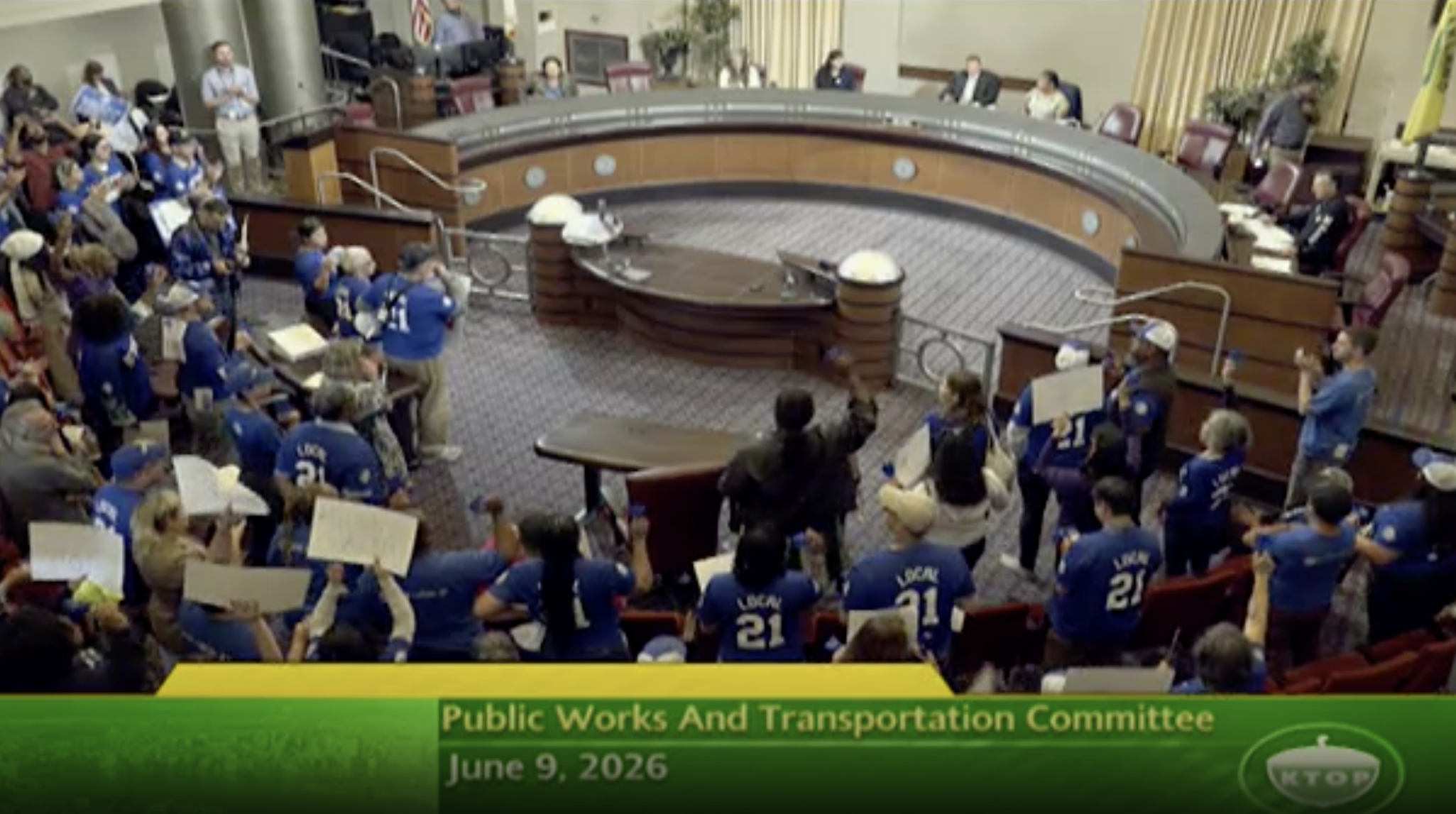
Members of IFPTE Local 21 staged an organized protest during the bike share discussion, temporarily halting proceedings. Protesters entered the council chambers loudly, demanding that healthcare and pension cuts be removed from the city's bargaining position and calling for raises that keep pace with regional standards. They rejected what they described as a 0-1-1 offer after a year without any pay increase, directing their demands at City Administrator Betsy Lane.

Councilmember Ken Houston called the protest "democracy at the highest level." The meeting resumed after the demonstrators departed.

Why it matters: The protest signals escalating labor tensions heading into contract negotiations. With workers publicly rejecting the city's offer, council members will face pressure to weigh in as negotiations continue — a dynamic that could complicate the city's already strained budget.


Minor Items

  • May 26 committee minutes approved 4-0.

  • Committee pending list approved 4-0 with no changes; public commenters raised concerns about free parking revenue at the ice skating center, Mosswood Park safety, and poor communication during Diamond District repaving.

  • Easement vacation at 747 52nd Street approved 4-0, clearing a 1967-era public utility easement for Benioff Children's Hospital campus construction after PG&E relocated its utilities. Forwarded to the June 16 City Council agenda on consent.

  • Diamond District repaving complaints: A resident reported no-parking signs were posted for nearly a month with no contact information and that OakDOT email addresses bounced. Staff provided the correct address on the record: onlinepermits@oaklandca.gov.

  • Open forum: Public commenter Simuel Ramey of the California Oakland Union Homeless for Mental Health criticized the city's allocation of resources to shelters and senior centers. Public commenter Assata Olugbala asked about the city's intent to rename the Cesar Chavez Library and Park and praised the committee's collaborative working relationships.

Bike Share Franchise Splits Committee as Oakland Advances $30M in Infrastructure | Public Works and Transportation Committee | Locunity