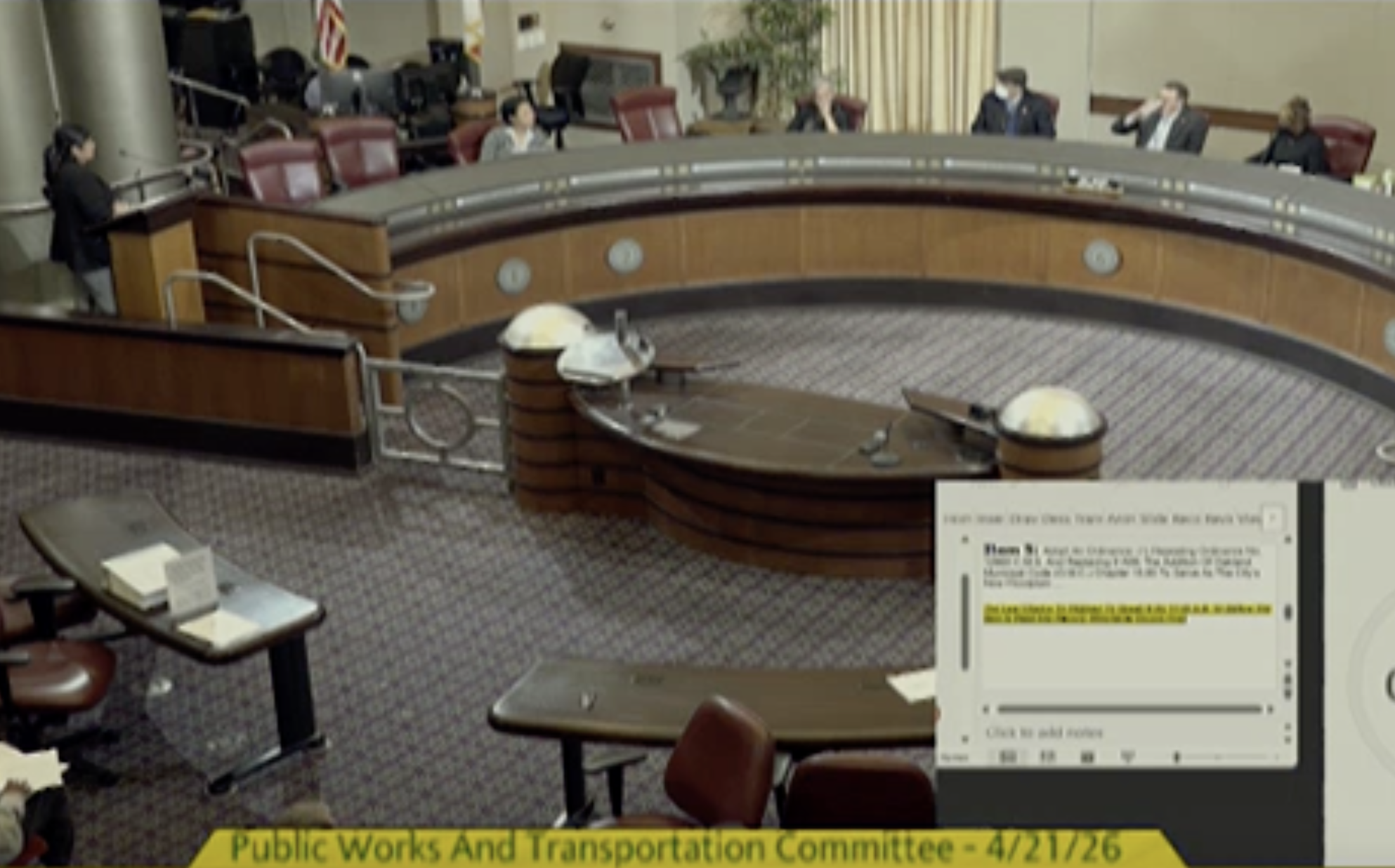
Public Works and Transportation Committee - Apr 21, 2026 - Special Meeting
Public Works and Transportation Committee • OaklandApril 21, 2026
Locunity is a independent informational service and is not an official government page for this commission.We use AI-assisted analysis and human editorial review to publish information.
Only One Sewer Truck Available Citywide as Oakland Fleet Crisis Deepens
Oakland's Public Works Committee got a blunt warning this week: the city's basic service delivery fleet is approaching failure, with just one of 13 sewer flusher trucks operational and overnight fire apparatus reserves down to a single unit with no spares. The committee advanced $16.8 million in fleet contracts on a rare 3-1 split vote, raced to meet a FEMA floodplain deadline that could strip residents of flood insurance, and learned the city has fallen to 79% stormwater trash compliance under tougher regional rules.
$16.8M in fleet contracts approved 3-1 after Public Works staff delivered an unusually candid account of a vehicle and staffing crisis threatening sewer response, street sweeping, and fire readiness
FEMA-compliant floodplain ordinance advances with a hard May 26 deadline — without it, homebuyers in flood zones can't get federally backed mortgages
Oakland drops from 100% to 79% on stormwater trash reduction after new regional permit rules eliminated credits for plastic bag bans and volunteer cleanups
MacArthur Transit Village Phase One formally accepted after a 20-year timeline, clearing the path for the next phases of the 900-unit transit-oriented development
Fire Station 29 design contract grows $700K to $2.5M as state broadband co-location targets East Oakland's lowest-connectivity neighborhoods
One Truck, Five Vacancies, No Margin: The Fleet Crisis
The most consequential presentation at the April 21 special meeting of Oakland's Public Works and Transportation Committee came from Richard Battersby, assistant director of Public Works' Bureau of Maintenance and Internal Services, who delivered a detailed and unusually frank accounting of how far the city's fleet has deteriorated — and what it means for basic services.
The basics: Battersby presented 33 cooperative purchase agreements totaling $16.815 million for fleet maintenance, fuel, equipment, and software, funded through the city's 4100 internal service fund. Cooperative purchasing allows the city to piggyback on contracts competitively bid by other public agencies rather than running its own solicitation.
Why it matters: Oakland is operating under a federal consent decree for sewer overflows. Battersby told the committee that of the city's 13 sewer and storm drain flusher trucks, 12 are currently unavailable, leaving a single truck to respond to flooding emergencies citywide. Street sweeper availability has dropped to 50%. Overnight fire apparatus reserves are down to one unit with zero spares. No significant vehicle replacements have occurred in four years, aside from 78 police patrol vehicles.
Where things stand: Five mechanic positions are vacant or frozen through the Department of Human Resources Management, forcing the city to outsource repairs.
"Unfortunately, that costs about 50 to 150% more, and it incurs more downtime," said Battersby. "But this is the environment we operate in currently."
Councilmember Noel Gallo pressed the point repeatedly, questioning what the council must do to equip workers.
"We can do a lot of talking about a safe, clean city, but I don't have the tools and the personnel to get the job done," he said. "And that's a reality."
Gallo also asked whether the city is still leasing its public works yard from a private family for $3 million to $5 million per year.
Councilmember Charlene Wang challenged the implied cost of outsourced labor, calculating a $321-per-hour rate from the report's figures.
"I don't know if this is the correct way to estimate the billable labor hours," she said. "If we take $16.8 million and divide that, that's $321 per hour."
She pressed staff on what obstacles DHRM was creating for hiring mechanics and questioned contract timelines and funding sources.
The other side: Councilmember Ken Houston cast the meeting's only no vote, zeroing in on vendor equity.
"Did we say three are from Oakland and the other 30 aren't?" he asked, noting only 3 of the 33 vendors are Oakland-based.
Public commenter Ms. Asada criticized the cooperative purchasing approach for bypassing competitive solicitation and pointed out that 16 of the 33 contracts had already expired, with some vendors carrying unspent balances while receiving additional money.
"This is an item that is called a cooperative purchase agreement. And what does that mean? It means you're going to spend over $16 million by bypassing the solicitation process," she said.
Battersby announced a significant policy shift in response: staff is moving from the cooperative purchasing model to a formal RFP process.
"Going to the RFP model we found is actually faster than working co-ops through the procurement process, and it will give more opportunities for Oakland-based businesses to bid on these contracts," he said.
Decisions: Passed 3-1 (For: Gallo, Wang, Unger; Against: Houston). Forwarded to the May 5 City Council meeting on non-consent, meaning it will receive full council debate rather than passing on the consent calendar.
What's next: The shift to an RFP model will be the key metric to watch — whether it actually increases Oakland vendor participation while still getting parts and services to a fleet in crisis. The broader fleet and staffing situation sits at the intersection of budget constraints, the federal sewer consent decree, and the city's ability to deliver basic services like street sweeping and illegal dumping response.
Racing the Clock on Flood Insurance
Why it matters: Without a FEMA-compliant floodplain ordinance on the books by May 26, Oakland homebuyers in flood zones — including neighborhoods around Jack London Square, Brooklyn Basin, Estuary Park, and Sausal Creek — would lose access to federally backed flood insurance, a requirement for anyone with a federal mortgage in a designated flood area.
Where things stand: Ceci Muela from the Planning and Building Department presented the new ordinance, which replaces Ordinance No. 12960 with Oakland Municipal Code Chapter 15.80, aligning Oakland with federal regulations and peer jurisdictions like San Francisco and San Jose. City Attorney Brian Mullery displayed FEMA flood risk maps showing the city's high-risk areas and made the stakes concrete:
"If we don't have a compliant ordinance on file, then anyone who buys a home and goes to get a federally backed mortgage needs to show federal flood insurance."
Councilmember Ken Houston asked whether the ordinance addresses routine drainage flooding or catastrophic events; staff clarified it covers catastrophic flooding only.
The other side: Public commenter Ms. Asada argued the discussion overlooked flooding risks in lower-income areas of West and East Oakland, including Havens Court, neighborhoods south of Eastmont, and areas near Interstate 880, citing the 2023 Coliseum Connection apartment flooding. She noted 37.1% of West Oakland properties face flood risk. Kevin Daly asked how FEMA accounts for future climate change in its flood risk maps and what Oakland is doing to prepare for sea level rise along Brooklyn Basin and Capitol Corridor tracks.
Decisions: Passed 4-0 (For: Gallo, Wang, Unger, Houston). Two readings are scheduled for May 5 and May 19 at City Council, with adoption required by May 26.
Oakland Falls to 79% on Stormwater Trash Compliance
The basics: The Municipal Regional Stormwater Permit, or MRP, governs how much trash cities must keep out of waterways. Oakland previously achieved 100% compliance — but the new, stricter permit eliminated credits for product bans like plastic bags, volunteer cleanups, and encampment abatement.
Why it matters: The overnight rule change dropped Oakland from full compliance to 79%. The city expects to reach 85.1% by year's end but will not hit 100%. Staff negotiated a deadline extension to December 2030, but meeting that target will require installing 300 to 525 additional small trash capture devices and three large ones, partly funded through Caltrans.
Ben Livesey of the Watershed and Stormwater Management Division explained the shift:
"The MRP became more stringent this fiscal year and now eliminates several trash reduction categories the city has relied upon, including product bans such as plastic bags, a problematic litter source, phases out other categories such as volunteer creek and shoreline cleanups."
Councilmember Charlene Wang asked about the city's status under the EPA consent decree for sewer overflows. Staff confirmed the city remains in compliance, with the decree extending through 2036. Wang also raised concerns about surface-level drain clogging causing localized flooding in her district. Terri Fashing of the Watershed and Stormwater Management Division announced a storm drainage master plan with results expected in early 2027.
Councilmember Ken Houston pressed for data on hazardous materials collected from storm drains in East Oakland.
"The things that are dumped, the needles, the batteries, the bestos, all these things go," he said, asking staff to document what they're finding.
Councilmember Noel Gallo invoked his personal history, recalling a time when he was hired as the Lake Merritt parks manager with a mandate to make it the cleanest spot in Oakland. He called for restoring the lake's condition.
Public commenter Ms. Asada highlighted the need for a culture shift around drain maintenance and described witnessing unsanitary conditions in storm drains near McClymonds. Kevin Daly reported storm drains in Glenview and Rockridge that lack proper grates, creating cyclist hazards and allowing more trash into the drainage system.
Decisions: The informational report was received and filed 4-0. No sustainable funding source has been identified for ongoing maintenance of the new trash capture devices.
MacArthur Transit Village: 20 Years to Acceptance
Reginald Bazile from OakDot presented a resolution accepting public infrastructure improvements for MacArthur Transit Village Phase One, located at 39th Street and Telegraph Avenue near MacArthur BART. The project converted 7 acres of surface parking into 900 housing units, including 90 affordable units.
Why it matters: Issuing the Unconditional Certificate of Completion frees developer funds for subsequent project phases, advancing transit-oriented housing in a central Oakland corridor. The project originated in 2006, was revised in 2017, and saw delays from developer turnover, business cycles, and the creation of new streets.
Councilmember Charlene Wang asked why a ministerial certificate required council action; staff explained it was brought for public discussion. Councilmember Noel Gallo pressed on fiscal impact and learned approximately $400,000 in permit fees were collected into the 2415 cost recovery fund. Bazill noted the project's long arc:
"This is a five-phase development. Phase one is done. We're here to accept the infrastructure."
Public commenter Ms. Asada questioned why delays should continue to be tolerated.
Decisions: Passed 4-0 (For: Gallo, Wang, Unger, Houston). Forwarded to May 5 City Council on consent.
Minor Items
Easement at 260 Oak Street approved 4-0: a $255,000 purchase of a 992-square-foot easement from the Vukasin Family Limited Partnership to support the Embarcadero West Rail Safety and Access Improvements Project, fully funded by a CalSTA AB 128 grant. Vehicles frequently get stuck on tracks at this crossing near the Amtrak station. Councilmember Wang praised the project for economic development and goods movement and confirmed a full appraisal determined the price. Forwarded to May 5 City Council on consent.
Fire Station 29 design contract increased from $1.8M to $2.5M and approved 4-0. Alan Chan from Public Works explained the added scope: utility relocation studies, six community engagement sessions, environmental review for the state's Middle Mile broadband fiber hut co-location, and 2026 building code redesign. "We accommodated the state's initiative because East Oakland has some of the lowest broadband connectivity rates in the city," Chan said. Design is at 65%. Forwarded to May 5 City Council on consent.
Pending list of outstanding committee items adopted 3-0 (Houston absent at that point).
During open forum, Ms. Asada criticized a $900,000 fine imposed on a property owner for tree removal, alleging racial inequity in code enforcement. She noted the fire department had ordered the trees removed but the planning department — not public works — issued the violation.