
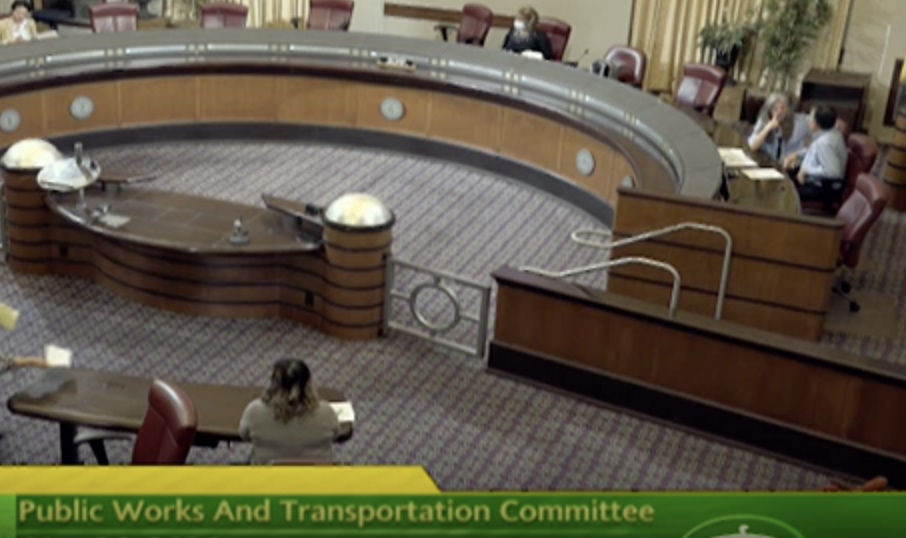
Public Works and Transportation Committee - May 26, 2026 - Meeting
Public Works and Transportation Committee • OaklandMay 26, 2026
Locunity is a independent informational service and is not an official government page for this commission.We use AI-assisted analysis and human editorial review to publish information.
Dumping Audit Exposes Oakland's $2M Enforcement Gap as Chinatown Resilience Hub Advances
Oakland's Public Works and Transportation Committee confronted the staggering costs of illegal dumping — $2 million spent on enforcement that yielded just $16,000 in fines — then unanimously advanced a $29.3 million contract to build the city's first emergency resilience hub in Chinatown, a project 30 years in the making.
City auditor finds Oakland spends $2M on dumping enforcement but collects just $16K in fines; residents pay 23–40% more for trash than neighbors
$28.4M construction contract and $848K architect amendment advance for Lincoln Recreation Center, Oakland's first resilience hub, after decades of community advocacy
Vandalism at East Oakland Arts Center forces $1M change order; Councilmember Houston casts lone no vote demanding local contractor participation
$13M in state transportation funds accepted for paving, stair paths and bike infrastructure — no local match required
Sewer consent decree progress: 61% spill reduction, but city risks missing 2028 federal milestone
Audit Lays Bare Oakland's Illegal Dumping Crisis
City Auditor Michael Houston delivered a sweeping performance audit covering 2019 through 2025, painting a picture of a city that pays more than its neighbors for trash service while its enforcement apparatus collects pennies on the dollar. The committee received and filed the report with 17 recommendations — all accepted by the administration.
The basics: Oakland generates roughly 3,600 tons of illegally dumped waste annually. The audit examined three pillars: the cost of legal disposal, the effectiveness of enforcement, and the accessibility of the city's 311 reporting system.
Why it matters: The audit found that Oakland residents pay 23–40% more for curbside trash service than residents in neighboring cities that use the same hauler, Waste Management. Reduced rates are unavailable to renters, even though Oakland is a majority-renter city. That cost gap, the auditor argued, fuels the incentive to dump illegally.
"Legal waste disposal is more expensive in Oakland than other local jurisdictions. Oakland residents paid between 23 to 40% more for curbside service than did residents of neighboring jurisdictions that use the same hauler," said Auditor Houston.
The enforcement numbers were equally stark. Oakland spent $2 million on enforcement but collected approximately $16,000 in fines. The city's administrative citation structure — $100 for a first offense, $250 for a second, $500 for a third — lagged far behind cities like San Jose, which imposes a $2,500 first-offense fine. Only six cases were referred to the Alameda County District Attorney countywide in 2025. Environmental Enforcement Officers lacked finalized training documents and written procedures.
Meanwhile, the city's 311 reporting system — the primary intake tool for dumping complaints — operates only in English, violating Oakland's own Equal Access Ordinance.
Where things stand: Public Works Director Liam Garland outlined actions already underway. The council has increased citation amounts, and the department is expanding its camera network with a target of 100 units, deploying aerial technology for pile identification, and partnering with OPD on footage-based investigations.
"OPW has shared footage with OPD and OPD has initiated investigations based on this footage. So progress is being made," said Garland.
He estimated that cameras could eventually generate roughly 1,500 citations per year.
The Franchise Fee Question
Councilmember Noel Gallo zeroed in on the money flowing through the waste contract, noting that Waste Management collects a franchise fee of $35–36 million annually from Oakland residents on top of their garbage bills.
"We have what we call a franchise fee where I as a citizen, besides paying for my garbage bill, I'm charged — or Waste Management collects $35 million a year from U.S. residents to give back to the city," Gallo said.
He described deploying five of his six staff members every day from 6 a.m. to noon just to clean up District 5 and pointed to dozens of broken Public Works trucks sitting idle at the Coliseum Way yard as evidence of insufficient resources.
Chair Zac Unger acknowledged the rate issue but noted the city's hands are tied:
"That's something we have to do in negotiation with Waste Management, whose contract is not up until 2030."
Enforcement Training and Equity Gaps
Councilmember Ken Houston drew on his background working with the Alameda County DA's office to argue that Environmental Enforcement Officers need rigorous training to build prosecutable cases.
"Our EEOs have to be trained properly — to be able to identify contaminated hazardous materials so they can be prosecuted to the full extent of the law," Houston said.
Councilmember Charlene Wang highlighted the equity dimension, noting that immigrant-heavy neighborhoods in her district file far fewer 311 reports despite worse conditions. She called the $16,000 collection figure against $2 million in spending "abysmal" and pushed for better interdepartmental coordination between Public Works and Finance.
Public commenter Duane Nelson challenged the audit's finding of a two-day median resolution time, citing personal service requests that had been open since June 2025. Kevin Dalley proposed a "fourth E" — making bulky item pickup easy, particularly for multifamily tenants who can only schedule pickups once per month at end of month, creating an incentive to dump when moving mid-month.
Decisions: The committee received and filed the audit unanimously (For: 4, Against: 0).
What's next: All 17 recommendations have been accepted by the administration. The Waste Management contract expires in 2030, setting the horizon for any rate renegotiation. Environmental Enforcement Officer training documents are targeted for completion by June 2027.
Chinatown's 30-Year Wait Ends as Lincoln Rec Center Advances
The committee unanimously approved a $28.4 million construction contract to S.J. Amoroso Construction Co. and an $848,000 increase to the professional services agreement with Shah Kawasaki Architects for the Lincoln Recreation Center expansion — the culmination of three decades of community advocacy.
Why it matters: The existing recreation center, built in the late 1970s at just 7,500 square feet, is the only public recreation center serving Chinatown and downtown Oakland. The surrounding census tract has a 34% poverty rate, and 80% of students at the adjacent Lincoln Elementary School qualify for free or reduced-price lunch.
"Over the last 25 years, there have been major park facilities updates in every single district except for District 2," said Councilmember Charlene Wang, who championed the project.
The new two-story, 22,221-square-foot facility will serve as Oakland's first resilience center, equipped with solar power, air conditioning, clean air systems, and emergency support capabilities. Funding is assembled from Proposition 68 ($8.4 million), a CDFA Community Resiliency Center Grant ($9.25 million), a HUD federal grant, and Measures KK and U. Construction is slated for summer 2026, with completion targeted by December 2027 to meet grant deadlines.
Community Voices
The item drew the meeting's largest public turnout. Multiple members of the Asian Pacific Environmental Network spoke in Cantonese through a translator, urging swift action and framing the project as long-overdue investment in low-income immigrant communities. Tiffany Ng, co-founder of Friends of Lincoln Square Park, noted that 2026 marks 30 years since the open space plan first called for the center's expansion.
Stephanie Tran, president of the Oakland Chinatown Chamber of Commerce, expressed frustration at more than a year of delays and emphasized the park's role as an economic engine generating foot traffic for surrounding businesses.
Claudia Lee, a Lincoln Elementary parent, advocated for continuing the Lincoln Explorers after-school program — which serves more than 100 children — during construction, and for close coordination between the contractor and the school's 700 students.
Councilmember Ken Houston raised questions about local hiring, noting that federal funding sources limit enforcement of local hiring requirements but urged the contractor to strongly encourage local participation.
Decisions: Approved 4-0 (For: Gallo, Houston, Wang, Unger; Against: 0). Both resolutions forwarded to the June 2 City Council meeting on consent.
Houston Votes No on East Oakland Arts Center Change Order
A vandalism-driven $1 million change order for the East Oakland Arts Center — formerly the DACA center, part of Rainbow Rec Center at 5818 International Blvd. — exposed tensions over capital project oversight and local hiring.
The basics: The original construction contract with CWS Construction Group was $1.785 million. Staff requested authority to increase the change order ceiling from 25% to 56% of the original contract, bringing the new total to $2.784 million.
Why it matters: During a construction pause while the city waited for electrical switch gear, vandals broke in and stole newly installed HVAC components, kitchen equipment, and electrical conduit. Because the city had directed the pause, liability reverted from the contractor's insurance to the city.
Councilmember Ken Houston objected forcefully, arguing the city should demand local contractors perform the change order work and questioning why insurance wasn't covering the damage.
"If it's not Oakland, I'm not going with it. We've been underserved for too long. My community's been underserved," Councilmember Houston said.
Councilmember Charlene Wang pressed for better documentation, requesting that future reports include itemized damage evidence rather than summary figures.
"I would like to see going forward in these reports these details spelled out. This is public dollars," she said.
Staff member Jimmy Mock indicated the project is expected to be completed within one to two months, with a ribbon cutting already being planned.
Decisions: Approved 3-1 (For: Gallo, Wang, Unger; Against: Houston). Forwarded to the June 2 City Council meeting on non-consent, ensuring full council debate.
Sewer Spills Down 61%, but 2028 Deadline Looms
Tyree Jackson, compliance officer for wastewater programs, reported that Oakland has achieved 87% compliance with mandates under the city's 22-year federal sewer consent decree — entered in 2014 with the EPA, State Water Board, and a local environmental organization — and has cut sewer spills 61% and untreated wastewater volume 41%.
However, the city fell short on system monitoring and sewer repair/replacement targets. Both gaps have been corrected, and full compliance is anticipated within 12 months. The first wet weather facility at San Antonio Creek is scheduled to go offline by Dec. 31, 2028, with a mid-course check in 2030. Missing that milestone would trigger additional costly work plan requirements under the federal decree.
Councilmember Gallo asked about staffing adequacy; Jackson acknowledged challenges in staffing and vehicles but said positions exist on paper.
Decisions: Received and filed 4-0.
Minor Items
Creek partnership renewed: The committee approved a $1.6 million, five-year agreement with the Alameda County Flood Control and Water Conservation District for creek improvement and clean creeks programs running through June 2031. Councilmember Houston described the ecological devastation of creeks near 105th and Sobrante Park, asking whether the program addresses storm drain pollution. Staff committed to expanding outreach to creekside property owners. Approved 4-0, forwarded to June 2 City Council on consent.
$13M in state transportation funds: Two resolutions accepted $756,000 in TDA Article 3 funds for stair path rehabilitation (Comstock Way, East 23rd Street, Longridge Road to Rosemont Road), bicycle signage, and Cityracks bicycle parking, plus SB 1 gas tax funds for paving, street maintenance, lighting, and traffic calming. No local match required. Approved 4-0, forwarded to June 2 City Council on consent.
Minutes and pending items: The committee approved the May 12, 2026, meeting minutes and the schedule of outstanding committee items.
Open forum: Omowale Fowles of the Telegraph Community Ministry Center described a predawn encampment sweep at Shattuck and 51st Street, arguing that belongings were taken without notice. Ms. Asada criticized the closure of three homeless shelters and alleged inequitable resource distribution across districts.