
SFPUC Backs $600M Transmission Rebuild, Opens Door to CAISO Cost Recovery
Public Utilities Commission • San FranciscoNovember 10, 2026
Locunity is an independent informational service and is not an official government page for this commission. All information is sourced from public footage and an analysis of official agendas with the aid of responsible, fact-checked AI. to report an error or omission.
The San Francisco Public Utilities Commission on Nov. 10, 2026, unanimously backed a plan to replace century-old Hetch Hetchy power lines with higher-capacity lines. The project would cost roughly $600 million, and staff hope to recover much of that through statewide transmission charges. The 5-0 vote names Alternative B2 as the preferred design for further planning and authorizes an application to the California Independent System Operator (CAISO), but it does not commit the city to build. Commissioners also advanced a dam safety contract worth up to $85.1M, while public commenters pressed the commission to challenge staff more as capital spending climbs.
- Transmission line plan advances 5-0: Alternative B2 would replace roughly 100-year-old 115 kV lines with 230 kV lines, alongside a bid for CAISO cost recovery.
- Moccasin Dam contract awarded 5-0: Up to $85.1M, but only $2.7M in pre-construction work is authorized for now.
- Water capital spending hits $359M in one year, the highest since 2014, with a net forecast cost increase of about $21M.
- Stormwater project bid far over budget, forcing staff to weigh deferrals or a return to the commission.
- Public commenters push for a governance review and fuller alternatives ahead of January capital plans.
Hetch Hetchy Power Lines Get a Path Forward
The basics: A participating transmission owner hands operational control of its lines to CAISO, the state grid operator. In return, it can recover costs through CAISO's transmission access charge, which spreads those costs across ratepayers statewide.
Why it matters: SFPUC's Lines 3 and 4 are about 100 years old. They run roughly 100 miles from Moccasin to Newark, offer limited grid reliability, lack a connection to a major substation and have limited cost recovery. Staff also pitched the replacement as a safety upgrade.
"We're also reducing some of our wildfire risk by replacing 100-year-old assets with new construction infrastructure," said Adam Mazurkiewicz, Division Manager, Hetch Hetchy Water and Power.
Where things stand: Alternative B2 would build new 230 kV lines from a new Warnerville connection about 70 miles to Newark, replacing Lines 3 and 4. Commissioner Meghan Thurlow focused on the money. She asked about the timing of recovery on about $600 million and about falling back to Option A.
"Is there any risk associated with the cost recovery coming through and the approvals from CAISO?" Thurlow asked.
Mazurkiewicz said endorsing B2 is not a construction pledge: "There's no commitment to us as an organization that we actually build and construct it." He added that the financial analysis and the transmission revenue requirement filing are due early next year, and that CAISO officials "do see a lot of benefit with this project."
Commissioner Kate H. Stacy asked about reconductoring Lines 5 and 6, which staff said is included in B2 but not in the transmission project itself. She also asked about the Riverbank load and about the downsides of CAISO control, and staff identified none. On a report table listing 14.2 MW of "losses," she asked: "Does that mean that we are currently losing the ability to use that much energy?" Staff said they would return with an answer.
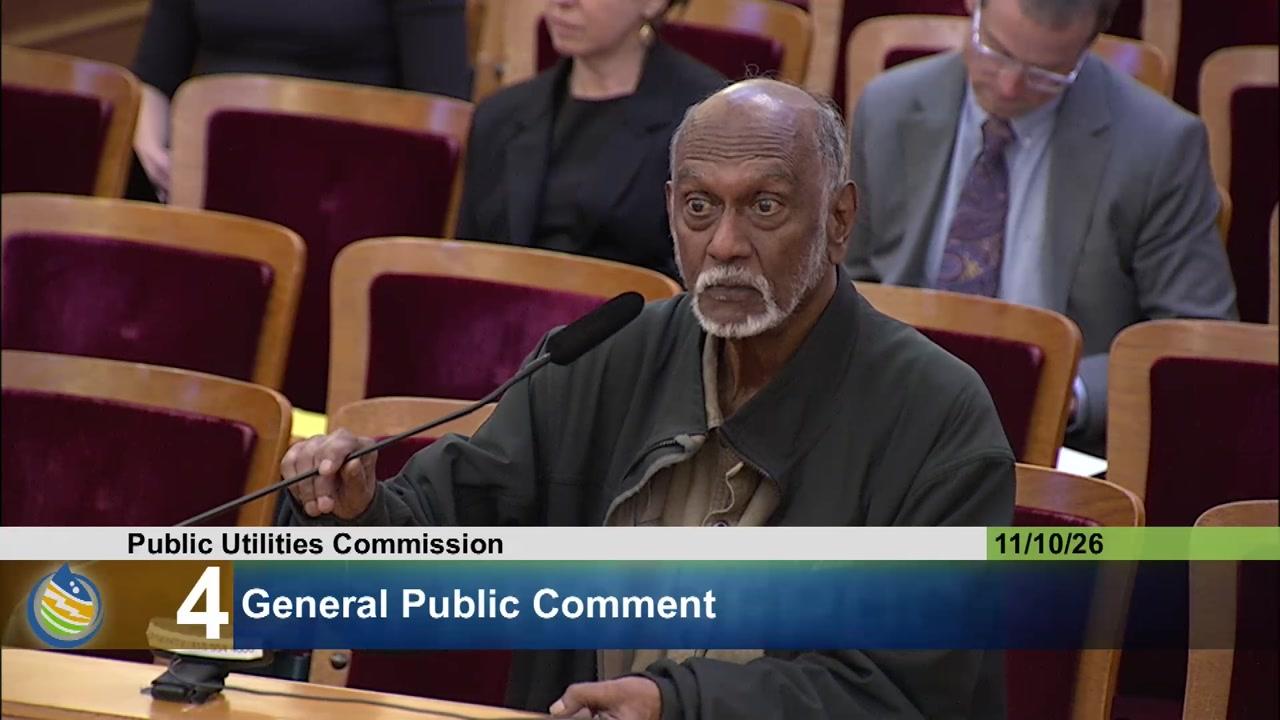
The other side: One public commenter asked why CAISO was not present, criticized deferred maintenance and said the presentation lacked empirical data. Another caller supported the upgrade for wildfire prevention, easing transmission constraints and access to cleaner, cheaper energy. Peter Drekmeier, Policy Director, Yosemite Rivers Alliance, said he knows little about the project but trusts staff. He urged more workshops and trust-building.
Decisions and stakeholder impacts: The resolution passed by roll call (For: 5 — Leveroni, Stacy, Arce, Jamdar, Thurlow; Against: 0; Absent: 0). If CAISO accepts SFPUC, operations and capital costs could shift from Hetch Hetchy's own customers to CAISO ratepayers. SFPUC would give up some control over the lines in exchange.
What's next: Staff expect the financial analysis and transmission revenue requirement filing early next year. They also owe the commission an explanation of the 14.2 MW figure.
Moccasin Dam Spillway Work Moves Ahead
Why it matters: The spillway's capacity falls short of the updated design flood standard. "During the March 2018 flood event, reservoir levels rose within approximately 1.3 feet of the dam crest," said Jimmy Leung, Principal Project Manager, Infrastructure Division. That flood forced downstream evacuations and damaged the auxiliary spillway.
Where things stand: Contract HH-1020 goes to the Myers Sukut joint venture, a team of Myers & Sons Construction and Sukut Construction that ranked first among three proposers. The project would replace the spillway with a concrete side-channel spillway. The contract uses a construction manager/general contractor model, in which the builder joins during design. It is capped at $85.1M over 2,325 days. Only the pre-construction phase is authorized for now: $2.7M over 774 days.
Local Business Enterprise participation stands at 2.99% in pre-construction, against a 12% contract requirement. Staff said the balance will come from future trade packages.
The other side: Before the vote, Commissioner Joshua Arce said: "I'd like to disclose that Myers and Sons has a seat on my employer's board of directors." He stated he has no financial interest and voted. No one spoke during public comment.
Decisions and stakeholder impacts: The contract passed (For: 5 — Leveroni, Stacy, Arce, Jamdar, Thurlow; Against: 0; Absent: 0). Downstream residents and the Hetch Hetchy Regional Water System gain a path to a safer spillway. Local firms' share of the work remains well below target for now.
What's next: Staff will return for construction authorization after review under the California Environmental Quality Act (CEQA) and by the state Division of Safety of Dams (DSOD).
Capital Spending Peaks as Stormwater Bid Stalls
Why it matters: The water system's 10-year capital plan now spends at a pace on par with the Water System Improvement Program (WSIP) at its peak. Wastewater and power programs are proceeding in parallel, which raises the stakes for affordability.
Where things stand: Water spending reached $181M over two quarters and $359M over the past year. That is "the highest spending level the program has experienced since the Water System Improvement Program in 2014," said Katie Miller, Director of Water Capital Programs. WSIP spent $441M that year.
After the 10-year plan's February 2026 rebaseline, the portfolio includes 36 regional and 15 local projects. Staff added 11 projects worth $203M and removed 12 that were deferred, completed or relocated. Four projects forecast cost increases and one a decrease, for a net increase of about $21M. Highlights included:
- The Sunol Valley ozonation facility
- The Alameda Creek Watershed Center
- 3.8 miles of water main replacement
- Completion of work on Geary Boulevard
WSIP has two active projects left, with no cost variances.
On the wastewater side, Bessie Tam, Wastewater Capital Program Director, reported progress across 123 projects:
- Channel Force Main Intertie: more than 90% complete, with completion expected in spring 2027
- Bar screen replacement: 80% complete
- Operations Engineering Maintenance building: about 9% complete
The trouble spot is the Lower Alumini stormwater project. In response to Commissioner Thurlow, Tam said the first solicitation drew no bids, and on the second, "the bid price came in very high, much higher than our engineer's estimate." Options include cost savings, deferring other projects or seeking supplemental approval from the commission. In response to Commissioner Stacy, Tam confirmed that "canceled/deferred" projects remain under review. She cited Tennessee Pump Station and Davidson as deferred and Pine Lake as in internal pre-planning.
The other side: Dave Warner, a public commenter, urged commissioners ahead of January's 10-year capital plans to "please ask for at least 3 10-year capital plan scenarios and how 20-year affordability looks for each of those scenarios." He also called for alternatives on projects over about $100M and for the chief financial officer's view on large projects. A second commenter questioned whether the spending delivers clean water at the end of the system.
What's next: The 10-year capital plans come back in January.
Public Commenters Question Deference to Staff
Why it matters: The commission is hiring a new general manager while commenters argue it rubber-stamps staff decisions on rates.
Where things stand: Warner cited the 12.5% water rate increase as an example of alternatives not being publicly debated. "My vote would be to bring in a board governance expert to evaluate your performance," he said. He also praised the general manager search and outreach.
On the search itself, Commissioner Stephen E. Leveroni, who chaired the meeting, said only that "the process is still moving forward." One commenter argued the next general manager should bring institutional and engineering experience, and objected to influence from powerful interests, citing AECOM. Drekmeier urged trust-building with the new general manager and a return to workshops. He noted that when Palo Alto held a water study session, "the SFPUC was invited to participate but declined."
Decisions and stakeholder impacts: The commission took no action on the suggestions. No commissioner proposed future agenda items.
- Minutes approved: The Oct. 27, 2026, minutes passed (For: 4 — Leveroni, Stacy, Jamdar, Thurlow; Against: 0; Absent: 1 — Arce, who had stepped away).
- Consent calendar approved: The calendar passed 5-0 without discussion.
- Water quality claims: Public commenter Francisco Da Costa alleged OSHA citations involving SFPUC and claimed reservoir and household water is unhygienic. These claims were not addressed or verified at the meeting.
- CleanPowerSF praise: A caller lauded the program's power content label and its electrification efforts.
Looking ahead: Watch for the transmission project's financial analysis early next year, the January 10-year capital plans and a decision on the over-budget stormwater project.