
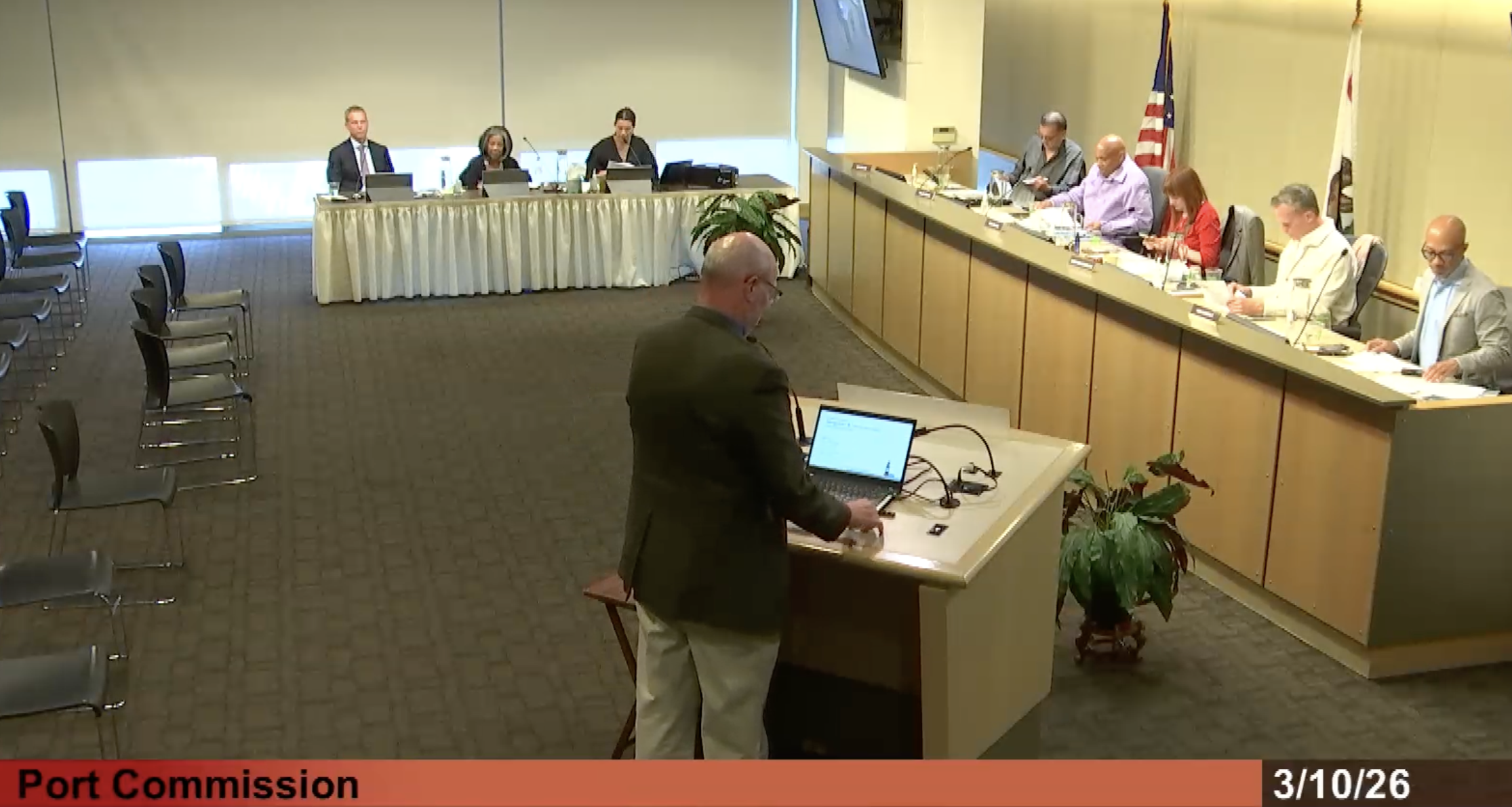
Port Commission - Mar 10, 2026 - Meeting
Port Commission • San FranciscoMarch 10, 2026
Locunity is a independent informational service and is not an official government page for this commission.We use AI-assisted analysis and human editorial review to publish information.
Port Commission Modernizes Leasing Rules as Piers 30-32 Developer Eyes Path Forward
The San Francisco Port Commission moved on two fronts to fill its waterfront vacancies March 10, unanimously adopting five resolutions that overhaul how it leases 25 million square feet of property while hearing an increasingly optimistic progress report on the $400 million Piers 30-32 redevelopment. Commissioners also charted an ambitious waterfront naming policy, advanced a blue economy hub strategy, and accepted nearly $5 million in ferry transit funding.
Five resolutions overhaul port leasing rules, restoring broker commissions, expanding tenant improvement credits, and giving staff new tools to fill persistent vacancies across a $131.6 million revenue portfolio
Piers 30-32 developer Strata Investment Group identifies six strategies to close a $125 million infrastructure gap, including cross-laminated timber construction and phased community benefits
Board of Supervisors approves Fisherman's Wharf Entertainment Zone, allowing bars and restaurants to sell alcoholic beverages to-go during special events along the northern waterfront
Port moves to join 43-block Downtown SF Partnership benefit district by 2027, bringing ambassador and activation services from the Agriculture Building to Pier 7
Commission accepts $4.97 million state grant for Mission Bay ferry landing and Ferry Gate B improvements
Draft naming guidelines draw expansive commissioner feedback, with proposals for corporate sponsorship revenue, a waterfront "walk of fame," and honoring living contributors
Leasing Overhaul: Brokers Back, Fees Waived, Approvals Streamlined
The Port Commission unanimously adopted five resolutions (2614–2618) representing its most comprehensive leasing policy update since July 2023 — a package designed to attack persistent vacancies across a portfolio of roughly 530 commercial property agreements spanning 25 million square feet and generating $131.6 million in annual lease revenue.
Why it matters: With industrial vacancy still climbing and office vacancy plateauing in the mid-30s, the Port is arming its staff with private-sector tools — broker relationships, faster approvals, tenant improvement incentives — to compete for tenants in a market that no longer comes knocking.
Where things stand: Deputy Director, Real Estate & Development from the Port of San Francisco, Rebecca Benacini, presented six policy changes, noting that most parameter rates increased 8–10% to account for three years of inflation, with targeted decreases for vacant or poor-condition spaces. The centerpiece is the return of broker commissions for office, shed, and land leases — extending a food-and-beverage pilot program to the broader portfolio.
"We stopped working with brokers when we had very strong market conditions. There was a view of why are we paying people to bring us tenants? Tenants are knocking down the door," said Benacini.
Other changes include aligning Port Commission lease approval thresholds with Board of Supervisors requirements (10 years or $1 million, up from five years); updated retail leasing procedures requiring financial data and business improvement plans; staff authority to waive late charges up to $300 twice per year — addressing $3,300 in small charges spread across 130 tenant accounts that consume disproportionate staff time; significantly expanded tenant improvement rent credits without a dollar cap; and increased mutual termination authority to $30,000 per month with an option for tenants to pay half of remaining contracted rent.
Benacini described the late-fee waiver in vivid terms:
"Literally stacks of paper with little tiny rows that we always see on our collections staff members' desk. And they're emailing people."
The other side: No opposition surfaced, but commissioners pushed for more. Commission Vice President Stephen Engblom asked for a future discussion on strategic use of brokers across the whole portfolio rather than one-off, transactional relationships. Commissioner Steven Lee asked about broker term limits and performance monitoring. Commission President Gail Gilman specifically cited long-vacant properties as prime candidates:
"I've always been a big proponent of us using brokers, particularly for some of our assets, like Ferry Plaza East or butterfly space that has been vacant the whole time I've sat on this commission."
Decisions: Adopted unanimously, 5-0, by voice vote (Gilman, Engblom, Lee, Adams, McNeely all voting yes).
Piers 30-32: Six Strategies, One $125M Gap
Developer Says Market Improving, but Feasibility — Not Money — Is the Constraint
Development Project Manager Christine Maher at the Port of SF and staff from Strata Investment Group delivered a six-month check-in on one of San Francisco's most complex waterfront redevelopment projects: Piers 30-32, which carries a total infrastructure bill of approximately $400 million against a roughly $125 million funding gap.
The basics: The project was decoupled from Seawall Lot 330 housing last year, with the housing component advancing separately and generating an estimated $60 million in IFD/CFD public financing that would seed Piers 30-32 infrastructure. The site is governed by a 40-foot height limit set by both the waterfront ballot measure and state SB 273.
Why it matters: In a city still carrying mid-30s office vacancy, this project's viability tests whether cost innovation and market recovery can converge before the 18-month Exclusive Negotiating Agreement evaluation window closes.
Where things stand: Staff and Strata identified six feasibility improvement strategies: (1) alternative construction using cross-laminated timber to fit three full floors within the 40-foot height limit instead of two with a mezzanine; (2) reducing or altering project scope; (3) phasing community benefits — including a proposed public pool — to align with public financing availability; (4) identifying local tax and fee sources; (5) streamlining the regulatory framework; and (6) monitoring the evolving office market.
Jesse Blount, partner at Strata Investment Group, told commissioners the challenge is structural, not financial:
"We do have a financial partner for this project. The issue isn't whether we have the investor. It is whether we have a feasible project."
He added that the firm needs a major office tenant willing to pre-lease roughly 50% of the building to proceed — but struck a notably optimistic tone, stating that the marketing is getting better and demand at the top end is strong.
The other side: Commission Vice President Stephen Engblom pressed on whether the 40-foot height limit should be reconsidered rather than engineered around. Staff explained that changing the limit would require both a new citywide ballot measure and state legislation amending SB 273. Commissioner Steven Lee emphasized community interest in a potential cruise ship berth at the site. Commissioner Willie Adams praised Strata for its persistence.
Alice Rogers, president of the South Beach | Rincon | Mission Bay Neighborhood Association, offered public comment applauding the continuing dialogue and expressing hope despite neighborhood disappointment over the project's separation from housing.
What's next: A 12-month update with quantified analysis of the six strategies is expected at the next milestone check-in.
Port Leases Into Downtown: CBD Expansion and Entertainment Zone Wins
Acting Executive Director of the Port of SF Michael Martin delivered a sweeping report covering waterfront activation efforts, capital projects, and federal advocacy — together signaling the Port's most aggressive post-pandemic economic strategy to date.
Fisherman's Wharf Entertainment Zone
The Board of Supervisors officially approved a Fisherman's Wharf Entertainment Zone, allowing bars and restaurants to sell alcoholic beverages to-go within a defined waterfront area during designated special events. The zone straddles port property and the land side, aiming to create neighborhood cohesion and extend visitor stays. Martin thanked Supervisors Danny Sauter, Steven Sherrill, Rafael Mandelman, and Shaman Walton for supporting the legislation.
Commissioner Ken McNeely asked whether Pier 39 was included. Martin clarified that Pier 39 has its own entertainment zone and the new designation is designed to spread activation to the land side. The Port also reported a second consecutive sellout of the Crab Crawl event, with 200 registrants sampling crab dishes at six Fisherman's Wharf establishments.
Downtown SF Partnership
The Port is working with the Office of Economic and Workforce Development and the Downtown SF Partnership — a 43-block community benefit district representing the Financial District and Jackson Square — to join their special assessment district when it expands in 2027. The coverage area would span from south of the Agriculture Building to Pier 7, bringing ambassador services, event support, and waterfront activation at a shared cost.
"We'd love to see those same ambassadors welcoming people off the ferries and having that sort of seamless connection with downtown that we really feel," Martin said.
Commission President Gail Gilman asked about the fee mechanics and whether the Port would absorb costs or push them to tenants through lease provisions. Martin acknowledged that each lease has different provisions, complicating the arrangement, and that the Port expects to make its own investment as well. A proposal is expected before the commission this spring.
Capital Projects: Crane Barge, Pier Rehabs, and Bike Safety
Acting Executive Director of the Port of SF Michael Martin highlighted several grant-funded capital projects advancing simultaneously:
Pier 29½ bulkhead rehabilitation, begun last August, is nearly complete and will be marketed to tenants this summer. "We often find different types of tenants who don't find space in more normal places, really like our spots. So we're going to give it a shot," Martin said.
Pier 90 grain silo demolition is eliminating trespasser access points that attracted "urban adventurers" taking dangerous social media videos. Landside demolition is nearly done; timber wharf demolition is expected during the in-water work window this year, creating additional leasable maritime space near berths.
A new crane barge will allow in-house waterfront repairs instead of relying on contractors — expected to arrive in early 2027 after transit through the Panama Canal. "This barge will allow us, when needed, to do repairs ourselves with our teams and not have to go out to the contractor community being subject to inflation, being subject to the contracting pipeline," Martin said.
The Terry Francois Boulevard Bike-Pedestrian Safety Project began Feb. 28 in partnership with Public Works and SFMTA, featuring new asphalt, concrete barriers separating bikes from cars, and accessibility features, with completion expected by the end of March.
Naming Policy: Commissioners Push for Revenue and Recognition
Corporate Sponsorship, a Walk of Fame, and Honoring the Living
Deputy Director of Port of SF David Beaupre presented draft guidelines covering two categories: monuments and memorials, and commemorative plaques and markers. Eligible persons must generally be deceased or retired from public or private service for at least two years, with Port Commission discretion for exceptions. A 90-day waiting period after commission consideration would precede final action.
Why it matters: Commissioners see the naming policy not just as civic recognition but as a potential revenue tool for the Port's infrastructure funding gaps — and they pushed staff to think much bigger.
Where things stand: Commissioner Willie Adams advocated strongly for honoring people while they are alive, citing the Willie Brown bridge as a precedent. He named Kimberly Brandon, who served 30 years as a commissioner and longtime staff as deserving of recognition.
Commissioner Steven Lee proposed a waterfront "walk of fame" with QR codes for public education. Commission Vice President Stephen Engblom suggested tying naming to corporate sponsorship, citing a specific model:
"I think about Salesforce Park. When you look at the capital stack of how that park was paid for, they have a very real line item that says a big gap was filled by Salesforce stepping up and saying, we're going to name that park."
He also proposed expanding beyond static plaques to naming events like concert series and suggested commemorative brick programs similar to Mission Rock.
Commission President Gail Gilman expressed interest in the corporate model but urged guardrails against "corporatization" of the waterfront, and recommended separating interpretive signage from naming and honoring in the final policy.
What's next: Staff indicated a Fisherman's Wharf plaza naming proposal is forthcoming. The broader policy is expected to return for formal adoption this spring.
Blue Economy and Federal Advocacy
Commission Vice President Stephen Engblom reported on a Blue Economy workshop the Port hosted with the Center for Sea Level Rise, drawing more than 50 participants from sister ports including San Diego, Los Angeles, Richmond, and Humboldt Bay. He highlighted the Port of LA's "AltaSea" program and San Diego's small business incubation — noting that San Francisco Dogpatch company ReefGen is now prototyping in San Diego rather than locally.
"I really believe that somewhere in this whole dialogue that the fact that we're here at the global center of venture capital, global center of AI, the fact that we're building one of the most high-profile, resilient waterfronts, we have a big near-term push on clean energy at our port," Engblom said, floating the idea of San Francisco hosting a California Blue Economy Center "front office."
Separately, Commission President Gail Gilman, Acting Executive Director Michael Martin, and Maritime Director Andre Coleman attended the AAPA legislative summit in Washington, D.C., meeting with congressional members to advocate for continued Port Infrastructure Development Program funding (currently supporting the Amador Street rebuild), swift passage of the Water Resources Development Act critical for the seawall resilience partnership with the Army Corps of Engineers, and opposing the Army Corps' 35% design rule that threatens to slow sea level rise projects.
Martin noted that a blue economy incubator consultant has been retained, with an informational presentation expected before the commission in coming months.
Minor Items
Minutes approved: Feb. 24, 2026, Port Commission meeting minutes adopted unanimously.
Closed session held: Commission met in executive session on real property negotiations and anticipated litigation; voted to disclose nothing upon returning to open session.
Consent calendar (Resolutions 2611–2613) adopted unanimously: Crane Cove Park contract extension; SFPD training MOU at Pier 94; and acceptance of a $4.97 million SFCTA grant for the Mission Bay ferry landing and Ferry Gate B improvements. Alice Rogers of the South Beach Rincon Mission Bay Neighborhood Association offered appreciation for staff efforts securing the ferry grant.
New business recorded: Commissioners requested a film studio space feasibility study (tied to the mayor's new filming incentives), a blue economy strategy informational, a Seawall Lot 330 affordable housing update, and a presentation on bundling deferred maintenance projects.