
Port Commission - Jul 14, 2026 - Meeting
Port Commission • San FranciscoJuly 14, 2026
Locunity is a independent informational service and is not an official government page for this commission.We use AI-assisted analysis and human editorial review to publish information.
Port Commission Launches Blue Economy, Advances $182M Hotel After Decade-Long Wait
The San Francisco Port Commission opened a new chapter on July 14, electing Stephen Engblom as president, unanimously launching a first-of-its-kind program to recruit ocean-economy startups to the waterfront, and green-lighting a restructured luxury hotel deal more than a decade in the making. Newly sworn-in Executive Director Michael Martin set the tone for his tenure by spotlighting the Embarcadero Seawall Program as the largest infrastructure investment in Port history — and by confronting the politically charged Giants Pride Night controversy head-on.
- Blue Economy Initiative launches with tiered leasing incentives capped at $250K to attract sustainable maritime businesses across seven sectors
- $182M hotel and Teatro Zinzanni dinner theater project advances with revised lease terms and a ~$38M city tax incentive — still needs Board of Supervisors approval
- Port revenue at Fisherman's Wharf down 33% since 2019; staff outlines $35M Pier 45 repair and over a dozen waterside upgrades
- Engblom directs staff to develop LGBTQ inclusion recommendations in response to Giants Pride Night incident, noting Oracle Park sits on Port property
- Stephen Engblom and Ken McNeely elected Commission president and vice president unanimously
Ocean Startups Get a Home on the Waterfront
The Commission unanimously adopted Resolution 2638, creating Phase 1 of the Port's Blue Economy Initiative — a leasing incentive program designed to lure sustainable maritime businesses to vacant and underused waterfront space.
Why it matters: San Francisco joins the Port of San Diego's Start Blue and LA's AltaSea in formally building a blue economy ecosystem. With nearly 300 blue economy companies already operating in the Bay Area, according to the Bay Area Ocean Cluster, the Port is positioning itself as an anchor institution for a growing sector that spans sustainable seafood, clean energy, maritime robotics, and AI-driven ocean monitoring.
Where things stand: Government Affairs Manager Boris Delapine presented a three-tiered incentive structure: Tier 1 offers 25% off new leases (capped at $25,000); Tier 2 offers 50% off leases with bay access (capped at $50,000); and a separate tenant improvement incentive ranges from $25,000 to $50,000. The executive director has delegated authority to execute incentives up to $250,000 total, after which staff must return to the Commission.
"Our milestones for the first two years are to build the internal framework grounded in the Port of San Diego model with the goal of establishing at least three transactions before the end of 2027," said Delapine. A three-phase roadmap envisions a proof of concept now, ecosystem expansion in Phase 2, and an eventual brick-and-mortar facility in Phase 3. Staff will report back at six-month and one-year intervals.
Eight public commenters spoke unanimously in support. Jameson Buffmire, co-founder of Buoy Fish, a fishing tech startup developing GPS float technology to reduce whale entanglement, called the initiative a chance to access a real-world test bed and waterfront space to scale. John Hurwitz of Sound Maritime Solutions, an autonomous boat company, emphasized the Port's unique ability to reduce barriers around water access, permitting, and testing. Mike Blakely of the Bay Area Ocean Cluster reported cataloguing nearly 300 blue economy companies in the region and urged an inclusive approach. Alison Beach, Blue Acceleration Advisor at the World Ocean Council, noted alignment with a NOAA-funded blue tech accelerator consortium. Ellen Jonck, co-chair of the Maritime Commerce Advisory Committee, offered the committee as a forum for presentations and oversight. Representatives from SF Blue Tech and the San Francisco Sailing Science Center also spoke in favor.
Commissioner Willie Adams urged staff to reach out to ILWU Local 10 longshore workers. "Did you talk to longshore? Did you talk to local team?" he asked. Vice President Ken McNeely praised the program's accountability structure: "I've not seen this much energy around a particular topic since I've been on the commission."
Decisions: Resolution 2638 passed 5-0. President Engblom suggested creating a broader advisory board and partnering with other Bay Area ports. "There's a lot of other ports in our region," he said. "I don't want us to only think about ports outside of the San Francisco Bay area, but really talk with Oakland, Richmond, Redwood City."
What's next: Staff will report at six-month and one-year milestones; the $250,000 delegated authority triggers a return to the Commission if exhausted.
$182M Hotel Deal Clears Port After 11-Year Odyssey
The Commission unanimously adopted Resolution 2639, approving a restructured development agreement for a 164-room luxury hotel and Teatro Zinzanni dinner theater at Broadway and the Embarcadero — a project that has been in the works since the developer first engaged with the Port.
The basics: TZK Broadway, LLC, a partnership between Kenwood Investments and Teatro Zinzanni, plans to build on seawall lots 323 and 324. Originally approved in 2019 at $164M, the project's cost has grown to $182M due to COVID-era construction increases. The hotel program was reduced from roughly 200 rooms to 164 to accommodate a luxury flag with larger rooms.
Why it matters: The deal uses transient occupancy tax revenue — the city's hotel tax — to close a financing gap created by the pandemic and rising costs. The structure could set precedent for future Port hotel developments and still requires Board of Supervisors approval.
Where things stand: Waterfront Development Project Manager Ricky Tijani presented three documents for approval: a Fourth Amendment to the LDDA providing up to nine months of extension in three-month increments at $25,000 per extension; revised lease terms with flat rent of $500,000 to $700,000 for years one through seven, then 2% to 4.5% of gross hotel revenue thereafter; and a Hotel Development Incentive Agreement providing approximately $38M in net present value through rebates of 89% of the transient occupancy tax generated by the hotel over 20 years, subject to annual Board of Supervisors appropriation. The capital stack includes $90M in senior debt, up from $60M, with equity making up the remainder.
Developer Darius Anderson of Kenwood Investments recounted the project's long journey and the pre-COVID financing that collapsed. Norman Langill, founder of Teatro Zinzanni, spoke passionately about returning to San Francisco after closing operations in Seattle and Chicago. "I've been dying to come back for 12 years," he told the Commission, praising San Francisco's unique political support for arts and culture.
Cynthia Gomez, Research Analyst for UNITE HERE Local 2, backed the project for its guarantee of union hotel jobs. "Hotel workers who are members of UNITE HERE know that their union jobs provide a pathway to the middle class — with respect, dignity, and retirement security," she said.
The other side: No opposition was voiced, but Commissioner Adams acknowledged the challenges Teatro Zinzanni has faced with closures in other cities. "This is going to be a challenge, but I think we're up for it. I mean, it's been 11 years. I'm all in," he said. President Engblom urged proactive permitting coordination, noting the building permit falls within the Port's jurisdiction and that previous drawings had been substantially reviewed.
Decisions: Resolution 2639 passed 5-0.
What's next: The ~$38M hotel tax incentive agreement requires Board of Supervisors approval. Engblom directed staff to begin permitting work immediately to avoid delays once financing closes.
Port Maps Sweeping Wharf Overhaul as Revenue Lags
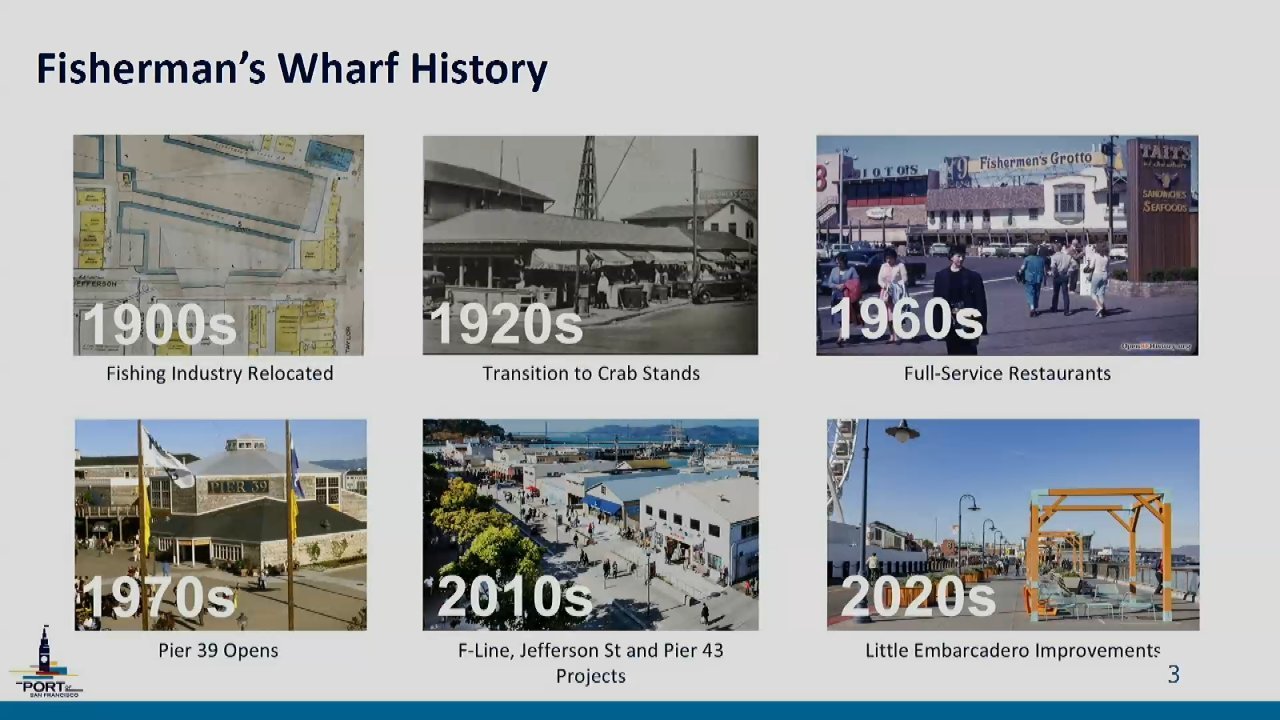
Acting Maritime Director Dominic Moreno delivered an informational overview of more than a dozen waterside improvement projects at Fisherman's Wharf — the Port's response to a 33% revenue decline in the wharf area since 2019.
Why it matters: The fishing industry's operational backbone — piers, fuel, ice, timber piles — has deteriorated, and targeted infrastructure investments are intended to stabilize the district and honor commitments made under the Fisherman's Wharf Forward initiative.
Where things stand: The largest single project is a $35M phased apron repair at Pier 45's west side, starting in 2027 with an estimated completion by 2030. Other projects include: replacement of the industrial ice machine at Pier 45; replacement of 95 severely degraded timber piles at Pier 47 (where Scoma's restaurant is located) by fall 2026; inner lagoon improvements including redesigned boat ladders, electrical upgrades, security cameras, and 15 critical timber pile replacements; fuel dock reopening by spring 2027 after petroleum leak remediation; planned dredging of the inner lagoon and Pier 45 approach in the 2027 in-water work window; demolition of the old smokehouse to create a new inner lagoon overlook with a pop-up fish market; and installation of an in-water trash capture device.
"This is the promise we've made to our partners in the fishing industry and in the working waterfront," said Executive Director Martin. "We need both sides of this to really advance, to really succeed."
Vice President McNeely raised creative dredging procurement strategies, including potential public-private partnerships. Commissioner Adams urged federal lobbying through MARAD and Congress members. President Engblom asked about integrating the blue economy with the fishing industry's supply chain and pushed for the fuel dock to be future-proofed: "This should be a fuel and charging dock in the future," he said.
What's next: Dredging strategy is expected to return as a future agenda item. The Alioto's plaza opening is planned for August. No vote was required on this informational item.
Engblom Addresses Giants Pride Night, Calls for Waterfront Inclusion
In his first major act as newly elected president, Engblom directly addressed the Giants Pride Night controversy — a topic that had generated significant citywide attention.
Why it matters: Oracle Park sits on Port property, making the Commission a direct stakeholder in how the Giants handle equity and inclusion. Engblom framed the issue not as an isolated incident but as part of the Port's broader responsibility as a public landlord.
Engblom said he had begun constructive dialogue with Giants leadership and was encouraged by their reaffirmation of commitment to the LGBTQ community. He broadened the conversation to include LGBTQ cruise passengers being denied entry in Turkey and Egypt, framing inclusive waterfront leadership as a global responsibility.
"I would like staff to return to this commission with recommendations on how we can build upon the Port's equity," Engblom said, directing engagement with tenants, labor, and community organizations. He added: "The Port of San Francisco can demonstrate what inclusive public leadership looks like." He quoted Mayor Daniel Lurie's call to "lean in, to educate, engage and lead."
What's next: Staff will return with inclusion recommendations at a future meeting.
New Leadership Takes the Helm
The Commission unanimously elected Stephen Engblom as president and Ken McNeely as vice president, succeeding outgoing President Gail Gilman, whose term concluded June 30. Both elections passed 5-0.
Executive Director Martin, recently sworn in as the Port's eighth executive director, delivered his first report. He welcomed new Commissioner Rich Lee, a small business entrepreneur who founded Spro Coffee Lab, and congratulated Commissioner Adams on his reappointment. Martin highlighted the Embarcadero Seawall Program, calling it the largest infrastructure investment in Port history.
Adams delivered extended remarks on Martin's career trajectory, naming all eight Port executive directors since 1969. "Your crown has already been paid for. All you have to do is put it on," Adams told Martin.
Martin also reported on July 4th waterfront operations, a wayfinding signage partnership with the National Association of the Deaf Conference, the One City Day volunteer event with Mayor Lurie, the Ferry Building's 128th birthday celebration, and an expansion of the Big Art Loop public art program from Pier 9 to Bayview Gateway.
Minor Items
- Pier 70 closed session: The Commission entered executive session to discuss real property negotiation strategy for the Pier 70 28-Acre Site. Tim Bacon, VP of Development at Brookfield Properties, previewed a broader public presentation expected in August.
- New business: President Engblom flagged upcoming agenda items including equity and inclusion recommendations, a dredging information item, and exploration of drone fish delivery.
- Adjournment: The meeting adjourned at 5:27 p.m. in memory of Nolan Xavier Wells.