Port Commission - Jun 09, 2026 - Meeting
Port Commission • San FranciscoJune 9, 2026
Locunity is a independent informational service and is not an official government page for this commission.We use AI-assisted analysis and human editorial review to publish information.
Mission Rock Gets $10M Boost as Port Commission Bets on Waterfront Growth
The San Francisco Port Commission moved aggressively to accelerate development, restructure underperforming deals, and chart new economic territory at its June 9 meeting, approving five resolutions that collectively reposition the waterfront from pandemic recovery to proactive investment. The headliner: a $10 million capital bet to fast-track the next phase of Mission Rock, the flagship mixed-use neighborhood rising alongside Oracle Park.
- $10M port investment aims to cut Mission Rock Phase 2 timeline in half, with possible groundbreaking by late 2027
- Pasha Pier 80 deal restructured, eliminating $600K annual management fee and opening 15 acres to cruise ship operations as auto exports decline
- Downtown CBD expands to the waterfront with $883K annual Port commitment for overnight security, hospitality ambassadors, and marketing through 2036
- Woods Beer wins pop-up tap room lease at vacant Grotto 9 on Fisherman's Wharf under a percentage-rent-only model
- Blue Economy roadmap unveiled to incubate maritime startups — a local GPS tracking firm says it tests in Mexico and Canada because San Francisco lacks the infrastructure
- $41M Mission Bay Ferry Landing contract approved on consent calendar
Mission Rock Phase 2: $10M to Compress a Three-Year Wait
The basics: Mission Rock is a joint development between the Port and the San Francisco Giants' development arm. Phase 1, completed between 2019 and 2025, delivered 537 homes (132 below market rate), more than 500,000 square feet of office space, 50,000 square feet of retail, and a five-acre China Basin Park. Phase 2 would add hundreds more homes and commercial space — but the post-COVID economy stalled the timeline.
Why it matters: Infrastructure costs for Phase 1 ballooned from $145 million to $218 million — a 36% increase — while office vacancies sapped projected revenues. The commission approved investing $10 million of port capital to run infrastructure design and transaction document amendments simultaneously rather than sequentially.
Where things stand: Assistant Deputy Director Wyatt Donnelly-Landault told commissioners the parallel approach could dramatically compress the schedule. "Rather than a three-year timeline, we're hoping for an 18-month timeline, potentially even 12 if we were able to move at lightning speed," he said. "That puts us with a possible Phase 2 at the end of 2027, early 2028."
The $10 million earns a 10% return for the Port and will be repaid from the first Phase 2 revenue sources. Staff framed the investment as necessary to keep Mission Rock competitive with other city developments that have already renegotiated their terms in the post-pandemic market.
Jack Baer of the San Francisco Giants called the investment "an important first step" to enable Phase 2.
Decisions: Resolution 2634 passed unanimously (For: 5, Against: 0, Absent: 0).
What's next: Staff will renegotiate over 2,000 pages of transaction documents while infrastructure design proceeds in parallel.
Pier 80 Reset: Port Drops $600K Fee, Opens Door to Cruise Ships
Why it matters: Tesla once drove massive auto export volumes through Pier 80, peaking at 125,174 vehicles in fiscal year 2020–21. But after Tesla opened factories in China and Germany and declined to commit to a minimum annual guarantee, volumes plummeted. The Port was still paying Pasha Automotive Services a $50,000 monthly management fee — $600,000 a year — to run a shrinking operation.
Where things stand: Maritime Director Dominic Moreno presented the restructured deal. Key terms: the monthly management fee is eliminated entirely; a new revenue-sharing formula gives the Port 40% of gross tariff revenues up to $4.5 million (Pasha keeps 60%), with Pasha receiving 100% above that threshold, plus a 50/50 split on event revenue. Critically, Pasha's exclusive-use footprint is restructured to allow up to 15 acres for cruise ship operations.
The Portola Festival, introduced at Pier 80 in 2022 as a revenue recovery strategy, has generated nearly $1 million. Silkee Sylvester of the Pasha Group noted the company, founded in 1947, has never turned away a ship due to an event.
Commissioner Willie Adams confirmed support, citing his longstanding relationship with the Pace family that owns Pasha. Vice President Stephen Engblom asked about engagement with the Southern Waterfront Advisory Committee on the changes.
Decisions: Resolution 2637 passed unanimously (For: 5, Against: 0, Absent: 0).
Downtown Meets the Waterfront: CBD Expansion Links $350B Tax Base to Seawall
Why it matters: The Downtown San Francisco Partnership's Community Benefit District is expanding from 43 blocks to 70, and for the first time, Port-owned waterfront property is included as a dedicated Zone 3. The Port's annual contribution: $883,000 for fiscal year 2026–27, funding hospitality and outreach ambassadors, two overnight security staff for the full district, special events support, and marketing coordination. The commitment runs through December 2036 with up to 5% annual increases, growing the CBD's total budget from $4.8 million to $11.05 million.
Where things stand: Robbie Silver, president and CEO of the Downtown San Francisco Partnership, highlighted the CBD's track record, including Let's Glow SF (375,000-plus attendees), California's first entertainment zone on Front Street, and programs like Drag Me Downtown.
Commissioner Steven Lee pressed on how overnight security would be deployed and how it would coordinate with existing Port security staff. Acting Executive Director Michael Martin explained the CBD personnel supplement Port employees who escort overnight cleaning crews.
Vice President Engblom drew the most strategic connection of the evening, linking the CBD partnership to the Port's long-term case for the $18 billion seawall rebuild. "When we go to talk to people about rebuilding our seawall, if it's not thought of as a singular unity," he said, the argument falls apart. Having downtown property owners and the waterfront "in the same sentence also comes with a lot of responsibility in the future."
President Gail Gilman suggested the partnership eventually expand to Columbus Avenue and Broadway.
Decisions: Resolution 2636 passed unanimously (For: 5, Against: 0, Absent: 0).
Woods Beer Taps Into Fisherman's Wharf With Pop-Up Lease
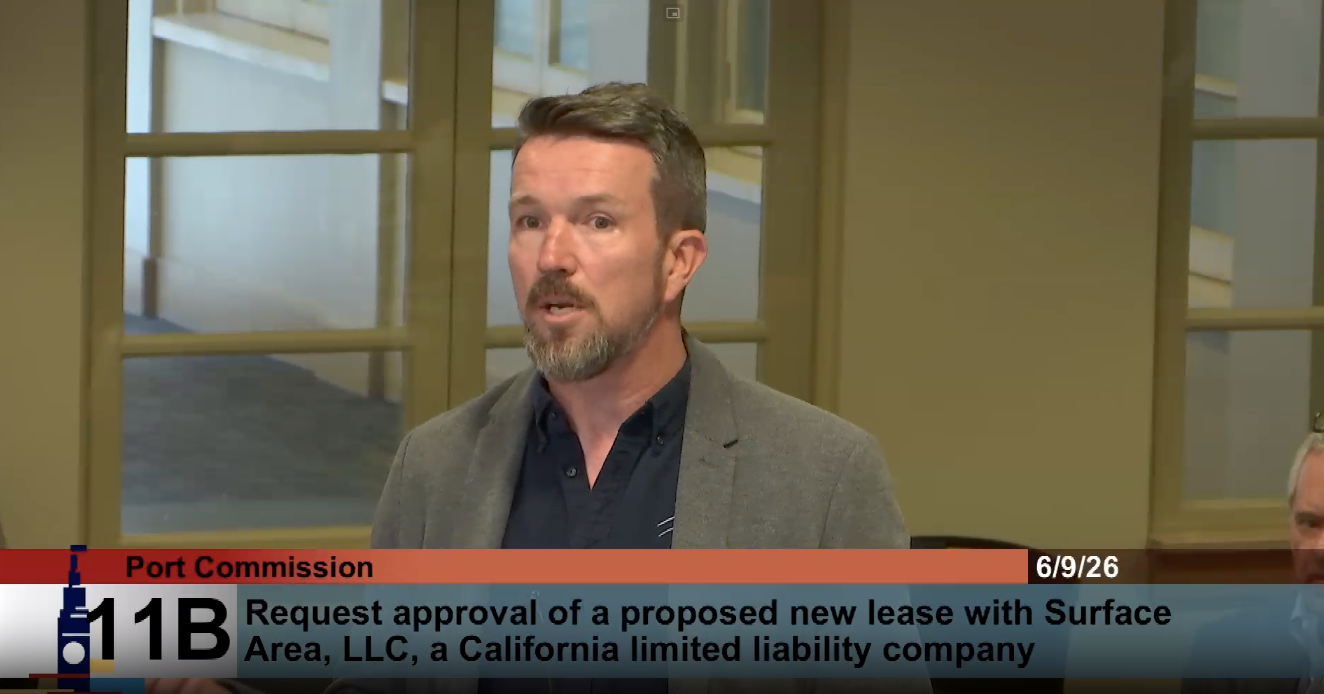
Why it matters: The Port invested approximately $600,000 from its Fisherman's Wharf Forward budget to bring the vacant Grotto Number 9 space at 2875 Taylor Street to usable condition. The new lease with Surface Area LLC, operating as Woods Beer and Wine Company, tests a fast, low-cost activation model: percentage-rent only at 10% during high season (May through October) and 8% during low season, plus $1,000 per month for utilities. The two-year lease includes a one-year extension option.
Where things stand: Owner Jim Woods said his firm would invest approximately $25,000 in non-recoverable improvements plus additional movable fixtures. Commissioner Lee pushed on whether the tenant's investment level was sufficient and asked about Health Department compliance. Staff confirmed the space would be delivered in compliance-ready condition.
President Gilman encouraged Woods to court local residents. "94133 is the zip code for that. So maybe there could be some creative ways that you can entice locals to come on down," she said. "I think that's how we're going to keep Fisherman's Wharf vibrant and economically sound through those down months."
Decisions: Resolution 2635 passed unanimously (For: 5, Against: 0, Absent: 0).
Blue Economy Roadmap: SF Startups Test Tech Abroad Because Home Won't Help
Why it matters: San Francisco sits on 7.5 miles of waterfront, yet local maritime startups leave the city to develop and test their technology. The Port's new Blue Economy Initiative aims to change that by positioning itself as a launchpad for sustainable maritime companies.
Where things stand: Staff benchmarked three West Coast models: the Port of San Diego's incubator (13 projects, $2.95 million in return, $5.2 million in outside funding), Washington Maritime Blue's accelerator ($450 million in follow-on capital from graduates), and AltaSea at the Port of Los Angeles. The phased recommendation starts lean — a single staff administrator targeting three transactions by the end of 2027 — before growing into a dedicated waterfront property and eventually an external nonprofit administrator.
The most compelling testimony came from the public. Jameson Buckmeyer, founder of Bluefish, a GPS tracking startup for fishing gear, said his company has deployed 270-plus buoys and recorded over 800,000 location readings — in Mexico and Canada — because San Francisco lacks the support infrastructure.
Commissioner Lee urged staff to prioritize technology that helps commercial fishermen cope with delayed crab seasons. Vice President Engblom championed the initiative as "a really powerful expression of the Burton Act," arguing the Port should pivot to "projecting for future strength" rather than only protecting traditional maritime uses.
What's next: Staff will return in July with actionable next steps. No vote was taken; this was an informational presentation.
Farewell to a Maritime Leader
The commission dedicated extended time to honoring Andre Coleman, the Port's former maritime deputy director, who is departing after seven years for Pacific Maritime Association. Commissioners and staff credited Coleman with navigating the pandemic's devastation of cruise operations and then achieving record-high passenger numbers three years later, launching the Portola Festival at Pier 80 as an economic recovery strategy, establishing the Rising Tides maritime internship program, and standing up retail crab sales.
President Gilman underscored the stakes: "We can boom in office, we can boom in commercial, but the heart of this waterfront has always been maritime."
Commissioner Adams requested that the full transcript of tributes be sent to Coleman and his family for posterity.
Minor Items
- $41M Mission Bay Ferry Landing Phase 2b and Agua Vista Park contract approved on consent (Resolution 2630), advancing critical ferry infrastructure for the growing Mission Bay neighborhood.
- Pier 96 lease, Pier 23 Cafe lease restructure, and Fisherman's Wharf plaza contract modification approved on consent (Resolutions 2631, 2632, 2633).
- Public commenter David Lewis, a bicycle taxi operator, objected to new LED signage on Jefferson Street at Fisherman's Wharf, calling the bright lights blinding and disruptive to birds and the area's character.
- New business: Commissioner Lee requested a partnership with the GLBT Historical Society for an LGBTQ waterfront history project in time for next year's Pride Month.
- World Cup activations at four waterfront venues — Pier 39, the Ferry Building, Chase Center, and the Midway — plus fan parades and a World Cup Art Market were announced by Acting Director Martin.
- EV truck infrastructure: The Port completed a zero-emission truck feasibility study and is pursuing a California Energy Commission grant for 10 fast chargers at Pier 96.
- Waterfront resilience: A South Beach open house drew 70 attendees; a downtown coastal resilience meeting was planned for the following week.
- Roundhouse office complex, repaired with $6 million in ARPA funds, landed its first major lease with Asim Labs Aerospace.