
Port Commission - May 12, 2026 - Meeting
Port Commission • San FranciscoMay 12, 2026
Locunity is a independent informational service and is not an official government page for this commission.We use AI-assisted analysis and human editorial review to publish information.
Port's $10M Surplus and Private Capital Push Signal New Era for Waterfront Resilience
The San Francisco Port Commission met May 12 with money in the bank and momentum on the waterfront. A $10.1 million budget surplus — half of it from a legal settlement — gives the Port new flexibility to invest in aging infrastructure, while commissioners zeroed in on an ambitious strategy to attract private capital for an $18 billion coastal resilience program that protects the city's financial core.
Port posts $10.1 million surplus, including a $5 million legal settlement, giving commissioners fresh capital for waterfront infrastructure
Vice President Engblom pitches waterfront resilience as investment-grade asset at Milken Institute, framing $18 billion program as protection for $350 billion in property value
Pier 94 lease approved to stage Caltrans highway repaving, eliminating 8,000 truck trips and 45 metric tons of CO₂ from Bayview residential streets
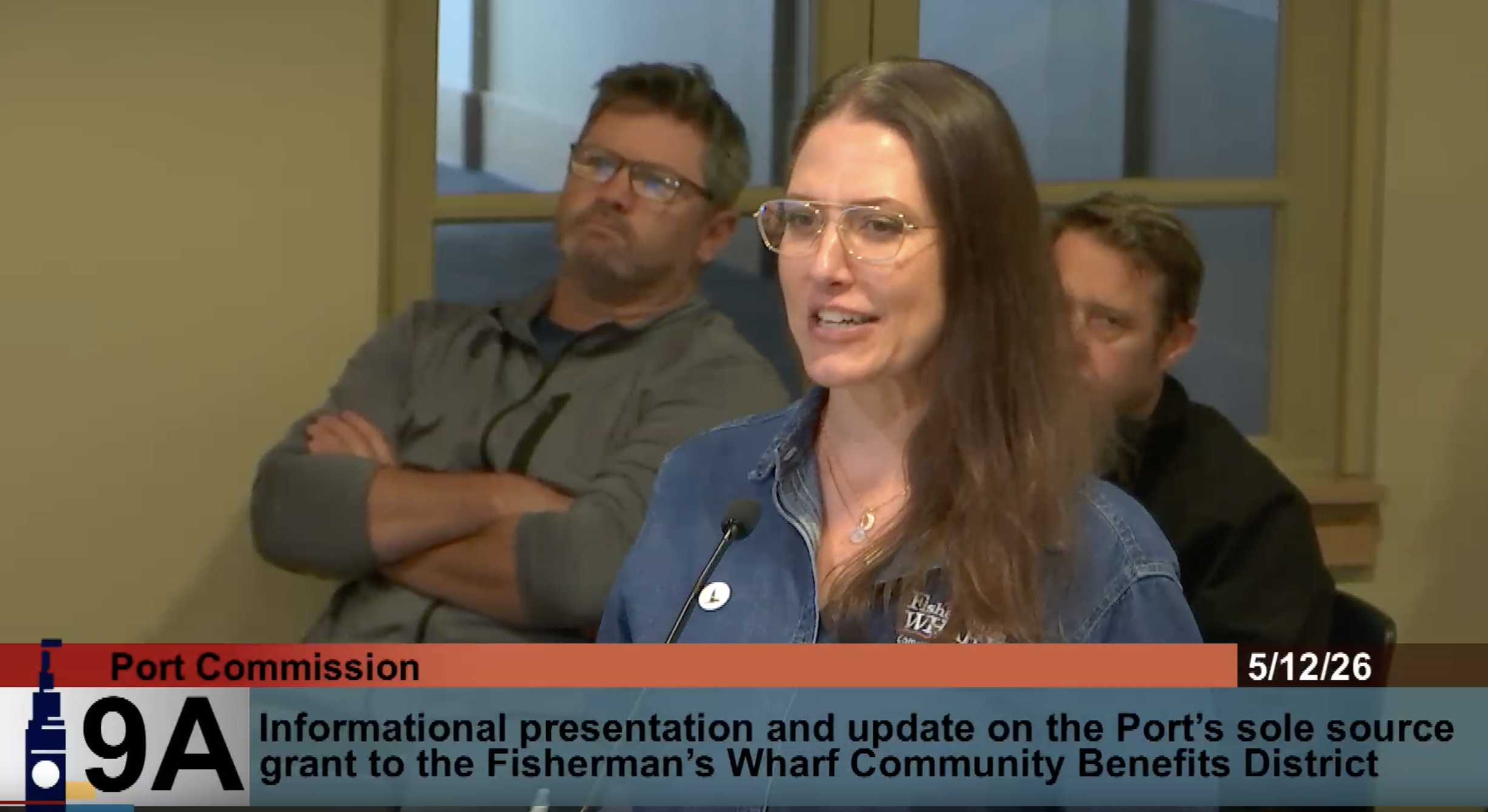
Fisherman's Wharf CBD reports 131,000 hospitality interactions and $201,000 in self-generated revenue from its $6.3 million Port grant, with district expansion underway
Exploratorium announces outdoor sea level rise Field Station at Piers 15-17, targeting 100,000+ students annually beginning summer 2026
Commercial salmon season returns to the Wharf for the first time in three years
Port's Financial Cushion Grows as Surplus Tops Projections
Why it matters: The Port operates as an enterprise agency that funds itself from leases, maritime revenue, and interest income — not the city's general fund. A surplus this large, on top of conservative budget assumptions, strengthens the case for accelerating capital investments in seismically vulnerable piers and seawall segments.
Where things stand: Acting Executive Director Michael Martin reported that the Port's nine-month fiscal year report ending in March showed a $10.1 million net surplus, well above the $11.4 million conservative net revenue projection in the adopted budget. Three drivers powered the result: disciplined spending on interagency work orders, strong interest earnings on reserves, and a one-time $5 million settlement from Pilot Thomas related to a fuel spill at Fisherman's Wharf.
"Our nine-month report reflects a $10.1 million net surplus," said Martin.
Commissioner Ken McNeely pressed on what the picture looked like without the settlement windfall. Martin confirmed the settlement accounted for roughly half of the surplus — meaning the Port's operating performance alone still exceeded projections.
President Gail Gilman confirmed the settlement funds are unrestricted. Martin noted that the funds can be applied to capital projects.
What's next: Martin said the Port is considering issuing some debt rather than spending down its fund balance to preserve the interest income benefits. The Comptroller's Office nine-month citywide report is expected later in May, and the Board of Supervisors Budget and Finance Committee was scheduled to hear the Port's budget the following day.
The $18 Billion Pitch: Resilience as an Asset Class
Why it matters: The Port's waterfront resilience program — protecting the Embarcadero seawall and surrounding infrastructure from earthquakes and sea level rise — carries an estimated $18 billion price tag that dwarfs any single bond measure or federal grant. Attracting private capital is essential, and the Port is now actively courting institutional investors.
Where things stand: Vice President Stephen Engblom reported on his recent presentation at the Milken Institute conference in Los Angeles, where he pitched the waterfront resilience program to global institutional investors, philanthropic groups, family funds, and pension funds including CalPERS and the Washington State Investment Pension Fund. His framing was blunt: this isn't about preserving a postcard.
"If all we talk about is an $18 billion program, people glaze over," Engblom said. "But if you talk about the fact that this is $18 billion to protect our $350 billion worth of property roll tax that's just here in our financial district and the $35 billion worth of venture capital that has invested in San Francisco-based AI companies just this year, then all of a sudden it becomes like, how can we not do this?"
Commissioner Willie Adams underscored the stakes.
"This waterfront resilience and flood protection — we have to get this thing done. This is so important to the citizen. We have to be ready for whatever is coming at us because we don't have a crystal ball," he said.
President Gail Gilman connected the private capital thread to the legacy of labor leader Larry Mazzola Sr., whose plumbers union pioneered the first private-capital-only supportive housing development in San Francisco, the Jazzy Collins apartments. She suggested that model — labor-driven, privately financed public benefit — could inform how the Port structures resilience deals.
On the ground, Acting Executive Director Michael Martin announced two upcoming community engagement sessions for coastal resilience projects: a downtown project covering Broadway to Pier 24 focused on the critical Rincon Park flood risk area, and a South Beach project from Harrison Street to Townsend Street funded by a California Coastal Conservancy grant. The South Beach session is scheduled for June 6, with the downtown session later in June.
Pier 94 Lease Cuts Truck Traffic Through Bayview
The basics: The commission unanimously approved an 18-month lease with FBD Vanguard Construction at Pier 94 for a temporary cement batching plant supporting Caltrans' phased repaving of US 101 from the Harney interchange to the Vermont Street exit.
Why it matters: Without the staging area near the project site, cement trucks would route through residential Bayview streets. Placing the operation at Pier 94 eliminates an estimated 8,000 truck trips, 27,000 truck miles traveled, and 45 metric tons of CO₂ emissions.
Where things stand: Maritime Business Development Manager Charles Labitan presented the lease covering approximately 21,780 square feet of paved land for the full term, plus an additional 108,900 square feet for up to four two-week staging periods. The Port will generate $335,000 in revenue, with the option for Vanguard to receive rent credits in exchange for remediating water ponding areas on the property — improving the site for future tenants.
The Southern Waterfront Advisory Committee endorsed the arrangement, and truck routes will remain on primarily industrial streets. Staff noted the long-term vision for the site includes offshore wind staging, but revenue is needed in the interim.
The other side: Vice President Stephen Engblom asked about whether Caltrans was using low-carbon cement for the project. He also pushed for sharper environmental messaging.
"When I hear, oh, there's less air quality impacts on the neighborhood, I just want us to be sharper about, like, less than what?" Engblom directed.
Commissioner Steven Lee asked about the water ponding issue and future site plans; staff confirmed the remediation credit structure addresses both.
Decisions: Resolution 26-29 passed unanimously (For: 5, Against: 0, Absent: 0).
Wharf District Delivers on $6.3M Grant, Eyes Expansion
Why it matters: The Port's sole-source grant to the Fisherman's Wharf Community Benefits District (CBD) is the only public funding for port-side services at the city's top tourist destination. The CBD is now pursuing an early renewal and boundary expansion that could fundamentally change how the district funds itself long-term.
Where things stand: Bri Maughan, the executive director of CBD, presented a comprehensive update covering three and a half years and more than $6.3 million in Port funding. The numbers were substantial: over 131,000 hospitality interactions, 6,400 block faces swept, 117,000 pounds of trash collected, 4,500 graffiti removals, and 2,500 wellness checks.
Major events included Pier Party at the Wharf (15,000 visitors), Fleet Fest during Fleet Week (150,000 visitors), and Warm Up at the Wharf (16,000 visitors). The CBD installed live flower baskets on Jefferson and Taylor streets, new seating and pergolas on the Promenade, and launched a pop-up fish market serving over 700 customers. The current fiscal year budget stands at approximately $2.3 million with $1.2 million remaining through December.
The CBD also generated approximately $201,000 in revenue — exceeding its goal by $100,000 — with funds reinvested into programming. Board Chair Taryn Hoppe clarified that the revenue effort is a self-sustainability initiative, not the CBD's core purpose.
Commissioner Steven Lee praised the scope.
"It's overwhelming that it's not just about the entertainment, but how much infrastructure and beautification that you have put into it," he said.
Commissioner Willie Adams highlighted the accountability dimension.
"This is great because we're living in a time where the public can scrutinize everything that's being done," he said.
Vice President Stephen Engblom pressed for better context on how the $6 million investment compares to other funding sources, asking about the role of private assessments and city economic development dollars. He urged the CBD to more explicitly connect its work to the city's $9 billion tourism economy.
President Gail Gilman encouraged more neighborhood outreach, noting that hundreds of new housing units could eventually be built along the waterfront under the family zoning plan.
"There needs to be more in-reach into the neighborhoods around the wharf," she said.
What's next: The CBD board has approved an early renewal strategy, with a steering committee that includes Port leadership already convened to explore expanding district boundaries and potentially reassessing property assessment formulas.
Exploratorium Plans Outdoor Sea Level Rise Lab on the Waterfront
Why it matters: With 100,000-plus students visiting the Exploratorium annually on field trips, an outdoor exhibit installation on the museum's public plaza creates a permanent touchpoint for building the public awareness — and ultimately voter support — needed to fund multi-decade resilience investments.
Where things stand: Patrick Foster from the Port's Planning Division and Rob Semper, the Exploratorium's chief science officer, presented the Sea Level Rise Education Initiative, a joint effort between the Exploratorium, the Port, and the Bay Conservation and Development Commission (BCDC) that has been in development since approximately 2019.
The centerpiece is the Waterfront Field Station, an outdoor installation on the Piers 15-17 public plaza featuring exhibits on shifting shorelines, historical tide data from the 160-year Presidio tide gauge measurement, tidal pattern sculptures, and a bronze seawall cross-section model. The installation is positioned where field trip buses discharge students, ensuring all visitors pass through.
"Often people don't know what it takes to do installations now that may take five or 10 years to build and have implications 10, 20, 30 years down the line," said Semper. "Part of this is education, not just formal education about why sea level rise happens, but what it means to have adaptation happen."
Commissioners were enthusiastic. Commissioner Ken McNeely predicted high foot traffic. Commissioner Steven Lee suggested a water-tank model of the Ferry Building showing rising seas. Vice President Stephen Engblom urged the Exploratorium to also target CEOs and philanthropy leaders. President Gail Gilman encouraged integrating economic impact data from the resilience program into the exhibits to build the case for private investment.
What's next: Construction is targeted for summer 2026. A BCDC development permit amendment is in progress.
Minor Items
Acting Executive Director Michael Martin announced the return of commercial salmon season after a three-year closure. Fresh local salmon is expected at Fisherman's Wharf restaurants and the weekly pop-up fish market at 101 Alcoma Way, open Saturdays from 8 a.m. to 2 p.m. The market has been extended through September.
Pier 80 construction contract (Resolution 26-26) authorized on consent for infrastructure improvements at the maritime facility.
1300 Battery Street lease (Resolution 26-27) restructured on consent, reducing rent and providing up to $188,192 in rent credits for tenant improvements at a waterfront restaurant.
Bauer's Intelligent Transportation settlement (Resolution 26-28) approved on consent, resolving parking operator litigation and rent balances at Pier 50 in exchange for completed safety upgrades.
April 28, 2026, meeting minutes approved unanimously.
Terry Francois Boulevard ribbon-cutting for bike and pedestrian safety improvements held with Mayor Lurie.
Virgin Voyages maiden call at Pier 27 highlighted during the director's report.
Trades career fair praised by Commissioner McNeely for building the next generation of trade talent.
Water taxi promotion urged by Commissioner Lee, who noted a $10 fare from the northern waterfront to Chase Center and Pier 39 at 85% capacity.
The meeting adjourned in memory of Larry Mazzola Sr., the longtime leader of Plumbers Local 38. Commissioner Adams called him "a labor legend, a warrior, and a gladiator." A future meeting will include a farewell for departing staff member Andre Coleman.